Eurofighter Typhoon variant
Eurofighter Typhoon CE.16 Typhoon
Spanish Air and Space Force designation for the two-seat Eurofighter Typhoon: 14 of the 73 aircraft originally purchased, used by 113 Squadron at Morón to convert every Spanish Typhoon pilot and by the operational squadrons.

- February 17, 2003
- First flight
History
CE.16 is the Spanish military designation of the two-seat Eurofighter Typhoon, the code by which the Spanish Air and Space Force distinguishes its twin-stick aircraft from the single-seaters, designated C.16. The added letter E follows the long-standing Spanish practice of marking training versions, while the number 16 continues the fighter sequence begun in 1978 that runs through the C.14 Mirage F1 and the C.15 Hornet, the very aircraft the Typhoon came to replace in Spanish units. Mechanically the two-seater keeps the airframe, the two Eurojet EJ200 turbofans and the systems of the single-seater; the substantive difference lies in the cockpit, which seats two crew in tandem, making it ideal for conversion and qualification without giving up the full operational capability of the fighter.
Of the 73 Eurofighters that Spain bought in the first three tranches of the programme, 14 were CE.16 two-seaters. Deliveries were staggered between 2003 and 2020: 17 Tranche 1 aircraft between 2003 and 2007, 34 Tranche 2 aircraft between 2008 and 2016 and 20 Tranche 3 aircraft between 2015 and 2020. The first Spanish production Typhoon to fly was in fact a two-seater, CE.16-01 (construction number ST001), which took off from Getafe Air Base on 17 February 2003 and was also the first aircraft handed over to the Spanish armed forces. Like the rest of Spanish production, the two-seaters came off the EADS-CASA final assembly line at Getafe.

The natural home of the CE.16 was Ala 11 at Morón de la Frontera Air Base near Seville. On 27 May 2004 the first three Eurofighters arrived at Morón from Getafe to equip 113 Escuadrón, the Typhoon Operational Conversion Unit of the Spanish Air Force, radio callsign "Gallo". Every pilot who is to fly the Eurofighter in any Spanish squadron passes through this unit, and new pilots are trained first on the two-seat examples before moving to the single-seater. 111 Escuadrón ("Dólar") is the wing's operational air defence and attack squadron. Morón aircraft carry the unit code 11-XX, whereas those of Ala 14 at Albacete use 14-XX and those of 462 Escuadrón at Gando use 462-XX. In 2008 Ala 11 was qualified for Quick Reaction Alert, a duty the Spanish Typhoons took on in July of that year.
Typhoon conversion at Morón combines real flying in the CE.16 with simulation. The Training Centre opened in 2004, the same year the first aircraft arrived, although its first simulator was not declared ready for training until 2006. The centre later grew to three networked simulators, one cockpit trainer and two full-mission simulators with 360-degree visuals; the split between simulated and real missions is around 50 per cent. The courses, supervised by 113 Escuadrón, last six to seven months, with two intakes a year of up to eight pilots each, and around 200 pilots have already passed through the centre, not only Spanish but also from Saudi Arabia, Italy and Germany. Simulator time averages around 2,000 hours a year and the centre has passed the milestone of 20,000 accumulated hours.
Its role as a training aircraft explains the only serious accident suffered by a CE.16. On 24 August 2010, CE.16-08 (ST008, code 11-77), a Tranche 1 Block 5 aircraft of Ala 11, crashed at Morón Air Base moments after take-off at around half past nine in the morning. The Spanish instructor pilot was able to eject, but the Saudi passenger was killed; he was flying under the agreement signed between Spain and Saudi Arabia for Saudi pilots to receive Eurofighter training.
The lineage of the Spanish two-seaters also includes the DA6 prototype, serialled XCE.16-01, built by CASA as the second two-seat development aircraft and lost on 21 November 2002 following a double engine flame-out. Its test serial already anticipated the designation the production CE.16s would carry.
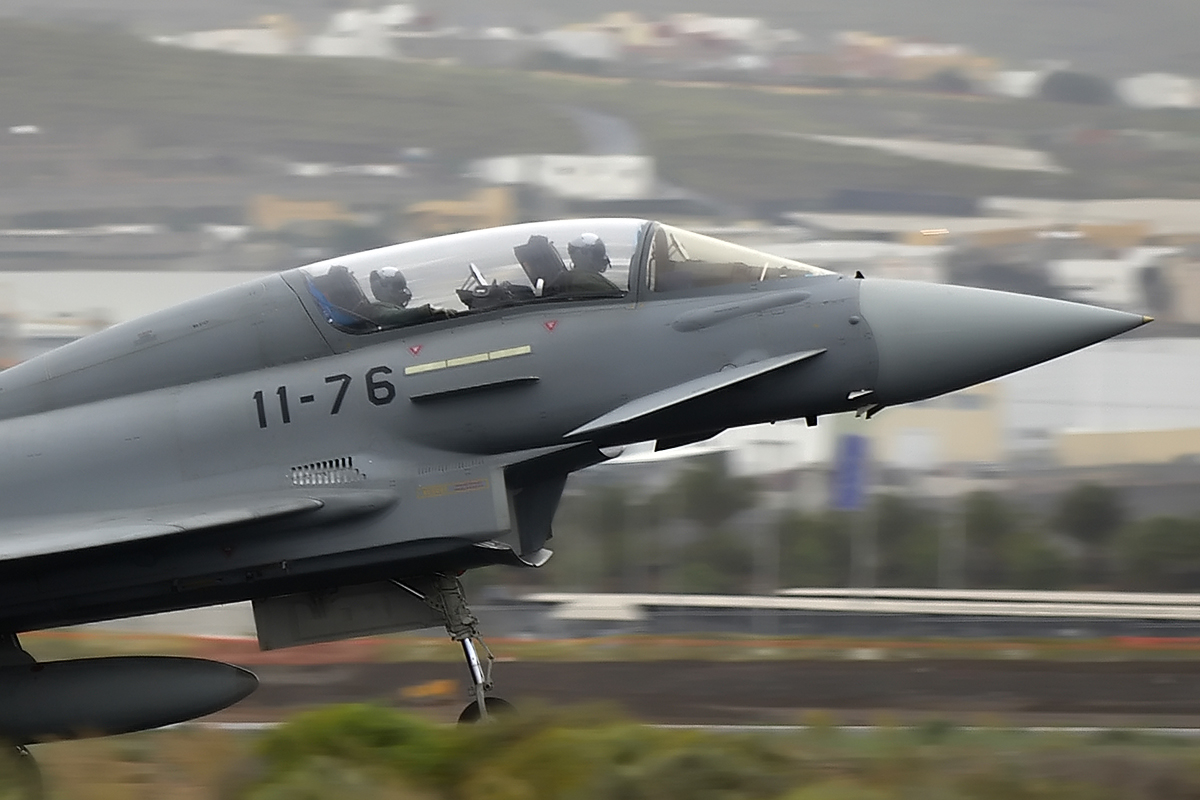
The two-seater then accompanied the Typhoon's spread to the other units. In April 2012 the first four C.16s reached 142 Escuadrón of Ala 14 at Albacete to replace the Mirage F1, officially retired on 23 June 2013; 141 Escuadrón followed in September 2017 and in January 2020 the last of the 73 aircraft ordered arrived at the unit. Meanwhile the CLAEX at Torrejón has been upgrading the Tranche 1 aircraft, two-seaters included, to remove their shortfalls against the Tranche 2 and 3 machines by means of interchangeable equipment, IFF, the Litening III pod and air-to-ground weapons.
The CE.16 fleet will grow under the Halcón programmes. On 14 December 2021 the Spanish cabinet approved the Halcón project to replace the F/A-18s at Gando, and on 24 June 2022 the Air Force announced at the Berlin air show the purchase of 20 Tranche 4 Eurofighters with electronically scanned radar, 16 single-seaters and 4 two-seaters. In September 2023 Halcón II was announced, with 25 Tranche 4+ aircraft, 21 single-seaters and 4 two-seaters, signed with NETMA on 20 December 2024. With them the Spanish two-seat fleet will rise from 14 to 22 aircraft, and on 26 June 2026 the first Eurofighters arrived at Ala 46 in the Canary Islands from Ala 14 at Albacete.
Multimedia


