Eurofighter Typhoon variant
Eurofighter Typhoon IPA3
Instrumented Production Aircraft two-seater (PT003, serial 98+03) assembled by EADS Deutschland at Manching, the first German-built production Eurofighter to fly (8 April 2002) and the testbed for underwing load trials, the Litening III pod and A310 MRTT air-to-air refuelling.

- April 8, 2002
- First flight
- 1
- Units built
History
IPA3 is the third of the Eurofighter programme's Instrumented Production Aircraft: airframes built to Tranche 1 production standard but fitted with telemetry instrumentation so that they could complete the development and systems-integration testing that the seven DA prototypes could not carry alone. Within the consortium's industrial split, IPA3 was the German aircraft of the first batch of three two-seaters (alongside the British IPA1 and the Italian IPA2), carrying the production number PT003 and the Luftwaffe serial 98+03. Like all the IPAs it is owned by the NETMA agency rather than by a national air force. Programme literature assigns it the integration of air-to-air weapons, although EADS documentation describes it as the aircraft earmarked for air-to-surface weapons integration, with 408 flights planned before operational readiness.
Final assembly began at the EADS plant in Manching in December 2000, following delivery of the rear fuselage section jointly manufactured by BAE Systems and Alenia; the front fuselage arrived from Warton in mid-December and the wings, canards and fin in early 2001. The first two EJ200 engines delivered by MTU Aero Engines for the programme, in early October 2001, were installed in this first German production aircraft by the end of that month. According to Italian programme sources IPA3 was in fact the first of the IPAs to enter production, although not the first to fly: that distinction went to IPA2 on 5 April 2002.
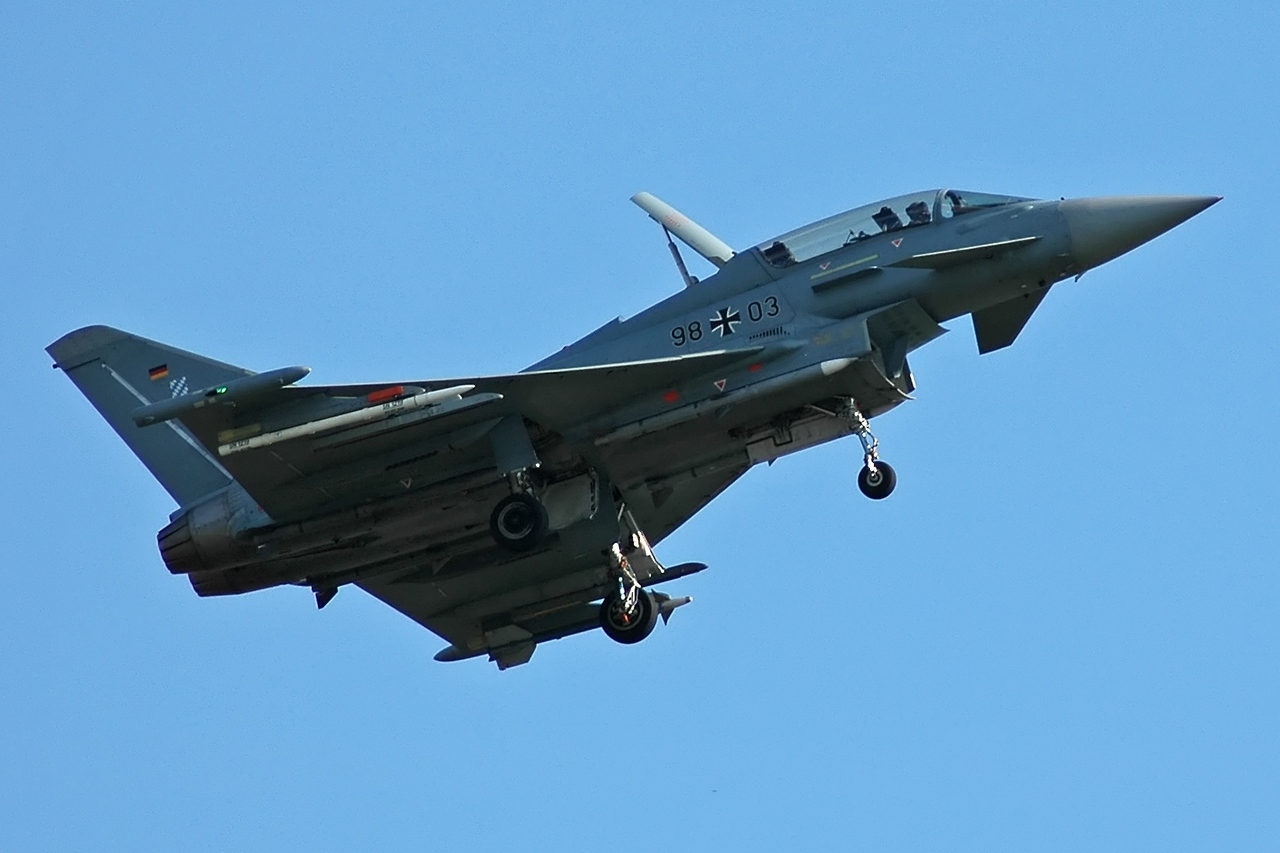
IPA3 made its maiden flight from Manching on 8 April 2002 at around 08:50, with EADS test pilot Chris Wörning and Lieutenant Colonel Robert Hierl of the Bundeswehr's WTD 61 flight test centre at the controls; an F-4F Phantom (38+13) flew as chase aircraft. The sortie lasted 31 minutes, and a second flight followed the same afternoon at around 14:00, this time with a Tornado (46+10) as chase. A week later, on 15 April, IPA1 flew from Warton, so that the first three production aircraft joined the development fleet to complete flight testing and certification ahead of the first customer deliveries. Some chronologies give 11 April 2002 for the first flight; industry and German sources agree on 8 April.
From 2005 the aircraft was devoted to load and stores-configuration trials. During the 2006 air-to-surface campaign, while IPA1 concentrated on Paveway II clearances and IPA4 on the GBU-16, IPA3 took on the underwing load tests with the full air-to-air weapons load plus up to four Paveway II bombs and external fuel tanks. On 21 February 2006 it made its first flight at Manching carrying four UK Paveway II laser-guided bombs. On 20 November 2006 it flew the first Litening III targeting pod for environmental data gathering, again at Manching; the aerodynamic testing of the laser designator pod being integrated for the Royal Air Force was likewise done on this aircraft at EADS Military Air Systems. By then the four-nation industry test fleet of eleven aircraft had passed 5,000 flights (29 September 2006).
At the end of October 2008 the flight series to certify single- and twin-seat Eurofighters for air-to-air refuelling from the Airbus A310 MRTT tanker began at Manching. The first refuelling flights with this tanker, during which the aircraft remained airborne for up to five hours, were flown by IPA3 and IPA7; nine certification flights were planned and clearance was expected by the end of 2008. Unlike most of the IPAs, whose avionics were later raised to Tranche 2 standard, IPA3 (like IPA1) kept its original Tranche 1 avionics. Its stores-carriage trials ended in 2013.
Multimedia


