Eurofighter Typhoon variant
Eurofighter Typhoon DA4
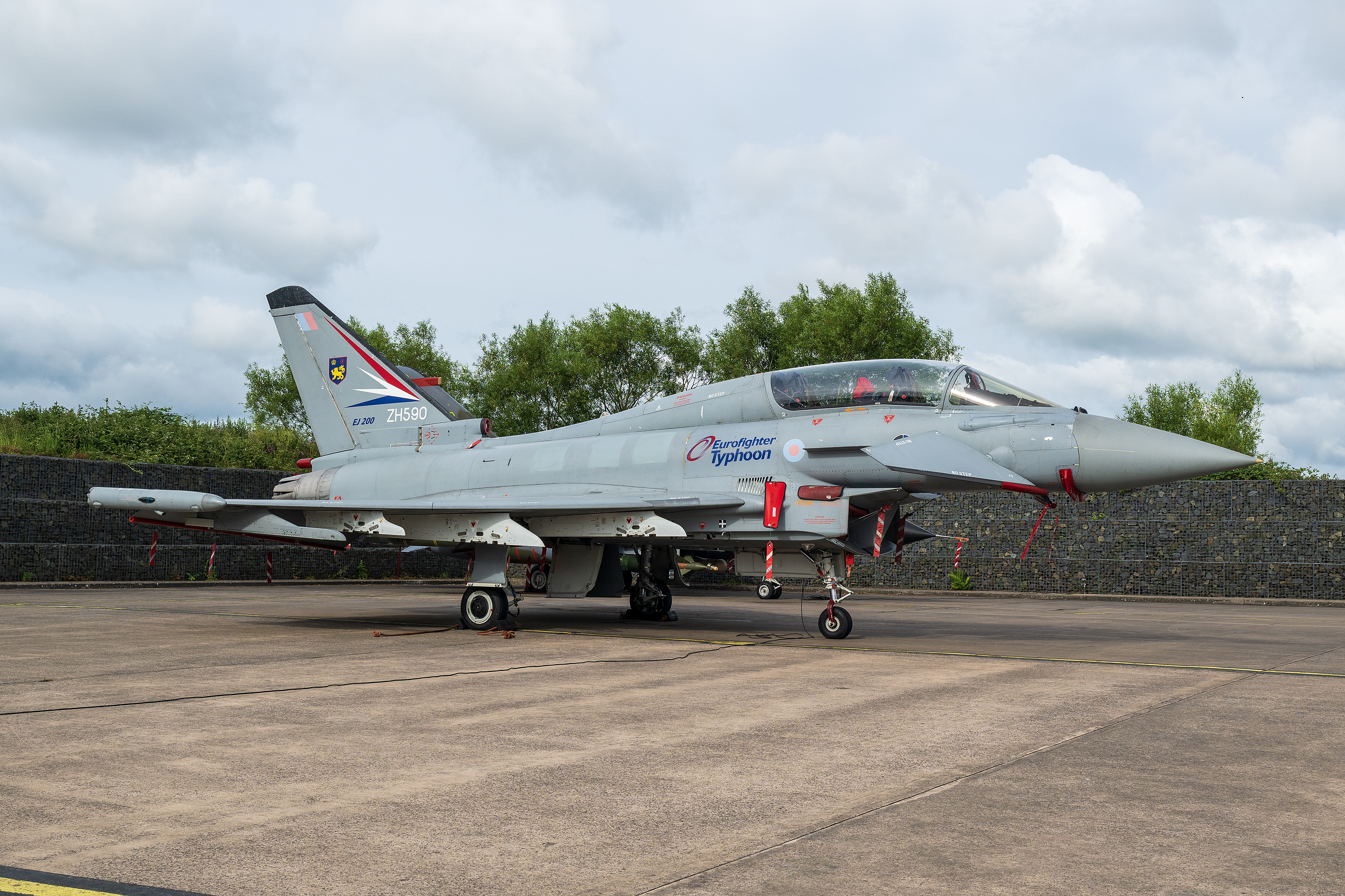
DA4 (ZH590) was the British two-seat Eurofighter development aircraft, built by BAE Systems at Warton and the last of the seven Development Aircraft to fly (14 March 1997). Assigned to radar, avionics and air-to-air refuelling trials, it now serves as an instructional airframe at RAF Coningsby.

- March 14, 1997
- First flight
- 1
- Units built
History
DA4, carrying the British military serial ZH590, was one of the seven Development Aircraft (DA) with which the Eurofighter consortium tested the future Typhoon ahead of series production. Two of those prototypes were built in the United Kingdom (DA2 and DA4), two in Germany (DA1 and DA5), two in Italy (DA3 and DA7) and one in Spain (DA6). DA4 emerged from the BAE Systems plant at Warton as a two-seater, and in the programme's division of labour it was tasked, together with the German DA5, with radar and avionics development, later being brought up to the Phase 2 software standard.
Its maiden flight took place on 14 March 1997 with test pilot Derek Reeh at the controls. It was the last of the seven DAs to take off and the second two-seater to do so, after the Spanish DA6, which had flown in August 1996; some sources simply describe it as the programme's first two-seater, meaning the first built in the United Kingdom. Unlike the earliest prototypes, DA4 carried the complete radar installation, which made it the natural test bed for the ECR-90, the radar later renamed CAPTOR.
The early years of testing moved quickly. On 20 February 1998 it made its first supercruise flights, and between May and June of that year it underwent artificial lightning-strike trials at Warton, needed to certify the electrical protection of an airframe made largely of composite materials. On 28 April 1999 the autopilot and autothrottle functions were engaged for the first time with the new flight-control software release, which DA4 and DA5 introduced in parallel; the same year both aircraft flew for the first time with the production standard of the ECR-90/CAPTOR radar, and development of the sensor software began. On 17 June 1999 it made the first flight with the helmet-mounted sight, and that spring it also acted as the programme's showcase, carrying eleven high-level guests in its rear seat, among them the chiefs of the air staffs of Germany, Italy and the United Kingdom. In February 2000, during its 75th sortie, the Eurofighter fleet as a whole passed 1,000 flying hours. After 2000 it flew for the first time with the missile approach warners (MAW) and performed the programme's first night flight by a two-seater.
From 2001 ground testing of the DASS defensive aids system began, and the aircraft received an upgrade to its electrical generation and avionics before resuming flight testing in November 2001. In January 2002, together with DA2, it carried out the first simultaneous in-flight refuelling of two Eurofighters, and on 9 April 2002 it fired the programme's first AMRAAM missile against a target drone as part of the weapons-integration trials. There followed the first aerial refuelling of a two-seater, the first with external tanks and the first at night, as well as the longest Eurofighter flight up to that point, of 4 hours 22 minutes. From 2002 it conducted electronic support measures (ESM) trials and, from March 2004, flights with the Direct Voice Input system. In September 2004 an improved flight-control system was fitted, and in February 2005 it shot down an unmanned target with an AMRAAM. At Warton the airframe was also used to measure the aircraft's radar cross-section and to evaluate radar-absorbent coatings and composites intended to reduce its signature.
On 13 December 2006 DA4 was moved to RAF Coningsby, where its airframe was put to use for teaching and training maintenance personnel. The aircraft later passed into the collection of the Imperial War Museum; after a planned transfer to the Newark aviation museum fell through, it was to return to Coningsby to continue in that instructional role.
Multimedia


