Fighter · Military · Germany
Messerschmitt Bf 109
- May 28, 1935
- First flight
- 1937
- Introduced
- 1945
- Retired
- 33,984–34,852
- Units built
-1600.webp)
%2C_Brandenburg-Briest%2C_Bf_109_D_(1a)-1600.webp)

_2010-07-14_Andre_Gerwing_Collection_ID_011579-1600.webp)

_(Czech_version_of_Messerschmitt_Bf_109G-12_pic1-1600.webp)

-1600.webp)
-1600.webp)

-1600.webp)
-1600.webp)


-1600.webp)


-1600.webp)
_2025-09-12_Andre_Gerwing_Collection_ID_026003-1600.webp)

_(UF_25)_pic2-1600.webp)


%2C_surviving_airframe%2C_2011-1600.webp)
.jpg)

%2C_Hangar_10%2C_Heringsdorf%2C_2016-1600.webp)

%2C_Brandenburg-Briest%2C_Bf_109_D-800.webp)
.jpg)

-800.webp)

-800.webp)

_LG_2_und_Ju_87_B%2C_III._StG_77_in_Vrba-Ost%2C_s%C3%BCdl._Radomir%2C_Bulgarien%2C_01.04-1600.webp)

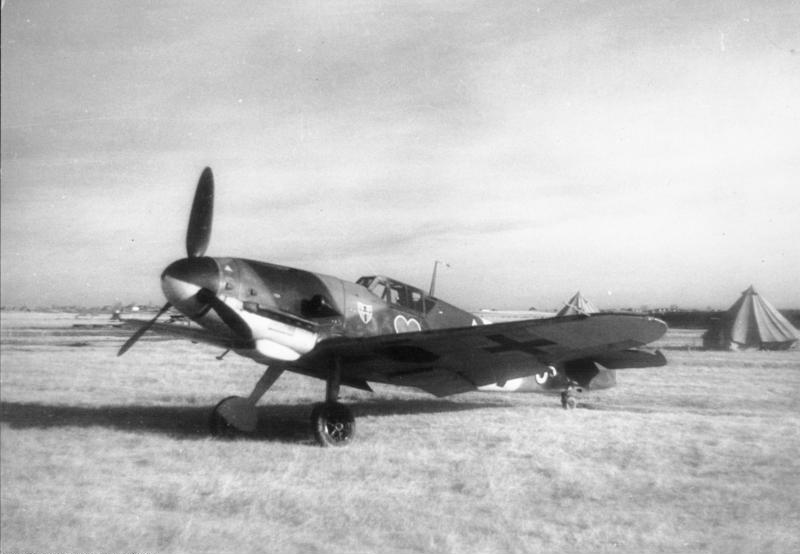


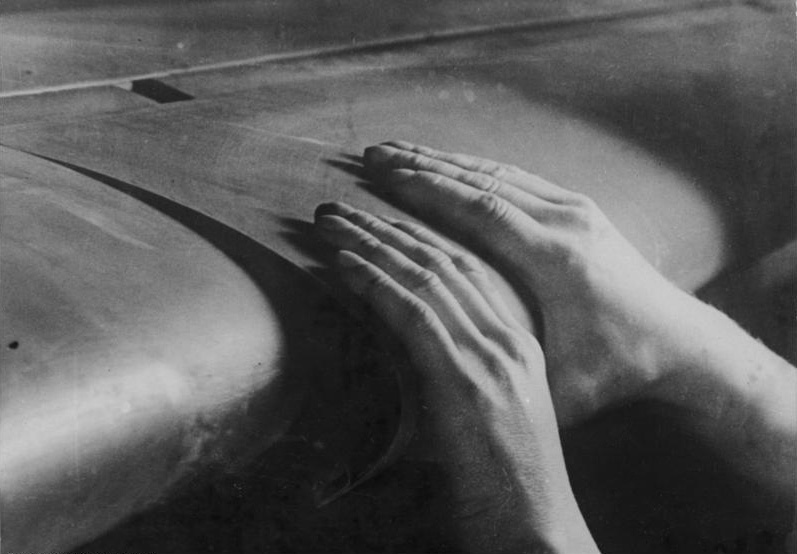


-1600.webp)

-1600.webp)


_Keski-Suomen_ilmailumuseo_1-1600.webp)


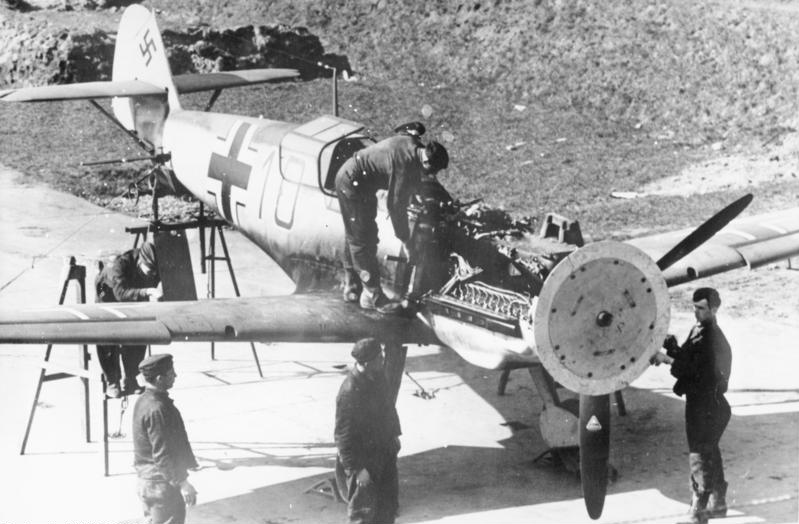


-1600.webp)
-1600.webp)
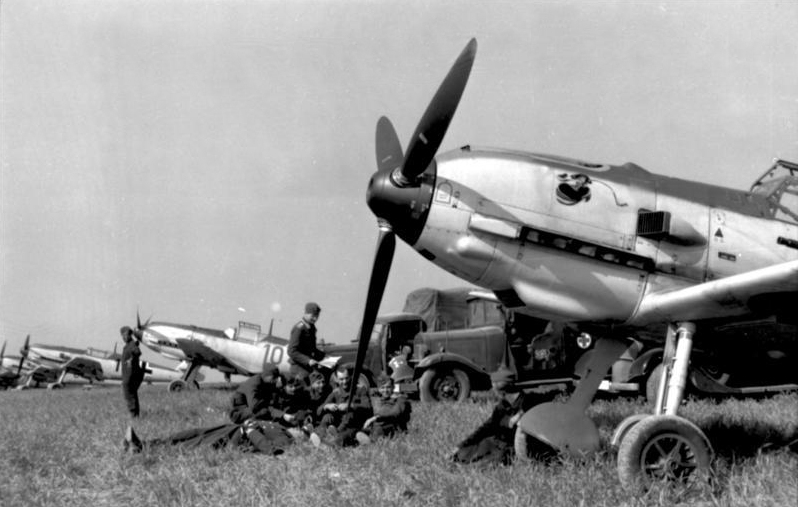
.png)
The Messerschmitt Bf 109 is a German single-seat monoplane fighter laid out in the mid-1930s by the team of Willy Messerschmitt and Robert Lusser at Bayerische Flugzeugwerke, the company whose initials gave the aircraft its «Bf» prefix. It was among the first genuinely modern fighters: an all-metal airframe, a cantilever low wing, retractable landing gear and an enclosed cockpit, at a time when most air forces still flew fixed-gear biplanes. The first prototype took to the air at the end of May 1935 from the Haunstetten airfield on the southern edge of Augsburg, and did so behind a British engine: the German powerplants intended for it were not ready, so the air ministry obtained four Rolls-Royce Kestrels by trading Rolls-Royce a Heinkel He 70 for use as an engine testbed. With 34.248 airframes completed between 1936 and April 1945, the Bf 109 is the most-produced fighter in history. Together with the Focke-Wulf Fw 190 it formed the backbone of the Luftwaffe fighter arm throughout the Second World War, and its output — sustained by dispersing the factories and by the massive use of forced labour after Allied bombing struck the Regensburg plant — continued until the regime collapsed. That single figure explains why the type turns up on virtually every European front, from Spain to the Caucasus and from Norway to the Libyan desert. Its longevity rests on a small, light airframe that absorbed three generations of engines. Early versions used the Junkers Jumo 210 of roughly 522 kW; the E model, the «Emil», was structurally revised to take the heavier and more powerful Daimler-Benz DB 601 of 1.100 PS along with a harder-hitting armament; the F, the «Friedrich», cleaned up the aerodynamics of the nose and tail; and the G, the «Gustav», powered by the DB 605, became the largest family of all — more than a third of every 109 built belonged to the G-6 series, with 12.000 units manufactured from March 1943 until the end of the war. The nicknames were not slang but the official variant letter spoken through the German phonetic alphabet of the period. The fighter saw its first action with the Condor Legion in Spain in mid-1937, where it was measured against Soviet-supplied opponents. Its decisive test came in the summer of 1940, when the E-1 and E-4 bore the brunt of the Battle of Britain against the Royal Air Force; the direct fuel injection of the DB 601 gave it an early advantage in the dive, because the gravity-fed carburetted engines of the Spitfire and Hurricane cut out under negative g. On the German side the aircraft was the instrument of the highest-scoring fighter pilots ever recorded: Erich Hartmann with 352 victories, Gerhard Barkhorn with 301 and Günther Rall with 275, all of them serving in Jagdgeschwader 52 on the Eastern Front, alongside Hans-Joachim Marseille in North Africa. The design also left a mark away from combat and away from Germany. A V13 prototype converted from a Bf 109 D and fitted with a racing DB 601R took the world speed record for landplanes with piston engines for Germany, at 610.95 km/h on 11 November 1937, with Hermann Wurster at the controls. After the war the airframe went on being built under other flags: as the Avia S-199 in Czechoslovakia, twenty-five of which served with Israel in 1948 as its air force's first fighter, and as the Hispano Aviación HA-1109 and HA-1112 in Spain, where some examples were still flying in the late 1960s and ended up playing their own ancestors on screen. Switzerland operated its Bf 109 G well into the 1950s, Finland did not retire its own until March 1954, and Romania kept them until 1955.
Related events
Category
Messerschmitt Bf 109 in the news
German Ace Adolf Galland Adolf Josef Ferdinand Galland was born on 19 March 1912 in Westphalia, a region in north-western Germany, into a family of French Huguenot ancestry. He spent a brief period…
The Bf 109E during the Battle of Britain The Messerschmitt Bf 109 was the Luftwaffe’s principal fighter aircraft during the Battle of Britain. It could outclimb and outgun the RAF’s Hurricanes and…
%2C_surviving_airframe%2C_2011.jpg)
One of the world’s finest single seat fighters During the early war years the Bf 109 was one of the world’s finest single seat fighters. Its basic design provided the potential for it to take new…
Discover the new Hobby Master models in our Air-Store: Messerschmitt Bf109G-5 “Walter Dahl” W.Nr.27112, 3./JG 54, Russia, Dec 1943 – HA8768 Northrop F-5A Freedom Fighter RNoAF 128, 336…

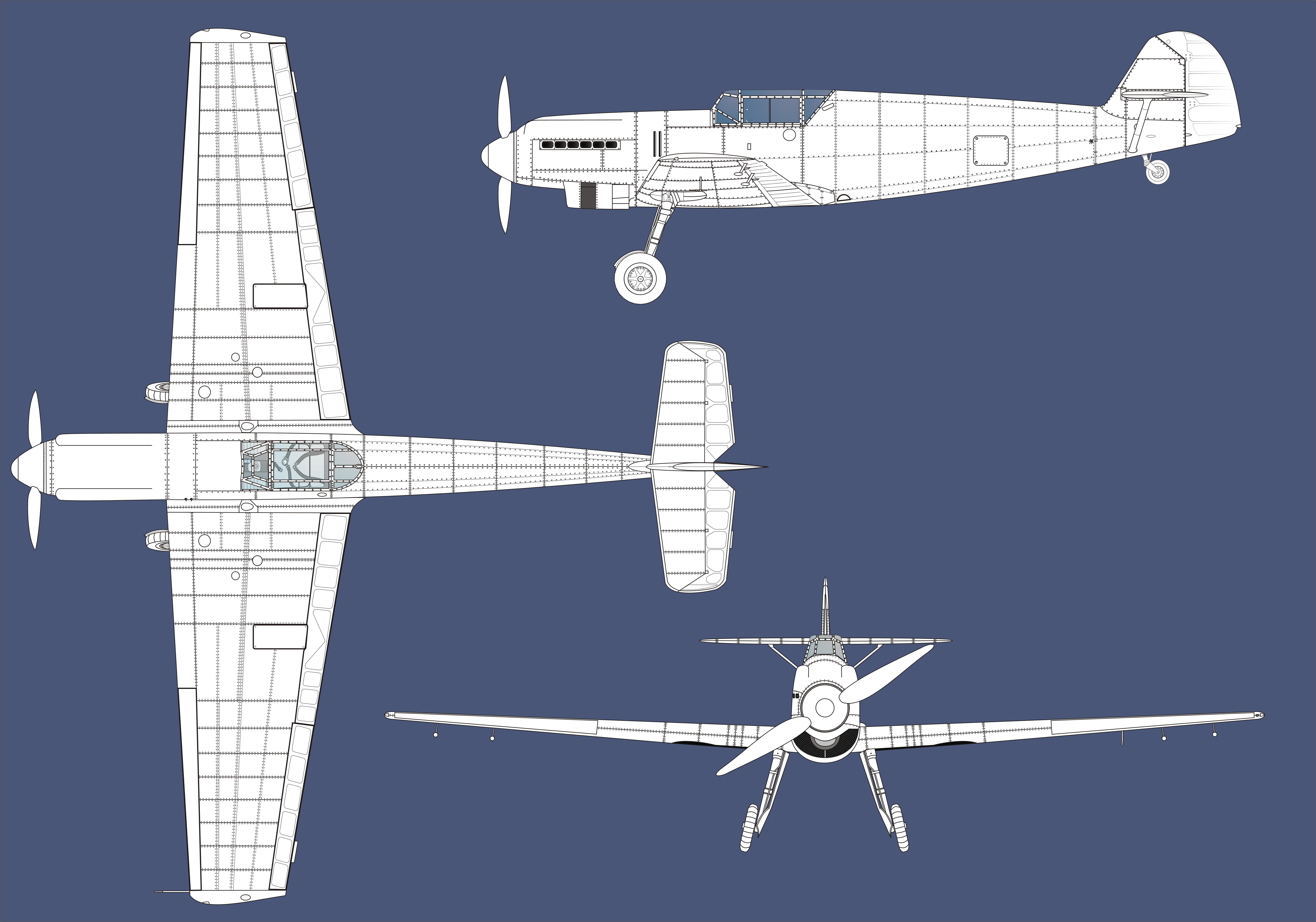
Three-view drawing
_del_primer_prototipo.jpg)
.jpg)
.jpg)
.jpg)
.jpg)
.jpg)
.jpg)
.jpg)
.jpg)
_%E2%80%94_tr%C3%ADptico_(tres_vistas).jpg)
.jpg)
.jpg)
%2C_versi%C3%B3n_sobre_fondo_azul.jpg)
%2C_con_vistas_frontal%2C_lateral_y_cenital.png)
_%E2%80%94_despiece_con_llamadas_descriptivas_(r%C3%B3tulos_en_suajili).jpg)
History
Origins: the fighter competition and the first prototype
The Bf 109 grew out of the specification with which the Reichsluftfahrtministerium sought, in the mid-1930s, a modern single-seat fighter to replace the biplanes then in service. The requirement was demanding for its day: a critical altitude of 6,000 metres was to be reached in no more than seventeen minutes, and the aircraft was to have an operational ceiling of 10,000 m, with power supplied by the new Junkers Jumo 210 of about 522 kW (710 PS). The intended armament was either a single 20 mm cannon mounted in the engine vee and firing through the propeller hub — the Motorkanone arrangement that would accompany the type throughout its life — or a pair of synchronised machine guns above the cowling.
The team led by Willy Messerschmitt at Bayerische Flugzeugwerke answered with a low-wing monoplane of all-metal construction, enclosed cockpit and retractable undercarriage: the combination of features that would define the fighter of the following decade. The first prototype, Versuchsflugzeug 1 or V1, carrying the civil registration D-IABI, was completed by May 1935, but the German engines intended for it were not ready. To get the design into the air the ministry acquired four Rolls-Royce Kestrel VI engines by trading Rolls-Royce a Heinkel He 70 Blitz for use as an engine test-bed; Messerschmitt received two of them and adapted the engine mounts of V1 to take the British V-12 upright. The irony is worth stating plainly: the fighter that would face the Spitfire for the whole war first flew behind a Rolls-Royce engine.
The comparison against its rivals came at Travemünde, where in 1936 the Arado Ar 80 V3, the Focke-Wulf Fw 159 V3, the Heinkel He 112 V4 and the Bf 109 V2 were flown head to head. The He 112 arrived first, in early February, and the remaining prototypes followed by the end of the month. The Bf 109 initially unsettled fighter pilots accustomed to open-cockpit biplanes: enclosed canopy, high wing loading, narrow-track undercarriage and trailing-edge flaps were all unwelcome novelties. Those same decisions — the smallest, lightest airframe wrapped around the most powerful engine available — gave the design the growth margin that sustained ten years of development.
From the B series to the D: an interim fighter
The first production series, powered by the Jumo 210 in its several versions, served to mature the airframe rather than to deliver a definitive fighter. Changes accumulated in propeller, cooling, armament and fuel system while the engine the design really wanted — the larger-displacement Daimler-Benz — was awaited. The B, C and D series were in practice the operational test bed of an aircraft still unfinished, and the pre-war output reflects it: a total of 2,193 Bf 109 A–E was built before the war, from 1936 to August 1939.
Spain and Dübendorf: baptism of fire and shop window
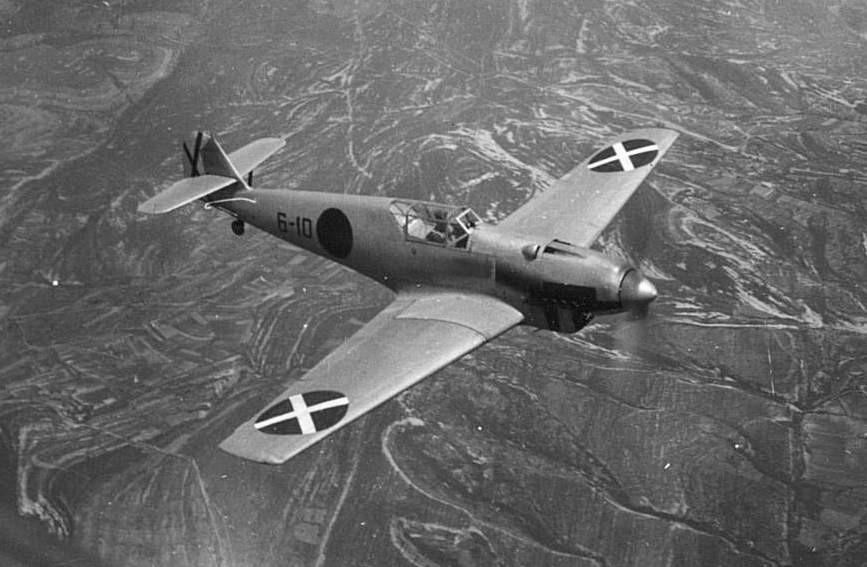
The Bf 109 entered combat in the Spanish Civil War with the Condor Legion from the middle of 1937, and there it gained what no test establishment could give it: real tactical experience. Both the technical fixes and the employment doctrine that came out of that campaign — the loose pair-and-section formation — went with the German fighter arm into 1939 with a running start over its opponents.
The second baptism was a propaganda one. Between 23 July and 1 August 1937, at the fourth International Flying Meeting held at the Dübendorf military airfield near Zurich, six Bf 109s competed against aircraft and pilots from other nations within a deliberately large German entry, and won the events they took part in. The message reached European staffs more clearly than any intelligence report: Germany already had a front-line fighter.
The Emil: the first major redesign
The first deep redesign came with the E series, the *Emil*, which also included the naval variant Bf 109T (T for *Träger*, carrier). The Emil introduced the structural changes needed to accommodate the heavier and more powerful Daimler-Benz DB 601, rated at 1,100 PS (809 kW; 1,085 hp), together with heavier armament and increased fuel capacity. The later sub-variants added fighter-bomber capability and provision for a standardised 300-litre drop tank, using the higher-output DB 601N.
The Emil first saw service with the Condor Legion during the last phase of the Spanish Civil War and was the main variant from the beginning of the Second World War until mid-1941. It also exposed the type's most quoted structural limitation: a combat radius of some 300 kilometres on internal fuel, the consequence of a 660 km range, which in the summer of 1940 left German bombers without effective escort over much of England. On 31 August 1940, 375 E-1s were reported on strength, excluding JG 77; no flying quality could compensate for the fuel the aircraft did not carry, and the shortfall shaped the campaign more than any handling comparison did.
The Friedrich: aerodynamics before power
The second big redesign, worked out during 1939 and 1940, produced the F series. The *Friedrich* received new wings, a redesigned cooling system, a cleaner cowling and a cantilever tail that dispensed with the stabiliser lift struts of earlier models; those improved aerodynamics were retained by every later variant. The DB 601E of the F-3 and F-4 was paired with a VDM propeller of broader blades for better altitude performance, and was initially restricted to 1,200 PS at 2,500 rpm until its full rating of 1,350 PS was cleared for service use in February 1942, running on standard 87 octane B-4 aviation fuel.
Some Fs were used late in the Battle of Britain in 1940, but the variant came into common use only in the first half of 1941. Among pilots the Friedrich is usually regarded as the balance point of the whole design: the best compromise between power, armament and aerodynamic refinement before growing weight began to tell.
The Gustav: the mass-produced variant
The G series, the *Gustav*, was introduced in mid-1942 and became by far the most numerous. Its initial versions, G-1 through G-4, differed from the Friedrich only in minor details, most notably the more powerful DB 605 of 1,475 PS (1,085 kW; 1,455 hp). Odd-numbered variants were built as high-altitude fighters with a pressurised cockpit and GM-1 boost, while even-numbered variants were unpressurised air-superiority machines.
The G-6 was the emblematic and most numerous sub-variant, with some 12,000 built from March 1943 — more than a third of all Bf 109s produced. Luftwaffe personnel nicknamed it *Die Beule*, "the bump", after the bulged cowling covers required to clear the breeches of the 13 mm MG 131 machine guns, a feature later cowling versions eliminated. The Gustav also illustrates the drift of the programme: every new requirement — heavy anti-bomber armament, armour, radio equipment, *Rüstsätze* field kits slung under the wings — added weight and drag to an airframe conceived for less than half the power it now carried.
Production, industrial dispersal and slave labour
Total Bf 109 production was 33,984 units, of which 30,573 were built between September 1939 and May 1945; a second accounting, closing in April 1945 and covering all airframes built from 1936, gives 34,248, the figure that makes it the most produced fighter aircraft in history. Fighter production accounted for 47% of all German aircraft production, and the Bf 109 for 57% of all German fighter types built.
Those numbers have a side no data table records: part of the production took place in concentration camps through slave labour. In January 1943, as part of the effort to increase fighter output, Messerschmitt licensed the SS-owned company DEST to manufacture Bf 109 parts, and production at Flossenbürg began in February. The number of prisoners working for Messerschmitt increased greatly after the bombing of the Regensburg plant on 17 August 1943. Erla, a Messerschmitt subcontractor, established its own Flossenbürg subcamps, among them Johanngeorgenstadt, set up in December 1943 to produce Bf 109 tailplanes. The dispersal of the industry under Allied bombing and the resort to forced labour are inseparable from the type's production record.
The Kurfürst and the end of the war
The last series to reach significant production sought to rationalise a range that had fragmented into dozens of sub-variants and field kits. The standardisation attempt proved a failure, but the result offered improved combat performance: MW 50 water-methanol boosting raised output to 1,800 PS (1,324 kW), and the clear-view *Erla Haube* canopy became a standard installation. Top speed was 573 km/h at sea level and 665 km/h at 5 km altitude. Some projected K-series models, such as the K-6, were designed to carry 30 mm MK 108 cannon in the wings, armament intended to bring down four-engined bombers with a short burst.
Records and propaganda
The world speed record contest of the later 1930s was fought out between German manufacturers. The Bf 109 itself opened the series: on 11 November 1937 the V13, registered D-IPKY and flown by Messerschmitt's chief test pilot Dr Hermann Wurster, reached 610.95 km/h on a racing DB 601R of 1,230 kW (1,672 PS), an airframe converted from a Bf 109 D; it was the first time Germany had taken the world air speed record for landplanes with piston engines. Hans Dieterle beat the preceding mark at 746.61 km/h with the He 100 V8, and Messerschmitt soon regained the lead: on 26 April 1939 Flugkapitän Fritz Wendel, flying the Me 209 V1, set a new record of 755.14 km/h. For propaganda purposes the Me 209 V1 was given the designation Me 109R, a prefix never used for wartime Bf 109 fighters. The record aircraft was not a Bf 109 and shared with it little beyond the manufacturer and the deliberate wish to conflate the two in the public mind.
Aces and operational use
The Bf 109 was flown by the three top-scoring fighter aces of all time, who claimed 928 victories between them while flying with Jagdgeschwader 52, mainly on the Eastern Front. The highest-scoring, Erich Hartmann, was credited with 352 victories. It was also flown by Hans-Joachim Marseille, the highest-scoring ace of the North African campaign, who shot down 158 enemy aircraft in about a third of the time. Such totals need their context: they reflect both the aircraft's qualities and a rotation system that kept German pilots in combat without relief until death or capture, in contrast to the Allied practice of returning them to training duties.
The type remained in service to the end of the conflict in 1945 and continued to be operated by several countries for many years afterwards.
After 1945: Avia, Hispano and a second life
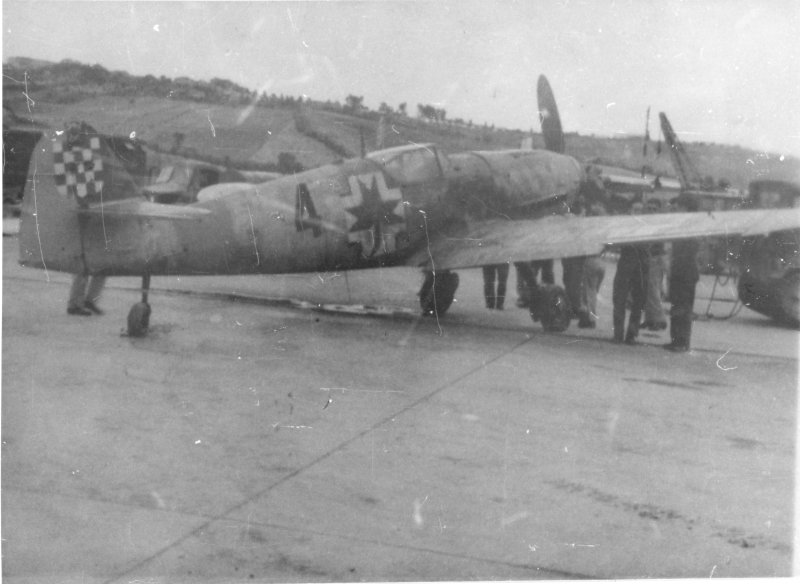
With the war over, the 109 went on being built outside Germany. In Czechoslovakia it was produced as the Avia S-99 and S-199; twenty-five S-199s served with Israel in 1948 and formed the basis of the fledgling Israeli Air Force, one of the most quoted ironies in the aircraft's history. In Spain two versions derived from the Bf 109G-2 were built under licence: the Hispano Aviación HA-1112 "Tripala", with a Hispano-Suiza engine, and the HA-1112 "Buchón", with the same Rolls-Royce Merlin that had powered the Spitfire.
The final variant, the HA-1112-M1L Buchón — the name of a breed of pouter pigeon — first flew on 29 March 1954 with a 1,600 hp Rolls-Royce Merlin 500-45 and a four-bladed Rotol propeller, both bought as surplus from the United Kingdom. The Merlin's chin intake altered the characteristic line of the nose. It was an improvised assembly of parts of disparate origin, but it turned the German fighter's descendant into a British-engined aircraft and, by that route, into the natural supplier of "Messerschmitts" for the war films of the following decades.
Legacy and survivors
The Bf 109 combines two conditions rarely found together: it was the most produced fighter in history and it stood in the front line from the first day of the war to the last. Its formula — the smallest possible airframe around the most powerful available engine — explains both its virtues and its faults: excellent power-to-weight ratio and climb, and at the same time a narrow-track undercarriage responsible for a high number of take-off and landing accidents, especially among pilots given abbreviated training in the final phase of the war.
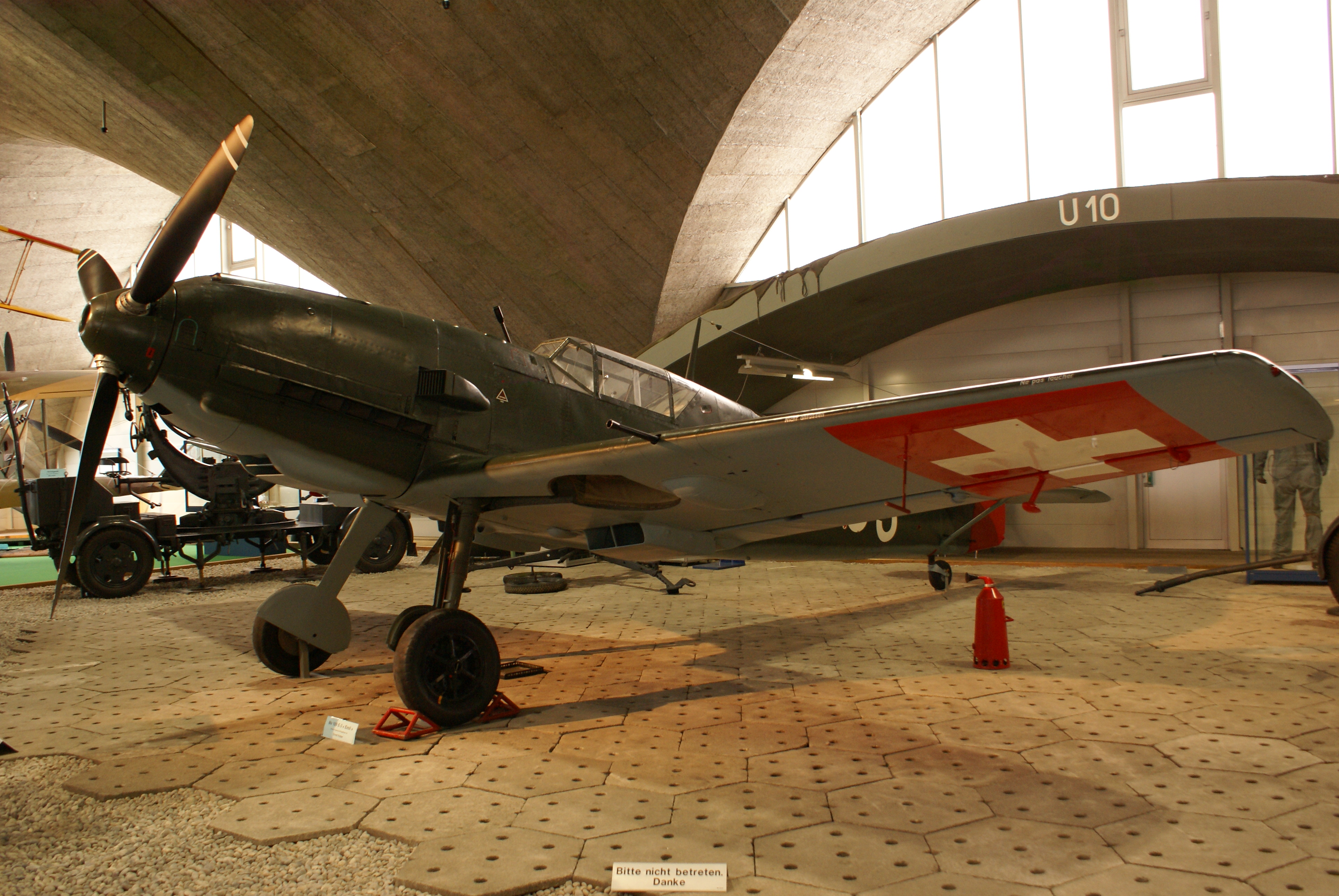
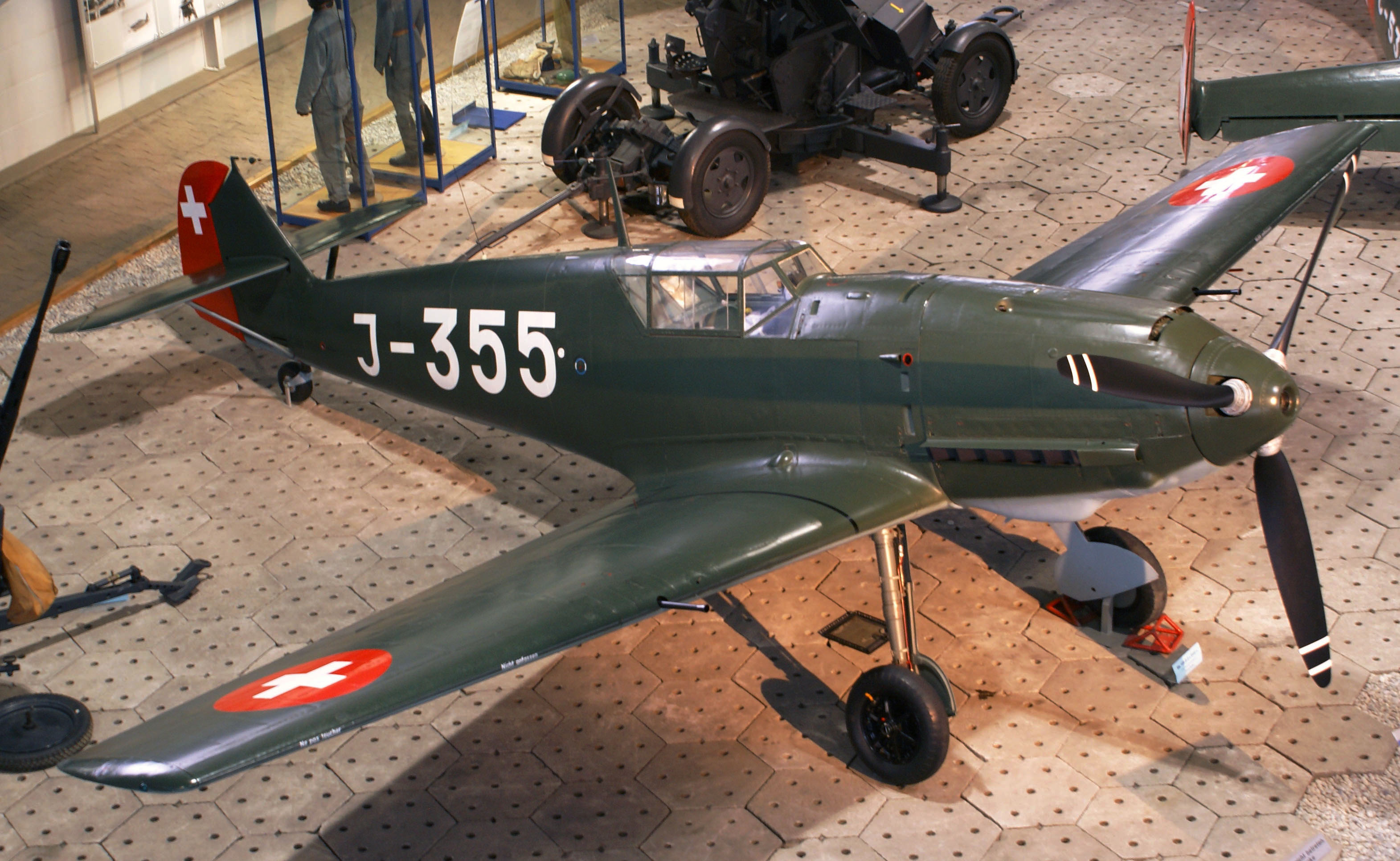
The survivors today are divided between original airframes and their Spanish and Czechoslovak descendants. Preserved HA-1112s include static examples, such as the HA-1112-K1L at the Museo del Aire in Madrid, and airworthy ones, some of them re-engined and modified to resemble the German Bf 109. Telling an authentic Bf 109 from a Buchón, and a Buchón from a "converted" Buchón, is one of the points where the paperwork deserves more attention than the silhouette.
Variants
| Bf 109 A | Bf 109 B | Bf 109 C | Bf 109 D | Bf 109 E-3 | Bf 109 E-4 | Bf 109 F-2 | Bf 109 F-4 | Bf 109 G-10 | Bf 109 G-14 | Bf 109 G-2 | Bf 109 G-4 | Bf 109 G-6 | Bf 109 H-1 | Bf 109 K-4 | Bf 109 T | |
|---|---|---|---|---|---|---|---|---|---|---|---|---|---|---|---|---|
| First flight | May 28, 1935 | — | — | — | — | — | — | — | — | — | — | — | — | — | — | — |
| Aircraft type | — | — | — | — | — | — | — | — | — | — | — | — | Single-seat, single-engine piston fighter | — | — | — |
| Powerplant | — | — | — | — | — | — | — | — | — | — | — | — | Daimler-Benz DB 605A-1 piston engine, 1,475 hp (1,085 kW) | — | — | — |
| Powerplant | 1 × Junkers Jumo 210D | 1 × Junkers Jumo 210D | 1 × Junkers Jumo 210G | 1 × Junkers Jumo 210D | 1 × Daimler-Benz DB 601A | 1 × Daimler-Benz DB 601A | 1 × Daimler-Benz DB 601N | 1 × Daimler-Benz DB 601E | 1 × Daimler-Benz DB 605D-2 | 1 × Daimler-Benz DB 605AM | 1 × Daimler-Benz DB 605A | 1 × Daimler-Benz DB 605A | 1 × Daimler-Benz DB 605A-1 | 1 × Daimler-Benz DB 605A | 1 × Daimler-Benz DB 605 DB/DC | 1 × Daimler-Benz DB 601N |
| Power per engine | 661 hp | 661 hp | 691 hp | 661 hp | 809 kW | 809 kW | 864 kW | 1,332 hp | — | 1,324 kW | 964 kW | 964 kW | 1,455 hp | — | 1,971 hp Best value in this row | 864 kW |
| Length | — | — | 8.6 m | 8.7 m | — | — | — | 8.9 m | — | — | — | — | 9 m Best value in this row | — | 9 m Best value in this row | — |
| Wingspan | — | — | 9.9 m | 9.9 m | — | — | — | 9.9 m | — | — | — | — | 9.9 m | 11.9 m Best value in this row | 10 m | — |
| Height | — | — | 2.6 m | 3.4 m Best value in this row | — | — | — | — | — | — | — | — | 2.6 m | — | 2.6 m | — |
| Wing area | — | — | 16.2 m² | — | — | — | — | 16.1 m² | — | — | — | — | 16.1 m² | — | 16.4 m² Best value in this row | — |
| Empty weight | — | — | — | — | — | — | — | — | — | — | — | — | 2,247 kg Best value in this row | — | 2,350 kg | — |
| MTOW | — | 2,200 kg | 2,310 kg | — | — | — | — | — | — | — | — | — | 3,400 kg Best value in this row | — | 3,360 kg | — |
| Top speed | — | 470 km/h | 440 km/h | — | — | — | 615 km/h | 659 km/h | — | 665 km/h | 660 km/h | 660 km/h | 642 km/h | 750 km/h Best value in this row | 710 km/h | — |
| Max speed altitude | — | 4,000 m | 4,000 m | — | — | — | — | 6,200 m | — | 5,000 m | 7,000 m | 7,000 m | 6,300 m | 10,100 m | 7,500 m | — |
| Cruise speed | — | — | — | — | — | — | — | — | — | — | — | — | 590 km/h | — | — | — |
| Cruise altitude | — | — | — | — | — | — | — | — | — | — | — | — | 6,000 m | — | — | — |
| Service ceiling | — | — | 9,500 m | — | — | — | — | 11,600 m | — | — | — | — | 12,000 m | — | 12,500 m Best value in this row | — |
| Initial climb rate | — | — | — | — | — | — | — | — | — | — | — | — | 22.7 m/s | — | — | — |
| Range | — | — | — | — | — | — | — | — | — | — | — | — | 880 km Best value in this row | — | 560 km | — |
| Ferry range | — | — | — | — | — | — | — | — | — | — | — | — | 1,994 km Best value in this row | — | 850 km | — |
| Range conditions | — | — | — | — | — | — | — | — | — | — | — | — | 880 km on internal fuel; up to 1,994 km with a 300 l drop tank | — | — | — |
| Armament | Two 7.92 mm MG 17 machine guns mounted in the engine cowling, synchronized to fire through the propeller arc. A third gun firing through the propeller shaft was tested but not adopted for the production series. | Two 7.92 mm MG 17 machine guns in the engine cowling, the same layout as the A-series and already considered inadequate in combat. Some aircraft carried a third, engine-mounted MG 17, but it proved unreliable because of vibration and overheating and was not adopted generally. | Four 7.92 mm MG 17 machine guns: two in the engine cowling and two in the wings, thanks to the structural reinforcement introduced in this series. The experimental C-2 variant added a fifth, engine-mounted gun; the planned C-3 would have replaced the two wing MG 17s with 20 mm MG FF cannons, and the C-4 an additional engine-mounted MG FF gun, but neither reached series production. | Four 7.92 mm MG 17 machine guns: two wing-mounted and two mounted above the engine. The D-2, with an additional engine-mounted machine gun, again failed to work reliably; the D-3 was planned to replace the wing MG 17s with two 20 mm MG FF cannons, like the C-3 project. | 2x MG17 7.92 mm above the engine + 2x MG FF 20 mm in the wing | 2x MG17 7.92 mm above the engine + 2x MG FF/M 20 mm in the wing (Minengeschoss shell) | 1x MG151 15 mm through the propeller hub (200 rounds) + 2x MG17 7.92 mm above the engine | 1x MG151/20 20 mm through the propeller hub (200 rounds) + 2x MG17 7.92 mm above the engine; the F-4/R1 added 2x MG151/20 20 mm in underwing gondolas (135 each) | 1x MK108 30 mm or MG151/20 20 mm through the propeller hub + 2x MG131 13 mm above the engine (armament inherited from the G-6/G-14) | 2x MG131 13 mm above the engine (300 each) + 1x MG151/20 20 mm through the propeller hub; the G-14/U4 replaced the latter with 1x MK108 30 mm | 1x MG151/20 20 mm through the propeller hub + 2x MG17 7.92 mm above the engine (same base armament as the F-4) | 1x MG151/20 20 mm through the propeller hub + 2x MG17 7.92 mm above the engine; identical to the G-2 except for the longer-range FuG 16 VHF radio | 2x MG131 13 mm synchronized (300 each) + 1x MG151/20 20 mm or 1x MK108 30 mm (65) through the propeller hub; optional 2x MG151/20 20 mm in underwing gondolas; 2x Wfr.Gr.21 21 cm rockets | The H-1 was built on Bf 109 G-5 airframes, described by the same source as identical to the G-6 except for its pressurized cockpit; the standard armament of that family consisted of two 13 mm MG 131 machine guns synchronized in the engine cowling plus one 20 mm MG 151/20 engine-mounted cannon firing through the propeller hub. The source consulted does not detail a distinct armament fit specific to the H-1. | 1x MK108 30 mm (65 rounds) through the propeller hub + 2x MG131 13 mm in the nose (300 each); some examples carried an MG151/20 instead of the MK108 | 2x MG17 7.92 mm above the engine + 2x MG FF/M 20 mm in the wing (one per wing half) |
| Max weapons load | — | — | — | — | — | — | — | — | — | — | — | — | 250 kg | — | — | — |
| Payload | — | — | — | — | — | — | — | — | — | — | — | — | 0 kg | — | — | — |
| Cargo capacity | — | — | — | — | — | — | — | — | — | — | — | — | No cargo or passenger capacity: it is a single-seat fighter whose only station is the pilot's. | — | — | — |
| Crew | — | 1 Best value in this row | 1 Best value in this row | 1 Best value in this row | — | — | — | 1 Best value in this row | — | — | — | — | 1 Best value in this row | — | 1 Best value in this row | — |
| Passengers | — | — | — | — | — | — | — | — | — | — | — | — | 0 | — | — | — |
| Units built | 22 | 341 | 58 | 647 | 1,276 | 561 | 1,230 | 1,841 | 2,600 | 5,500 Best value in this row | 1,587 | 1,246 | — | — | — | 70 |
Images
Elsewhere
- Australian War MemorialBf 109 de 2./JG 1: vista lateral derecha (fotografía oficial) ↗
- Australian War MemorialBf 109 de 2./JG 1 estacionado en el aeródromo ↗
- Australian War MemorialBf 109G-6 W.Nr. 163824 conservado en el Australian War Memorial ↗
- National Air and Space MuseumMesserschmitt Bf 109 G-6/R3 conservado (ficha de objeto NASM) ↗
- National Air and Space MuseumMesserschmitt Bf 109 G (galería multimedia NASM) ↗
- National Air and Space MuseumMesserschmitt Bf 109 V1, el primer prototipo ↗
- Planes of Fame Air MuseumMesserschmitt Bf 109G-10/U4 «Gustav» en vuelo y en tierra ↗
- Planes of Fame Air MuseumMesserschmitt Bf 109E-7 «Emil», veterano de la JG 5 ↗
- Planes of Fame Air MuseumHispano HA-1112-M1L «Buchón», derivado español del Bf 109 ↗
- AviationMuseum.euGalería de ejemplares de Bf 109 conservados en museos europeos ↗
- AviationMuseum.euFlugmuseum Messerschmitt (Manching): Bf 109 en vuelo ↗
- AviationMuseum.euBf 109E-3 NX109J del Museum of Flight (célula Hispano) ↗
Show the 9 more
- AviationMuseum.euHispano HA-1112-M1L Buchón N90602 (Erickson Aircraft Collection) ↗
- AviationMuseum.euMuseo del Aire (Cuatro Vientos): Buchones y Bf 109 españoles ↗
- FlickrBf 109 G-6: ala seccionada mostrando la estructura interna ↗
- The Museum of FlightMesserschmitt Bf 109E-3 en los colores de Hans «Assi» Hahn ↗
- Flying Heritage & Combat Armor MuseumBf 109 E-3 «Emil» recuperado de la playa de Calais y restaurado ↗
- This Day in AviationPrimer vuelo del Bf 109 V1, 28 de mayo de 1935 ↗
- This Day in AviationMe 209 V1 y el récord mundial de velocidad, 26 de abril de 1939 ↗
- This Day in AviationArchivo fotográfico de efemérides del Messerschmitt Bf 109 ↗
- This Day in AviationEtiqueta «Bf 109»: hitos ilustrados del caza de Messerschmitt ↗







![Willy Messerschmitt - Flugzeuge für Krieg und Frieden [Bf 109]](https://i.ytimg.com/vi/hehU4dYFpfA/hqdefault.jpg)