Messerschmitt Bf 109 variant
Messerschmitt Bf 109 H-1
High-altitude fighter of the H series: a Bf 109 with wingspan widened to 11.92 m, pressurised cockpit and GM-1 boost. A small H-0/H-1 pre-series, tested in France in 1944 and dropped over wing flutter.

History
The Bf 109 H was Messerschmitt's attempt to obtain, with the least possible development effort, a high-altitude fighter to fill the gap left in the Luftwaffe inventory by the failure of the Me 155 and Me 209 projects. At the beginning of 1943, in parallel with the evolution of the G series, the company proposed to the Air Ministry (RLM) a derivative of the F series: the wingspan grew to 11.92 m through a new rectangular, constant-chord centre section fixed to the fuselage, onto which the unmodified outer wings were attached. Historyofwar gives a different figure for the extended span, 13.25 m, which no other source consulted supports. The main undercarriage pivots moved to the outer ends of that centre section, so the track widened considerably and came close to that of the Fw 190; the aircraft was therefore easier to take off and land and less prone to the ground swings that had plagued the Bf 109 from the start. The legs still retracted into the wells of the original outer wings, and the aircraft kept the advantage of standing on its own undercarriage even with the wings removed. The horizontal stabiliser, also widened, regained the bracing struts to the fuselage that the B to E versions had carried.
The first test aircraft of the series was an F-series airframe, the V49, redesignated Bf 109 H V1, which Daimler-Benz used for performance trials at Stuttgart-Echterdingen, reaching altitudes above 12,000 m on several occasions; for this it received the pressurised cockpit introduced with the G series, which the F series had lacked. Historyofwar places the first flight of the prototype Bf 109 V54 on 5 November 1943, with satisfactory initial results, and notes that a second prototype, the V55, was destroyed in an air raid on 25 February 1944; later tests with the V54 were less impressive, although the programme went on.
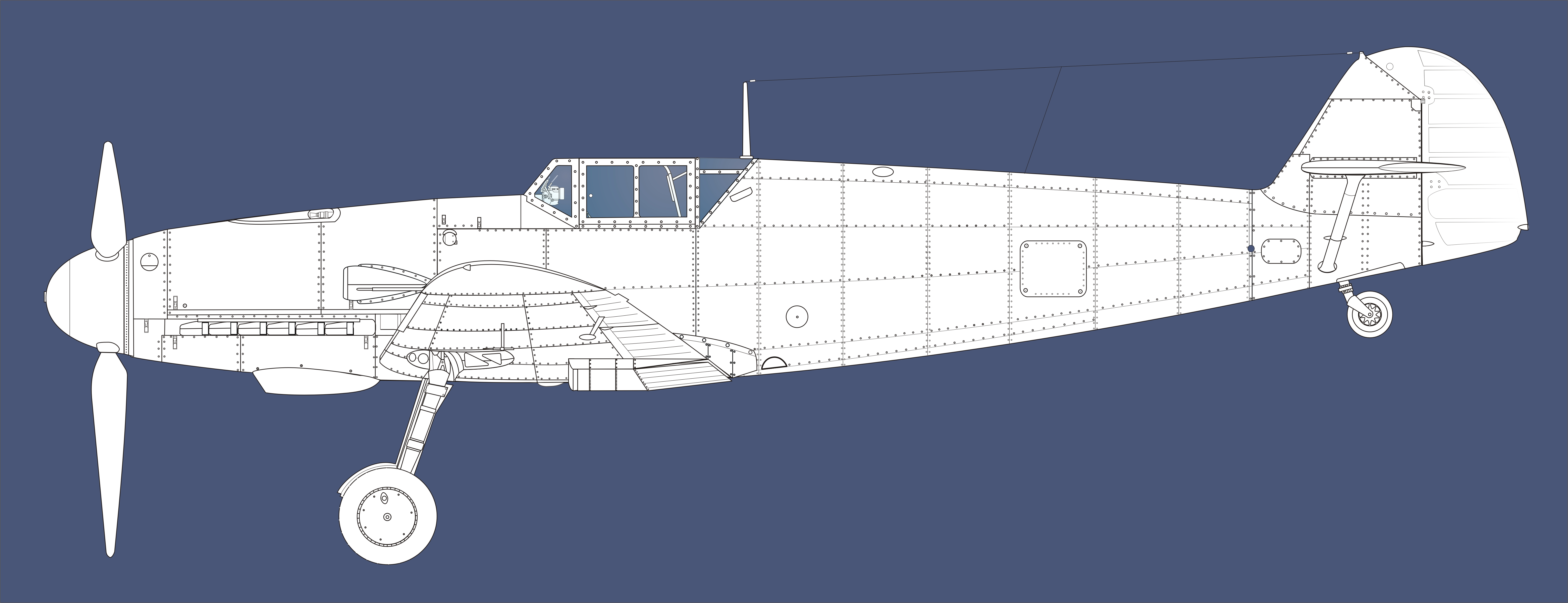
In the summer of 1943 the H-0 pre-series was launched, rebuilt from F-4/Z airframes, with a 1,350 hp DB 601 E engine and the GM-1 nitrous-oxide injection system to sustain power at altitude; armament comprised two 7.92 mm MG 17 machine guns and one 30 mm MK 108 cannon firing through the propeller hub. Despite a take-off weight of 3,800 kg, the H-0 exceeded 740 km/h at 14,000 m according to the German Wikipedia, while the English Wikipedia and historyofwar quote a maximum speed of 750 km/h at 10,100 m.
The H-0 was followed by a small H-1 series. Here the sources diverge on an essential point: historyofwar describes the H-1 as practically identical to the H-0, with DB 601 E and GM-1 and an engine-mounted MK 108 or MG 151/20, whereas the English and German Wikipedias present it as a conversion of G-5 airframes powered by a DB 605 A with GM-1. The German version adds that they carried Rb 50/30 or Rb 75/30 cameras in the fuselage behind the cockpit and were used as short-range high-altitude reconnaissance aircraft over Great Britain. The exact number of H-1s built appears in none of the sources consulted; all agree that it was a very small quantity and that the H-1 was the last version of the H series to be produced.
In early 1944 a Luftwaffe test unit operated these aircraft under combat conditions from Guyancourt, near Paris; historyofwar describes it as a fighter-reconnaissance unit. A record survives of one particular H-1, Werknummer 110073, converted into a photo-reconnaissance aircraft by Fernaufklärungsgruppe 123 in May 1944 and flown in the days immediately following the Normandy landings; one of its missions was meant to photograph the whole French coast from Cherbourg to Ouistreham from some 15 km, an altitude that proved to be just beyond the reachable ceiling. During these trials strong wing oscillations (flutter) appeared at high speed, which ended the tests.
Further versions were planned: the H-2 heavy high-altitude fighter, with two MG 17 and three MK 108 cannon in fuselage and wings; the H-3, a light high-altitude fighter with two 13 mm MG 131 and one MK 108; the H-4, an unarmed reconnaissance aircraft, all with the Junkers Jumo 213 E engine; and the H-5 with the DB 605 L and its special high-altitude supercharger. Historyofwar orders these projects somewhat differently (the H-3 as a reconnaissance version with Rb 50/30 or Rb 75/30 cameras and the H-4 as a fighter-bomber with a 500 kg bomb), but agrees that none went beyond paper. The calculated speed of the DB 605 L version, designated Bf 109 L, exceeded 760 km/h at 11,000 m.
The cancellation date also differs by source: the German Wikipedia places it in February 1944, not least because of the vibration problems encountered in service, in favour of Focke-Wulf's Ta 152 H; historyofwar states that by mid-July production was almost ready and that the RLM cancelled the project on 18 July 1944, when the Ta 152 and the Me 262 promised better results. The last studies of a high-altitude Bf 109 continued internally as the Me P.1091, on G-5 airframes with the enlarged wings and tail of the H, and the preliminary work on the Me 155 passed to Blohm & Voss as the BV 155, which reused Bf 109 components such as the outer wings. No Bf 109 H survives.
Three-view drawing
.jpg)
Multimedia
