Messerschmitt Bf 109 variant
Messerschmitt Bf 109 B
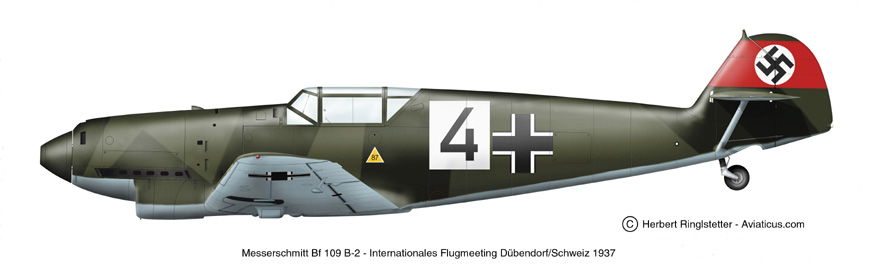
First production version of the Bf 109 (1937): Junkers Jumo 210 D engine of 670-680 PS, two-blade propeller, first wooden fixed-pitch and later metal variable-pitch (the so-called "B-2"), two or three MG 17s. It equipped JG 132 "Richthofen", shone at Dübendorf and fought with the Legion Condor in Spain.

- 341
- Units built
History
The Bf 109 B, nicknamed "Berta" after the German phonetic alphabet of the day, was the first version of Messerschmitt's fighter to reach series production. It closed the prototype phase opened by the V1 in 1935 and began the operational career of an aircraft that would become the backbone of German fighter aviation throughout the Second World War.
From competition to production order
.jpg)
The Bf 109 was born from the "Rüstungsflugzeug IV" specification drawn up in December 1933 and issued to industry in February 1934, which called for a low-wing, all-metal monoplane with retractable undercarriage at a time when the Luftwaffe's front-line fighters were still biplanes. Bayerische Flugzeugwerke was the outsider against Arado and Heinkel, but its design proved the most advanced. Comparative trials at Rechlin and Travemünde soon eliminated the Arado Ar 80 and the Focke-Wulf Fw 159, and in the extended evaluations of February and March 1936 the V2 showed itself superior to the Heinkel He 112, the favourite until then. The decisive fly-off took place at Travemünde in November 1936: the Bf 109 performed 23 left-hand spins and 21 right-hand spins followed by a dive from 23,000 feet, a display the Heinkel could not repeat. The Messerschmitt was also clearly cheaper to build, and the contract for the new front-line fighter went to Augsburg.
Even before the award the requirements changed. The Bf 109 A had been planned with two MG 17 machine guns above the engine, but by late 1936 news of the new British fighters, the Hurricane and the Spitfire, was reaching Germany and the armament was judged inadequate. A third machine gun firing through the propeller hub was added, with the intention of replacing it later with a 20 mm MG FF cannon. That engine-mounted gun, repeated in several early versions, was never popular with pilots: buried between the cylinder banks it suffered from vibration and overheating that made it jam or cook off.
Four prototypes served as the direct basis of the B series: the V4 appeared in November 1936, the V5 and V6 in December and the V8 in early 1937. The production B-1 was ready in the spring of 1937, and in April some examples were already on their way to Spain.
Technical description
.jpg)
The B-1 was powered by the Junkers Jumo 210 D, an inverted V12 introduced in 1936 with a two-speed supercharger; depending on the source its output is given as 670 PS (493 kW) or 680 PS for take-off. With a take-off weight of around 2,200 kg it reached, according to historyofwar.org, 470 km/h at about 4,000 m. Compared with the prototypes, the oil cooler left the large chin fairing and was relocated under the left wing. The initial armament comprised three 7.92 mm MG 17s, two over the cowling and one in the engine, aimed with a Zeiss C/12 reflector sight; the cowling guns had to be cocked by hand by the pilot between bursts.
The first examples, about thirty, carried a two-blade fixed-pitch wooden propeller. At that point the assembly line switched to a two-blade metal variable-pitch propeller built by Junkers under Hamilton Standard licence. German sources and the English Wikipedia agree that aircraft so equipped were unofficially known as "B-2", a designation that appears in no official document; historyofwar.org, by contrast, treats the B-2 as a sub-variant of its own, further characterised by the third, engine-mounted MG 17. In any event many B-1s were retrofitted with the metal propeller, and a small number are said to have received the direct-injection Jumo 210 G, which delivered 730 PS at 1,000 m. To test heavier armament the V8 trialled two additional machine guns in the wings, revealing the need to strengthen the wing structure, and the V9 replaced those guns with 20 mm MG FF cannon; both lines led to the C and D series. The V10 to V13 prototypes, built on B-series airframes, were used to test the Daimler-Benz DB 600 A engine.
Production
The English Wikipedia puts the number of B-1s built by Messerschmitt, Fieseler and Erla Maschinenwerke in 1937-1938 at 341; the German Wikipedia speaks of "about 350" B-series aircraft. Production gave way to the C series, which according to historyofwar.org entered manufacture in September 1937 and according to the English Wikipedia in the spring of 1938.
Entry into service and Dübendorf
The first unit to receive the new fighter, in the spring of 1937, was the II. Gruppe of Jagdgeschwader 132 "Richthofen" at Jüterbog-Damm. It was followed by I./JG 131 at Jesau, JG 134 "Horst Wessel" at Dortmund, JG 135 at Bad Aibling, JG 234 "Schlageter" at Cologne and II./JG 333 at Eger, which shared the B and C series between them. With the Berta the Luftwaffe replaced its Heinkel He 51 biplanes and acquired for the first time a realistic capacity to defend German airspace.
The aircraft's public debut came at the 4th International Flying Meeting held at the military airfield of Dübendorf, near Zurich, from 23 July to 1 August 1937. Within a large German contingent, six Bf 109s competed against aircraft and pilots from other nations and won every contest they entered: Carl Francke took the climb-and-dive event in the V7 (D-IJHA) and the speed race in the V13 (D-IPKY); Major Hans Seidemann won the Alpine circuit in the single-seat class, covering the 367 km in 56 minutes 47 seconds, and the three-aircraft patrol of Werner Restemeier, Fritz Schleif and Hannes Trautloft won its category by a wide margin. Ernst Udet had less luck: his V14, painted bright red and fitted with an experimental DB 601, failed in the race and was wrecked in a forced landing near Thun during the Alpine circuit. The performance was overshadowed by the death the previous week of flight engineer Kurt Jodlbauer, who on 17 July was unable to pull out of a dive at Rechlin in a nose-heavy B-0 (Werk-Nr. 1014) and crashed into Lake Müritz. After the return from Switzerland the V13 received a boosted DB 601 with which Hermann Wurster set the world air speed record for landplanes at 610.95 km/h on 11 November 1937.
Spain: the trial by fire

Four prototypes (V3, V4, V5 and V6) had gone to Spain in December 1936 for evaluation by VJ/88 of the Legion Condor; the V4 was destroyed on take-off on 10 December, but the others proved their worth against a Heinkel He 51 already outclassed by the Polikarpov I-15 and I-16. The first three production B-1s arrived on 14 March 1937 and were allocated to 2.J/88. The first victory by a Bf 109 B came on 6 April 1937, when Oberleutnant Günther Lützow shot down an I-15. In all, 41 B-series aircraft were shipped to Spain, 14 B-1s and 27 B-2s according to historyofwar.org, out of just under 140 production aircraft of the B, C, D and E versions that fought there until the end of the war on 1 April 1939.
The Bf 109 B proved the equal of the I-16 and superior to every other Republican fighter, and the leap in performance over the prototypes was obvious. But the engine gun kept jamming and cooking off, to the point that the field workshops of Jagdgruppe 88 usually removed it and series production soon dropped it altogether. By late 1937 the I-16 Type 10 could out-climb, out-turn and out-gun the Berta, and by the summer of 1938 the Legion Condor was running short of aircraft: 1.J/88 was down to four Bf 109s and 2.J/88 to seven. Only five Bf 109 Cs reached Spain, so the Bs fought on until the end of June 1938, when the first Ds began to appear. Of the 136 Bf 109s sent to Spain, 47, among them B-series aircraft, remained in Spanish service after the war.
Lessons and twilight
The Spanish experience was decisive for the design's evolution. The B series was not the equal of its British contemporaries, the Hurricane I and Spitfire I, and even with the third gun it was clearly under-armed; the undercarriage proved fragile and prone to collapse, and pilots used to fixed gear sometimes forgot to lower it. Take-off and landing accidents destroyed around 5 % of all Bf 109s built, some 1,600 losses. The short range was also evident from the outset. In return, Spain was where the more flexible tactics that gave German fighters their edge in 1939 were worked out.
By the outbreak of war the Berta was already a second-line aircraft: the strength returns of 2 September 1939 list 24 Bf 109 Bs with II.(J)/186 (T), the group intended for the carrier Graf Zeppelin. The bulk of the series went to the fighter schools (Jagdfliegerschulen), where it went on training pilots in the early years of the war, as numerous photographs of B-2s wearing school codes document.
Three-view drawing
.jpg)
Multimedia
-1600.webp)
-1600.webp)

