Messerschmitt Bf 109 variant
Messerschmitt Bf 109 C
The Bf 109 C "Caesar" was the third production series of Messerschmitt's fighter and the last one designed around the Junkers Jumo 210 engine. It introduced the direct-injection Jumo 210 G and a strengthened wing carrying two additional MG 17 machine guns, bringing the armament to four 7.92 mm weapons. Production began in the spring of 1938 and ended after only 58 aircraft, as the Bf 109 D and above all the Daimler-Benz-powered Bf 109 E made it obsolete almost at once. It served in Spain with the Legion Condor, with Luftwaffe fighter and night-fighter units into the early months of the war, and afterwards with the fighter pilot schools.

- 58
- Units built
History
Origins: lessons from Spain and the armament problem
The C series of the Bf 109 grew out of two simultaneous pressures. On one hand, early experience in the Spanish Civil War with the Bf 109 A and B of Jagdgruppe 88 had shown that the third machine gun mounted behind the engine and firing through the propeller hub was a constant source of trouble: it jammed and suffered cook-offs from overheating, to the point that field workshops usually removed it. On the other, the appearance of British fighters armed with eight machine guns made it obvious that two synchronised guns above the cowling were too light an armament for a modern fighter. Messerschmitt's answer was to strengthen the wing structure so that, for the first time on the Bf 109, two unsynchronised MG 17 machine guns could be fitted outside the propeller disc. The armament thus became four 7.92 mm weapons: two above the engine with 500 rounds each and two in the wings with 420 rounds each. The first aircraft equipped in this way was the V11 prototype (civil registration D-IFMO, Werknummer 1012).
The Jumo 210 G and direct fuel injection
The other novelty of the C series was its engine. The Junkers Jumo 210 G, a liquid-cooled inverted-V twelve, incorporated a direct petrol injection system developed by August Lichte, with a small plunger pump beside each cylinder driven from the crankshaft. Injection raised take-off power by about 20 PS without increasing boost, reduced fuel consumption and, above all, allowed manoeuvres under negative g without the engine cutting out, something carburettor engines of the day could not do. According to German Wikipedia the 210 G delivered 730 PS for take-off; English Wikipedia quotes 700 PS (515 kW) for the Bf 109 C installation, and the engine's own article gives 730 PS (534 kW). Junkers reserved this engine for fast aircraft such as the Bf 109 and Bf 110, and a few Bf 109 B-1s had already received it before it was standardised on the C series. As historyofwar.org notes, the C was thus the first production Bf 109 with direct injection, an advantage the Bf 109 D lost when it reverted to the carburetted Jumo 210 D and which did not reappear until the Daimler-Benz DB 601 of the Bf 109 E.
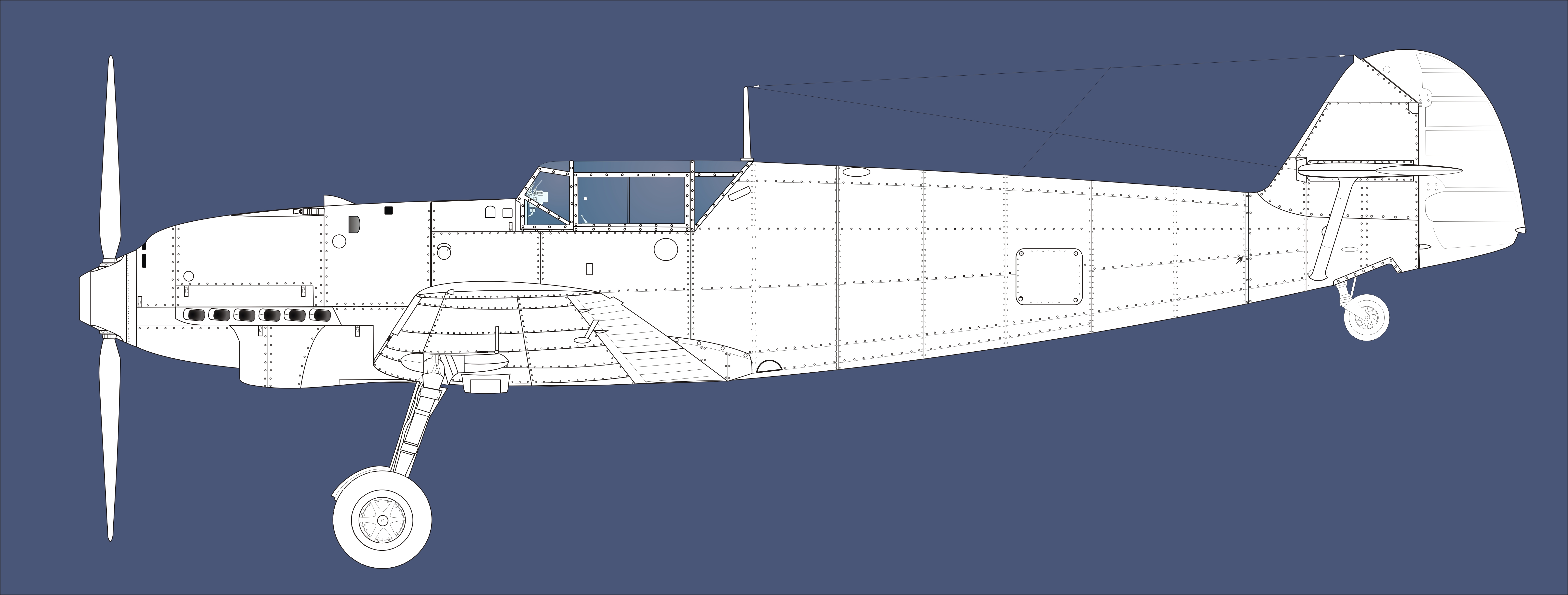
The C series also introduced a different exhaust arrangement: where the B series had flush outlets that subjected the surrounding structure to heavy thermal loads, the C carried protruding, slightly rearward-curved exhaust stubs that relieved the problem and added a small amount of thrust.
Sub-variants
The C-0s were pre-production aircraft and the C-1 the production version, with the Jumo 210 G and four MG 17s. The C-2 was an attempt to restore the central weapon: it carried a fifth MG 17 firing through the propeller hub, and once again the installation proved unreliable. The C-3 was to replace the two wing machine guns with 20 mm MG FF cannon; the trial of that installation on the V12 prototype (D-IVRU, Werknummer 1016) at the Travemünde test centre had to be abandoned because of wing strength problems, and it is not known how many C-3s, if any, were built or converted. Captions in the asisbiz archive nevertheless show aircraft identified as C-3s with JG 26 and 2./JG 71 in 1938-1939 and with the school JFS 4 in November 1941. The C-4, which would have combined the four MG 17s with an engine-mounted MG FF cannon, was never produced. In all Messerschmitt built 58 Bf 109 Cs of all versions, a figure on which the English and German Wikipedias agree; the production table drawn from Prien and Rodeike places the series between spring and late 1938.
Performance
The German Wikipedia data table for the C-1 gives a length of 8.55 m, a wingspan of 9.87 m, a wing area of 16.2 m², a height of 2.60 m, a take-off mass of 2,310 kg, a maximum speed of 440 km/h at 4,000 m and a service ceiling of 9,500 m, with a 337-litre fuel tank against 235 litres on the A and B series. The prose of the same source quotes 470 km/h at 4,000 m instead, and historyofwar.org gives 292 mph (about 470 km/h) at 14,765 ft, 261 mph at sea level, a cruising speed of 214 mph at 10,000 ft, a range of 405 miles and a ceiling of 27,560 ft. The lower figure in the table probably corresponds to a different engine rating, but the sources consulted do not clarify the point.
Service in Spain
Like its predecessors, the C series was tested in combat in the Spanish Civil War. According to historyofwar.org five C-1s reached Spain in 1938 and were numbered 6-46 to 6-50. The asisbiz photo archive documents 6-47 of 2.J/88 flown by Wolfgang Schellmann, 6-48 of the same Staffel after a forced landing in February 1938, 6-49 "Jaguar" and 6-50 of 1.J/88, while German Wikipedia illustrates 6-47 with 2.J/88 in spring and summer 1938 and a C-1 of the Stab of Jagdgruppe 88 at La Cenia. A photograph taken at Recajo (Logroño) in 1939 shows 6-47 alongside a B-2 and an E-3, proof that the Cs survived to the end of the conflict.
Luftwaffe service
In Germany the Bf 109 Cs were spread among several fighter units during 1938 and 1939. Photographs in the asisbiz archive place them with JG 26 (a C-3 "Yellow 12" during gun calibration tests in October 1938), with 2./JG 71 at Friedrichshafen, with 2./JGr 102 over Poland, with I./JGr 137 in August and September 1939 and still with 5./JG 52 at Strassberg in March 1940. Some Luftwaffe night-fighter Staffeln, such as Johannes Steinhoff's 10.(Nacht)/JG 26, were flying Jumo-engined Bf 109s in the winter of 1939-1940; at the Battle of the Heligoland Bight on 18 December 1939, however, English Wikipedia credits that Staffel with Bf 109 Ds rather than Cs, and the sources consulted do not confirm that C models took part in that action. The large-scale arrival of the Bf 109 E from late 1938 quickly relegated the C, together with the D, to second-line duties.
Withdrawal to the schools
From 1939 the Cs passed to the Jagdfliegerschulen, where they served to train new fighter pilots. The asisbiz archive records C-1s with JFS 5 and other training units in 1939, a C-1 coded SG+FR damaged in a landing mishap in May 1941 with a pilot-checking unit, and the C-3 "White 30" of 4./JFS 4 over Mönchengladbach on 6 November 1941. Several C-1s coded EI+AG and GA+DE also appeared in a German propaganda film portraying the French air force. No Bf 109 C is known to survive.

Three-view drawing
.jpg)
Multimedia


