Messerschmitt Bf 109 variant
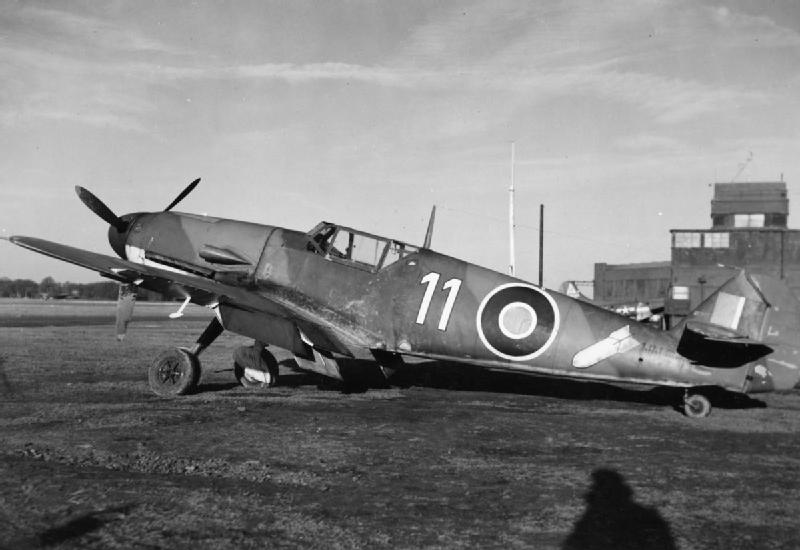
Messerschmitt Bf 109 F-4
Definitive and most numerous Bf 109 F version: 1,350 PS DB 601 E engine and MG 151/20 engine cannon. Regarded by many of its pilots as the best of all Bf 109 variants.
-800.webp)
- 1,841
- Units built
History
The Bf 109 F-4 was the culmination of the F-series ("Friedrich") and, in the eyes of many of its pilots, the high-water mark of the whole Messerschmitt Bf 109 lineage. The F-series had grown out of the fighter's second major redesign in 1939–40: new wings with semi-elliptical tips and a reduced area of 16.05 m², shallower wing radiators set further back and regulated by thermostat, a smoother, rounder cowling behind a large spinner adapted from the Me 210, an elbow-shaped supercharger intake, a smaller rudder, strut-less tailplanes and main undercarriage legs raked forward by six degrees. All armament was concentrated in the nose: two synchronised 7.92 mm MG 17 machine guns above the engine and a Motorkanone firing through the propeller hub.
The engine intended for the series from the outset was the Daimler-Benz DB 601 E, developed from February 1940 and tested in the V22 prototype. Because it was not yet available in numbers, the first production versions (F-1 and F-2) flew with the 1,175 PS DB 601 N, which required 100-octane C3 fuel. The F-4 was the first mass-produced model to receive the DB 601 E, rated at 1,350 PS for take-off and driving a VDM 9-12010 propeller with broader blades for better altitude performance; to feed the engine's greater appetite for air, the slightly enlarged supercharger intake trialled on the F-2/Z prototypes was adopted. Paradoxically, the DB 601 E ran on standard 87-octane B4 fuel despite its higher output. When it entered service the engine was restricted to 1,200 PS at 2,500 rpm; the full 1,350 PS rating was not cleared for operational use until February 1942. With the initial restriction the F-4's maximum speed was 635 km/h at rated altitude; once full power was released it rose to 659 km/h at 6,200 m.

The other major change was the armament: the 15 mm Mauser MG 151 engine cannon of the F-2 gave way to the harder-hitting 20 mm MG 151/20 with 200 rounds. Pilot protection also improved, with 6 mm head armour, a readily removable armoured windscreen and new fuel tanks, and from around 1942 F-series aircraft were retrofitted with additional layered light-alloy armour behind the pilot and the tank. The light armament of the F-series divided the aces: Adolf Galland thought it inadequate for the average pilot and Walter Oesau preferred to keep flying a Bf 109 E, whereas Werner Mölders saw the single centreline cannon as an improvement. Once the early tail-unit failures of the first F-1s had been cured, pilots generally agreed that the F-series was the best-handling of all Bf 109s.
The first F-4s reached front-line units in June 1941, on the eve of the invasion of the Soviet Union, and production lasted exactly one year, from May 1941 to May 1942, with 1,841 aircraft of all F-4 sub-variants according to English Wikipedia; German Wikipedia gives partial per-factory figures that do not add up to the same total. It was by far the most-produced version of the F-series. Among the sub-variants, the F-4/R1 was fitted at the factory with the attachment points and wiring for a faired gondola under each wing housing an MG 151/20 cannon with 135 rounds; the 240 built came from Wiener Neustädter Flugzeugwerke (WNF) in the first quarter of 1942, and the installation was later standardised as a field kit for the G and K series. The F-4/Z was a high-altitude fighter with GM-1 nitrous-oxide injection: English Wikipedia puts its production at 544 in the first quarter of 1942, German Wikipedia at 861, a discrepancy this text does not resolve. The F-4 trop, with sand filter and desert survival equipment, was built by Erla: 576 aircraft in the first half of 1942. Two dedicated reconnaissance versions were also built by Erla in very small numbers, the F-4/R2 with an Rb 20/30 camera (five aircraft) and the F-4/R3 with an Rb 50/30 camera (36 aircraft), both without engine cannon and with the camera replacing the radio. Equipment kits also provided a 300-litre drop tank and an ETC rack for one 250 kg bomb or four 50 kg bombs, with which F-4/B fighter-bombers raided across the English Channel.
The F-4 fought on every front in 1941 and 1942: over the Channel with JG 2 and JG 26, in the East with the Geschwader of the summer offensive, in the Arctic with JG 5 and in North Africa, where the F-4/Trop of JG 27 was the mount of Hans-Joachim Marseille against the Desert Air Force. Mölders, Wilhelm Balthasar and Marseille are among the aces who flew it with great success. It also served with Axis allies and volunteers: the Spanish Escuadrilla Azul was equipped with F-4s and listed as 15.(span.)/JG 51 at Orel; the Royal Hungarian Air Force received 66 F-4s, and its first fighter unit to convert to the type, subordinated to JG 52, flew its first sorties on 15 October 1942; Romania received five, Spain fifteen and Switzerland two. Several were captured by the Allies: the JG 27 F-4/Trop "Yellow 2" taken at Derna in December 1941 and flown out just before the Germans retook the airfield, another captured at Martuba by No. 3 Squadron RAAF during Operation Crusader, and a pair from III./JG 3 that force-landed out of fuel behind Soviet lines on 29 May 1942; "Yellow 9" (W.Nr. 7640) was handed over by the USSR to the United States in March 1943.
The F-4 was also the direct basis of what followed: the DB 605 A of the Bf 109 G was a development of the DB 601 E with greater displacement and compression, the G-0 pre-production batch kept the DB 601 E, the early Gustavs retained its armament and clean lines, and F-4/Z airframes were rebuilt into the high-altitude H-0. No F-4 remains airworthy, but several examples and wrecks survive, mostly recovered from the northern fronts: W.Nr. 10132, displayed at the Canada Aviation and Space Museum at Rockcliffe and assigned to Horst Carganico in 1942; W.Nr. 7108 of 9./JG 5 at the Finnish Air Force Museum in Tikkakoski; an F-4 trop of 7./JG 53 at the South African National Museum of Military History in Johannesburg; and numerous JG 5 and JG 54 wrecks held by private restorers in the United States and the United Kingdom.
Multimedia



%2C_surviving_airframe%2C_2011-1600.webp)
