Messerschmitt Bf 109 variant
Messerschmitt Bf 109 G-14
1944 production standard that consolidated the late G-6 improvements: DB 605 AM engine with MW 50 injection, Erla Haube canopy and tall wooden tail. Second most numerous Bf 109 variant.
_2016-04-30_Andre_Gerwing_Collection_ID_011584-1600.webp)
- 5,500
- Units built
History
Origin: standardising the Gustav
The Bf 109 G-14 was born of industrial urgency rather than technical ambition. Through 1943 and early 1944, G-6 production had splintered into a tangle of factory fits, field kits (Rüstsätze) and conversions (Umrüst-Bausätze): old framed or clear-view canopies, metal or wooden tails, engines with or without injection, differing radio sets. That dispersion hampered decentralised mass production and repair at the very moment the defence of the Reich demanded the maximum number of fighters. The Jägerstab, the body created in 1944 under the Fighter Emergency Programme (Jägernotprogramm) to drive up fighter output at the expense of bombers, decided to gather the improvements that were trickling unevenly into the G-6 line into a single standard type.
The immediate trigger was the delay of the G-10. That version was to use the new DB 605 D, but the engine was late, and the G-14 was conceived as a stopgap: a late G-6 airframe with unified equipment, available at once. According to the sources the variant was ready in June 1944 and reached the invasion front over France in July 1944. The G-10, despite its designation, did not enter service until November 1944, and from then on it displaced the G-14 on the Erla, WNF and Messerschmitt Regensburg lines. Some early G-10s even carried two data plates, one stamped G-14, because the airframes had originally been allocated to G-14 assembly before being diverted.
The standardisation effort, the sources concede, failed in its stated aim: the profusion of sub-variants did not go away. But the package offered a real improvement in combat performance over the production G-6.
What changed from the G-6
At the heart of the G-14 was the Daimler-Benz DB 605 AM, the DB 605 A with the MW 50 water-methanol injection system fitted as a factory standard. With injection the take-off rating rose to 1,800 PS (1,324 kW), against 1,475 PS for the basic DB 605 A, and the engine gave 1,700 PS at 4,000 m. This special emergency rating (Sondernotleistung) was obtained at 1.7 ata and 2,800 rpm and was limited to ten minutes of continuous use. The system itself was not new: from early 1944 G-5s and G-6s had been retrofitted with MW 50 kits, chiefly the G-6/U2s that already carried the rear tank and plumbing intended for GM-1, and in May 1944 an order for 250 conversion kits was placed before the G-14 standard was accepted. The formal difference in the G-14, as noted in German type datasheets, was that the MW 50 fluid was forced from the rear fuselage tank by compressed air tapped from the supercharger rather than from the pressurised bottles used on converted G-6s. The DB 605 AM initially required 100-octane C3 fuel together with injection; in mid-1944 standard 87-octane B4 fuel with MW 50 was authorised, and that combination became general towards the end of the year.
The package also included the three-panel Erla Haube clear-view canopy, replacing the old heavily framed hood with its fixed rear section; the enlarged fin and rudder of wooden construction, with an inset balance, which improved high-speed stability and ground handling at the cost of extra weight and a nose counterweight; a shortened aerial mast; and the FuG 16ZY radio with the Y-Verfahren guidance procedure. Armament was unchanged from the G-6: one 20 mm MG 151/20 engine-mounted cannon and two 13 mm MG 131 machine guns over the engine, with their characteristic bulged fairings (Beulen). The sources also note the growing use of plywood for less vital parts: the tall tail itself, the pilot's seat or the instrument panel.
By the official datasheet the G-14 reached 573 km/h at sea level and 665 km/h at 5,000 m. A flight trial reproduced in the Kurfürst archive, flown with MW 30 rather than the service MW 50 and with the aircraft in clean fighter configuration (one MG 151 and two MG 131, no gondolas), gave 568 km/h at sea level and 652 km/h at 4,900 m, in reasonable agreement with the datasheet and slightly lower, probably because of the weaker methanol mix.
Sub-variants
- **G-14/AS**: high-altitude fighter with the DB 605 ASM, the engine with the large supercharger taken from the DB 603 plus MW 50 injection, which raised full-throttle height to about 7.8 km. It reached 590 km/h at sea level and 680 km/h at 7,500 m. The larger supercharger required a redesigned cowling that absorbed the MG 131 fairings into a continuous, asymmetrical surface enlarged on the port side; the G-14/AS therefore lacked the Beulen of the standard G-14. Spanish-language sources add the FuG 16ZY aerial under the port wing and a larger oil-pump air intake. It was a common sub-variant and, according to the German Wikipedia, a numerous one, unlike the scarce G-5/AS and G-6/AS. - **G-14/U4**: as the G-14 but with the 30 mm MK 108 engine cannon in place of the MG 151/20. - **G-14y** and **G-14/ASy**: command fighters with extended radio equipment. - **G-14/R2**: a few reconnaissance fighters, cited by the German source.

The G-14 accepted the same field kits as the G-6 (R1, R2, R3, R6) and could carry the Werfer-Granate 21 rocket tubes under the wings, unofficially known as BR 21 on the G-5, G-6 and G-14.
Production
A cautious estimate based on the available records puts the number of G-14s and G-14/ASs built at about 5,500, making the G-14 the second most numerous Bf 109 variant after the G-6. The English Wikipedia table breaks this down as more than 5,500 G-14s built between July 1944 and February 1945 and about 1,373 G-14/ASs between July 1944 and March 1945. The exact figure is hard to pin down: the German source explains that monthly delivery reports count fewer G-14s than the production programmes because many G-14s were delivered in 1944 and 1945 as trainers without the MW 50 installation, which left them in practice at G-6 equipment standard and had them counted as such. That also explains why G-6 deliveries were still being recorded in February 1945.
Service
The G-14 went into action in the summer of 1944 over France and, alongside the G-6 and later the G-10, became the standard fighter of the defence of the Reich in the final phase of the war. According to the Spanish Wikipedia, G-14s equipped JG 1, JG 3, JG 7, JG 11, JG 27, JG 53 and JG 300, and G-14/ASs served with JG 4, JG 6 and JG 27. The German source sums up its position bluntly: by the time it was leaving the lines in large numbers at the end of 1944 it could no longer fully match the newest Allied fighters; it was inferior to the G-10 and K-4, but it was available, and so it was built in quantity. Like the G-6 and G-10 it remained in front-line service until the end of the war.

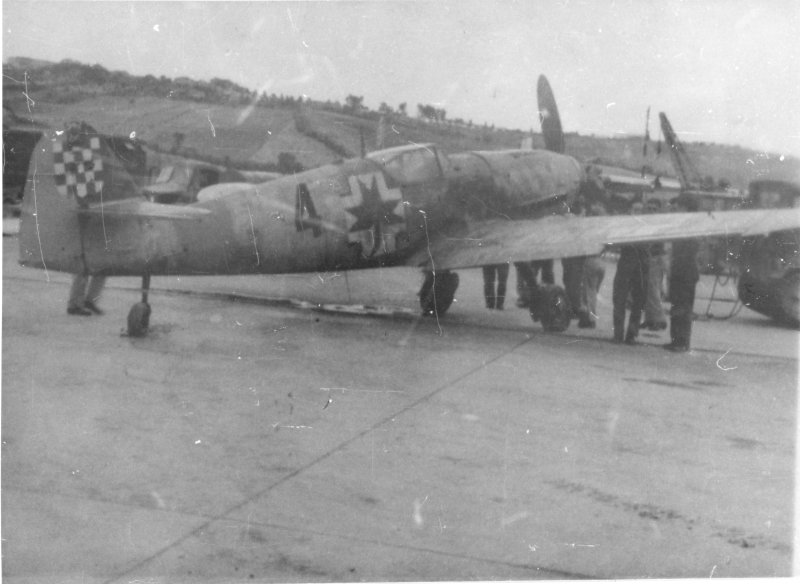
Abroad, Hungary received some 250 Bf 109 G-10s and G-14s in late 1944; its 101st fighter regiment was reorganised in November 1944 on these types and, after collecting new aircraft at Wiener Neustadt at the end of December, fought mainly against the Soviet air force. Croatia received a small number of G-14s up to the autumn of 1944, and Italy's Aeronautica Nazionale Repubblicana at least 76 G-10s and G-14s. Finland, by contrast, received only G-2s, G-5s and G-6s plus one G-8, never the G-14. Several examples ended up in Allied hands: a Croatian G-14, "Black 10", deserted to Italy and landed at Jesi, where it was taken over by 3 Wing SAAF; another, "Black 4", passed to the USAAF, then to the Italians and finally to the Polish Air Force; and the British captured a G-14 at the end of 1944 at Gilze-Rijen in the Netherlands.
After the war
In 1946 Czechoslovakia restarted the Bf 109 line at the Avia works in Prague using the original jigs and a substantial number of uncompleted airframes. Between 1946 and 1949 about 550 were completed as the Avia S-99, essentially a G-14, and as the Avia S-199, the version with the Junkers Jumo 211 F engine forced by the loss of the DB 605 stock in a warehouse fire, with notoriously poor handling.
Survivors
Few G-14s survive. Werknummer 784993, "White 13" of IV./JG 53, is listed at the Aviaticum in Wiener Neustadt; the same survivors list also records it as a G-14/AS at the aviation museum in Košice, Slovakia, a duplication the sources do not resolve. Werknummer 610937 (civil registration N109EV), a former G-10/U4 that served with the Bulgarian and Yugoslav air forces as number 9644, moved from the Evergreen Aviation Museum in Oregon to the American Heritage Museum at Stow, Massachusetts.
Multimedia


%2C_Hangar_10%2C_Heringsdorf%2C_2016-1600.webp)
