Messerschmitt Bf 109 variant
Messerschmitt Bf 109 A
First version of the Bf 109: the V1-V4 prototypes of the 1935-1936 fighter competition and the A-0 pre-production batch with a Junkers Jumo 210 engine and two MG 17 machine guns. Combat-tested with the Legion Condor in Spain from December 1936, it bridged the gap to series production of the Bf 109 B.

- May 28, 1935
- First flight
- 22
- Units built
History
The Bf 109 A was the first version of Messerschmitt's fighter and, in practice, the link between the prototypes of the 1935-1936 competition and the series production that began with the Bf 109 B. The letter A covers the first Versuchsmuster (V1 to V4) and the A-0 pre-production aircraft built by the Bayerische Flugzeugwerke at Augsburg.
Origins and prototypes
.jpg)
The Bf 109 grew out of the specification for an all-metal low-wing monoplane fighter with retractable undercarriage (the so-called Rüstungsflugzeug IV) drawn up by the RLM in December 1933 and issued to industry in February 1934. Arado and Heinkel were the established fighter suppliers; Willy Messerschmitt's Bayerische Flugzeugwerke was the outsider, with a poor relationship with the Luftwaffe leadership, which until then had only given it a contract to licence-build twelve Heinkel He 45s. Messerschmitt answered with the most advanced design: an all-metal stressed-skin structure, a fully enclosed cockpit and the narrowest fuselage able to take the two most powerful V-12 engines then under development in Germany, the Junkers Jumo 210 and the Daimler-Benz DB 600. Focke-Wulf entered late with the Fw 159, a parasol-wing monoplane.
Since neither the Jumo nor the DB 600 was ready when the first prototype left the shop, the RLM obtained four British Rolls-Royce Kestrel VI engines by trading Rolls-Royce a Heinkel He 70 for use as an engine test-bed; two of them went to Messerschmitt. The Bf 109 V1 (Werknummer 758, civil registration D-IABI), with a Kestrel rated at 695 PS for take-off and a two-blade fixed-pitch wooden propeller by Schwarz, began taxiing trials in the spring of 1935 and made its first flight on 28 May 1935 at Augsburg-Haunstetten with Hans-Dietrich 'Bubi' Knoetzsch at the controls (the English Wikipedia dates the flight to 29 May; historyofwar.org places it in September). After some four months of factory testing, the aircraft was delivered in September to the Luftwaffe test centre at Rechlin. Knoetzsch was dismissed shortly afterwards: by one account, for landing the V1 at Dessau, home of the rival Junkers, on the way to Rechlin; by another, because of a breakage of the V1 that threatened to set the programme back. In the comparative trials at Travemünde the V1, at a take-off weight of 1,900 kg, reached 470 km/h at 3,300 m and a climb rate of 13.7 m/s near the ground.
The second prototype, V2 (D-IILU, Werknummer 759), already had the 610 PS Jumo 210A intended for the series and all the provisions for two 7.92 mm MG 17 machine guns with 500 rounds each. Hermann Wurster, Knoetzsch's successor as test pilot, first flew it on 12 December 1935 and ferried it to Travemünde on 21 February 1936, where he demonstrated it successfully over the following days. On 1 April, during an endurance test, the forward section of the canopy tore away from pilot Trillhase; without goggles and almost blind, he overturned in the ensuing forced landing, escaping with minor injuries, but the aircraft had to be scrapped. The armament planned for the V2 was finally fitted to the V3 (D-IOQY, Werknummer 760), with a mechanical cocking device, which became the pattern aircraft for the A-0 series.
The competition
.jpg)
The comparative trials brought together the Arado Ar 80 V3, the Focke-Wulf Fw 159 V3, the Heinkel He 112 V4 and the Bf 109 V2; the He 112 arrived first, in early February 1936, and the rest followed by the end of the month. The Arado, which turned up with a fixed undercarriage because of delays with its retractable gear, was soon eliminated; the Fw 159 could not compete with the other two. The He 112 was the favourite of the Luftwaffe leaders and, initially, of the test pilots, thanks to its wide-track undercarriage, better visibility and lower wing loading, but it was 18% heavier and its thick wing had been reworked at the last minute, so the V4 could not be demonstrated in accordance with the commission's rules. The smaller, lighter Bf 109 was 30 km/h faster in level flight and superior in the climb and the dive, and its pilot's demonstration of spins, dives, flick rolls and tight turns, with the aircraft under full control throughout, won the commission over. In March 1936 news reached Berlin that the Supermarine Spitfire had been ordered into production; on 12 March the RLM issued the document 'Bf 109 Priority Procurement' ordering the type into production and ordered ten pre-production aircraft from each of the two finalists while Heinkel radically redesigned the He 112. The V1 made its public debut during the 1936 Berlin Olympics. The final fly-off took place at Travemünde in November 1936: the Bf 109 performed 23 left-hand spins and 21 right-hand spins followed by a dive from 23,000 feet, a sequence the Heinkel could not repeat; it was also considerably cheaper to build.
The A-0 pre-production batch and its armament
The armament planned for the Bf 109 A was two MG 17s above the engine, firing through the propeller arc. By the end of 1936 rumours were reaching Germany about the new British Hurricane and Spitfire, each with eight 7.7 mm machine guns, and the RLM's Technisches Amt judged the Bf 109 A's armament inadequate. Experiments were carried out with a third machine gun firing through the propeller shaft, which was eventually to be replaced by a 20 mm MG FF cannon; this engine-mounted weapon, repeated in several early versions, was never popular: buried between the cylinder banks, it suffered from overheating and vibration. The V4 and some A-0s had the 640 PS (471 kW) Jumo 210B driving a two-blade fixed-pitch propeller; production switched to the 670 PS (493 kW) Jumo 210D as soon as it became available, an engine with the same gearing but a two-speed supercharger that improved take-off power and altitude performance. The A-0s were not uniform: the ventilation holes and slats for the engine, cockpit and machine guns changed, and the position of the oil cooler was moved several times to cure overheating. According to RLM documentation, 22 aircraft were ordered and delivered, with the V4 as the A-series prototype; historyofwar.org, by contrast, speaks of ten pre-production aircraft per finalist, so the exact number of 'Antons' depends on which prototypes are counted. The V4 appeared in November 1936, the V5 and V6 in December and the V8 in early 1937; historyofwar.org already treats them as B-series prototypes.
Spain

The Legion Condor, whose creation was made public on 7 November 1936, had started the war with Heinkel He 51 biplanes that by late 1936 were outclassed by the Soviet-supplied Polikarpov I-15 and I-16. In December 1936 the prototypes V3, V4, V5 and V6 (together with the He 112 V3) were shipped to Spain for evaluation by the experimental fighter Staffel VJ/88; the V4 was destroyed while taking off on 10 December, but the remaining aircraft proved their worth. The V3 flew from Seville in December 1936 with the tactical code 6-1 and Hannes Trautloft at the controls, who claimed an I-16 on 8 December 1936; Paul Rehahn's 6-2 was lost in an accident on 11 February 1937, and the V5 (Werknummer 879) served as 6-3 with Henning Strümpell and underwent major maintenance at Tablada in early 1937. The first unit to fly the 109 was Günther Lützow's 2.J/88, which suffered several landing accidents until its pilots grew used to the narrow-track undercarriage. The first three production B-1s arrived on 14 March 1937 and the type's first victory went to Lützow on 6 April 1937 against an I-15.
Many A-0s served with the Legion Condor and were often misidentified as B-series aircraft; they probably wore the codes 6-1 to 6-16. Period photographs show, among others, Guido Höness's 6-4, Herbert Ihlefeld's 6-6, Norbert Flegel's 6-7 at La Albericia (Santander) in August-September 1937, Rolf Pingel's 6-11, Hermann Stange's 6-12 being salvaged after a landing mishap at Santander and Otto Polenz's 6-15 at Bujaraloz. That 6-15, which incorporated several improvements from the Bf 109 B programme and had been prepared for a variable-pitch propeller that had not yet been fitted, ran out of fuel and landed behind Republican lines: the English Wikipedia dates the event to 11 November 1937 in its variants article and to 4 December 1937 in its operational history article. The aircraft, captured intact, was later transferred to the Soviet Union for close examination.
Assessment
The Spanish experience was decisive for the later development of the type. The Anton and its immediate successors were clearly under-gunned compared with their British contemporaries, and the undercarriage proved a weakness, both because it tended to collapse under stress and because pilots trained on fixed-gear aircraft sometimes forgot to lower it; take-off and landing accidents destroyed around 5% of all Bf 109s built. Yet the basic design was sound: with more power and heavier armament, the formula introduced by the Bf 109 A remained effective for most of the Second World War.
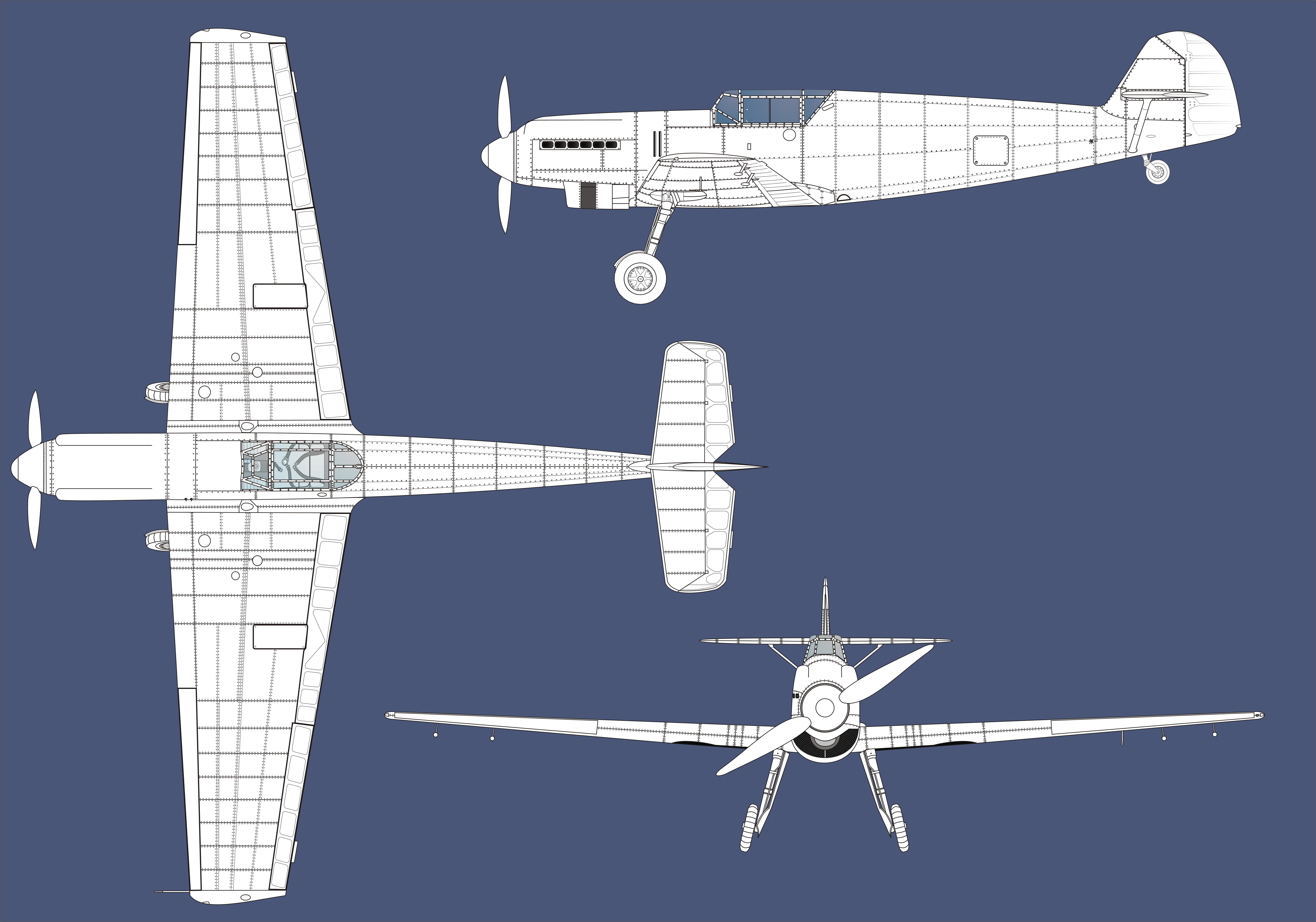
Three-view drawing
Multimedia
-1600.webp)
-1600.webp)
