Family: Falcon · SpaceX
Falcon 9
Launch statistics
- 683
- Launches (as of August 30, 2026)
- 71
- Successes
- 2
- Failures
- 97.3 %
- Success rate


-1600.webp)


-1600.webp)

-1600.webp)

-1600.webp)
-1600.webp)
-800.webp)

-1600.webp)


-1600.webp)


-1600.webp)

-1600.webp)
-1600.webp)
-1600.webp)
_de_un_Falcon_9_con_Crew_Dragon_hacia_la_rampa%2C_misi%C3%B3n_Crew-9-1600.webp)


-1600.webp)

-1600.webp)


-800.webp)

-1600.webp)


-1600.webp)
The Falcon 9 is the launcher that rewrote the rules of space access: a two-stage rocket burning RP-1 kerosene and liquid oxygen, whose first stage comes back, lands upright and flies again — something the industry considered economically impossible until SpaceX made it routine. It was born from NASA's commercial programme of the mid-2000s, when the agency chose to buy transportation from private companies rather than design its own rockets. SpaceX, coming off the small Falcon 1, answered with a nine-engine launcher that debuted on 4 June 2010 and that the company developed for roughly US$300 million, against the US$3.6 billion NASA reckoned the same rocket would have cost under traditional cost-plus contracting. On 21 December 2015 it achieved the unprecedented: setting an orbital rocket's first stage back down on solid ground. Reuse has not been an experiment since — with landings on autonomous drone ships at sea, boosters accumulating as many as 36 flights, and a launch cadence without precedent in history. The payload fairing is recovered and reflown as well; the second stage is not, an ambition SpaceX abandoned in late 2014 once it became clear that a heat shield and recovery hardware would eat the payload. The rocket has gone through five major revisions — v1.0, v1.1, Full Thrust (or Block 3), Block 4 and Block 5 — growing from 8,500 kg to more than 22,800 kg to low Earth orbit in expendable configuration. The current Block 5 has flown since May 2018 and is certified to carry crew, with nine Merlin 1D engines delivering 7,607 kN at sea level. Today the Falcon 9 is the workhorse of Western space access: it has carried astronauts to the International Space Station aboard Crew Dragon since 2020, deploys the Starlink constellation, flies dedicated rideshare missions with dozens of small satellites, and had logged 668 successes in 671 full missions — a 99.6% record — as of 30 July 2026.
Related events
- First flight of the Falcon 9 (v1.0)
- First Dragon mission to the ISS (COTS Demo Flight 2)
- Falcon 9 failure on the CRS-7 mission
- First successful ground landing of a first stage
- First landing of a first stage on a droneship
- Falcon 9 explosion during the AMOS-6 static-fire test
- First reflight of a recovered first stage (SES-10)
- Debut of the Falcon 9 Block 5
- First batch of Starlink satellites
- First crewed flight of the Falcon 9 (Demo-2)
- First Transporter rideshare mission
Falcon 9 in the news
The American aerospace company SpaceX launched the Falcon 9 rocket on Thursday carrying the USSF-481 mission from Space Launch Complex 4E (SLC-4E) at the Space Force Base…
.jpg)
The launch will use a Falcon 9 rocket to carry a secret military payload from Vandenberg Space Force Base in California The post SpaceX launches secret US military mission with…
The exhaust plumes of a SpaceX Falcon 9 rocket carrying the company’s Dragon spacecraft are seen illuminated by sunlight against the predawn sky during the launch of NASA’s SpaceX CRS-35 mission…
.jpg)
Sunlight illuminates the exhaust plumes of a SpaceX Falcon 9 rocket carrying the company’s Dragon spacecraft on Oct. 13, 2026. This visual phenomenon is known as a “jellyfish”; it happens near…
.jpg)
This week features a relatively quiet launch manifest, with SpaceX’s workhorse Falcon 9 comprising much… The post Launch Preview: Falcon 9, ZhuQue-2E to launch during quiet week appeared first on…

Powerplant
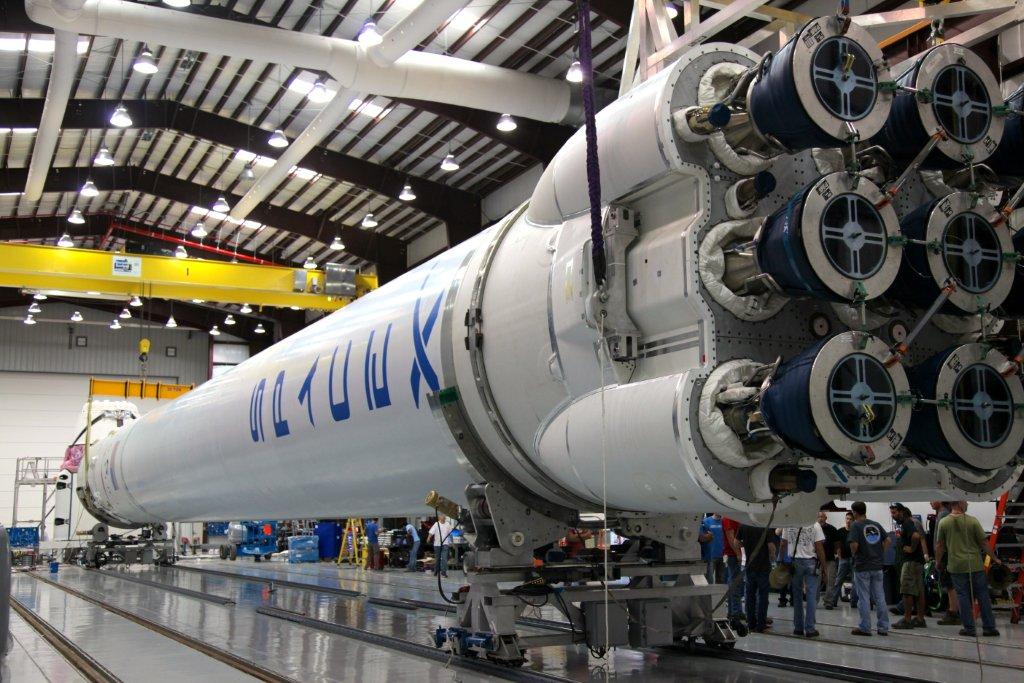
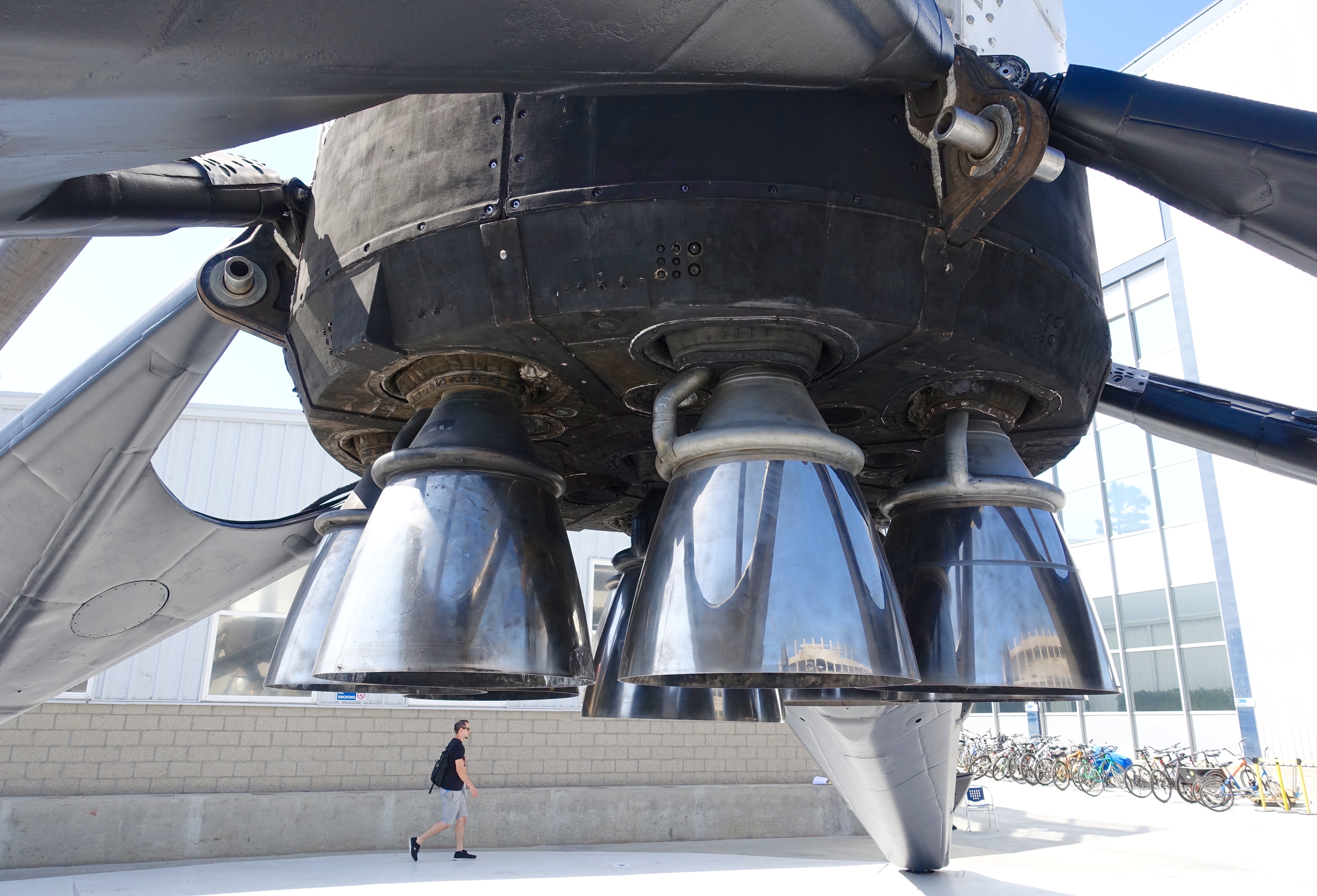
The Falcon 9 Block 5 burns the same propellant combination in both stages: refined kerosene (RP-1) as fuel and liquid oxygen (LOX) as oxidiser. Since the Full Thrust version both are loaded cryogenically chilled so as to densify them —more mass fits in the same tank volume—, a change that on its own allowed thrust to rise by 17 %. The tanks are made of aluminium-lithium alloy, the LOX tank of monocoque construction and the fuel tank of skin-and-stringer design. The first stage carries nine Merlin 1D engines arranged in the «Octaweb» pattern. Each produces 854 kN, so the stage delivers 7,607 kN at sea level and 8,227 kN in vacuum, with specific impulses of 283 s and 312 s and a nominal burn time of 162 seconds. The Merlin is a fuel-rich open-cycle gas-generator engine: a pintle injector —inherited from the Apollo Lunar Module descent engine— and a single-shaft, dual-impeller turbopump feed a regeneratively cooled chamber. Ignition is not electrical: a pyrophoric mixture of triethylaluminium and triethylborane (TEA-TEB) is injected and burns spontaneously on contact with the oxidiser. Each engine is governed by three redundant voting computers that check one another, and the stage is designed with engine-out capability, able to tolerate the loss of one engine in flight. Attitude control during ascent comes from gimballing the Merlins themselves, whose nozzles steer pitch, yaw and roll; during coast phases and the booster's descent, nitrogen gas thrusters and deployable grid fins take over. The second stage carries a single Merlin Vacuum (MVac), a variant of the 1D with a much larger exhaust section and expansion nozzle: 981 kN of thrust, 348 s of specific impulse, a nominal burn time of 397 seconds and a propellant load of 92,670 kg. The engine can throttle down to 39 % of its maximum thrust (360 kN) and is designed to relight in orbit —the igniter propellant lines were insulated to better support in-space restart after long coast phases—, which allows it to circularise the orbit, reach geostationary transfer orbit or deorbit the stage. Its attitude control combines engine gimballing with nitrogen gas thrusters.
History
Falcon 9 debuted on June 4, 2010 and transformed access to space: in December 2015 it achieved the first propulsive landing of an orbital first stage, and reuse has been the family norm ever since.
Origin
SpaceX announced Falcon 9 in October 2005, before it had reached orbit with the small Falcon 1, promising a first launch in the first half of 2007; that flight would not happen until 2010. The company had originally planned an intermediate step, the Falcon 5, and dropped it to go straight to a nine-engine launcher. The family name comes from the Millennium Falcon of the Star Wars films.
.jpg)
The decisive push came from NASA. The commercial cargo programme — the COTS agreement signed in 2006, structured as a Space Act Agreement "to develop and demonstrate commercial orbital transportation service" — funded both the rocket and the Dragon capsule through milestone payments: US$278 million for three demonstration flights, later raised to US$396 million. In 2008 SpaceX also won a Commercial Resupply Services contract worth US$1.6 billion for a minimum of twelve missions to the International Space Station, payable only once the demonstrations were complete. The agency's bet on buying transportation rather than owning rockets proved cheap: in 2011 SpaceX put v1.0 development at about US$300 million, while NASA estimated it would have spent US$3.6 billion the traditional way, and an agency report reckoned roughly US$4 billion against US$1.7 billion for a "more commercial" approach. In 2014 SpaceX disclosed combined Falcon 9 and Dragon costs of US$396 million from NASA plus over US$450 million of its own.
Configuration and architecture
Falcon 9 is a two-stage vehicle burning liquid oxygen and rocket-grade kerosene (RP-1) in both stages. The first carries nine Merlin 1D engines in the arrangement SpaceX calls Octaweb; the second, a single Merlin 1D Vacuum with a long or short nozzle. Ignition uses a pyrophoric mixture of triethylaluminium and triethylborane (TEA-TEB) that lights on contact, with no spark needed.
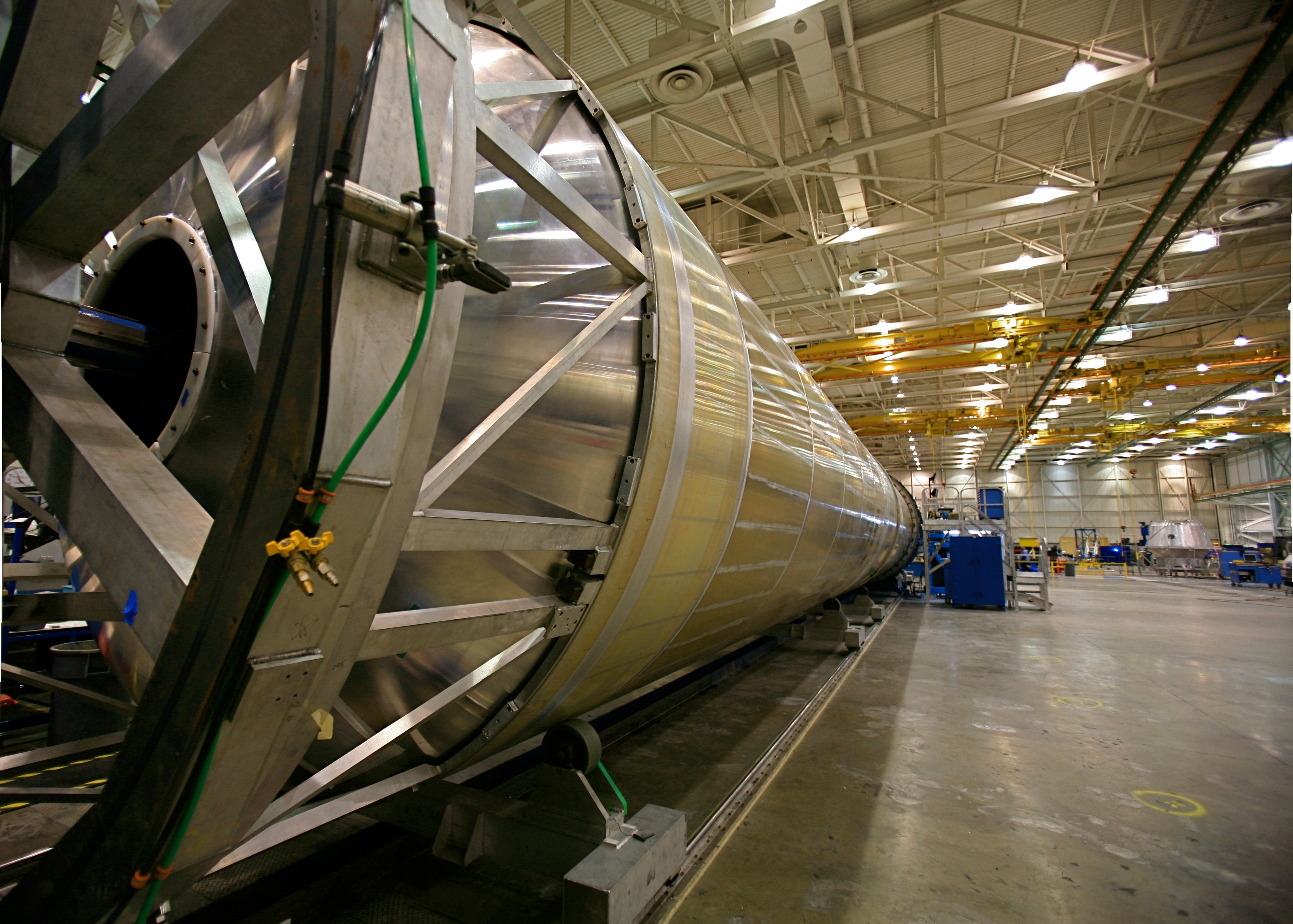
The tanks are aluminium-lithium alloy, entirely friction-stir welded, with a monocoque LOX tank and a skin-and-stringer fuel tank. The second-stage tank is a shortened version of the first-stage one and shares most of its tooling, material and manufacturing techniques — a design choice that keeps production cheap. The interstage joining them is a carbon-fibre, aluminium-core composite structure holding reusable separation collets and a pneumatic pusher; the original design had twelve attachment points, cut to three on v1.1.
The fairing protects payloads that do not ride inside a Dragon. It is 13 m long and 5.2 m across, weighs roughly 1900 kg, and is built from carbon-fibre skin over an aluminium honeycomb core. SpaceX designs and fabricates it in Hawthorne, and tested it in spring 2013 at NASA's Plum Brook Station, where acoustic shock, launch vibration and electrostatic discharge were reproduced on a full-size article in a vacuum chamber.
Flight control rests on multiple redundant, fault-tolerant computers running C++ on Linux, using commercial off-the-shelf parts with system-wide radiation-tolerant design rather than rad-hardened components. Each stage has its own flight computers, and each Merlin its own controller: three voting computers, each with two CPUs constantly checking the other two of the trio. Recoverable boosters carry four extensible landing legs around the base and grid fins that deploy moments after stage separation; the aluminium fins of the early Full Thrust vehicles gave way to larger titanium ones, cast and cut from a single piece, offering better control authority, surviving re-entry heat and reusable indefinitely with minimal refurbishment. Boosters that will be deliberately expended fly without legs or fins.
The Merlin engines
Merlin is a turbopump-fed, gas-generator-cycle engine. The 1D version was developed between 2011 and 2012 around three stated goals — reliability, performance and manufacturability — and first flew in 2013. Its 2011 targets called for 690 kN of vacuum thrust; in November 2013 Elon Musk said the engine was running at 85% of its potential and that sea-level thrust should reach about 730 kN with a thrust-to-weight ratio of 180. In May 2016 SpaceX announced a further upgrade to 914 kN in vacuum and 845 kN at sea level, which would take Falcon 9 to roughly 22 tonnes to low Earth orbit fully expendable; in May 2018, with Block 5 entering service, it confirmed the 845 kN figure had been met. Each Block 5 Merlin produces 854 kN of thrust.
The vacuum variant, Merlin 1D Vacuum, was developed for the second stage of v1.1 and of Falcon Heavy. As of 2020 its thrust was 981 kN with a specific impulse of 348 seconds, the highest ever achieved by a US hydrocarbon rocket engine.
v1.0: the original rocket
Falcon 9 v1.0 was an expendable launcher developed from 2005 to 2010 that flew five times, all successfully, before retirement in 2013. It stood 53 m tall and 3.66 m wide, with a 318-tonne liftoff mass. Its first stage carried nine Merlin 1C engines in a 3 × 3 grid, each producing 556 kN at sea level for about 5,000 kN of liftoff thrust. The second stage used a single Merlin 1C modified for vacuum, with a 117:1 expansion ratio and a nominal 345-second burn, and gaseous nitrogen thrusters for attitude control. It placed 8,500 to 9,000 kg into low Earth orbit from Cape Canaveral and 3,400 kg into geostationary transfer orbit. It never flew with a fairing: all five missions carried Dragon.
Early recovery attempts — a lightweight ablative cork thermal protection layer plus parachutes — were defeated by aerodynamic stress and re-entry heating. In 2011 SpaceX opened a formal development programme for a reusable Falcon 9, focused first on the first stage.
v1.1: the growth spurt
V1.1, which first flew in September 2013, was 60% heavier and 60% more powerful than v1.0. Its nine Merlin 1D engines were rearranged into the octagonal Octaweb pattern to simplify manufacturing, and the tanks were stretched 60%, making the vehicle more prone to bending in flight. The first stage delivered 5,885 kN at sea level, rising to 6,672 kN as the booster climbed out of the atmosphere, over a nominal 180-second burn. The separation system went from twelve attachment points to three, and avionics and software were upgraded.
Capacity rose from 9,000 kg to 13,150 kg to low Earth orbit and 4,850 kg to GTO, on a 68.4 m vehicle massing 506 tonnes at liftoff. SpaceX president Gwynne Shotwell acknowledged that v1.1 had about 30% more payload capability than the published price list showed, that margin being reserved for returning stages under powered re-entry. The second stage's igniter propellant lines were later insulated to support in-space restarts after long coast phases, and four extensible carbon-fibre and aluminium-honeycomb landing legs were fitted on later flights where landings were attempted. Its maiden flight carried a small 500 kg payload, the CASSIOPE satellite, and was both the first launch from Vandenberg and the first attempt at a propulsive first-stage return.
Full Thrust and Block 4
The Full Thrust upgrade — also known as FT, v1.2 or Block 3 — brought major changes in December 2015. The most important was cryogenic sub-cooling of the propellants to raise their density, allowing 17% more thrust; the stage separation system was improved, the second stage stretched for more propellant, and the struts holding the helium bottles strengthened after they were implicated in the loss of flight 19. At 70 m tall and 549 tonnes at liftoff, the version carried 22,800 kg to low Earth orbit and 8,300 kg to GTO expendable, and about 5,300 kg to GTO while recovering the booster. Actual payload was capped at 10,886 kg by the structural limit of the payload adapter fitting.
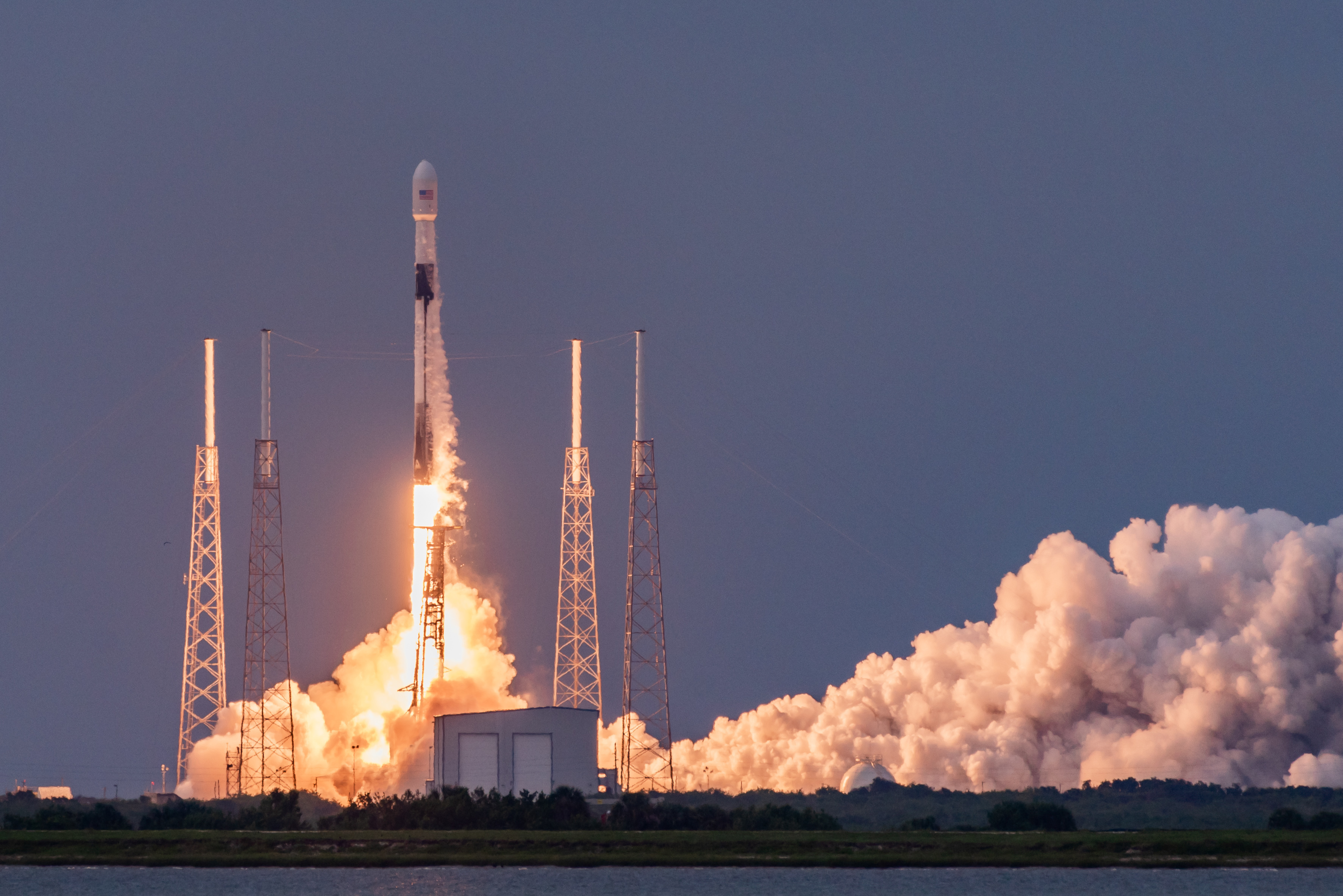
Full Thrust was the first version with a genuinely reusable first stage, developed with systems and software proven on the SpaceX prototypes. Plans to reuse the second stage were abandoned: a heat shield and its supporting hardware cut too deeply into payload. This version introduced the Autonomous Flight Safety System (AFSS), replacing ground-based flight-termination personnel and equipment with on-board navigation, timing and decision logic; first used operationally on CRS-10 in February 2017, it flew on every launch after 16 March. In June 2017, the second batch of ten Iridium NEXT satellites flew with the new titanium grid fins.
Block 4, introduced in 2017, was a transition. At first only the second stage was modified, flying atop Block 3 first stages on NROL-76 and Inmarsat-5 F5 in May 2017 and Intelsat 35e in July. The complete Block 4 design, both stages, debuted on CRS-12 on August 14, 2017, carrying the incremental thrust increases that led to Block 5.
Block 5: the definitive version
In October 2016 Musk described Block 5 as "a lot of minor refinements that collectively are important", with uprated thrust and improved legs the most significant; in January 2017 he added that it "significantly improves performance and ease of reusability". The maiden flight came on May 11, 2018 with the Bangabandhu Satellite-1.
Its numbers describe a mature rocket. The first stage is 42.6 m long and the second 12.6 m, both 3.7 m in diameter. The first weighs 22,200 kg empty and 433,100 kg fuelled, holding 287,400 kg of sub-chilled liquid oxygen and 123,500 kg of RP-1; the second, 4,000 kg empty and 111,500 kg fuelled, with 75,200 kg of oxygen and 32,300 kg of kerosene. The nine Merlin 1D engines total 7,607 kN and the second stage's Merlin Vacuum 934 kN. Nozzles are gimbaled, with expansion ratios of 16:1 below and 165:1 above. Both stages can restart: the first only on three engines, for boostback, re-entry and landing burns; the second through dual-redundant TEA-TEB pyrophoric igniters. Tanks are pressurised with heated helium. Quoted capability is at least 22,800 kg to LEO expendable and at least 17,400 kg with booster recovery — the heaviest explicitly confirmed payload — and at least 8,300 kg to GTO expendable against 5,800 kg reusable.
Conquering reuse
SpaceX intended from the outset to reuse both stages. Early first stages carried parachutes and a layer of ablative cork, salt-water corrosion resistant, which did not survive aerodynamic stress and heating. In late 2011 the company abandoned parachutes for powered descent, completing the design by February 2012.
Powered landings were first flight-tested with Grasshopper, a low-altitude, low-speed suborbital demonstrator that made eight vertical landings between 2012 and 2013, including a 79-second round trip to 744 m. In March 2013 SpaceX announced that from the first v1.1 flight onward every booster would be equipped for powered descent.
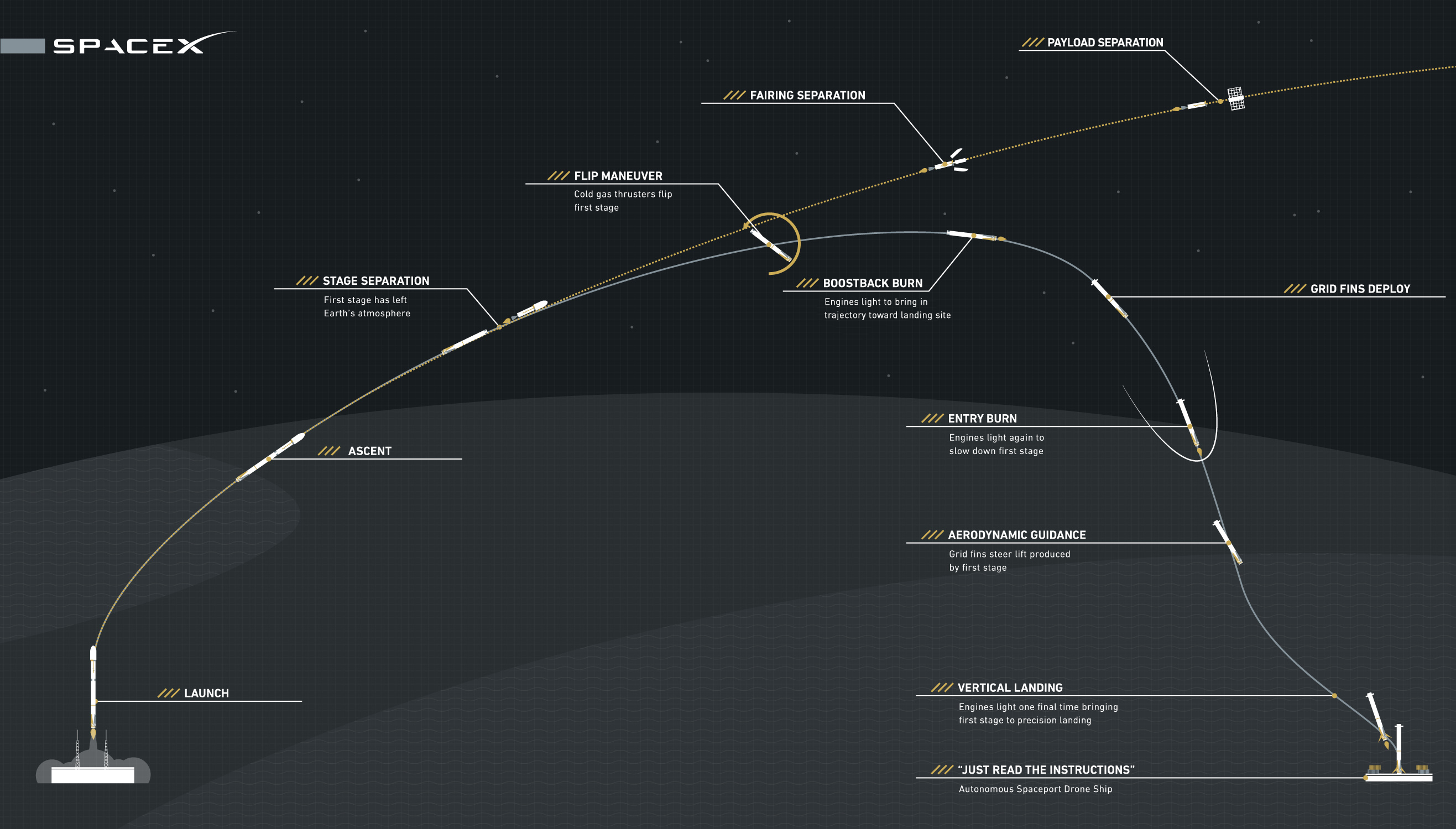
On flight 6, in September 2013, the stage was to slow itself with a re-entry burn and a second burn just before reaching the water. It was not a complete success, but the stage did change direction and enter the atmosphere under control; during the final burn the RCS thrusters could not overcome an aerodynamically induced spin, and centrifugal force starved the engine of fuel, shutting it down early. After four more ocean tests, the CRS-5 booster attempted a landing on the autonomous drone ship in January 2015: it flew grid fins for the first time on an orbital mission, guided itself accurately to the vessel, then ran out of hydraulic fluid and crashed onto the deck. A second attempt on CRS-6 in April 2015 failed when a bipropellant valve stuck and the control system could not react fast enough.
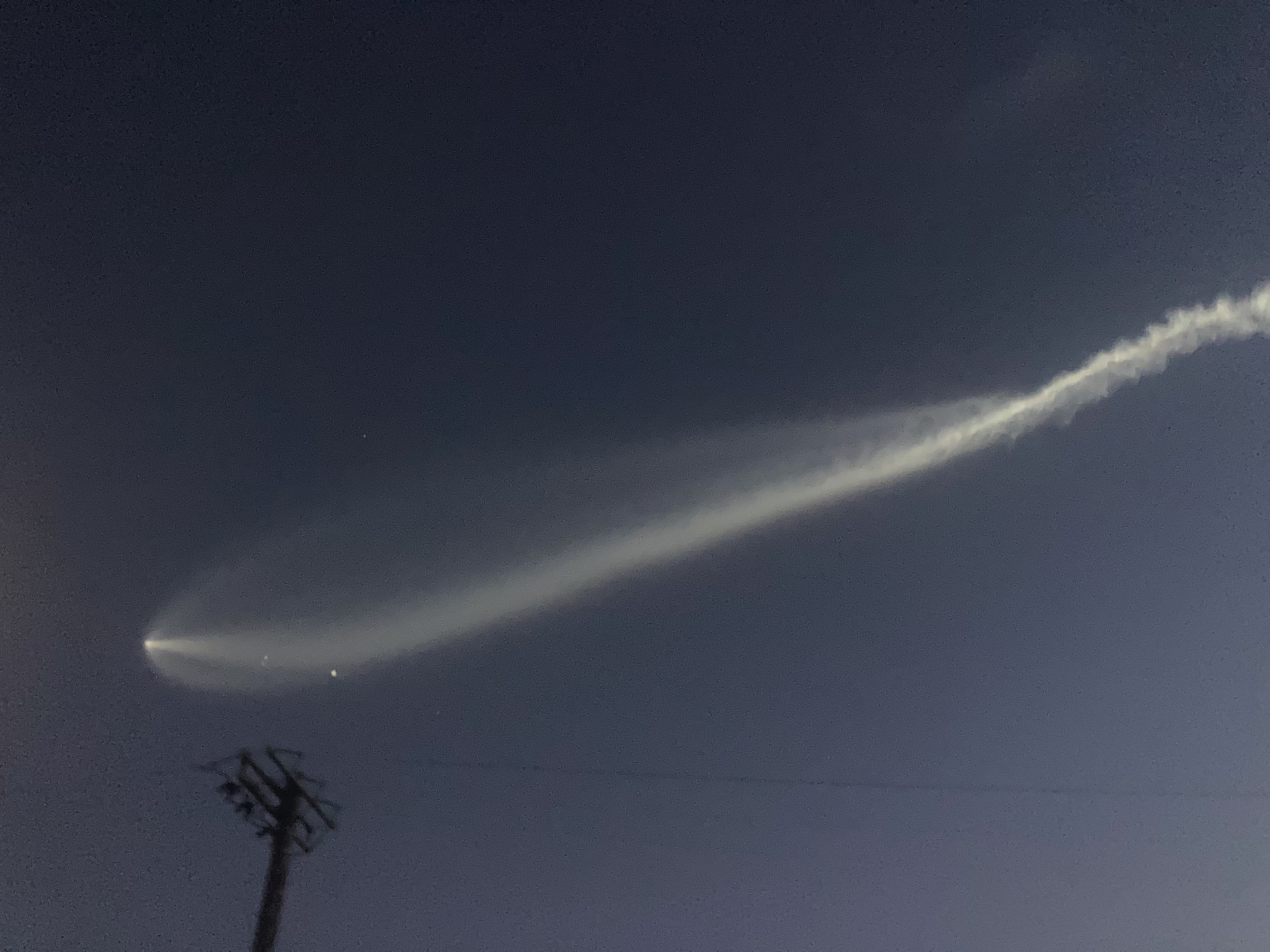
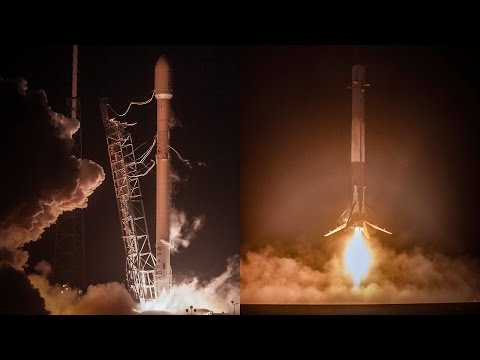
On December 21, 2015, on flight 20 — the Orbcomm OG-2 mission — a first stage landed for the first time on a ground pad near the launch site. It was the first time in history that an orbital launcher's first stage achieved a controlled vertical landing after completing its mission. The first successful drone-ship landing followed in April 2016 on CRS-8, aboard Of Course I Still Love You. Sixteen test flights were flown from 2013 to 2016, six of which ended in a soft landing and booster recovery. Since January 2017, with a handful of exceptions — the Falcon Heavy test flight centre core, the STP-2 mission, the CRS-16 resupply flight and a few Starlink missions — every landing attempt has succeeded. Two boosters were lost at sea after landing: the Arabsat-6A centre core and B1058 after a Starlink flight.
The first operational reflight of a flown booster was B1021 in March 2017 on SES-10, after flying CRS-8 in April 2016; it was retired after its second landing. In June 2017 B1029 carried BulgariaSat-1 toward GTO after an Iridium NEXT mission that January. The third reuse flight came in November 2018 with SSO-A, whose core B1046 had been the first Block 5 booster built and had flown the Bangabandhu Satellite-1 mission. In May 2021 a booster reached ten missions, and as of July 30, 2026 the record stood at 36 flights by a single vehicle, with 598 successful landings overall.
Fairings are recovered too. SpaceX developed halves with steerable parachutes and RCS thrusters; the first was recovered after a soft ocean landing in March 2017, following SES-10. A ship-based system with huge nets followed, two dedicated vessels making their first catches in 2019; after mixed results the company reverted to water landings and wet recovery. Since 2019 fairings have been designed to re-enter and fly again. The second stage, by contrast, was written off: by late 2014 SpaceX concluded that the mass of a heat shield, landing engines and other recovery hardware was prohibitive, and dropped the effort.
Reliability, failures and anomalies
As of July 30, 2026, Falcon 9 had achieved 668 full mission successes out of 671, or 99.6%, with two in-flight failures, one partial failure and one pre-flight destruction. Block 5 alone stood at 99.8% (614 of 615). The comparison with historic competitors is telling: the Soyuz family had flown 1880 launches at 95.1% success, the Proton series 425 at 88.7%, Europe's Ariane 5 117 at 95.7% and China's Long March 3B 85 at 95.3%.
The launch sequence includes a hold-down that allows full engine ignition and a systems check before release — the same principle used by Saturn V and the Space Shuttle — with automatic safe shutdown and propellant unloading if anything abnormal appears. The vehicle carries triple-redundant flight computers and inertial navigation with a GPS overlay.
.jpg)
The first warning came early, and as a partial success: on CRS-1 in October 2012 engine number 1 lost pressure 79 seconds into flight and shut down. The first stage burned 28 seconds longer than planned and the second an extra 15 to compensate, cutting fuel reserves and dropping the odds of completing the secondary mission from 99% to 95%; NASA, which contractually controlled several mission decision points, declined SpaceX's request to restart the second stage, and the secondary payload re-entered. The primary mission succeeded — a practical demonstration of the engine-out capability inherited from the philosophy of the Saturn family. Merlin 1D engines have suffered two premature ascent shutdowns — March 2020, from isopropyl alcohol not properly purged after cleaning, and February 2021, when hot exhaust gases entered an engine through a fatigue hole in its cover — neither affecting the primary mission, but both costing the landing.
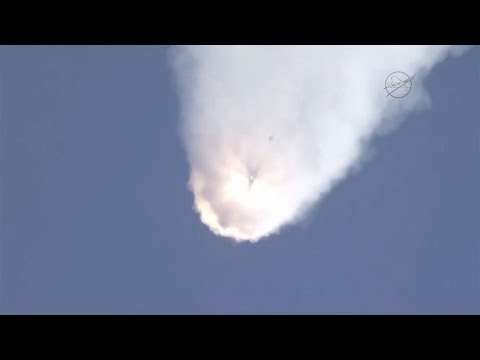
The first outright loss came on June 28, 2015 with CRS-7, the nineteenth Falcon 9 flight and the fourteenth of v1.1. The vehicle disintegrated 139 seconds into flight, shortly before stage separation: a cloud of white vapour appeared, followed by rapid pressure loss in the second stage's liquid oxygen tank. The Dragon capsule was ejected and kept transmitting until it hit the ocean; SpaceX said it could have been recovered had the parachutes deployed, but the onboard software version made no provision for that case. The investigation traced the accident to the failure of a strut securing a high-pressure helium bottle inside the oxygen tank: the COPV broke loose and struck the tank's upper dome. SpaceX's report noted the stainless-steel eye bolt was rated for 10000 pounds and failed at 2000.
Just over a year later, on September 1, 2016, the vehicle due to launch the Israeli satellite AMOS-6 — it would have been flight 29 — exploded on the pad during the run-up to a static fire test, destroying rocket and payload. Nobody was hurt. SpaceX published the cause on January 2, 2017: a buckled liner in several composite overwrapped pressure vessels (COPVs) had perforated, letting liquid or solid oxygen in.
The extreme cadence brought its own problems from mid-2024. That July the upper-stage engine failed during the Starlink Group 9-3 launch, losing all twenty satellites and prompting a two-week FAA grounding. In August a booster tipped over and was destroyed on landing after an otherwise successful flight, the first failed landing in over three years. In September, after Crew-9, the upper stage again malfunctioned during its deorbit burn and re-entered outside its designated zone, ten days before the launch window of NASA's Europa Clipper, which required two burns of that same stage; the agency joined the investigation and convened its own independent anomaly review board. Europa Clipper launched successfully on October 14. In February 2025 another upper stage failed to perform its deorbit burn after Starlink Group 11-4, remaining in orbit for two weeks before an uncontrolled re-entry near Poznań, Poland, caused by a liquid oxygen leak similar to the July 2024 failure; in March a booster caught fire and tipped over after a droneship landing, blamed on a fuel leak inside a first-stage engine during ascent. NASA's Aerospace Safety Advisory Panel warned in its 2024 annual report that the launch pace might "interfere with sound judgment, deliberate analysis, and careful implementation of corrective actions", while praising the company's openness.
Human spaceflight
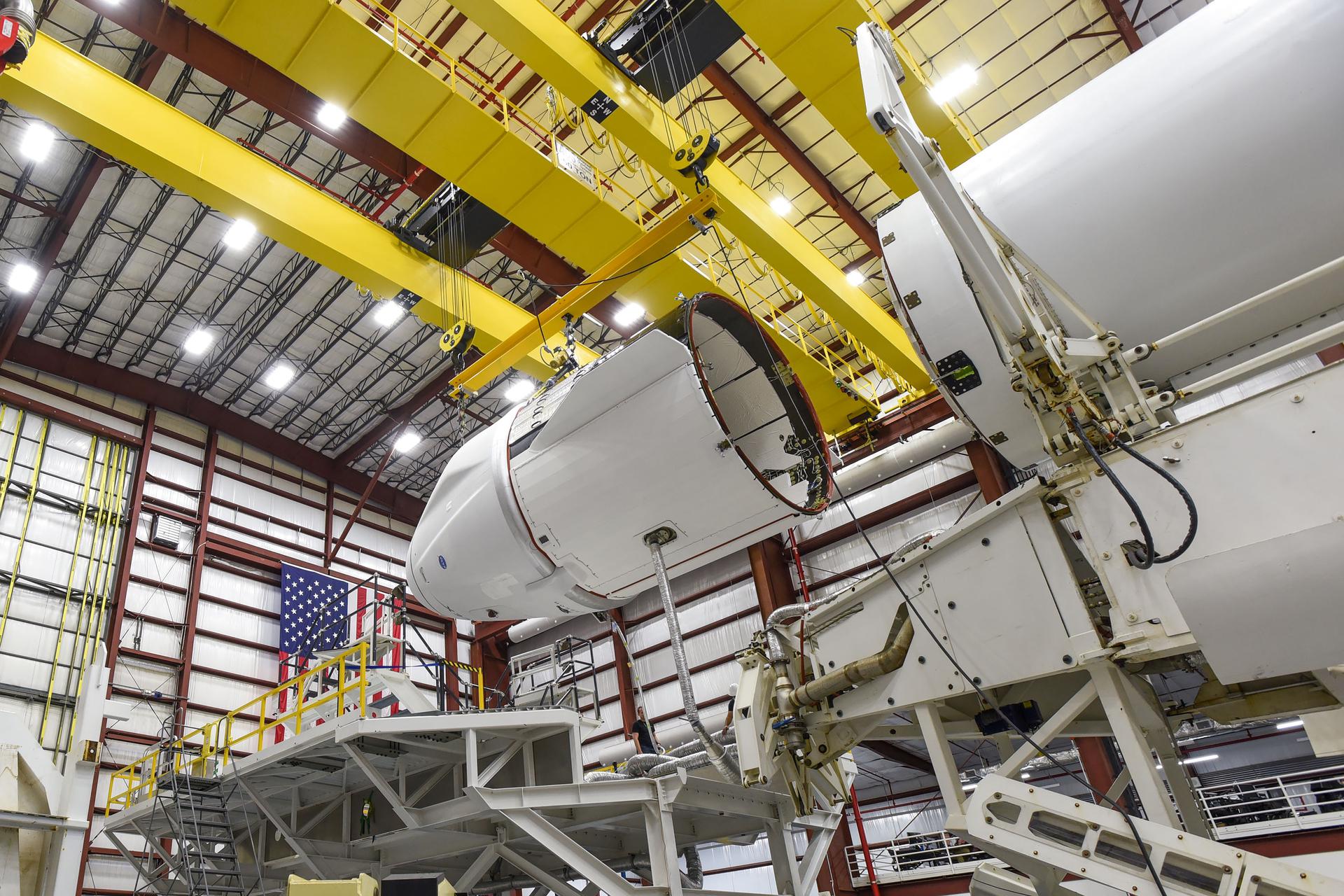
Falcon 9 is human-rated and carries NASA astronauts to the International Space Station. Crew Dragon's first, uncrewed flight was Demo-1, on the launcher's 69th flight. The decisive step was Demo-2: on May 30, 2020, on flight 85, a Falcon 9 put the capsule Endeavour into orbit with astronauts Doug Hurley and Bob Behnken aboard. It was the first crewed orbital flight launched from the United States since the last Shuttle mission in 2011, the first ever operated by a commercial provider, and the first two-person orbital flight from US soil since STS-4 in 1982.
Docking, autonomous but monitored by the crew, took place on May 31, nineteen hours after launch; after soft capture, twelve hooks closed to complete hard capture eleven minutes later. Hurley and Behnken worked for 62 days alongside Expedition 63 — Behnken performing four spacewalks with Chris Cassidy to replace batteries — and Endeavour undocked autonomously on August 1, 2020. Demo-2 completed the validation of crewed operations on SpaceX hardware and earned the spacecraft its human-rating certification. In September 2021 the Inspiration4 mission, on flight 126, became the first all-private orbital spaceflight.
Beyond human rating, Falcon 9 is certified for the National Security Space Launch programme, and NASA's Launch Services Program lists it as a "Category 3" (low risk) vehicle, the class allowed to fly the agency's most expensive, important and complex missions.
Payloads, records and notable missions
Falcon 9's list of firsts sums up the decade. Flight 1, in June 2010, carried a Dragon qualification unit. Flight 3, with Dragon C2+, made the first cargo delivery to the International Space Station. Flight 7 launched SES-8, the first payload to geostationary transfer orbit; flight 9, CRS-3, introduced the landing legs and achieved the first fully controlled descent to a vertical ocean touchdown; flight 15 placed the DSCOVR observatory in the Sun–Earth L1 region. After the landings of flights 20 and 23, flight 30 (CRS-10) inaugurated pad LC-39A, flight 32 (SES-10) added the first booster reflight and the first fairing recovery, and flight 41 launched the X-37B spaceplane on its fifth mission. Flight 129 carried DART, the first planetary-defence impact mission against a near-Earth object, and flight 134 (CRS-24) marked the hundredth successful booster landing.
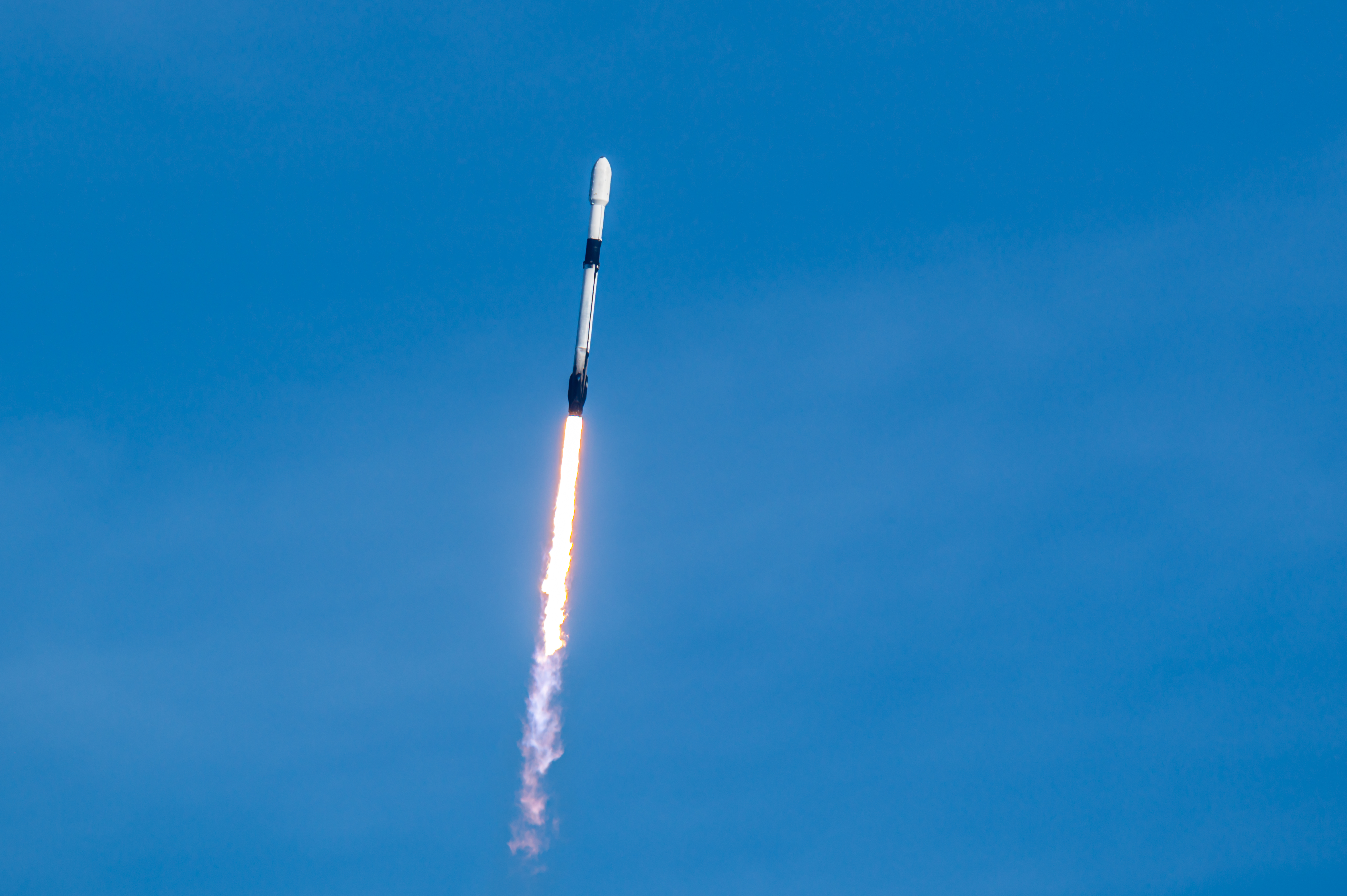
The heaviest payloads flown to geostationary transfer orbit were Intelsat 35e at 6,761 kg, sent into an advantageous super-synchronous transfer orbit, and Telstar 19V at 7,075 kg, into a lower-energy GTO with an apogee well below geostationary altitude. On January 24, 2021, Transporter-1 — flight 106 — set the record for satellites launched by a single rocket, carrying 143.
Starlink and cadence
Most launches today are SpaceX's own. Starlink, the low-orbit satellite internet constellation, comprised roughly 10,413 satellites in June 2026, of which 10,397 were operational, communicating with user terminals and gateway ground stations; by August 2026 the active fleet stood at 10,895 units across two hardware generations. Deploying such a swarm turned orbital launch into an almost routine operation and explains the unprecedented Falcon 9 cadence, the highest of any active launcher. The second-generation satellites, however, do not fit: SpaceX said in 2022 that Gen2 spacecraft are too large for Falcon 9 and need Starship.
Rideshare: Transporter and Bandwagon
SpaceX runs two regularly scheduled rideshare programmes for small satellites. Transporter, introduced in 2021, flies to sun-synchronous orbit at inclinations near 90°, serving mostly Earth-observation payloads, with launches roughly every four months from Vandenberg. Bandwagon, begun in 2024, provides mid-inclination access at about 45°, with missions roughly every six months from Cape Canaveral.
Because these missions drop many satellites into a single orbit, many customers buy third-party orbital transfer vehicles — Momentus with Vigoride, D-Orbit with the ION Satellite Carrier, Exolaunch — that separate from the upper stage and manoeuvre payloads to their final altitude and inclination. The Vigoride-7 mission on Transporter-16 demonstrated high-power OTV buses supporting complex government payloads for DARPA and NASA. For spacecraft between 500 and 2,500 kg, SpaceX also offers a "cake topper" slot atop the payload stack, the position a primary payload would occupy on a conventional launch. As of 2025, rideshare pricing started at US$300,000 for 50 kg to sun-synchronous orbit. High cadence and low prices have made SpaceX the dominant provider in the smallsat launch market and a hard competitive problem for operators of dedicated small launchers.
Launch sites
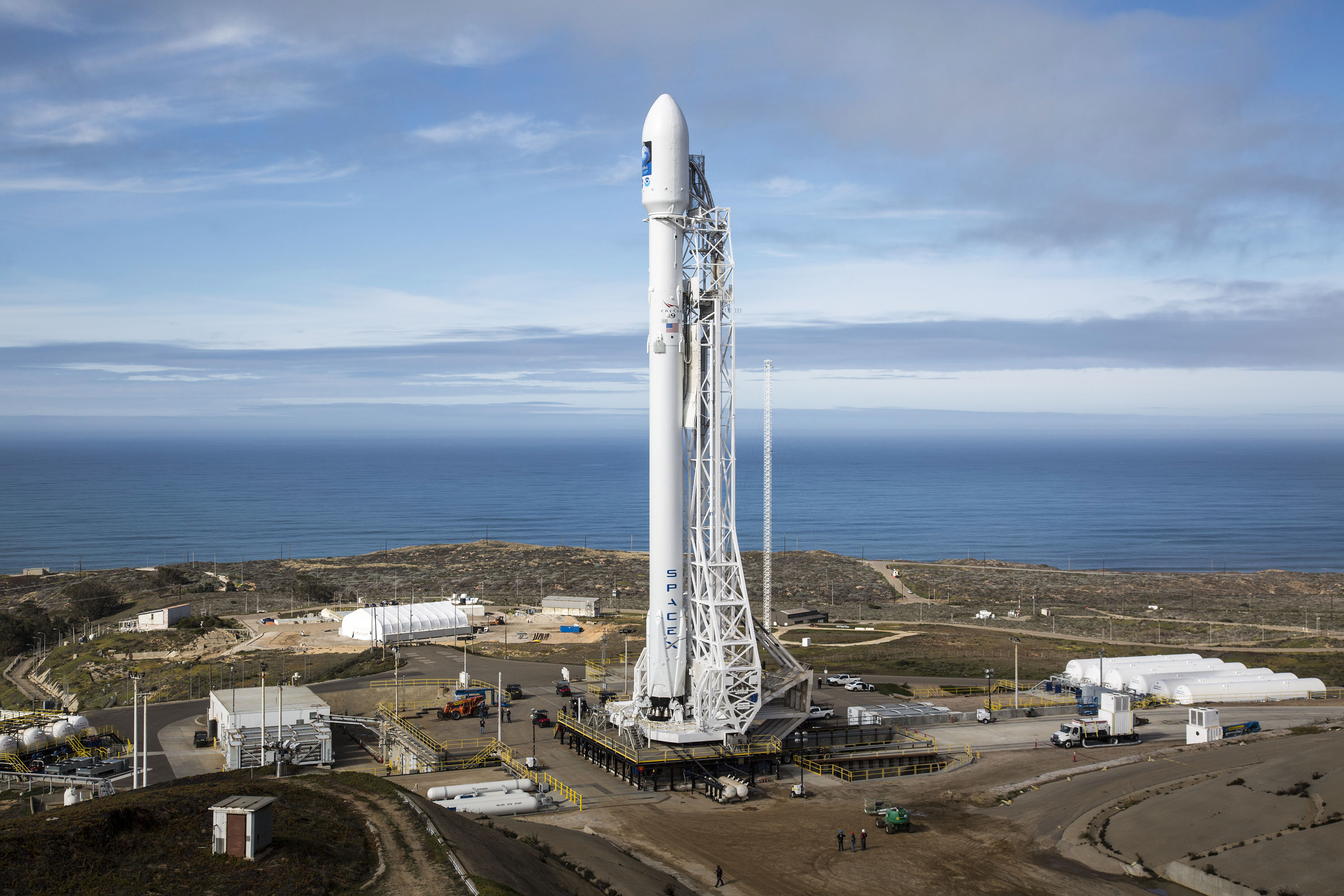
Falcon 9 flies from three orbital complexes: Space Launch Complex 40 at Cape Canaveral Space Force Station in Florida, operational since 2007; Space Launch Complex 4E at Vandenberg Space Force Base in California, since 2013; and Launch Complex 39A at the Kennedy Space Center in Florida, since 2017. Each has a defined role: SLC-40 is the high-volume pad for medium-inclination orbits, 28.5° to 55°; SLC-4E is optimised for highly inclined polar orbits, 66° to 145°; and LC-39A is reserved for complex missions such as Crew Dragon and Falcon Heavy, although SLC-40 was upgraded in 2024 to serve as a Crew Dragon backup. On April 21, 2023 the US Space Force granted SpaceX a lease on Vandenberg's SLC-6, which will become its fourth orbital pad and allow Falcon Heavy launches from the West Coast.
Price and industry impact
At the maiden flight in 2010, the advertised commercial price for a v1.0 launch was US$49.9–56 million. It then rose with inflation: US$54–59.5 million by 2012, US$56.5 million for v1.1 in 2013, US$61.2 million in 2014, US$62 million for Full Thrust in 2016 and US$74 million for Block 5 in 2026. Government contracts cost more: Dragon cargo missions to the ISS ran US$133 million under a fixed-price NASA contract, the DSCOVR mission for NOAA US$97 million, and US Air Force launches US$95 million as of 2020 because of added security requirements. That gap led Roscosmos administrator Dmitry Rogozin to accuse SpaceX of price dumping in the commercial market in 2020.
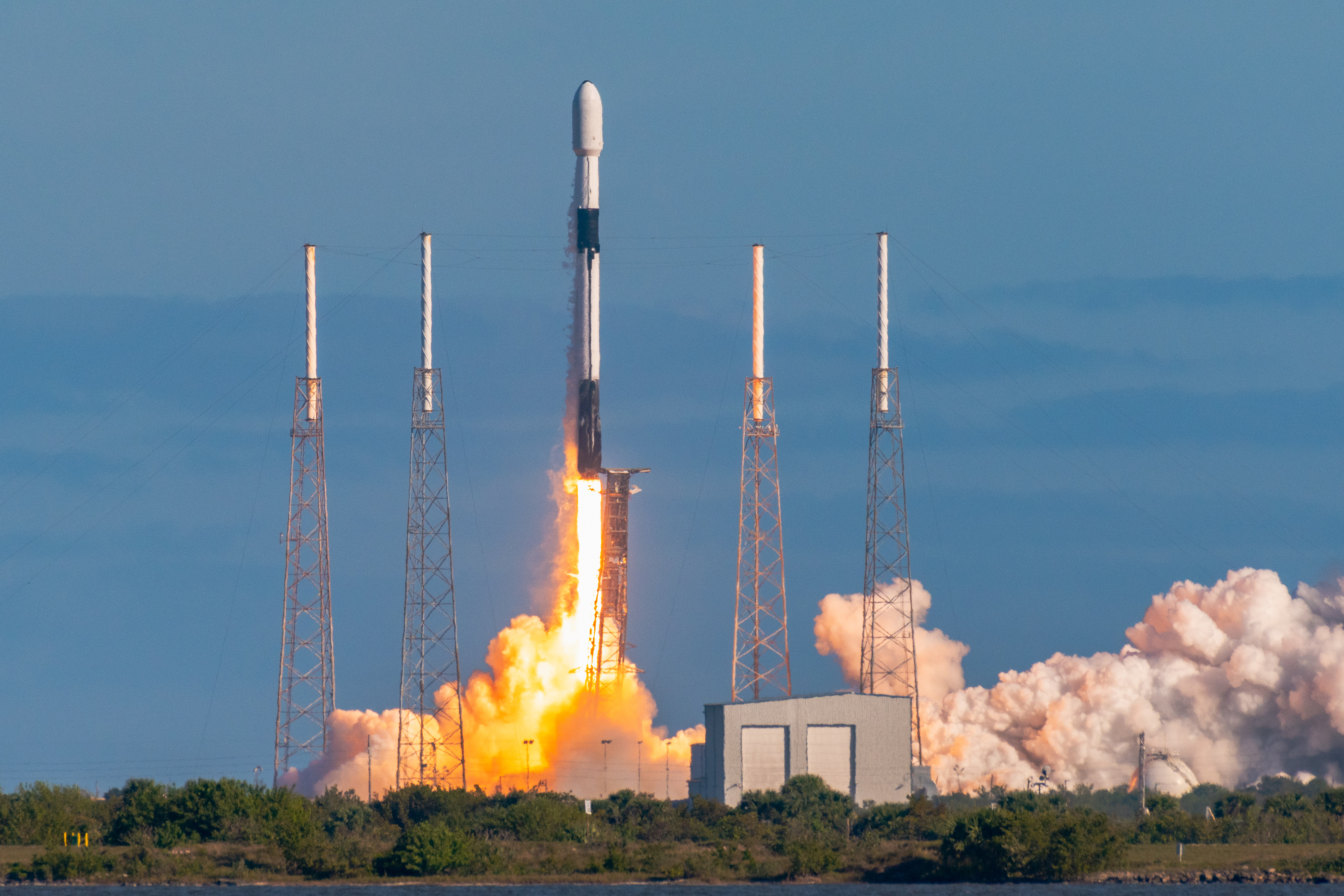
Internally, a Falcon 9 launch was estimated in 2024 to cost between US$15 million and US$28 million once workforce, refurbishment, assembly, operations and facility depreciation are counted; the expendable second stage is the largest single item, at US$12 million to produce according to the company's chief operating officer. The economics of reuse were debated in public: ULA chief executive Tory Bruno reckoned each booster would need ten flights to break even on the cost of designing and operating a reusable rocket, while Musk countered that recovery and refurbishment cost under 10%, break-even arrives on the second flight and substantial savings by the third.
Falling prices pushed competitors to redesign their offerings: Arianespace introduced Ariane 6, ULA developed Vulcan Centaur, and Roscosmos fell back on Proton-M.
Legacy
Falcon 9 proved that propulsive reuse works technically and commercially, and forced the whole industry — from Europe to China — to redesign its launchers around the idea. It made the landing of an orbital rocket an everyday image, returned crewed launch capability to the United States, and single-handedly sustains the largest satellite constellation ever built. Few machines have moved the frontier of what is possible in space as far since the Shuttle.
_de_un_Falcon_9_con_Crew_Dragon_hacia_la_rampa%2C_misi%C3%B3n_Crew-9.jpg)
Launch timeline
| Date | Launch site | Program | Outcome | Payload |
|---|---|---|---|---|
| Oct 10, 2026, 7:39 AM | Space Launch Complex 4E | — | Success | Tranche 1 Transport Layer A is one of six missions by the United States Space Force Space Development Agency (SDA) for the Proliferated Warfighter Space Architecture (PWSA) Tranche 1 Transport Layer constellation, which will provide assured, resilient, low-latency military data and connectivity worldwide to the full range of warfighter platforms from Low Earth Orbit satellites. The constellation will be interconnected with Optical Inter-Satellite Links (OISLs) which have significantly increased performance over existing radio frequency crosslinks. It is expected to operate over Ka band, have stereo coverage and be dynamically networked for simpler hand-offs, greater bandwidth and fault tolerance. This launch carries 21 satellites manufactured by Northrop Grumman. |
| Oct 1, 2026, 6:32 PM | Space Launch Complex 4E | — | Success | Dedicated rideshare flight to a sun-synchronous orbit with dozens of small microsatellites and nanosatellites for commercial and government customers. |
| Oct 1, 2026, 3:10 PM | Space Launch Complex 40 | — | Success | SpaceX Crew-13 is the thirteenth crewed operational flight of a Crew Dragon spacecraft to the International Space Station as part of NASA's Commercial Crew Program. |
| Sep 26, 2026, 2:00 PM | Space Launch Complex 4E | — | Success | A classified mission for the United States Space Force. It is possibly a batch of classified LEO satellites based on SpaceX’s Starshield satellite bus, based on locations of rocket stage drop zones being exact fits with previous Starlink Group 15 launches. |
| Sep 20, 2026, 1:47 AM | Space Launch Complex 4E | — | Success | A batch of 27 satellites for the Starlink mega-constellation - SpaceX's project for space-based Internet communication system. |
| Sep 17, 2026, 1:07 AM | Space Launch Complex 4E | — | Success | USSF-259 is a classified mission for the United States Space Force. It is possibly a batch of classified LEO satellites based on SpaceX’s Starshield satellite bus, based on locations of ascent rocket stage drop zones being fits with previous SDA Transport Layer launches. |
| Sep 13, 2026, 6:49 PM | Space Launch Complex 40 | — | Success | 3 high-throughput communications satellites in Medium Earth Orbit (MEO) built by Boeing and operated by SES. |
| Sep 10, 2026, 3:42 PM | Space Launch Complex 4E | — | Success | USSF-153 is a classified mission for the United States Space Force. It is possibly a batch of classified LEO satellites based on SpaceX’s Starshield satellite bus, based on locations of rocket stage drop zones being exact fits with previous Starlink Group 15 launches. |
| Sep 6, 2026, 2:26 PM | Space Launch Complex 4E | — | Success | A batch of 27 satellites for the Starlink mega-constellation - SpaceX's project for space-based Internet communication system. |
| Sep 2, 2026, 8:42 AM | Space Launch Complex 4E | — | Success | A batch of 27 satellites for the Starlink mega-constellation - SpaceX's project for space-based Internet communication system. |
| Aug 26, 2026, 9:35 AM | Space Launch Complex 4E | — | Success | A batch of 27 satellites for the Starlink mega-constellation - SpaceX's project for space-based Internet communication system. |
| Aug 25, 2026, 9:33 AM | Space Launch Complex 40 | — | Success | A batch of 29 satellites for the Starlink mega-constellation - SpaceX's project for space-based Internet communication system. |
| Aug 22, 2026, 7:25 AM | Space Launch Complex 4E | — | Success | A batch of 27 satellites for the Starlink mega-constellation - SpaceX's project for space-based Internet communication system. |
| Aug 21, 2026, 3:14 PM | Space Launch Complex 40 | — | Success | A batch of 29 satellites for the Starlink mega-constellation - SpaceX's project for space-based Internet communication system. |
| Aug 19, 2026, 4:01 AM | Space Launch Complex 4E | — | Success | A batch of 24 satellites for the Starlink mega-constellation - SpaceX's project for space-based Internet communication system. |
| Aug 16, 2026, 1:50 AM | Space Launch Complex 4E | — | Success | USSF-366 is a classified mission for the United States Space Force. It is possibly a batch of classified LEO satellites based on SpaceX’s Starshield satellite bus, based on locations of rocket stage drop zones being exact fits with previous Starlink Group 15 launches. |
| Aug 16, 2026, 1:12 AM | Space Launch Complex 40 | — | Success | The Globalstar global mobile communications network offers global, digital real time voice, data and fax services via its Low Earth Orbit satellite constellation. The constellation operates in a 1410 km orbit inclined at 52 degrees. In early 2022, Globalstar contracted with MDA for the construction of 17 new 2nd generation refresh satellites to replenish the existing constellation. Rocket Lab is sub-contracted to build the satellites' buses and the launch dispensers. |
| Aug 12, 2026, 4:46 AM | Space Launch Complex 4E | — | Success | A batch of 24 satellites for the Starlink mega-constellation - SpaceX's project for space-based Internet communication system. |
| Aug 11, 2026, 3:58 PM | Space Launch Complex 40 | — | Success | A batch of 29 satellites for the Starlink mega-constellation - SpaceX's project for space-based Internet communication system. |
| Aug 8, 2026, 4:35 PM | Space Launch Complex 4E | — | Success | A batch of 24 satellites for the Starlink mega-constellation - SpaceX's project for space-based Internet communication system. |
| Aug 5, 2026, 7:49 AM | Space Launch Complex 40 | — | Success | AST SpaceMobile’s Block 2 BlueBird satellites are designed to deliver up to 10 times the bandwidth capacity of the BlueBird Block 1 satellites, required to achieve 24/7 continuous cellular broadband service coverage in the United States, with beams designed to support a capacity of up to 40 MHz, enabling peak data transmission speeds up to 120 Mbps, supporting voice, full data and video applications. The Block 2 BlueBirds, featuring as large as 2400 square foot communications arrays, will be the largest satellites ever commercially deployed in Low Earth orbit once launched. This launch will feature 3 satellites. |
| Aug 4, 2026, 5:05 PM | Space Launch Complex 4E | — | Success | A batch of 24 satellites for the Starlink mega-constellation - SpaceX's project for space-based Internet communication system. |
| Aug 1, 2026, 3:08 AM | Space Launch Complex 4E | — | Success | A batch of 24 satellites for the Starlink mega-constellation - SpaceX's project for space-based Internet communication system. |
| Jul 30, 2026, 7:10 AM | Space Launch Complex 40 | — | Success | Classified payload for the US National Reconnaissance Office. |
| Jul 25, 2026, 3:51 PM | Space Launch Complex 4E | — | Success | A batch of 24 satellites for the Starlink mega-constellation - SpaceX's project for space-based Internet communication system. |
| Jul 21, 2026, 9:15 PM | Space Launch Complex 40 | — | Success | The Northrop Grumman/SpaceLogistics MRV-1 is a mission extension payload including a mission robotic vehicle (MRV) and multiple mission extension pods (MEPs). The MRV is designed to attach up to 30 MEPs (Mission Extension Pods) to various satellites in GEO over the course of its life, and the MEPs (Mission Extension Pods) are 400 kg spacecraft designed to be captured by the MRV and then attached to a customer's satellite. A single MEP can extend a 2000 kg satellite's service life by up to 6 years. For this mission, 2 of the MEP's will service satellites for Intelsat, while the third will service a satellite for Optus. |
| Jul 21, 2026, 2:49 PM | Space Launch Complex 4E | — | Success | A batch of 24 satellites for the Starlink mega-constellation - SpaceX's project for space-based Internet communication system. |
| Jul 16, 2026, 8:32 PM | Space Launch Complex 4E | — | Success | Tranche 1 Transport Layer E is one of six missions by the United States Space Force Space Development Agency (SDA) for the Proliferated Warfighter Space Architecture (PWSA) Tranche 1 Transport Layer constellation, which will provide assured, resilient, low-latency military data and connectivity worldwide to the full range of warfighter platforms from Low Earth Orbit satellites. The constellation will be interconnected with Optical Inter-Satellite Links (OISLs) which have significantly increased performance over existing radio frequency crosslinks. It is expected to operate over Ka band, have stereo coverage and be dynamically networked for simpler hand-offs, greater bandwidth and fault tolerance. This launch carries 21 satellites manufactured by York Space Systems. |
| Jul 14, 2026, 9:10 AM | Space Launch Complex 40 | — | Success | A batch of 29 satellites for the Starlink mega-constellation - SpaceX's project for space-based Internet communication system. |
| Jul 14, 2026, 1:28 AM | Space Launch Complex 4E | — | Success | A batch of 27 satellites for the Starlink mega-constellation - SpaceX's project for space-based Internet communication system. |
| Jul 11, 2026, 3:01 AM | Space Launch Complex 4E | — | Success | A batch of 24 satellites for the Starlink mega-constellation - SpaceX's project for space-based Internet communication system. |
| Jul 9, 2026, 9:25 AM | Space Launch Complex 40 | — | Success | A batch of 29 satellites for the Starlink mega-constellation - SpaceX's project for space-based Internet communication system. |
| Jul 7, 2026, 7:12 AM | Space Launch Complex 4E | — | Success | Dedicated rideshare flight to a sun-synchronous orbit with dozens of small microsatellites and nanosatellites for commercial and government customers. |
| Jul 5, 2026, 10:50 AM | Space Launch Complex 40 | — | Success | A batch of 29 satellites for the Starlink mega-constellation - SpaceX's project for space-based Internet communication system. The Falcon 9 1st stage carries 2 customer payload from Besxar Space Industries for testing their Fabships pilot reusable semiconductor wafers manufacturing pods in launch and re-entry environments. |
| Jul 2, 2026, 2:58 AM | Space Launch Complex 4E | — | Success | A batch of 24 satellites for the Starlink mega-constellation - SpaceX's project for space-based Internet communication system. |
| Jun 29, 2026, 2:25 AM | Space Launch Complex 40 | — | Success | SXM-11 is the 12th high-powered, digital, audio radio satellite built by Lanteris Space (ex-Maxar, Space System/Loral) for SiriusXM. The SXM-11 satellite will be based on the proven IM-1300 (ex-LS-1300)-class platform and built at the company’s manufacturing facility in Palo Alto, California. SXM-11 has a large, mesh, unfurlable reflector almost 10 meters in diameter that allows SiriusXM programming to reach its radios, including those in moving vehicles. |
| Jun 28, 2026, 4:09 PM | Space Launch Complex 4E | — | Success | A batch of 24 satellites for the Starlink mega-constellation - SpaceX's project for space-based Internet communication system. |
| Jun 25, 2026, 3:30 AM | Space Launch Complex 4E | — | Success | A batch of 24 satellites for the Starlink mega-constellation - SpaceX's project for space-based Internet communication system. |
| Jun 23, 2026, 10:53 AM | Space Launch Complex 40 | — | Success | Note: Mission profile and payload details are TBD. Demonstration mission for SpaceX’s Project Starfall, which aims to mass-produce reentry capsules designed to autonomously transport valuable customer experiments and other payloads safely back from space to Earth, including for in-orbit manufacturing. Starfall is a cylindrical shaped capsule approximately 0.75 meters tall with a diameter of 3.1 meters, weighing approximately 2100 kilograms, and capable of carrying 1000 kilograms of payload. It is designed to be carried on Starship flights. |
| Jun 21, 2026, 4:39 PM | Space Launch Complex 4E | — | Success | A batch of 24 satellites for the Starlink mega-constellation - SpaceX's project for space-based Internet communication system. |
| Jun 19, 2026, 8:50 AM | Space Launch Complex 4E | — | Success | Fourteenth batch of satellites for a reconnaissance satellite constellation built by SpaceX and Northrop Grumman for the National Reconnaissance Office to provide imaging and other reconnaissance capabilities. |
| Jun 17, 2026, 6:39 AM | Space Launch Complex 40 | — | Success | AST SpaceMobile’s Block 2 BlueBird satellites are designed to deliver up to 10 times the bandwidth capacity of the BlueBird Block 1 satellites, required to achieve 24/7 continuous cellular broadband service coverage in the United States, with beams designed to support a capacity of up to 40 MHz, enabling peak data transmission speeds up to 120 Mbps, supporting voice, full data and video applications. The Block 2 BlueBirds, featuring as large as 2400 square foot communications arrays, will be the largest satellites ever commercially deployed in Low Earth orbit once launched. This launch will feature 3 satellites. |
| Jun 15, 2026, 3:34 PM | Space Launch Complex 4E | — | Success | A batch of 24 satellites for the Starlink mega-constellation - SpaceX's project for space-based Internet communication system. |
| Jun 12, 2026, 12:37 PM | Space Launch Complex 40 | — | Success | A batch of 29 satellites for the Starlink mega-constellation - SpaceX's project for space-based Internet communication system. |
| Jun 11, 2026, 3:05 PM | Space Launch Complex 4E | — | Success | A batch of 24 satellites for the Starlink mega-constellation - SpaceX's project for space-based Internet communication system. |
| Jun 8, 2026, 10:13 AM | Space Launch Complex 40 | — | Success | A batch of 29 satellites for the Starlink mega-constellation - SpaceX's project for space-based Internet communication system. |
| Jun 7, 2026, 4:24 AM | Space Launch Complex 4E | — | Success | A batch of 21 satellites for the Starlink mega-constellation - SpaceX's project for space-based Internet communication system. 2 US military Starshield satellites are also on board. |
| Jun 4, 2026, 10:26 AM | Space Launch Complex 40 | — | Success | A batch of 29 satellites for the Starlink mega-constellation - SpaceX's project for space-based Internet communication system. |
| Jun 3, 2026, 3:40 PM | Space Launch Complex 4E | — | Success | A batch of 24 satellites for the Starlink mega-constellation - SpaceX's project for space-based Internet communication system. |
| May 30, 2026, 3:25 PM | Space Launch Complex 4E | — | Success | A batch of 24 satellites for the Starlink mega-constellation - SpaceX's project for space-based Internet communication system. |
Versions
| v1.0 | v1.1 | Full Thrust | Block 4 | Block 5 | |
|---|---|---|---|---|---|
| First launch | June 4, 2010 | September 29, 2013 | December 22, 2015 | August 14, 2017 | May 11, 2018 |
| Last launch | March 1, 2013 | January 17, 2016 | February 22, 2018 | June 29, 2018 | — |
| Powerplant | Nine Merlin 1C engines burning refined kerosene and liquid oxygen on the first stage, with a 170-second burn; a single 617 kN Merlin 1C Vacuum on the second. The Merlin 1C used regenerative cooling and delivered a specific impulse of 275 s at sea level and 304 s in vacuum. | First stage: 9 Merlin 1D in an octaweb (5,885 kN sea level, 6,672 kN vacuum). Second stage: 1 Merlin 1D Vacuum (716 kN). Liquid oxygen and RP-1. | Nine uprated Merlin 1D engines on the first stage, giving 6,800 kN at liftoff over a 162-second burn, and a 934 kN Merlin 1D Vacuum — 840 kN in the short-nozzle variant — on the second, with 348 s specific impulse. Cryogenic chilling of the kerosene and liquid oxygen is what makes the thrust increase possible. | The same Merlin architecture as Full Thrust with incremental thrust increases leading to the final Block 5 value; SpaceX published no thrust figures specific to Block 4. | Nine Merlin 1D+ engines on the first stage giving 7,600 kN at liftoff, and a 934 kN Merlin 1D Vacuum on the second, which can be built with a mission extension kit for extra restarts and longer flights. Liquid oxygen and RP-1 propellants densified by cryogenic chilling. |
| Propellant | LOX / RP-1 | LOX / RP-1 | LOX / RP-1 | LOX / RP-1 | LOX / RP-1 |
| Height | 54.9 m | 68.4 m | 70 m Best value in this row | — | 70 m Best value in this row |
| Diameter | 3.7 m Best value in this row | 3.7 m Best value in this row | 3.7 m Best value in this row | 3.7 m Best value in this row | 3.7 m Best value in this row |
| Mass | 333,400 kg | 505,846 kg | 549,000 kg Best value in this row | — | 549,000 kg Best value in this row |
| Liftoff thrust | 4,940 kN | 5,885 kN | 6,800 kN | — | 7,607 kN Best value in this row |
| Stages | 2 Best value in this row | 2 Best value in this row | 2 Best value in this row | 2 Best value in this row | 2 Best value in this row |
| LEO capacity | 10,450 kg | 13,150 kg | 22,800 kg Best value in this row | — | 22,000 kg |
| GTO capacity | 4,540 kg | 4,850 kg | 8,300 kg Best value in this row | — | 8,300 kg Best value in this row |
| Fairing height | — | 13 m | — | — | 13.2 m Best value in this row |
| Fairing diameter | — | 5.2 m Best value in this row | — | — | 5.2 m Best value in this row |
| Reusable | No | No | Yes | Yes | Yes |
Images
Elsewhere
- Wikimedia CommonsFalcon 9 booster B1063 tras el aterrizaje en el dron OCISLY ↗
- Wikimedia CommonsFalcon 9 lanza la misión CRS-34 desde Cabo Cañaveral ↗
- Wikimedia CommonsFalcon 9 lanza la misión TRACERS de la NASA desde Vandenberg ↗
- NASADespegue de Falcon 9 con la cápsula Dragon (CRS-8) ↗
- NASAFalcon 9 en la plataforma SLC-40 antes del lanzamiento CRS-6 ↗
- Flickr (SpaceX)Falcon 9 y Dragon despegan en la misión CRS-5 ↗
- Flickr (SpaceX)Aterrizaje de la primera etapa de Falcon 9 tras la misión SES-10 ↗
- Flickr (SpaceX)Primera etapa de Falcon 9 en el hangar de SpaceX ↗
- TeslaratiBooster Falcon 9 Block 5 regresa a bordo del dron oceánico ↗
- TeslaratiAterrizaje del booster de Falcon 9, fotos de prensa in situ ↗
- Getty ImagesFalcon 9 y la cápsula Crew Dragon listos para el lanzamiento ↗
- BehanceDespiece (cutaway) del Falcon 9 Full Thrust Block 4 ↗
Show the 1 more
Videos















![[Annulation météo] LANCEMENT SPACEX CRS-34 (Fusée Falcon 9 - Lancement spatial FR Cargo vers l'ISS)](https://i.ytimg.com/vi/oRwxxyQnrQo/hqdefault.jpg)





![🔴 EN DIRECT LANCEMENT SPACEX SES-18 et SES-19 ( Fusée Falcon 9 - Lancement spatial ) [FR]](https://i.ytimg.com/vi/QLsMMEMMFpk/hqdefault.jpg)







![[Annulation à T-1m14s] LANCEMENT SPACEX STARLINK 17 ( Fusée FALCON 9 )](https://i.ytimg.com/vi/F7QoYQlWIPo/hqdefault.jpg)












Did you know… about Falcon 9
- Why did falcon 9 hit the moon?
Because a spent upper stage on a lunar trajectory has no mission and no way to steer. A Falcon 9 upper stage from the January 2025 Firefly Blue Ghost 1 launch…
- How long spacex been around?
SpaceX was founded by Elon Musk in 2002, so it has been around for about 24 years (figure as of September 2026). It needed six years to reach orbit - Falcon 1…
- How much a rocket weight?
Rockets range from about 13 t for Rocket Lab's Electron to roughly 549 t for Falcon 9, 2,800 t for Saturn V and close to 5,000 t for Starship with its Super…
- Why do rockets launch from florida?
Rockets launch from Florida because the Cape sits at 28.5 degrees north, low enough to gain about 410 m/s from the Earth's rotation on an eastward launch, and…
- How much falcon 9 launch cost?
SpaceX lists a standard Falcon 9 mission at 69.75 million dollars, with the booster recovered (data as of January 2025). Small satellites can share a ride…