Fighter · Military · United States
Lockheed Martin F-22 Raptor
- September 7, 1997
- First flight
- 2005
- Introduced
- In service
- Status
- 195
- Units built


-1600.webp)


The F-22 Raptor, built by Lockheed Martin together with Boeing, is an American twin-engine, all-weather supersonic stealth fighter built above all for air superiority, though it also carries ground attack, electronic warfare and signals intelligence capabilities. It emerged from the United States Air Force (USAF) Advanced Tactical Fighter (ATF) programme, with Lockheed Martin building most of the airframe and weapon systems and performing final assembly while programme partner Boeing supplied the wings and the aft fuselage and took charge of avionics integration and of the training systems. The aircraft first flew in 1997, descended from the Lockheed YF-22 demonstrator, spent a period designated F/A-22, and reached operational service in December 2005 under the F-22A designation, replacing the F-15 Eagle across most active-duty USAF squadrons. The programme began in 1981, when the USAF sought a successor to the F-16 Fighting Falcon and the F-15 Eagle in the face of new Soviet integrated air defence networks, the Beriev A-50 "Mainstay" airborne early warning aircraft and the Mikoyan MiG-29 "Fulcrum" and the Sukhoi Su-27 "Flanker" fighters. Code-named "Senior Sky", the future fighter was to make an ambitious leap in capability through composite materials, lightweight alloys, advanced flight controls and avionics, propulsion able to sustain supersonic cruise—supercruise, around Mach 1.5—and stealth. Seven companies bid; Northrop and Lockheed went through as finalists on 31 October 1986 for the demonstration and validation phase, Lockheed teaming with Boeing and General Dynamics and Northrop with McDonnell Douglas. On 23 April 1991 Donald Rice, Secretary of the Air Force, named the Lockheed team and Pratt & Whitney as winners: the YF-23 was reckoned stealthier and quicker, whereas the YF-22, thanks to its thrust-vectoring nozzles, proved more manoeuvrable, cheaper and less risky. As a design, the F-22 was the first operational aircraft to combine supercruise, supermanoeuvrability, stealth and integrated avionics in a single platform. Its clipped delta wing is swept 42° at the leading edge and its weapons ride in three internal bays, so the fighter keeps performance that a conventional aircraft loses when it hangs stores outside. Two Pratt & Whitney F119 turbofans in the 156 kN (35,000 lbf) class, with two-dimensional nozzles vectoring ±20° in pitch, allow sustained flight at Mach 1.5 at 15,000 m (50,000 ft) and supercruise without afterburner. The avionics suite—the AN/APG-77 AESA radar, the AN/ALR-94 electronic warfare system, the AN/AAR-56 missile launch detector and the AN/ASQ-220 CNI package—fuses every sensor into a single tactical picture. The exact radar cross-section is classified, but in 2009 Lockheed Martin released a figure of 0.0001 m² from certain angles. The programme's history is equally a history of shrinking numbers. The USAF once planned 750 aircraft, cut to 648 in the 1990 review led by Dick Cheney, to 442 in the 1993 Bottom-Up Review and to a service requirement of 381; delays and cost growth left 277 by 2003 and 183 under Donald Rumsfeld in 2004, before Congress fixed a ceiling of 187. In December 2011 the 195th airframe was completed—eight test and 187 production aircraft—and delivered on 2 May 2012. As production wound down the total programme cost was put at roughly 67.3 thousand million dollars, about 360 million for each production aircraft delivered. Since fiscal year 1998, annual Department of Defense appropriations acts have barred any funds from being used to approve the sale of the F-22 to a foreign government, so neither Japan, nor Australia, nor Israel could buy it. In service the Raptor reached initial operational capability in December 2005 with the 94th Fighter Squadron and full operational capability in December 2007. Early large-force exercises produced simulated kill ratios of 108-0 at Red Flag 07-2 and 221-0 during the 2008 readiness inspection. It also carried a serious crisis: oxygen system problems caused losses of consciousness, a fatal accident in 2010 and a grounding of four months in 2011, and flight restrictions that were not lifted until April 2013. Although designed for air combat, the type's baptism of fire came on 22 September 2014, dropping GPS-guided bombs on Islamic State targets near the Tishrin Dam in Syria; its first air-to-air kill waited until 4 February 2023, against a suspected Chinese surveillance balloon off the coast of South Carolina. The USAF plans to start withdrawing the F-22 during the 2030s, when the Next Generation Air Dominance sixth-generation fighter, the Boeing F-47, takes over. Until then the aircraft keeps absorbing upgrades—new sensors, the AIM-260 JATM missile, the infrared search and track set that had been deleted back in the 1980s, the Scorpion helmet display, low-observable external tanks and open-architecture mission computers—and sustains regular deployments to Okinawa, NATO's eastern flank and the Middle East. As of August 2022 the Air Force held 178 active aircraft in its inventory.
Category
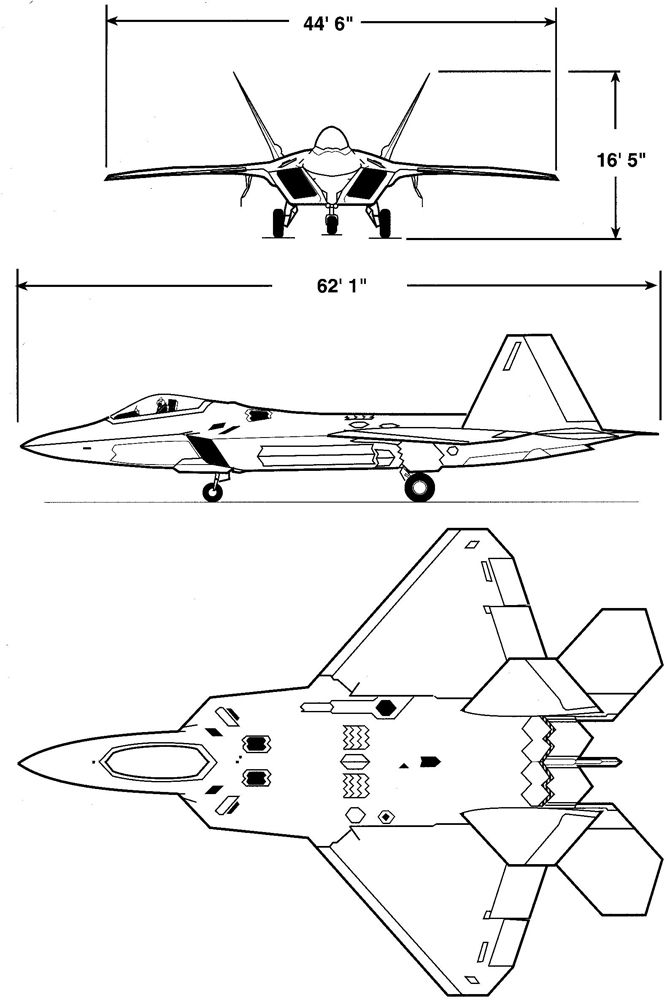
Three-view drawing
.jpg)
.jpg)
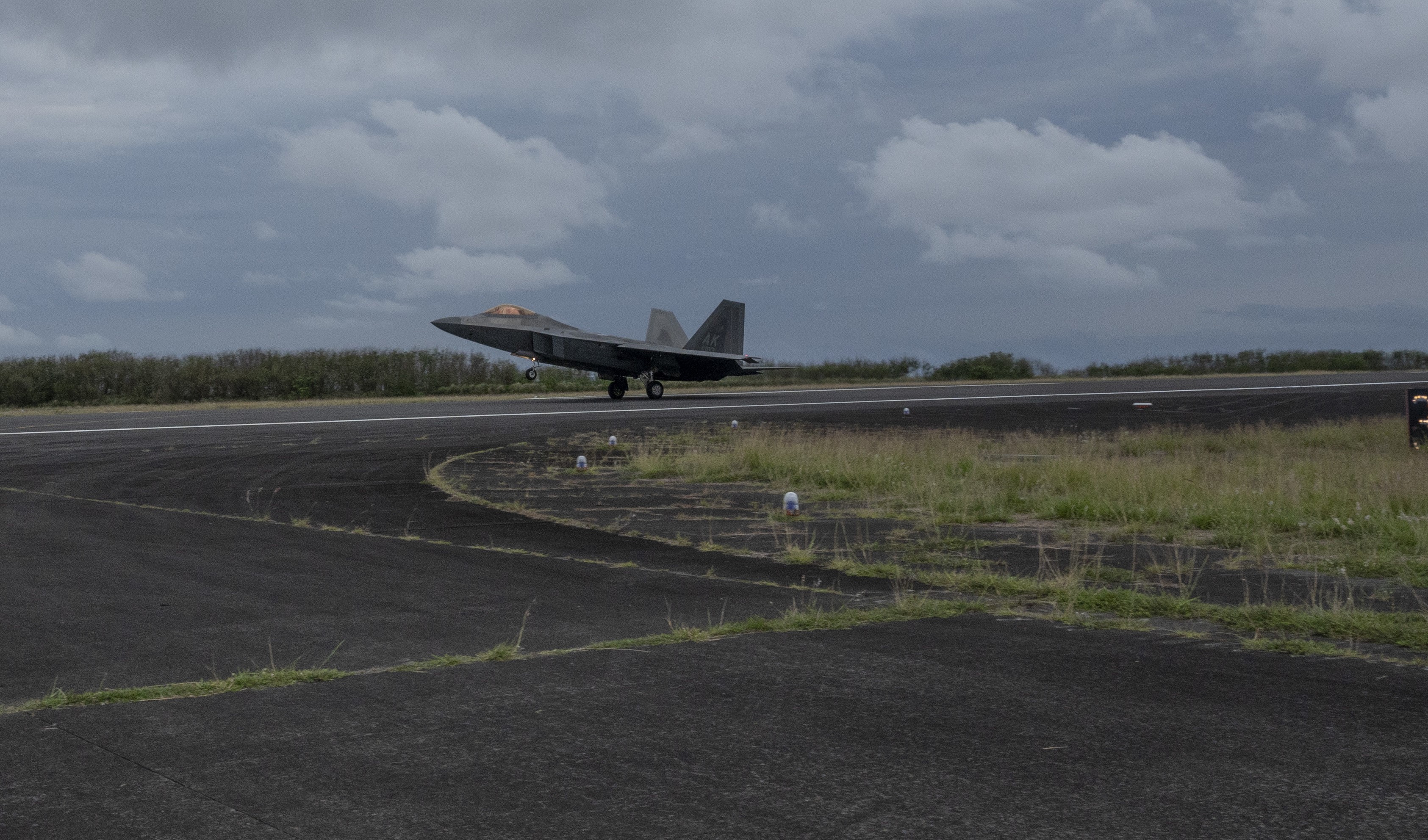
History
The ATF programme: why the USAF wanted another fighter (1981-1986)
The F-22 did not begin with a blank sheet of paper but with an intelligence assessment. In the early 1980s the United States Air Force concluded that the effectiveness of the F-15 Eagle and the F-16 Fighting Falcon would be eroded by a combination of emerging Soviet threats: new surface-to-air missile systems folded into dense integrated air defence networks, the entry into service of the Beriev A-50 "Mainstay" as an airborne early-warning and control platform, and the proliferation of fighters in the class of the Sukhoi Su-27 "Flanker" and the Mikoyan MiG-29 "Fulcrum". In 1981 the USAF launched the Advanced Tactical Fighter (ATF) programme to replace both types, under the code name "Senior Sky".
The scenario that shaped the design was very specific: a Soviet and Warsaw Pact invasion of Central Europe. In that setting the ATF was to spearhead offensive and defensive counter-air operations in a heavily contested environment, so that NATO's subsequent waves of strike and attack aircraft could reach the ground formations behind the front. The USAF therefore bet on an ambitious leap in capability and survivability built on the fighter-design technologies then appearing on the horizon: composite materials, lightweight alloys, advanced flight controls and avionics, more powerful propulsion able to sustain supersonic cruise — supercruise, envisaged at about Mach 1.5, and low-observable design.
The administrative process was long. The USAF issued a request for information to industry in May 1981; concepts and specifications were then worked up over several years, and in September 1985 the programme office in charge of the ATF put out the request for proposals covering the demonstration and validation phase (Dem/Val), whose requirements leaned heavily on stealth, supersonic cruise and manoeuvre. That request did not stay as issued: signature reduction targets were tightened in December 1985 and, in May 1986, flying technology demonstrators became a requirement in their own right. Given the immense investment needed to mature those technologies, teaming among companies was encouraged.
Seven companies bid, and on 31 October 1986 two of them went through as Dem/Val finalists. Lockheed ran its bid out of the Skunk Works at Burbank, California, in partnership with Boeing and General Dynamics; Northrop paired up with McDonnell Douglas. Each team faced fifty months of work whose end point was flying two technology demonstrators, the Lockheed YF-22 on one side and the Northrop YF-23 on the other. One nuance is often lost in the popular account: although the two designs competed, the prototypes existed to prove the concept viable and to retire risk, not to stage a competitive flyoff. The engine was contested separately, Pratt & Whitney against General Electric.
Demonstration, validation and the 1987 redesign
Dem/Val focused on systems engineering, technology development plans and risk reduction rather than on freezing a point aircraft design. The proof is that after the down-select, weight analysis drove the Lockheed team to redraw the airframe configuration from scratch in the summer of 1987; notable changes included moving the wing planform from swept trapezoidal to a diamond-like delta and reducing the forebody planform area.
The work rested on analytical and empirical methods applied on an unusual scale: computational fluid dynamics and computer-aided design, eighteen thousand hours of wind tunnel testing during Dem/Val alone, and radar cross-section calculations and pole testing. Avionics were exercised in ground prototypes and flying laboratories. During this phase the programme office drew on trade studies from both teams to go back over the system specifications, adjusting or striking out those requirements that drove weight and cost hardest while adding little in return. The short takeoff and landing requirement was relaxed enough to delete the thrust reversers, saving substantial weight; the dedicated infrared search and track set and the side-looking radars were eventually removed as well, though space and cooling provisions were retained so they could be added later, and the ejection seat reverted from a clean-sheet design to the ACES II already in service. For all the effort both teams put into holding weight down, takeoff gross weight estimates grew from 22,700 to 27,200 kg (50,000 to 60,000 lb), which in turn pushed the engine thrust requirement from the 133 kN class to the 156 kN class (30,000 to 35,000 lbf).
Each team built two prototype air vehicles, one for each of the competing engines. The YF-22 flew for the first time on 29 September 1990 and, over the test campaign, showed that it could supercruise, manoeuvre at high angles of attack and fire air-to-air missiles out of its internal bays. Once the flying at Edwards Air Force Base was over, both teams handed in their results together with their proposals for full-scale development; that was in December 1990. The verdict came on 23 April 1991, when Donald Rice, then Secretary of the Air Force, named the Lockheed team winner of the aircraft competition and Pratt & Whitney winner of the engine competition.
Both designs met or exceeded every performance requirement. The YF-23 was considered stealthier and faster; the YF-22 was the more manoeuvrable of the two thanks to its thrust vectoring nozzles, and it was also cheaper and carried less risk, since it had accumulated far more test sorties and flight hours than its rival. The press also speculated that the Lockheed design lent itself better to the Navy Advanced Tactical Fighter, the carrier variant with which the US Navy intended to replace the F-14 Tomcat. That programme, which would have required variable-geometry wings to lower approach speeds while retaining Mach 2 class performance, along with an expanded weapons load including the AIM-152 AAAM, the AGM-88 HARM and the AGM-84 Harpoon, was cancelled in 1991 as budgets tightened, and by fiscal year 1992 the Navy had abandoned it.
Full-scale development: from YF-22 to F-22 (1991-1997)
The programme formally moved to full-scale development — engineering and manufacturing development, or EMD — in August 1991. The production design, internally designated Configuration 645, had evolved appreciably away from the YF-22, an immature aircraft because it had been frozen relatively soon after the 1987 configuration redesign. While the overall layout remained recognisable, the external geometry changed a great deal: the wing leading-edge sweep was reduced from 48° to 42°; the vertical stabilizers were shifted rearward and reduced in area by 20 per cent; the radome was reshaped to improve radar performance; the wingtips were clipped so that antennas could go there, and the dedicated airbrake disappeared. The canopy was moved forward so that the pilot could see better 18 cm (7 inches) and the engine inlets moved rearward 36 cm (14 inches). Overall length fell by 0.6 m (2 feet) while wingspan grew by 0.5 m (1.5 feet). The trailing edges of the fuselage, the wing and the stabilators were reworked with aerodynamics, structural strength and stealth all in view, and the airframe was sized for 8,000 flight hours of service life. The revised shaping was validated with more than seventeen thousand additional hours of wind tunnel testing and with radar cross-section testing at Helendale, California, and at the USAF RATSCAT range before first flight. Weight growth during EMD, driven by demanding ballistic survivability requirements and added capabilities, slightly reduced projected range and manoeuvre performance.
Beyond what the airframe and the propulsion system brought, no combat aircraft had until then carried avionics of this complexity or this scale, integrating multiple sensor systems and antennas — electronic warfare, communications, identification friend or foe — and software amounting to 1.7 million lines of Ada. Time and again the avionics became the pacing factor for the entire programme. With computing and semiconductor technology moving fast, the design adopted the Department of Defense's PAVE PILLAR systems architecture and the technology of the Very High Speed Integrated Circuit programme; the computing and processing requirements were equivalent to those of several contemporary Cray supercomputers in order to achieve sensor fusion. To gain early looks and to troubleshoot mission software development, the code was run on the ground at Boeing's Avionics Integration Laboratory and in the air aboard a Boeing 757 fitted with the avionics and sensors of the F-22, the so-called Flying Test Bed. Because much of the avionics design took place in the 1990s, precisely as the electronics industry stopped treating the military as its predominant market, later upgrade efforts were initially difficult and protracted owing to shifting industry standards: C and C++, for instance, displaced Ada as the predominant languages.
The roughly equal division of work carried through from Dem/Val to EMD: Lockheed, as prime contractor, took the forward fuselage and the control surfaces; General Dynamics the centre fuselage; Boeing the wings and the aft fuselage. In 1993 Lockheed bought General Dynamics' fighter business at Fort Worth, Texas, and with it most of the airframe manufacturing; two years later it merged with Martin Marietta, and the result was Lockheed Martin. Dem/Val work had been performed mostly at the Skunk Works sites in Burbank and Palmdale, California, but the programme office and EMD work moved to Marietta, Georgia, where final assembly took place; Boeing manufactured airframe components, integrated the avionics and developed the training systems in Seattle, Washington.
As first written, the EMD contract covered nine aircraft: seven single-seat F-22As and two F-22Bs with a second cockpit. The two-seater fell in 1996 as a way of trimming development costs, and the pair became single-seaters like the rest. Tail number 91-4001, the first F-22A, was rolled out on 9 April 1997 at Air Force Plant 6, on Dobbins Air Reserve Base in Marietta, and it was there that the name "Raptor" became official. Alfred "Paul" Metz, the chief test pilot, took it up for the first time on 7 September 1997. For a little over three years the aircraft answered to a different designation, F/A-22, adopted in September 2002 as an echo of the Navy’s F/A-18 Hornet and meant to advertise the ground-attack role then planned, at a moment when the aircraft’s purpose and relevance were being argued over. The original designation came back in December 2005, the month the type entered service.
The flight test programme
The flight test programme comprised flight sciences, developmental test and initial operational test and evaluation by the 411th Flight Test Squadron at Edwards, plus follow-on operational test and evaluation and the work on tactics and operational employment carried out at Nellis Air Force Base, in Nevada, by the 422nd Test and Evaluation Squadron. Nine EMD jets assigned to the 411th flew under the Combined Test Force at Edwards. Envelope expansion fell to the first two — flying qualities, air vehicle performance, propulsion, stores separation — while the third, the first built with internal structure to production standard, took on flight loads, flutter and stores separation, and two non-flying F-22s were built for static and fatigue testing. Subsequent EMD aircraft and the Boeing 757 Flying Test Bed tested avionics, environmental qualifications and observables, and the first combat-capable Block 3.0 software flew in 2001.
Testing of the air vehicle produced a series of structural changes, several of them retrofitted to the earlier lots; one was a stiffer tail fin, the answer to buffeting encountered under certain conditions. Raptor 4001 stopped flying in 2000 and went to Wright-Patterson Air Force Base, where it served survivability work: live fire trials and training in battle damage repair. Other EMD airframes withdrawn from the test programme ended their days as maintenance trainers.
When the Cold War ended and the Soviet Union broke up in 1991, the effect on programme funding was enormous, since the F-22 had been designed to defeat existing and projected Soviet fighters. The Department of Defense lowered the urgency of new weapons systems and the following years brought successive budget cuts, so EMD was rephased — reprogrammed and extended — several times. The aircraft's sophistication and numerous innovations also demanded extensive testing, which aggravated cost overruns and delays, particularly in mission avionics. Some capabilities were deferred to post-service upgrades, lowering initial cost while raising the total programme cost. Full-rate production began in March 2005 and EMD was completed that December, after the test force had flown 3,496 sorties and more than 7,600 hours. In 2006 the F-22 development team received the Collier Trophy, the most prestigious award in American aviation.
Production, procurement and the arithmetic of the cuts
The USAF initially envisaged an order of 750 ATFs at a total programme cost of 44.3 thousand million dollars and an acquisition cost of 26.3 thousand million in fiscal year 1985 dollars, with production due to start in 1994 and the type in service somewhere between the middle and the end of the 1990s; in essence a one-for-one replacement of the F-15A/B/C/D air superiority fleet. The 1990 Major Aircraft Review, led by Secretary of Defense Dick Cheney, cut the figure to 648 aircraft, pushing production to 1996 and service entry into the first half of the 2000s. Once the Cold War was over the 1993 Bottom-Up Review brought the number down to 442, and the USAF eventually settled its requirement at 381 aircraft to sustain its expeditionary force structure, with final deliveries in 2013.
Throughout development and production the programme faced relentless scrutiny over cost, and cheaper alternatives such as upgraded versions of the F-15 or F-16 were proposed, even though the USAF held that the F-22 offered the greatest capability increase per dollar against peer adversaries. Unstable funding had pared the total down to 339 by 1997, and in 1999 Congress came within a hair of halting production. Although funding was restored, the projected number kept falling because of EMD delays and overruns, reaching 277 in 2003. In 2004, with attention absorbed by counterinsurgency in Iraq and Afghanistan, the Department of Defense under Donald Rumsfeld cut procurement to 183 production aircraft despite the Air Force requirement for 381; that figure was funded through a multi-year contract awarded in 2006, with the aircraft distributed across seven combat squadrons, and the total programme cost was projected at 62 thousand million dollars, equivalent to some 92.5 thousand million in 2024 terms. In 2008 the defence appropriations act raised the number to 187.
Production supported more than a thousand subcontractors and suppliers across 46 states and as many as 95,000 jobs, ran for fifteen years and peaked at a rate of roughly two aircraft a month, about half the rate anticipated in 1990; the contract for the first production lot was signed in September 2000. As manufacturing wound down in 2011 the total programme cost was estimated at some 67.3 thousand million dollars — close to 360 million per production aircraft delivered, of which 32.4 thousand million went on research, development, test and evaluation and 34.9 thousand million on procurement and military construction, all in then-year dollars. Adding one more F-22 at the margin was estimated to cost 138 million in 2009, equivalent to about 196 million in 2024.
In all, 195 F-22s came off the line. The first two, EMD airframes, were built to the Block 1.0 configuration for early testing and envelope expansion; the third was a Block 2.0 with production-representative internal structure, which let it be flown to full flight loads. A further six EMD aircraft followed in Block 10 configuration for upgrade development and testing, and the last two were considered essentially of production quality. What went to the operational squadrons was 74 training aircraft in Block 10/20 and 112 combat aircraft in Block 30/35, a total of 186 — or 187 if production-representative test vehicles and certain EMD aircraft are counted; one of the Block 30 jets is dedicated to flight sciences at Edwards. By 2020 the Block 20 aircraft from Lot 3 onward had been upgraded to Block 30 standard under the Common Configuration Plan, raising the Block 30/35 fleet to 149 aircraft and leaving 37 in Block 20 configuration for training.
Cost under scrutiny: statutory caps and the GAO reports
Few weapons programmes have been audited as relentlessly as this one, and the run of reports by the Government Accountability Office (GAO) and the Congressional Research Service (CRS) makes it possible to follow, year by year, the tension between what the Air Force wanted to buy and what Congress was willing to pay for. The first serious warning came in June 1996, when the Air Force's Assistant Secretary for Acquisition set up a Joint Estimating Team to work out the most probable cost of the programme and to identify realistic ways of holding it down. In January 1997 the team concluded that costs would rise by roughly $1.5 billion above previous estimates and that more time would be needed to finish the engineering and manufacturing development phase; its restructuring recommendations were adopted by both the Air Force and the Department of Defense.
Congress reacted with unusual bluntness. Statutory spending limits arrived with the fiscal year 1998 National Defense Authorization Act, passed in November 1997: $18.688 billion for development and $43.4 billion for production. What the law did not do was state how many aircraft that money had to buy, so the cap bore on the wallet rather than on the fleet: if unit cost rose, the quantity fell by itself. Both ceilings could be adjusted for inflation after 30 September 1997 and for changes in law, and the Air Force soon reset them to $18.939 billion for development and $40.940 billion for production; in later years the production limit stood at $37.6 billion and then $37.5 billion depending on the adjustment in force. Roughly $1.575 billion associated with the six production representative test vehicles fell outside the calculation altogether, although the cap did include some $200 million of advance procurement tied to them.
Much of the programme's financial balance rested on the so-called production cost reduction plans. Airframe and engine contractors, working with the programme office, eventually identified about 1,240 such plans worth a combined $21 billion. In August 2000 the GAO warned that close to half of those savings had yet to be realised: of ten plans reviewed, worth $6.8 billion between them, four — accounting for $5.6 billion — might not be achievable because they depended on decisions reserved to the Office of the Secretary of Defense or to Congress, and one worth about $1.5 billion needed legislative approval for multiyear procurement. By 2001 contractors put the plans at some $26.5 billion, yet official estimates diverged strikingly: for the 333 aircraft then planned, Air Force estimators projected $39.6 billion while the Office of the Secretary of Defense put it at $46.6 billion, both figures reached by adding $1.1 billion for two aircraft approved in fiscal year 1999 to projections of $38.5 billion and $45.5 billion for 331 aircraft. Both exceeded the statutory ceiling, and the GAO recommended that they be reconciled.
By 2003 the Department of Defense had identified around $18 billion of estimated production cost growth in just six years. The GAO noted that the Air Force had not fully funded the production improvement programmes, so their expected $3.7 billion of offsets might never arrive, and that the current official estimate left out roughly $1.3 billion that ought to have been counted. A year later, in 2004, the diagnosis was harsher: development costs had grown by 127 per cent to $28.7 billion; the Office of the Secretary of Defense reckoned the expanded air-to-ground capability would need as much as $11.7 billion of modernisation funding; and the Air Force had concluded that new avionics processors and a new architecture were required to support most of the planned enhancements, adding further cost and risk. If the production cap then in force, $36.8 billion, held and procurement money was diverted to cover development, the arithmetic led to one place only: fewer aircraft.
In March 2005 the GAO put the cost of the programme, after the recent budget cut, at $63.8 billion for 178 aircraft, and pressed the Air Force for a fresh business case to justify both the quantities and the added capabilities — expanded ground attack and new intelligence missions — warning that without one the service would be at a disadvantage when the time came to defend its modernisation plan against future budget pressure. That same year the decision to end procurement once fiscal year 2008 closed, together with the prospect of further cuts, weakened that business case still more, according to the GAO's testimony to the Senate. From then on the Raptor was rarely analysed alone: the office examined it alongside the Joint Strike Fighter as a pair representing a prospective future investment above $240 billion, presented in March 2006 as a joint commitment of almost $320 billion, of which some $75 billion had already been appropriated and about $245 billion remained to be spent over two decades; the fiscal year 2007 request for the two programmes alone exceeded $8 billion. By 2007 the frame was wider still: the Department of Defense had spent $534 billion over three decades developing, procuring and modifying its tactical air forces, and planned to invest $109.3 billion between 2007 and 2013 to buy about 570 new aircraft and modernise hundreds more. In that report the GAO summed up the Raptor's case in a sentence that explains its whole industrial history: since the programme began, the development period had doubled in length, the threat picture had shifted, fresh requirements for ground attack and intelligence gathering had been piled on and unit costs had more than doubled — with the result that steadily fewer aircraft came within the reach of the Air Force budget.
The export ban
To prevent the inadvertent disclosure of stealth technology and classified capabilities to American adversaries, the annual Department of Defense appropriations acts have since fiscal year 1998 carried a provision barring the use of that year's funds to approve or authorise any sale of the F-22 abroad. Foreign buyers of American fighters have therefore had to settle for older types — the F-15 Eagle, the F-16 Fighting Falcon — or for the F-35 Lightning II, a later design that inherits F-22 technology but was conceived to be less costly, more flexible and exportable. Congress upheld the ban in September 2006. Even so, the 2010 defence authorisation act included provisions requiring the Department of Defense to report on the cost and feasibility of an export version and on the effect of foreign sales on the American aerospace industry.
Several Australian officials and politicians expressed interest: in 2008 Air Chief Marshal Angus Houston, then Chief of the Defence Force, said the Royal Australian Air Force was considering the type as a possible complement to the F-35, and some commentators argued for buying it instead instead of the F-35s then planned, weighing the F-22's proven capabilities against the delays and uncertainties of the rival programme. The idea was eventually abandoned, and the F/A-18E/F Super Hornet covered the Australian interim requirement until the F-35 arrived. The Japanese government also showed interest, with reports that the Air Self-Defense Force could do its job with fewer fighters were it to obtain the F-22, saving on engineering and personnel; with production closing, Japan selected the F-35 in December 2011. The Israeli Air Force aspired to buy as many as fifty F-22s, but in November 2003 its representatives said that years of study and of talks with Lockheed Martin and with the Department of Defense had led them to conclude that Israel could not afford it; Israel too ultimately bought the F-35.
The provision originated in an amendment by Representative David Obey that barred selling F-22s to any foreign government, written into the appropriations act and renewed year after year thereafter. The text does allow the Department of Defense to carry out studies and design work towards an eventual export version that protects classified and sensitive information — a door left ajar that was never walked through. The Japanese case went furthest in the debate: a Congressional Research Service analysis devoted entirely to that possibility recorded that Air Force leaders said they required 381 aircraft and lacked the funds to buy the 198 additional ones beyond the 183 then authorised, the last of which would be procured with fiscal year 2009 money. The discussion sharpened precisely because the end of procurement funding and the closure of the assembly line were approaching: an export order would have extended the programme's industrial life. The arguments in favour that the report gathered were the health of the American industrial base, the contribution to the defence of Japan and of the region, and improved interoperability with Japanese forces; against them weighed the risk of technology transfer, Japan's own restraints on acquiring and exporting armaments, and the existence of alternatives — the F-35, the F/A-18E/F Super Hornet, advanced F-15 versions, unmanned combat aerial vehicles and European options — which in the end settled the matter without the ban having to be lifted.
The end of the line and the debate about reopening it
Across the 2000s, with the United States engaged above all against insurgencies in Iraq and Afghanistan, the figure of 381 F-22s came under question on several fronts at once: costs that kept climbing, early trouble with reliability and availability, thin multirole versatility and a shortage of adversaries worth an air combat mission. David Walker, then Comptroller General of the United States, reported in 2006 that the Department of Defense had not demonstrated any need for further investment in the aircraft. Objections came too from Secretary of Defense Rumsfeld and from Robert Gates, who followed him; from Deputy Secretary of Defense Gordon R. England; and from Senators John Warner and John McCain. Two forced resignations in 2008, those of Michael Wynne as Secretary of the Air Force and of General T. Michael Moseley as Chief of Staff, cost the aircraft influential backers. That November Gates judged it of little relevance to the asymmetric conflicts of the post-Cold War world and, in April 2009, with the Obama Administration in office, asked for the line to close in fiscal year 2011 once 187 aircraft had been completed.
The Pentagon itself finished off what political support remained. Appearing before the Senate Armed Services Committee in July 2008, General James Cartwright, at that time Vice Chairman of the Joint Chiefs of Staff, laid out why he backed termination: resources were better moved to the F-35, shared across services, and to the EA-18G Growler for electronic warfare. Fighter developments in Russia and in China did worry the USAF, but Gates brushed the argument aside and in 2010 fixed the requirement at 187 aircraft, having cut from two to one the number of major regional conflicts the force was to prepare for. Michael Donley and General Norton Schwartz, who had taken over from Wynne and from Moseley, pressed for 243 and got nowhere; by Schwartz's account the two gave way in exchange for Gates keeping the long-range strike bomber programme alive. Once President Barack Obama, urged on by Gates, threatened to veto any further production, Senate and House both accepted the ceiling of 187, in July 2009. Airframe number 195, the last of the line, was completed in December 2011 — eight test and 187 production aircraft — and the jet was delivered on 2 May 2012.
Once production ended, the neither the tooling nor the documentation that went with it was disposed of: both were placed in storage at the Sierra Army Depot, so that repairs and maintenance could be supported for as long as the fleet flew and so that a restart of production, or a service life extension, would not be foreclosed. The Marietta plant space was repurposed for the C-130J and the F-35, while sustainment and upgrade engineering continued at Fort Worth and Palmdale. The curtailed production obliged the USAF to keep 179 F-15C/Ds flying into the late 2020s, far past the date set for their retirement, simply to hold air superiority fighter numbers at an adequate level.
In April 2016 Congress directed the USAF to study the cost of resuming production, with the advancing Russian and Chinese threat as the reason. The answer came on 9 June 2017: the Air Force reported that it had no plans to restart the line because of cost-prohibitive economic and logistical challenges: it estimated approximately 50 thousand million dollars to procure 194 additional F-22s at 206 to 216 million per aircraft, including roughly 9.9 thousand million in non-recurring start-up costs and 40.4 thousand million for acquisition, with nothing delivered before the second half of the 2020s. So many years after the closure of the line, workers would have to be hired afresh, vendors replaced and plant space located, all of which pushed cost and lead time up. The USAF argued that the money would be better invested in its Air Superiority 2030 effort, the seed of what became the Next Generation Air Dominance programme; to replace the remaining F-15C/Ds it began procuring new-build F-15EX from 2019, keeping start-up costs low because an export line was already running.
The Congressional Research Service recorded the shutdown in administrative terms: the Marietta line was stopped and its tooling and equipment placed in storage, so any reopening would have to begin by retrieving them. The figures floated for that hypothesis were strikingly optimistic on the manufacturer's side: Alison Orne, a spokeswoman for Lockheed Martin, put the cost of bringing the line back at under $200 million in an email — "a fraction of the costs seen in previous line restarts of other weapons systems", citing a preliminary analysis. The report itself cautioned that the real cost of a restart, and its knock-on effect on unit cost, was unclear.
Configuration, structure and powerplant
The F-22 is a fifth-generation air superiority fighter that the USAF itself considers fourth generation in stealth aircraft technology. It was the first operational aircraft to combine supercruise, supermanoeuvrability, stealth and integrated avionics — sensor fusion — in a single weapons platform, so as so that it could survive in highly contested environments and carry out its missions there, above all counter-air operations both offensive and defensive.
Its shape reconciles stealth with aerodynamic performance. The edges of the planform and of the panels share a small set of angular aspects, and the surfaces, aligned accordingly, have continuous curvature to minimise radar cross-section. The clipped diamond-like delta wing has the leading edge swept 42°, the trailing edge swept −17°, a slight anhedral and conical camber to reduce supersonic wave drag. Shoulder-mounted, it blends smoothly into the fuselage by way of four empennage surfaces and leading-edge root extensions that run to the upper edges of the caret inlets, where the forebody chines also converge. For flight control there are leading-edge flaps, flaperons and ailerons, rudders on the canted vertical stabilizers, and horizontal tails that move as a whole; for air braking the ailerons deflect up, the flaperons down and the rudders outwards to increase drag. Because of the emphasis placed on supersonic performance, area ruling is applied throughout and nearly all fuselage volume lies ahead of the wing trailing edge, while the stabilators pivot on tail booms that run back past the engine nozzles. Weapons go inside the aircraft for stealth. A retractable tricycle landing gear, an emergency tailhook, a fire suppression system and a fuel tank inerting system complete the picture.
Two Pratt & Whitney F119 augmented turbofans sit close together in the aft fuselage, each exhausting through a rectangular two-dimensional nozzle that vectors ±20° in pitch and answers directly to the flight controls and to the vehicle management system. Control of each engine falls to a dual-redundant Hamilton Standard full-authority digital unit, and maximum thrust belongs to the 156 kN (35,000 lbf) class. At a typical combat weight the aircraft is close to a one-to-one thrust-to-weight ratio in maximum military power, and reaches 1.25 with the afterburners lit. The caret inlets are fixed, shoulder-mounted and held clear of the forward fuselage so that the turbulent boundary layer passes them by; oblique shocks form at their upper inboard corners, which is what recovers total pressure well and compresses the supersonic flow efficiently. Clean, the aircraft supercruises at about Mach 1.8 on military power and exceeds Mach 2 with afterburner. With 8,165 kg (18,000 lb) of internal fuel plus 3,629 kg (8,000 lb) in two 2,270 L (600 US gallon) external tanks, ferry range exceeds 2,960 km (1,600 nautical miles, 1,840 miles). The refuelling boom receptacle is centred on the spine and the auxiliary power unit is embedded in the left wing root.
Cruise speed and operating altitude higher than those of earlier fighters improve the effectiveness of sensors and weapons and increase survivability against surface defences. Supercruise allows the aircraft to intercept targets that afterburner-dependent fighters would lack the fuel to reach, and internal carriage avoids the parasitic drag of external stores. Thrust and aerodynamics together allow the aircraft to fight routinely at Mach 1.5 and 15,000 m (50,000 feet), which translates into 50 per cent more launch range for its air-to-air missiles, and double the effective range for JDAMs, compared with earlier platforms. The structure uses a substantial amount of high-strength material to withstand the stress and heat of sustained supersonic flight: titanium alloys account for 42 per cent of structural weight and bismaleimide/epoxy composites for 24 per cent, and both the materials and the multiple load path structural design contribute to ballistic survivability.
Aerodynamics, relaxed stability and powerful vectoring engines give the aircraft excellent manoeuvrability and energy potential across the envelope, with the capability for nine-g manoeuvres at takeoff gross weight and full internal fuel. Large control surfaces, vortex-generating chines and leading-edge root extensions, and vectoring nozzles produce outstanding high angle-of-attack characteristics: it can fly at a trimmed alpha of over 60° while retaining roll control and can perform manoeuvres of the sort of Pugachev's Cobra or the Herbst manoeuvre. The vertical tails took more vortex impingement, and therefore more buffeting, than had been anticipated, so the fin structure had to be stiffened by replacing the composite rear spar with one of titanium. The triplex-redundant fly-by-wire control system and the digital engine control make the F-22 highly departure-resistant and give the pilot carefree handling.
Stealth: what is known and what is not
Detection and tracking by radar were meant to be as hard as possible, and that governed the design: incoming radio waves are to be reflected, scattered or diffracted into particular sectors away from the emitter, or else soaked up and attenuated. Several things bring the radar cross-section down. The airframe is shaped with its edges aligned and its surfaces continuously curved; the weapons ride inside; the inlet ducts follow a fixed serpentine path and curved vanes block any exterior line of sight to fan faces and turbines; radar-absorbent material is applied; and details that might return a signal, hinges or the helmet of the pilot among them, were attended to one by one. The same effort went into radio frequency emissions, into the infrared and acoustic signatures and into what the naked eye can pick out. The rectangular vectoring nozzles flatten the exhaust plume and, through the vortices they shed, help it mix with the surrounding air, which lowers infrared emission and complicates the work of heat-seeking missiles; a special topcoat and active cooling manage the heat built up in supersonic flight.
Set against earlier stealth designs, the F-22 leans less on radar-absorbent material — maintenance-intensive and susceptible to adverse weather — and can be repaired on the flight line or in an ordinary hangar without climate control. It incorporates a signature assessment system that warns when the radar signature has degraded and repair is required. The exact value is classified, but information put out by Lockheed Martin in 2009 indicated a radar cross-section of 0.0001 m² from certain angles, or −40 decibels relative to a square metre, which the manufacturer likened to the return of a "steel marble"; for exercises and transits it can mount a Luneburg lens reflector to mask that value. On the missions that demand stealth, mission capable rates run between 62 and 70 per cent. From 2021 onwards the aircraft has been photographed with a chrome-like surface coating under test, speculated to help reduce its detectability by infrared tracking systems.
Those figures deserve caution, because the real effectiveness of stealth is hard to gauge. The radar cross-section value is a restrictive measurement of the frontal or side area as a static radar sees it; the moment the aircraft manoeuvres, a wholly different set of angles and surfaces comes into view and it may turn more observable. Moreover, the contouring and the absorbent materials tell above all against radars of high frequency, the kind usually carried by other aircraft; Rayleigh scattering and resonance effects mean that low-frequency radars such as weather and early-warning sets are more likely to detect the F-22 because of its physical size, though those radars are conspicuous, susceptible to clutter and imprecise. A faint or fleeting contact tells defenders that a stealth aircraft is present, but reliably vectoring an interception against it is far harder.
Avionics and sensor fusion
Integration is the point of the F-22's avionics: sensor fusion takes what every sensor aboard reports, adds what arrives from off-board, filters and processes the whole and returns a single tactical picture, which widens the awareness the pilot has of the situation while lightening the load on him. Five systems carry the mission. The AN/ALR-94 for electronic warfare comes from Sanders and General Electric; the AN/AAR-56 missile launch detector, working in the infrared and the ultraviolet, from Martin Marietta; the AN/APG-77 active electronically scanned array radar from Westinghouse and Texas Instruments; the AN/ASQ-220 suite for communication, navigation and identification from TRW; and an advanced infrared search and track sensor, still under test, from Raytheon.
Behind its radome the APG-77 carries an active-aperture electronically scanned antenna of low observability, tilted back for the sake of stealth, able to track several targets while scanning and to do so in any weather. Its emissions can also be concentrated so as to swamp an enemy sensor, which turns the radar into a means of electronic attack. Frequency hops occur at a rate above a thousand a second, which lowers the probability of interception; against a target of 1 m² the estimated range runs from 201 to 241 km (125 to 150 miles), and in narrow beams it reaches 400 km (250 miles) or beyond. Air-to-ground work arrived with the improved APG-77(V)1: mapping by synthetic aperture, indication and tracking of moving ground targets, and strike modes.
The ALR-94, among the most technically complex equipment aboard, integrates more than thirty antennas blended into wings and fuselage for all-round radar warning coverage and threat geolocation. It can serve as a passive detector able to search for targets at ranges beyond 250 nautical miles, exceeding the radar's own reach, and can gather enough information for a target lock by means of narrowband interleaved search-and-track while cueing radar emissions into a very narrow beam, as tight as 2° by 2° in azimuth and in elevation. According to which threat has been detected, the defensive systems may suggest to the pilot that he release countermeasures, flares or chaff. Stealth in the radio frequency spectrum requires that the ASQ-220 emit under strict control and only into given sectors, and tactical communication between F-22s uses the directional inter/intra-flight data link. That suite also manages TACAN, identification friend or foe including Mode 5, and communication through HAVE QUICK/SATURN, SINCGARS and, later, Link 16. The AAR-56 adds passive detection with six sensors giving full spherical infrared coverage and is being updated to the TacIRST; the advanced infrared search and track sensor, carried in a stealthy wing pod, works over a narrow field of view and serves to identify and target passively at long range. An automatic system for avoiding ground collision was added as well.
Information from the radar, the communication and navigation suite and the other sensors passes to two mission computers of the Hughes common integrated processor family, each able to execute up to 10.5 thousand million instructions per second. The baseline software runs to some 1.7 million lines of code, most of it in the mission systems. Precisely because the avionics architecture is so tightly integrated and because Ada was used, developing and testing upgrades proved challenging, so the processors were upgraded with Curtiss-Wright open mission systems modules and a modular open systems architecture that lets the suite interface with containerised third-party software. The IEEE 1394B bus, developed expressly for this aircraft, derived from the commercial FireWire bus. In 2007 the radar was trialled as a wireless data transceiver: it transmitted at 548 megabits per second and received at gigabit speed, far beyond what Link 16 allows.
Because it can work close to the battlefield, the Raptor detects and identifies threats about as well as an RC-135 Rivet Joint and can stand in as a "mini-AWACS", even though its radar has less power than those of the platforms built for the job. From there it can hand targets quickly to allies and coordinate friendly aircraft. At first it could only talk to other types by voice, but upgrades have enabled data transfer through a battlefield airborne communications node or via Link 16 traffic through MIDS-JTRS terminals. Its radio frequency receivers additionally provide electronic support measures and let the aircraft take on intelligence, surveillance and reconnaissance tasks.
Cockpit, life support and armament
The cockpit is fully digital. A monochrome head-up display of wide field of view acts as the primary flight instrument, with information also distributed across six colour liquid-crystal displays. Primary controls are a force-sensitive side stick and a pair of throttles. The USAF wanted to implement direct voice input but judged it too technically risky and abandoned it. The canopy measures roughly 355 cm long, 115 cm wide and 69 cm high (140 by 45 by 27 inches) and weighs 360 pounds; it had to be redesigned because the original lasted an average of 331 hours against a required 800. A helmet-mounted display, originally planned, was deferred during development to save cost, and only in recent years has the Scorpion helmet been integrated.
The integrated control panel is a keypad for entering communications, navigation and autopilot data. Two upper displays of 7.6 by 10.2 cm (3 by 4 inches) set around that panel show warnings and data from the communication and navigation suite and also serve as the stand-by instrument group and fuel gauge; the stand-by group presents an artificial horizon for basic instrument flight. Below the panel is the primary multi-function display of 20 by 20 cm (8 by 8 inches), dedicated to navigation and situation assessment, flanked by three secondary displays of 15.9 by 15.9 cm (6.25 by 6.25 inches) for tactical information and stores management.
For ejection there is a variant of the ACES II seat used throughout the Air Force, with a centre pull ejection control. Life support is an involved affair, made up of the onboard oxygen generating system, protective garments and a breathing regulator/anti-g valve regulating what flow and what pressure reach the mask and the garments of the pilot. Those garments, developed under the advanced technology anti-g suit project, protect against chemical and biological hazards and against immersion in cold water, offset g forces and the low pressure of great altitude, and provide thermal relief. After the series of hypoxia incidents the system was revised to add an automatic backup oxygen supply and a new valve in the vest. In combat environments the seat carries a modified M4 carbine, designated GAU-5/A, as a survival weapon.
Armament is carried in three internal bays: a large main bay on the lower fuselage and two smaller bays on the sides behind the inlets, with a small countermeasures compartment behind each of the side bays. Split along the centreline, the main bay takes six LAU-142/A launchers for missiles of beyond-visual-range missiles, while each side bay carries one LAU-141/A launcher for a short-range missile. The principal weapons are the AIM-120 AMRAAM and the AIM-9 Sidewinder; integration of the AIM-260 JATM is planned. Launching requires the doors to to open for under a second, time enough for pneumatic or hydraulic arms to throw the missile clear, reducing exposure to detection and permitting launch at high speed. A 20 mm M61A2 Vulcan rotary cannon with 480 rounds is embedded in the right wing root, its muzzle covered by a retractable door that stays closed when not firing so as not to penalise the radar signature; the projected gunfire path is displayed on the head-up display.
Although conceived with air-to-air missiles in mind, the main bay allows four of its launchers to give way to two bomb racks, each able to carry one 450 kg (1,000 lb) bomb or four 110 kg (250 lb) bombs, up to a total of 910 kg (2,000 lb) of ordnance for air-to-surface work. In 2024 Lockheed Martin unveiled its Mako hypersonic missile proposal, of 590 kg (1,300 lb), carried internally. The F-22 can employ GPS-guided weapons such as JDAMs and small diameter bombs but cannot self-designate targets for laser-guided weapons. Besides the bays, the wing has four hardpoints each rated at 2,300 kg (5,000 lb), suitable for 2,270 L (600 gallon) external tanks or for launchers carrying two air-to-air missiles; the two inboard stations are plumbed for fuel and the two outboard ones have been used for a pair of stealthy pods carrying the infrared search and track sensor and mission systems. Tanks and pylons can be jettisoned to restore low observability and kinematic performance.
Maintenance, availability and operating cost
Every 300 flight hours each F-22 goes into a packaged maintenance plan lasting three weeks. The stealth coatings were meant to stand up to handling and to weather better than those of earlier stealth aircraft, but they failed against rain and humidity when the first F-22s deployed to Guam in 2009. Stealth accounts for nearly a third of maintenance, with the coatings the most demanding element. Depot maintenance takes place at Hill Air Force Base, in Utah, at the Ogden Air Logistics Complex, with particular care given the small fleet and the limited attrition reserve.
Availability figures improved over the years: the F-22 was mission capable an average of 63 per cent of the time in 2015, as against the 40 per cent of 2005, the year of its introduction. Maintenance hours per flight hour fell from thirty at the start to 10.5 by 2009, below the requirement of twelve, though man-hours per flight hour stood at 43 in 2014. Mean time between maintenance was 1.7 hours on entry into service, short of the three hours required, and rose to 3.2 hours in 2012. The cost per flight hour in fiscal year 2015 came to 59,116 dollars, while the user reimbursement rate was about 35,000 dollars per flight hour in 2019, equivalent to roughly 42,237 in 2024 terms.
Fleet availability in the 2020s
The encouraging picture of the first decade in service reversed during the second. In a 2022 review of Air Force and Navy aviation maintenance, the GAO picked eight representative types — four per service — and tracked them from fiscal year 2015; the F-22 was one of the four Air Force types, alongside the B-1B bomber, the C-5M transport and the KC-135 tanker. Against a goal of 75 per cent, the average mission capable rate fell from 67.0 per cent in fiscal year 2015 to 60.2 per cent in 2016 and 49.0 per cent in 2017, then moved between 51.7, 50.6 and 52.0 per cent before settling at 50.3 per cent in 2021. The drop of 16.7 points over seven years was the sharpest among the Air Force types examined, matched only by the Navy's KC-130T. The figure is best read against the earlier trend: the availability gains achieved up to 2015 did not hold, and the Raptor ended the decade with fewer than two aircraft in three fit to fly a mission.
The causes documented by the office are those of a small fleet built on closed technology. Maintenance personnel from one F-22 unit described waiting 239 days in 2020 for a landing gear component to be built and delivered, and acknowledged that frequent cannibalisation of parts between aircraft masks how many are actually missing across the unit, because the spare is taken from another airframe instead of being ordered through the supply system. The F-22 and the KC-135 also share an intellectual property problem: some of the data on their components is proprietary to the manufacturer and not readily accessible to unit maintenance personnel, which hinders repairs that other types would handle in house. On top of that came shortfalls of experienced personnel in three of the type's sixteen specialties, among them low observable aircraft structural maintenance — precisely the trade that sustains the stealth — along with aircraft metals technology and the precision measurement equipment laboratory, with gaps also reported in avionics test station and aerospace propulsion specialties. Finally, the GAO recalled that a law passed in 2016 obliges each service to carry out sustainment reviews of their major weapon systems, that the Air Force had not completed them, and that its schedule stretched to fiscal year 2025; without those reviews, it warned, opportunities to spot risks to aircraft availability in time are lost.
Entry into service, training and early exercises
The F-22 was tested extensively before entering service. The first production aircraft arrived at Edwards in October 2002 for initial operational evaluation, and the first jet for the 422nd Test and Evaluation Squadron landed at Nellis in January 2003, but the evaluation slipped repeatedly from the mid-2003 start once planned, the stability of the mission avionics being the chief obstacle. After a preliminary assessment, formal evaluation began in April 2004 and finished that December, successfully demonstrating air-to-air capability although maintenance proved more intensive than expected. A follow-on evaluation in 2005 validated the air-to-ground capability.
The first combat-ready F-22, from the 1st Fighter Wing, reached Langley Air Force Base, in Virginia, in January 2005; that December the USAF announced that the type had reached initial operational capability with the 94th Fighter Squadron. The unit went on to take part in Northern Edge 06, held in Alaska in June 2006, and in Red Flag 07-2 at Nellis in February 2007, where the F-22 demonstrated overwhelming superiority in air combat against aggressor F-15s and F-16s and ran up a simulated tally of 108 kills and no losses. Those large-scale exercises also served to refine the aircraft's tactics and operational employment. Full operational capability came in December 2007, the month in which General John Corley, of Air Combat Command, declared the integrated F-22s of the 1st Fighter Wing and the Virginia Air National Guard's 192nd Fighter Wing fully operational. In the April 2008 operational readiness inspection the integrated wing was rated excellent in every category, with a simulated score of 221 to zero. The F-22's arrival brought a precision strike capability that helped push the F-117 out of operational service in 2008; the 49th Fighter Wing briefly operated the Raptor before a series of fleet consolidations aimed at reducing long-term costs, and in 2018 the Government Accountability Office recommended further consolidation to improve availability and pilot training.
Training was organised around the 43rd Fighter Squadron, reactivated in 2002 as the training unit at Tyndall Air Force Base, which received its first aircraft in September 2003. Severe damage from Hurricane Michael in 2018 forced the squadron and its aircraft to move to nearby Eglin Air Force Base; although several aircraft were initially feared lost, all were repaired and flown out. In 2023 the training unit and its aircraft moved to the 71st Fighter Squadron at Langley. By 2014 the basic course required 38 sorties to graduate, down from 43, and pilots converting from other aircraft went from 19 sorties to 12. Students first train on the T-38 Talon and receive additional instruction in F-16s, because the ageing T-38 is not qualified to sustain high accelerations and lacks modern avionics. Lacking a trainer able to emulate the Raptor faithfully, the Air Force frequently uses F-22s themselves, which is expensive: the F-22 costs nearly ten times as much per flight hour as the T-38. The future T-7 Red Hawk, with avionics closer to those of the F-22 and F-35, is scheduled to reach initial operational capability in 2027, several years later than planned. In 2014 the 2nd Fighter Training Squadron was activated at Tyndall with T-38s as aggressor aircraft to relieve the Raptors of those missions, and part of the training sortie load is substituted with simulator time to reduce costs and extend airframe life. The advanced weapons instructor course is taught by the 433rd Weapons Squadron at Nellis.
The oxygen crisis
During the early years of service F-22 pilots suffered symptoms attributable to oxygen system failures: losses of consciousness and of memory, emotional lability, neurological disturbances, along with persistent respiratory problems and a chronic cough. The issue led to a fatal accident in 2010, four months of grounding in 2011 and, after that, limits on altitude and distance. In August 2012 the Department of Defense determined that the anti-g valve inflating the pilot's vest during high-acceleration manoeuvres was faulty and restricted breathing, and that the onboard oxygen generating system fluctuated unexpectedly under high g. As early as 2005 the Raptor aeromedical working group had recommended changes to the oxygen system, but they were not funded; they were reconsidered in 2012. The F-22 Combined Test Force and the 412th Aerospace Medicine Squadron eventually identified breathing restriction as the root cause and attributed the cough to acceleration atelectasis arising from high-g exposure and from an excessive oxygen concentration supplied by the generating system. The presence of toxins and particulates affecting some ground personnel was treated as a separate matter. Once the life support and oxygen systems had been modified, an automatic backup among the changes, the limits on altitude and distance could be lifted in April 2013.
Congressional oversight of the episode was set down in a House subcommittee hearing devoted entirely to F-22 pilot physiological issues. It yields a rather more precise chronology than the one usually summarised: the commander of Air Combat Command restricted the aircraft's maximum flight altitude to 25,000 feet and ordered a safety investigation board to go over the oxygen system; in May 2011 the Secretary of the Air Force tasked the service's Scientific Advisory Board with a study of the life support system, chaired by retired General Gregory S. Martin; and from May to September of that year the fleet stood down in the face of a rising trend of reported physiological incidents. The board finished its work in January 2012 without pinning down a cause, though it did conclude that the oxygen, whether in supply or in quality, was contributing to the symptoms, and Air Combat Command set up a dedicated Life Support System Task Force to pursue both branches. On 24 July 2012 the Department of Defense announced that the root cause was the supply of oxygen delivered to the pilots rather than its quality, and described two immediate corrections: increasing the volume of air reaching the pilot by removing a filter that had been installed during the investigation itself to check for contaminants, and replacing a valve in the upper pressure garment worn on high-altitude missions. It is worth flagging that the sources do not fully agree on either the date or the wording: the most widely circulated account places the Department of Defense determination in August 2012 and describes the faulty part as the anti-g valve of the vest that inflates during high-acceleration manoeuvres, while the congressional testimony dates the announcement to 24 July and points to the upper pressure garment valve. Both descriptions point to the same family of components in the pilot's garment, but the divergence is noted here rather than quietly resolved.
Deployments, deterrence and real employment
After reaching initial operational capability the F-22 flew in January 2007 its first mission in defence of the homeland, under Operation Noble Eagle. In November 2007 aircraft of the 90th Fighter Squadron at Elmendorf Air Force Base, Alaska, made the type's first North American Aerospace Defense Command interception, against two Russian Tu-95MS bombers; since then they have also escorted Tu-160s on probing flights.
The first overseas deployment came in February 2007, when the 27th Fighter Squadron went to Kadena Air Base in Okinawa. That debut was marred when six F-22s flying from Hickam Air Force Base in Hawaii suffered multiple computer-related system failures on crossing the international date line at the 180th meridian and had to return by following their tankers; the error was fixed within forty-eight hours and the journey resumed. Kadena became a regular rotational destination, and F-22 units have also taken part in exercises in South Korea, Malaysia and the Philippines.
Secretary Gates initially refused to deploy the F-22 to the Middle East in 2007; the type first reached the region in 2009, at Al Dhafra Air Base in the United Arab Emirates. By April 2012 rotations to Al Dhafra placed Raptors within two hundred miles of Iran. In March 2013 the USAF disclosed that one of its F-22s had intercepted an Iranian F-4 Phantom II which had closed to sixteen miles of an MQ-1 Predator then flying off the Iranian coast.
The type's baptism of fire came on 22 September 2014, when F-22s flew the first combat sorties of the type in several of the first strikes of Operation Inherent Resolve, the intervention in Syria led by the United States, and putting thousand-pound GPS-guided bombs onto Islamic State positions in the neighbourhood of the Tishrin Dam. From September 2014 to July 2015 the F-22 force put 204 sorties over Syria and dropped 270 bombs at about sixty locations. Throughout the deployment they provided close air support and deterred Syrian, Iranian and Russian aircraft from attacking American-backed Kurdish forces or interfering with American operations. They also took part in the strikes against pro-Assad paramilitary forces and the Russian Wagner group on 7 February 2018 near Khasham, in eastern Syria. Even so, their principal role in the operation was intelligence, surveillance and reconnaissance. In November 2017, alongside B-52 bombers, they struck opium production and storage facilities in Taliban-controlled areas of Afghanistan.
To improve responsiveness and reduce the logistical footprint in a conflict against a peer adversary, the USAF developed the Rapid Raptor deployment concept, proposed in 2008 by two F-22 pilots, pairing two to four F-22s with a supporting C-17 with the aim of setting up and going into action within twenty-four hours from small, austere locations, favouring a dispersed and more survivable posture. The concept was tried out on Wake Island in 2013 and on Guam late in 2014, and in August and September 2015 four F-22s went to Spangdahlem in Germany, to Łask in Poland and to Ämari in Estonia to train with NATO allies in response to the 2014 Russian annexation of Crimea. Those principles were later folded into the agile combat employment concept, which favours distributed operations; F-22 detachments have flown from bare airfields on Tinian and on Iwo Jima in the course of exercises.
A suspected Chinese spy balloon was shot down off the coast of South Carolina on 4 February 2023 by an F-22 of the 1st Fighter Wing, at an altitude of between 60,000 and 65,000 feet (20,000 m): the type's first air-to-air kill. The wreckage fell about six miles offshore and was recovered by Navy and Coast Guard vessels. F-22s shot down further high-altitude objects off the Alaskan coast on 10 February and above the Yukon on 11 February.
According to American officials, on 22 June 2025 F-22s and F-35As flying from land bases in the Middle East were sent to bait surface-to-air missile fire in advance of the B-2 bombing runs during the American strikes on Iranian nuclear facilities. In January 2026 F-22s took part, alongside F-35s, B-1s, F/A-18s, E/A-18s, assorted intelligence, surveillance and reconnaissance aircraft and numerous drones, in dismantling and disabling Venezuela's air defences to secure the passage of helicopters to the objective area, an operation that ended with the capture of the Venezuelan president, Nicolás Maduro. Then, on 28 February 2026, they they moved to Israel and took part in Operation Epic Fury, a joint American-Israeli action against Iran; according to Aviation Week, the United States had deployed F-22s along with KC-135 and KC-46 tankers ahead of the strikes.
Accidents
The first F-22 accident occurred during takeoff at Nellis on 20 December 2004; the pilot ejected safely before impact. The investigation found that a brief interruption of electrical power during a pre-flight engine shutdown had caused a flight control system failure, and the design was corrected to prevent it. After a short grounding, operations resumed following a review.
An EMD F-22 came down on 25 March 2009 some 56 km (35 miles) northeast of Edwards during a test flight, killing Lockheed Martin test pilot David P. Cooley. The Air Force Materiel Command investigation concluded that Cooley had briefly lost consciousness during a high-g manoeuvre and ejected on finding himself too low to recover; he died during ejection from blunt-force trauma caused by the airstream at the aircraft's speed. No design problems were found.
An F-22 out of Elmendorf crashed on 16 November 2010 and its pilot, Captain Jeffrey Haney, was killed. The fleet was first restricted to flight below 25,000 feet and then grounded during the investigation. The accident was attributed to a bleed air system malfunction following the detection of engine overheating, which shut down the environmental control system and the oxygen generator. The review board held Haney responsible for failing to correctly operate the emergency oxygen system. His widow sued Lockheed Martin alleging equipment defects and later reached a settlement. Following the findings, the emergency oxygen activation handle was redesigned and an automatic backup eventually took its place. On 11 February 2013 the Department of Defense inspector general published a report stating that the Air Force had erred in blaming Haney and that the facts did not sufficiently support its conclusions; the Air Force stood by its findings.
On 15 November 2012 an F-22 crashed east of Tyndall in the course of a training mission; the pilot got out safely and nobody on the ground was hurt. The investigation determined that a chafed electrical wire had ignited fluid from a hydraulic line and started a fire that damaged the flight controls. Another F-22, this one from Eglin, crashed shortly after takeoff on 15 May 2020 on a routine training mission, with the pilot ejecting safely; the cause was attributed to a maintenance error after a wash of the aircraft that left faulty readings on the air data sensors.
Continuous modernisation
Aircraft and subsystems alike were meant to be improved over the life cycle by way of numbered increments and of updates to the operational flight programme, in anticipation of what technology and the threat would do; at first, though, that proved difficult and costly at first because of how tightly integrated the avionics architecture was. Amid debate over the aircraft's relevance in asymmetric warfare, the first upgrades focused on ground attack: Increment 2 brought JDAM employment in 2005, and the small diameter bomb was integrated with 3.1 in 2011, while the improved AN/APG-77(V)1 radar with air-to-ground modes obtained certification in March 2007 and went in from Lot 5 onward. To address the oxygen deprivation problems, F-22s were fitted from 2012 with an automatic backup oxygen system and a modified life support system.
Unlike its predecessors, Increment 3.2 emphasised air combat, with updates to electronic warfare, to the communication and navigation suite — including Link 16 receive — and to geolocation, plus integration of the AIM-9X and AIM-120D; the two parts were released to the fleet in 2013 and 2019 respectively. Concurrently, operational flight programme updates added an automatic system for avoiding ground collisions, cryptographic improvements and steadier avionics. A MIDS-JTRS terminal including Mode 5 identification and Link 16 transmit and receive has been installed from 2021. To tackle obsolescence and the rigidity of upgrades, that same year the mission computers were upgraded with military-hardened commercial off-the-shelf open mission systems processor modules and a modular open systems architecture, and an agile software development process with an orchestration system was implemented to allow software from more vendors; updates shifted away from waterfall-model increments to numbered annual releases.
What is under test spans new sensors and antennas, weapons to be integrated such as the AIM-260 JATM, and reliability work of the sort of longer-lasting stealth coatings; among the sensors coming back is the dedicated infrared search and track set that Dem/Val had struck out. The list runs on: all-aspect infrared for the missile launch detector; teaming between crewed aircraft and the uncrewed collaborative combat aircraft known as "loyal wingmen"; and the adoption of the Gentex/Raytheon — later Thales USA — Scorpion helmet-mounted display. To preserve stealth while increasing payload and fuel, external carriage of stealthy design has been under study since the early 2000s; a tank and pylon of low drag and low observability are being developed to stretch the combat radius flown stealthily. The F-22 has also served as a testbed on which technologies of the NGAD programme.
Not every proposed upgrade prospered: integration of the multifunction advanced data link was cut because of development delays and lack of proliferation. And although the Block 20 aircraft from Lot 3 onward did go up to Block 30/35, Lockheed Martin's 2017 proposal to bring the remaining training aircraft to that standard was not pursued because of other budget priorities. Apart from modernisation, structural design and construction improved over the production run: aircraft from Lot 3 onward have improved stabilators built by Vought, and the fleet went through a 350-million-dollar structures repair and retrofit programme that resolved problems identified during testing and corrected improper titanium heat treatment in parts of the early batches; by January 2021 every aircraft had been through the programme, ensuring full service lives across the fleet. The Raptor has also served to test and qualify alternative fuels, among them a fifty-fifty blend of JP-8 with synthetic natural gas-based fuel produced by the Fischer-Tropsch process, in August 2008, and a fifty per cent blend of camelina-derived biofuel, in March 2011.
Variants and proposed derivatives
The only production version is the single-seat F-22A, designated F/A-22A in the early 2000s before reverting to F-22A in 2005, with 195 examples built comprising eight test and 187 operational aircraft. The two-seat F-22B, planned with the same combat capabilities as the single-seater, was cancelled in 1996 to save development costs and its test aircraft were converted to F-22As. The naval variant, sometimes cited as NATF-22 or F-22N although it never received a formal designation, would have been the carrier-based derivative for the Navy Advanced Tactical Fighter programme: because it needed lower approach speeds than the F-22 to operate from carriers without giving up Mach 2 class performance, it would have used variable-geometry wings, along with an expanded weapons load including the AIM-152 AAAM, the AGM-88 HARM and the AGM-84 Harpoon. The programme was cancelled in 1991 as budgets tightened.
Among the proposed derivatives, the X-44 MANTA was an experimental aircraft derived from the F-22, with thrust vectoring controls of greater authority and without backup aerodynamic surfaces: it would have been controlled by thrust vectoring alone, without rudders, ailerons or elevators. Funding was halted in 2000. The FB-22, proposed in the early 2000s, would have been a stealthy supersonic regional bomber; its later iterations combined an F-22 fuselage with much enlarged delta wings and were projected to carry as many as thirty small diameter bombs to more than 3,000 km (1,600 nautical miles), roughly double the combat range of an F-22A. The proposals were cancelled with the 2006 Quadrennial Defense Review in favour of a larger subsonic strategic bomber of far greater range, which led to the Next-Generation Bomber, recast in 2009 as the long-range strike bomber that became the B-21 Raider. Finally, in August 2018 Lockheed Martin proposed to the Japan Air Self-Defense Force, for its F-X programme, a derivative combining an F-22 airframe modified with larger wings — for more fuel and to extend combat radius to 2,200 km (1,200 nautical miles) — and the improved avionics and coatings of the F-35; it was also offered to the USAF, and neither service pursued it because of cost, the export restrictions in force and the division of industrial work.
Technical data and divergences between sources
The published specifications of the F-22A give a length of 18.92 m (62 ft 1 in), a wingspan of 13.56 m (44 ft 6 in) and a height of 5.08 m (16 ft 8 in), with a wing area of 78.04 m² (840 sq ft), an aspect ratio of 2.36 and a NACA 6-series aerofoil. Empty weight is 19,700 kg (43,340 lb), gross weight 29,410 kg (64,840 lb) and maximum takeoff weight 38,000 kg (83,500 lb); fuel capacity is 8,200 kg (18,000 lb) internally and 12,000 kg (26,000 lb) with two 2,270 L tanks. The powerplant is two afterburning Pratt & Whitney F119-PW-100 turbofans of 120 kN (26,000 lbf) dry and 160 kN (35,000 lbf) with afterburner. Service ceiling is 20,000 m (65,000 ft), manoeuvre limits +9.0/−3.0 g, wing loading 377 kg/m² (77.2 lb per square foot) and thrust-to-weight ratio 1.08, rising to 1.25 at loaded weight with half internal fuel. Fixed armament is the 20 mm M61A2 cannon with 480 rounds, and the bays provide eight internal stations for combinations such as six AIM-120C/D and two AIM-9M/X, or air-to-ground loads of two 450 kg JDAMs with two AIM-120s, or eight 110 kg GBU-39s with two AIM-120s.
The speed figures come with a caveat, because the sources themselves disagree. The specification table sets maximum speed at Mach 2.25, that is 2,414 km/h (1,500 mph, 1,303 knots) at altitude, and Mach 1.21, or 1,482 km/h (921 mph, 800 knots), at sea level, with supercruise at Mach 1.76, equivalent to 1,870 km/h (1,162 mph, 1,010 knots); the design description, by contrast, puts maximum speed without external stores at "approximately Mach 1.8" in supercruise at military power and "greater than Mach 2" with afterburners, while the F119 engine documentation speaks of supercruise up to Mach 1.8. Part of the divergence stems from the difference between tabulated values and qualitative descriptions, but it is better declared than silently resolved. Something similar happens with thrust: the same engine is cited as being "in the 35,000 lbf (156 kN) class" in the descriptive text and as 160 kN in the specification table, two different roundings of the same pound-force figure.
Published ranges are likewise not a single number but a spread depending on configuration: 3,000 km (1,600 nautical miles) or more with two external tanks; a combat radius of 850 km (460 nautical miles) clean with 185 km (100 nautical miles) of supercruise; 1,102 km (595 nautical miles) clean and subsonic; 1,389 km (750 nautical miles) with two 600-gallon tanks including a hundred nautical miles of supercruise; and a ferry range of 3,220 km (1,740 nautical miles, 2,000 miles). In the same way, the total of operational aircraft is quoted as 186 or 187 depending on whether production-representative vehicles and certain EMD aircraft are counted, while the total built — 195 — is firm.
Two further discrepancies belong on that list, both of them accounting matters. The first concerns how the 195 aircraft are split: the most common description divides them into eight test articles and 187 production aircraft, whereas the Congressional Research Service, closing the procurement series with the fiscal year 2009 budget, gives 177 aircraft for production, 16 for test and 2 for development. Both add up to 195, but they classify the early-lot airframes differently — machines used for testing before joining, or not joining, operational units. The second concerns the delivery of the last aircraft: the date it rolled off the Marietta line, 13 December 2011, is firm across sources, but the delivery date appears as 2 May 2012 in some and 3 May 2012 in others. Nor is there a single figure for total cost: the projection of some $62 billion for the truncated programme sits alongside the GAO's March 2005 estimate of $63.8 billion for 178 aircraft, and both depend on the reference year of the dollars and on what — development, procurement, modernisation — falls inside the accounting perimeter.
The successor and the Block 20 standoff
The Air Force plans to start withdrawing the F-22 during the 2030s, as it is replaced by the sixth-generation crewed fighter of the Next Generation Air Dominance programme, the Boeing F-47, whose service entry is placed around 2030. In May 2021 the Chief of Staff of the Air Force, Charles Q. Brown Jr., described a future reduction in the number of fighter fleets to "four plus one": NGAD taking over from the F-22, the F-35A, the F-15EX taking over from the F-15E, the F-16 followed by a future medium-weight fighter, and the A-10, the last of these later dropped because of its accelerated retirement.
The most visible standoff of recent years has concerned the Block 20 aircraft. In 2022 the Air Force asked to divest all of its F-22s of that standard except three earmarked for Tyndall; Congress denied the request covering the 33 aircraft not coded for combat and passed a provision barring such retirement until fiscal year 2026. The service's position is that the Block 30/35 remains among its highest priorities and will continue to be upgraded, whereas the Block 20 is obsolescent and inadequate even for training F-22 pilots, and bringing it to combat standard would cost around 3.5 thousand million dollars, a figure it considers prohibitive. In September 2025, however, Lockheed Martin revealed plans to convert 35 Block 20 F-22s used for training into Block 30/35 combat aircraft.
While that debate plays out, the Raptor remains the backbone of American air superiority: as of August 2022 the USAF had 178 aircraft in active inventory, and two historic examples — 91-4002 and 91-4003 — are preserved on display at the Hill Aerospace Museum in Ogden, Utah, and at the National Museum of the USAF, in Dayton, Ohio.
Variants
| YF-22A | F-22A | F-22A Block 1/2 (EMD) | F-22A Block 10 (EMD) | F-22A Block 20 | F-22A Block 30 | F-22A Block 35 | F-22A Block 40 (propuesto) | F-22A Increment 2 | F-22A Increment 3.1 | F-22A Increment 3.2 | F-22B | F-22 derivado para el F-X japonés | F/A-22A | FB-22 | NATF-22 / F-22N | X-44 MANTA | |
|---|---|---|---|---|---|---|---|---|---|---|---|---|---|---|---|---|---|
| First flight | September 29, 1990 | September 7, 1997 | September 7, 1997 | — | — | — | — | — | — | — | — | — | — | — | — | — | — |
| Aircraft type | Prototype demonstrator | Production version | Pre-series / development | Development (EMD) | Training configuration | Combat configuration | Combat configuration | Proposed configuration | Modernisation increment | Modernisation increment | Modernisation increment | Cancelled project | Unbuilt export proposal | Redesignation | Unbuilt project | Unbuilt project | Unbuilt experimental project |
| Powerplant | Two afterburning turbofans, either Pratt & Whitney YF119-PW-100L or General Electric YF120-GE-100L. | Two Pratt & Whitney F119-PW-100 afterburning turbofans with thrust-vectoring nozzles, 120 kN dry and 160 kN with afterburner each. | — | — | — | — | — | — | — | — | — | — | — | — | — | — | — |
| Powerplant | 2 × Pratt & Whitney YF119-PW-100L / General Electric YF120-GE-100L | 2 × Pratt & Whitney F119-PW-100 | 2 × Pratt & Whitney F119-PW-100 | 2 × Pratt & Whitney F119-PW-100 | 2 × Pratt & Whitney F119-PW-100 | 2 × Pratt & Whitney F119-PW-100 | 2 × Pratt & Whitney F119-PW-100 | — | — | — | — | — | — | — | — | — | — |
| Thrust per engine | — | 160 kN | — | — | — | — | — | — | — | — | — | — | — | — | — | — | — |
| Length | 19.6 m Best value in this row | 18.9 m | — | — | — | — | — | — | — | — | — | — | — | — | — | — | — |
| Wingspan | 13.1 m | 13.6 m Best value in this row | — | — | — | — | — | — | — | — | — | — | — | — | — | — | — |
| Height | 5.4 m Best value in this row | 5.1 m | — | — | — | — | — | — | — | — | — | — | — | — | — | — | — |
| Wing area | 78 m² Best value in this row | 78 m² Best value in this row | — | — | — | — | — | — | — | — | — | — | — | — | — | — | — |
| Empty weight | — | 19,700 kg | — | — | — | — | — | — | — | — | — | — | — | — | — | — | — |
| MTOW | 28,123 kg | 38,000 kg | — | — | — | — | — | — | — | — | — | — | — | — | 42,000 kg Best value in this row | — | — |
| Top speed | 2,337 km/h | 2,414 km/h Best value in this row | — | — | — | — | — | — | — | — | — | — | — | — | — | — | — |
| Cruise speed | — | 1,870 km/h | — | — | — | — | — | — | — | — | — | — | — | — | — | — | — |
| Service ceiling | 19,800 m | 20,000 m Best value in this row | — | — | — | — | — | — | — | — | — | — | — | — | — | — | — |
| Range | 3,700 km Best value in this row | 3,000 km | — | — | — | — | — | — | — | — | — | — | — | — | — | — | — |
| Ferry range | — | 3,220 km | — | — | — | — | — | — | — | — | — | — | — | — | — | — | — |
| Combat radius | — | 850 km | — | — | — | — | — | — | — | — | — | — | 2,200 km | — | 3,000 km Best value in this row | — | — |
| Range conditions | — | Range of 3,000 km or more with two external tanks; combat range of 850 km clean including 185 km in supercruise, 1,102 km clean subsonic and 1,389 km with two 2,270-litre tanks. Ferry range, 3,220 km. | — | — | — | — | — | — | — | — | — | — | — | — | — | — | — |
| Armament | Provision for one 20 mm M61 Vulcan cannon, four AIM-120 AMRAAM and two AIM-9 Sidewinder. | One 20 mm M61A2 rotary cannon with 480 rounds and eight internal stations: up to six AIM-120C/D AMRAAM and two AIM-9M/X Sidewinder on the air-to-air loadout, or combinations of two 450 kg JDAM or eight 110 kg GBU-39 SDB with AMRAAM on the air-to-ground loadout. Four external underwing pylons rated at 2,270 kg each for weapons or 2,270-litre drop tanks. | — | — | — | — | — | — | — | — | — | — | — | — | — | — | — |
| Max weapons load | — | — | — | — | — | — | — | — | — | — | — | — | — | — | 15,000 kg | — | — |
| Payload | — | 0 kg | — | — | — | — | — | — | — | — | — | — | — | — | — | — | — |
| Cargo capacity | — | Single-seat air superiority fighter: it carries no passengers and no cargo payload. Weapons are housed in internal bays to preserve the radar signature; the optional underwing hardpoints accept detachable external fuel tanks or launchers holding two air-to-air missiles, and are used only when stealth is not the priority. | — | — | — | — | — | — | — | — | — | — | — | — | — | — | — |
| Crew | 1 Best value in this row | 1 Best value in this row | 1 Best value in this row | 1 Best value in this row | 1 Best value in this row | 1 Best value in this row | 1 Best value in this row | 1 Best value in this row | 1 Best value in this row | 1 Best value in this row | 1 Best value in this row | 2 | 1 Best value in this row | 1 Best value in this row | 2 | 1 Best value in this row | 1 Best value in this row |
| Passengers | — | 0 | — | — | — | — | — | — | — | — | — | — | — | — | — | — | — |
| Units built | 2 | 195 Best value in this row | 3 | 6 | — | — | — | 0 | — | — | — | 0 | 0 | — | 0 | 0 | 0 |
Images
Elsewhere
- DVIDSJefe de mantenimiento revisa las tomas de admisión y escape de un F-22 Raptor, Base Langley ↗
- DVIDSDespegue de un F-22 Raptor durante el ejercicio Red Flag, Base Nellis (2024) ↗
- DVIDSF-22 Raptor del 1st Fighter Wing en vuelo nocturno durante Red Flag, Base Nellis ↗
- DVIDSF-22 Raptor del 1st Fighter Wing en la línea de vuelo durante Red Flag nocturno, Base Nellis ↗
- DVIDSOperaciones nocturnas de F-22 Raptor durante Red Flag 19-3 ↗
- DVIDSF-22 Raptor durante el ejercicio Red Flag 22-3 ↗
- DVIDSVista ortográfica frontal de un F-22 Raptor ↗
- DVIDSVista ortográfica inferior de un F-22 Raptor ↗
- DVIDSVista ortográfica trasera de un F-22 Raptor ↗
- DVIDSEquipo de demostración del F-22 Raptor en el Arctic Thunder Open House, JBER (2026) ↗
- DVIDSF-22 Raptor en vuelo ↗
- DVIDSCañón rotativo M61A2 de 20 mm de un F-22 Raptor ↗
Show the 15 more
- DVIDSÚltimos F-22 Raptor de la Base Tyndall antes de su traslado a Langley ↗
- Smithsonian NASMF-22 Raptor, Museo Nacional del Aire y el Espacio (Smithsonian) ↗
- Smithsonian NASMDespegue de un F-22 Raptor ↗
- Smithsonian NASMF-22A Raptor en la exposición The Jet As Art, NASM ↗
- Wikimedia CommonsF-22 Raptor del 525th Fighter Squadron, Base Elmendorf (Alaska) ↗
- DVIDSDemostración de vuelo de un F-22 Raptor, America's Air Show 2025 ↗
- DVIDSPreparación de aparcamiento para F-22 Raptor a su llegada al Cold Lake Airshow, Canadá (2026) ↗
- DVIDSEl jefe del Estado Mayor de la USAF pilota un F-22 Raptor en EAA AirVenture Oshkosh (2026) ↗
- DVIDSRevisión post-vuelo de un F-22 Raptor por su jefe de mantenimiento, Cold Lake Airshow (2026) ↗
- DVIDSF-22 Raptor del equipo de demostración a su llegada al Cold Lake Airshow (2026) ↗
- Hill Aerospace MuseumF-22 Raptor de preserie «Old Reliable» (91-4002), avión de pruebas expuesto en el Hill Aerospace Museum ↗
- Hill Aerospace MuseumF-22 Raptor de preserie «Old Reliable» (91-4002), vista de estudio en el Hill Aerospace Museum ↗
- Lockheed MartinF-22 Raptor, fotografía oficial de producto de Lockheed Martin ↗
- Lockheed MartinF-22 Raptor en vuelo, fotografía oficial de Lockheed Martin ↗
- Lockheed MartinF-22 Raptor, fotografía oficial de Lockheed Martin (detalle) ↗