Lockheed Martin F-22 Raptor variant
Lockheed Martin F-22 Raptor X-44 MANTA
Tailless experimental demonstrator derived from the F-22, studied by NASA and the USAF in the late 1990s to prove full yaw, pitch and roll authority using three-dimensional thrust vectoring alone. Approved in June 1999, it lost its funding in 2000 and was never built.
Lockheed Martin F-22 Raptor sheet

History
The X-44 MANTA (Multi-Axis No-Tail Aircraft) was a conceptual design by Lockheed Martin studied jointly by NASA and the United States Air Force. Its purpose was to establish whether a combat aircraft could have full authority in yaw, pitch and roll without any tailplane, horizontal or vertical, relying purely on three-dimensional thrust vectoring for attitude control. The design was derived from the F-22 Raptor, replacing its wing with a stretched delta and doing away with every tail surface.
The idea grew out of the Raptor's own propulsion architecture. The F-22's Pratt & Whitney F119 engines have two-dimensional nozzles that direct thrust up to ±20° in the pitch axis for enhanced manoeuvrability, and in 2005 the F-22 became the first Western production fighter to use thrust vectoring widely for that purpose. MANTA proposed going a step further: modifying the existing 2-D vectoring nozzles so that they would also govern yaw and roll, effectively merging the flight control and propulsion systems into one. Planning documents described an aircraft that would "leapfrog state-of-the-art".
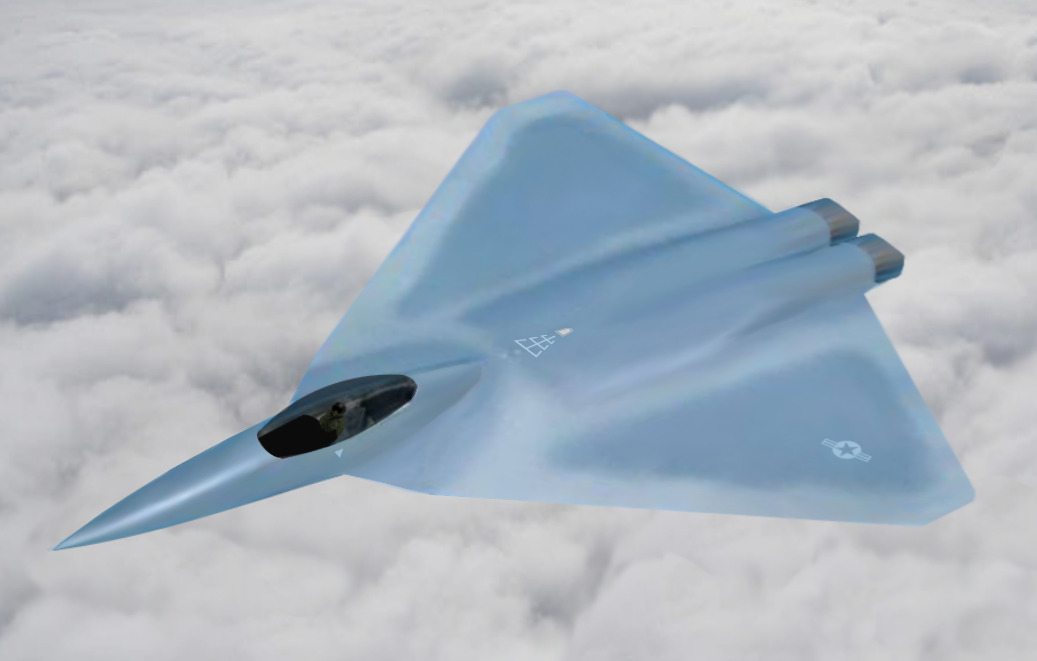
NASA and the USAF had begun preliminary work by May 1999. Plans called for MANTA technologies to be demonstrated on either an F-22 or an F-15, with an X-44 prototype beginning test flights by fiscal year 2007. NASA planners argued that the technologies developed for the X-44 could benefit the F-22 and the Joint Strike Fighter programmes as well as future commercial supersonic ventures. In June 1999 NASA approved the start of the programme and gave the aircraft the designation X-44A. The initial feasibility work was funded by the government and two contractors; contemporary accounts described a team drawn from the Air Force Research Laboratory (AFRL), NASA, Lockheed Martin and Pratt & Whitney.
In its most concrete form, the plan was to convert one of the early F-22s into a flying testbed: keep the Raptor's fuselage and engines, fit a large delta wing similar to the one later proposed for the FB-22 together with advanced vectoring nozzles, and remove rudders, stabilators and ailerons altogether. The studies themselves acknowledged that the X-44A was unlikely to fly before 2007, by which time the F-22 programme would already have retired its first two flying prototypes.
The expected benefits were of several kinds. Removing the tail and vertical stabilisers reduced the radar signature and eliminated the gaps and hinge lines of movable surfaces, which are a recurring source of low-observability problems. Without rudder and tail surfaces the airframe became structurally simpler, lighter and mechanically less complex. The delta wing, larger than the F-22's, provided greater fuel volume and therefore better efficiency and range. Taken together, MANTA promised reduced mechanical complexity, increased fuel efficiency and greater agility. It was even suggested that combining the technology with fluidic nozzles and supersonic-cruise aerodynamics could lead to a generation of high-performance, very stealthy aircraft of exceptional aerodynamic efficiency.
Funding for the X-44 ended in 2000 and the aircraft never progressed beyond the conceptual phase: it was neither built nor flown. The gains in stealth came at a high cost because of the complexity of developing the technology, and the budgetary climate surrounding the F-22 itself did not favour new experimental platforms. The concept did not vanish entirely, however. Some of the later FB-22 proposals — the supersonic stealth regional bomber derived from the F-22 that Lockheed Martin put forward in the early 2000s, combining a Raptor fuselage with greatly enlarged delta wings — considered having no tailplanes and would have continued the MANTA research; the FB-22 was in turn cancelled with the 2006 Quadrennial Defense Review. Alongside the FB-22, the X-44 is counted among the F-22 derivatives proposed in the late 1990s and early 2000s and eventually abandoned, and its premise — flight control without movable aerodynamic surfaces — has resurfaced in thinking about next-generation fighters.
Multimedia
