Lockheed Martin F-22 Raptor variant
Lockheed Martin F-22 Raptor YF-22A
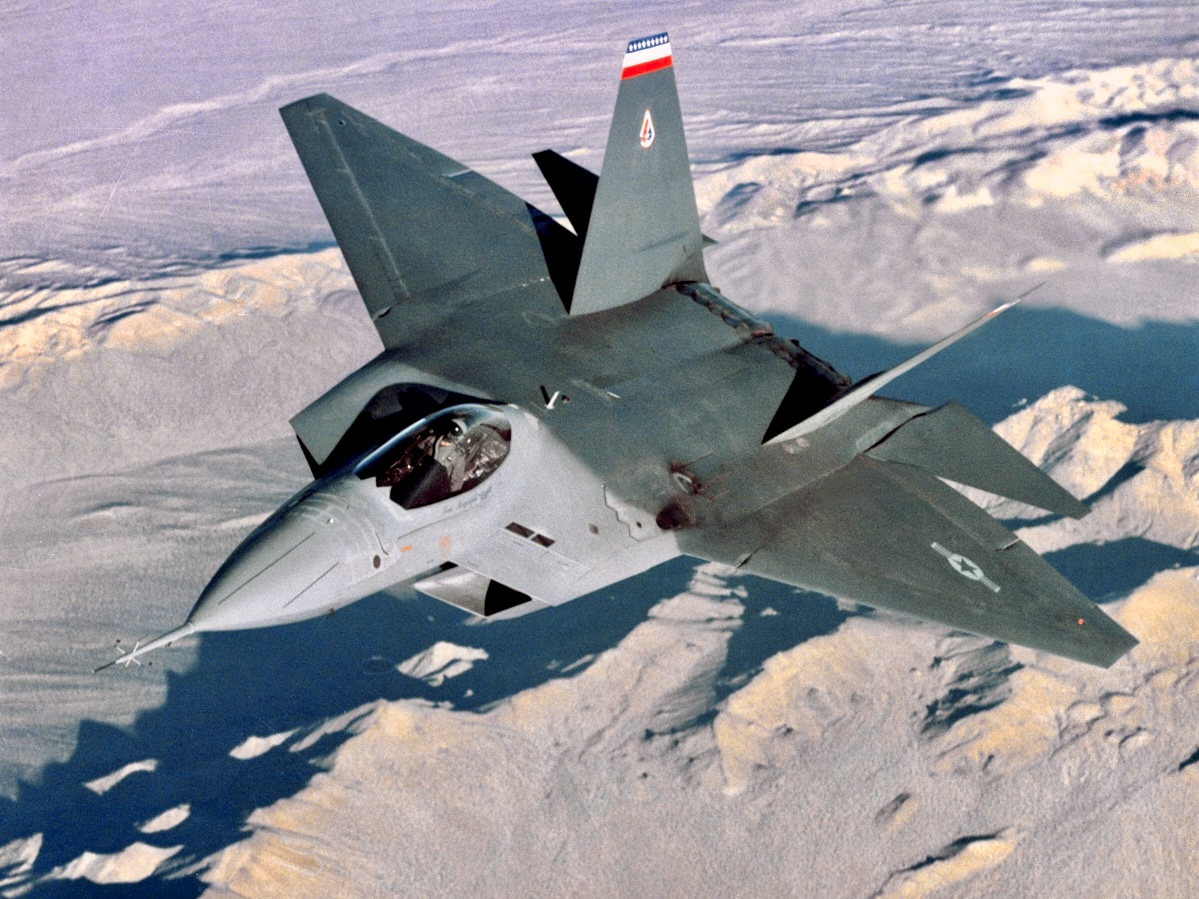
Technology demonstrator prototype of the Advanced Tactical Fighter programme built by the Lockheed/Boeing/General Dynamics team. Two aircraft (PAV-1 and PAV-2) flew between September and December 1990, won the competition against the YF-23 in April 1991 and led to the F-22 Raptor.
Lockheed Martin F-22 Raptor sheet

- September 29, 1990
- First flight
- 2
- Units built
- 3,700 km
- Range
History
The YF-22A was the prototype air vehicle with which the Lockheed-led team, partnered with Boeing and General Dynamics, competed in the demonstration and validation (Dem/Val) phase of the United States Air Force Advanced Tactical Fighter (ATF) programme. It was not a pre-production fighter but a "best-effort" technology demonstrator meant to prove the viability of the airframe and propulsion concept; it carried none of the mission avionics, which were developed in parallel through an Avionics Ground Prototype and a modified Boeing 757 flying laboratory.
The road to the prototype was long. The USAF began exploring the ATF concept in 1981 with a request for information to industry and, in 1983, turned the concept team into a System Program Office at Wright-Patterson. Lockheed's first proposal, the CL-2016, was a huge SR-71-inspired aircraft nicknamed "battlecruiser"; once stealth became a core requirement, the Skunk Works at Burbank drifted towards faceted shapes inherited from the F-117, whose poor aerodynamics left the company near the bottom of the concept exploration rankings. In 1984 Lockheed abandoned faceting and, backed by empirical radar measurements at its Helendale range, committed to curved surfaces. Configuration 090P, submitted for Dem/Val, already showed the arrowhead forward fuselage, S-shaped inlet ducts hiding the engine faces and an internal rotary missile launcher.
In November 1984 the Statement of Operational Need set out a fighter of about 50,000 lb (22,700 kg) takeoff weight with strong emphasis on stealth, manoeuvrability and supersonic cruise without afterburner. The request for proposals went out in September 1985 and, in May 1986, on the recommendation of the Packard Commission, a requirement for flying prototypes was added. Seven companies bid in July 1986 and on 31 October 1986 Lockheed and Northrop were selected as finalists, each with a $691 million contract for a 50-month Dem/Val phase. The programme office designated Lockheed's design YF-22 and Northrop's YF-23; Pratt & Whitney and General Electric would develop the competing YF119 and YF120 engines.
Work was split roughly equally. Lockheed took the forward fuselage, cockpit and stealthy edge treatments, with final assembly at Palmdale; Boeing built the wings and aft fuselage in Seattle, and General Dynamics the centre fuselage, weapons bays, tail and landing gear in Fort Worth. The partners invested a further $675 million of their own money. The design evolved turbulently: in early 1987 Configuration 095 replaced the rotary launcher with a flatter weapons bay, but by mid-1987 weight analysis showed the aircraft 9,000 lb (4,100 kg) overweight. In July 1987 the team chose to start over and, after an intensive three-month effort, adopted Configuration 614/1114 with shoulder-mounted inlets, diamond-like delta wings drawn from the General Dynamics concept and four tail surfaces. In May 1988 Configuration 632/1132 was frozen as the YF-22; by then the target weight had been raised to 60,000 lb (27,200 kg) and the required engine thrust from the 30,000 lbf to the 35,000 lbf class.
The outcome was a single-seat twin-jet with a 48° swept diamond-like delta wing, three internal weapons bays, canted fins and all-moving stabilators, two-dimensional thrust-vectoring nozzles, an airbrake between the fins and a frameless bubble canopy. It had relaxed static stability with fly-by-wire controls, an F-16-style sidestick and five multifunction displays. The first aircraft, PAV-1 (serial 87-0700, civil registration N22YF), carried General Electric YF120 engines; the second, PAV-2 (87-0701, N22YX), Pratt & Whitney YF119s. Within the project the aircraft was unofficially called "Lightning II" after the P-38, a name that did not stick and which the Air Force eventually gave to the F-35 in 2006.
PAV-1 was rolled out at Palmdale on 29 August 1990 and first flew on 29 September 1990 with David L. Ferguson at the controls: an 18-minute flight to 250 knots and 12,500 ft (3,800 m) ending at Edwards AFB. PAV-2 followed on 30 October with Thomas A. Morgenfeld. Unlike the YF-23, the YF-22 fired AIM-9 and AIM-120 missiles from its bays and flew at over 60° angle of attack, with low-speed pitch rates more than double those of the F-16 thanks to thrust vectoring. PAV-1 reached Mach 1.58 in supercruise on 3 November 1990 and PAV-2 Mach 1.43 on 27 December; maximum speed exceeded Mach 2. Testing ended on 28 December 1990 after 74 flights and 91.6 hours, far more than its rival accumulated.
.jpg)
On 23 April 1991 Secretary of the Air Force Donald Rice announced the Lockheed team as the winner. Both designs met the requirements: the YF-23 was stealthier and faster, but the YF-22 was more agile, had flown many more hours and was judged lower-risk and better managed; the aviation press also speculated that it was better suited to the naval NATF, although the Navy abandoned that programme by fiscal year 1992. The engineering and manufacturing development contract, initially worth about $11 billion, was awarded in August 1991. PAV-1 was retired to display; PAV-2 flew another 39 sorties and 61.6 hours until, on 25 April 1992, it was badly damaged at Edwards during a go-around demonstration when a pilot-induced oscillation was not prevented by the flight control software. Morgenfeld escaped unhurt; the aircraft was only superficially repaired, never flew again and ended as an antenna test model. The F-22 control laws were revised as a result.
The production F-22A departed markedly from the prototype as the design moved from Configuration 632/1132 to 645: the over-specified fins were reduced by 20–30 per cent; wing and stabilator sweep was cut by 6° from 48°; length shrank by 2 ft (0.6 m) while span grew by 1.5 ft (0.5 m); the radome and fuselage were reshaped, the dedicated airbrake was dropped in favour of opposed flap and aileron deflection, the canopy was moved forward 7 in (178 mm) for visibility and the inlets moved aft 14 in (356 mm). PAV-1 is preserved at the Air Force Flight Test Center Museum at Edwards and PAV-2 was stored at Rome Laboratory, New York.
Multimedia

-1600.webp)


