Fighter · Military · United States
Lockheed F-104 Starfighter
- March 4, 1954
- First flight
- In service
- Status




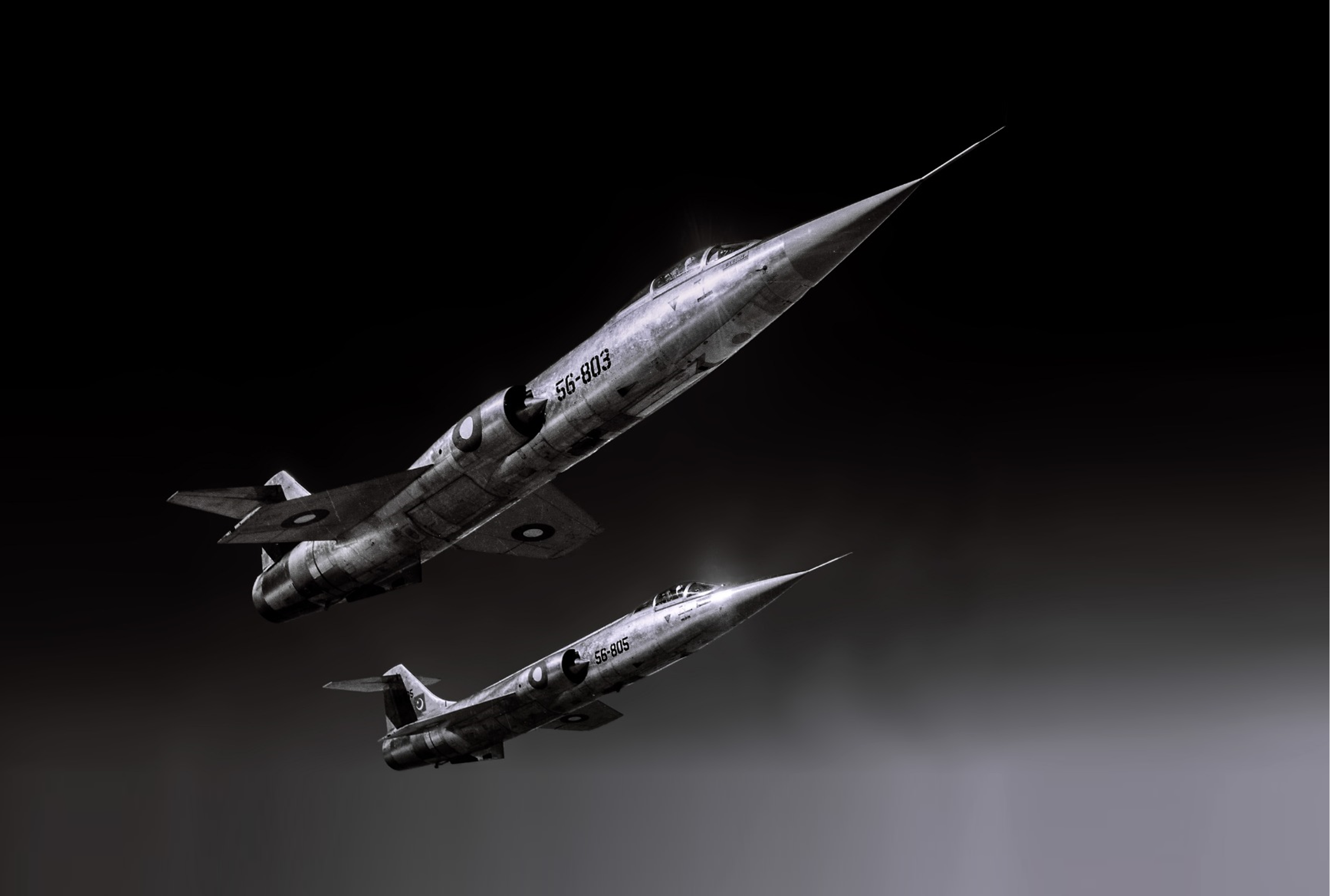


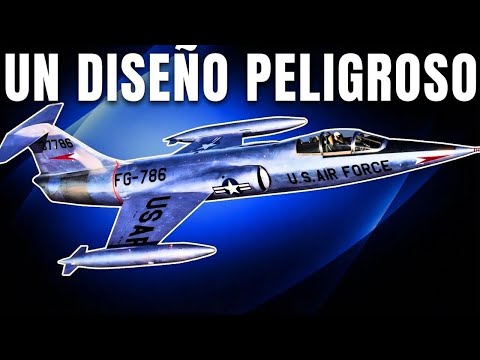
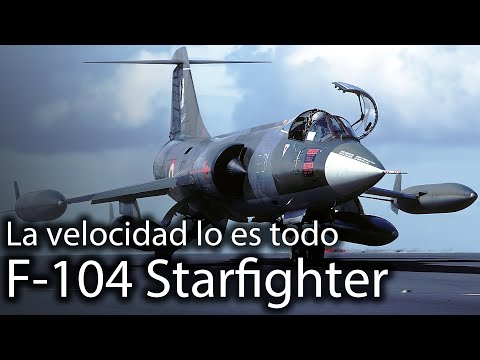
The Lockheed F-104 Starfighter was a single-engine American supersonic fighter, conceived as a day interceptor in the United States Air Force's "Century Series". Its designer, Clarence "Kelly" Johnson, head of Lockheed's Skunk Works, deliberately went against the fashion of the time: instead of ever larger and more complex fighters, he proposed a small, light and simple machine wrapped around a single very powerful engine, the General Electric J79 turbojet, and tuned above all for climb rate, altitude and speed. The outcome was unmistakable: a long, needle-nosed fuselage carrying tiny, straight and extremely thin wings set far aft with marked anhedral, under a T-tail. The XF-104 prototype flew on 4 March 1954 and the production fighter joined the USAF in 1958. It was the first production aircraft to reach Mach 2, the first to climb past 100,000 ft after taking off under its own power, and the first to hold the world speed, altitude and time-to-climb records at the same time. It was also the first aircraft armed with the M61 Vulcan rotary cannon. Its American career was brief, because the USAF wanted longer range and heavier loads, yet the type still deterred Chinese fighters during the 1958 Taiwan Strait crisis, deployed to Europe in the 1961 Berlin crisis and flew more than 5,000 combat sorties over Vietnam. Its real life came abroad. Reworked as the F-104G, an all-weather multirole fighter, it was chosen by West Germany in 1958 and then by Canada, the Netherlands, Belgium, Japan and Italy; the European partners set up the largest multinational manufacturing effort seen until then, and 2,578 Starfighters were eventually built. Two shadows followed that success. One was the bribery Lockheed had used to win contracts, exposed in the mid-1970s. The other was safety: West Germany lost 292 of 916 aircraft and 116 pilots between 1961 and 1989, and the press called it the "widowmaker". The last version, the Aeritalia-built F-104S, served Italy until 2004, and a few civilian examples still fly in Florida today.
Related events
- First flight of the Lockheed F-104 Starfighter
- The F-104 Starfighter enters USAF service
- A YF-104A breaks the world altitude record for jet aircraft
- A YF-104A sets the world airspeed record
- F-104A time-to-climb records at Point Mugu
- An F-104C becomes the first aircraft to pass 100,000 ft after a conventional take-off
- The NF-104A reaches 120,800 ft, an unofficial altitude record
- Chuck Yeager ejects from the NF-104A during an altitude flight
- Starfighter crisis: the Luftwaffe chief is dismissed
- Darryl Greenamyer sets the FAI 3 km low-altitude speed record
- The Italian Air Force retires its last F-104 Starfighters
Related sheets
Category
Lockheed F-104 Starfighter in the news
Starfighters Space is preparing to conduct in December a captive-carry test flight of its new Starlaunch 1 suborbital development vehicle on one of the company’s F-104 Starfighter aircraft…
The Tomcat Advancements during the Cold War in Soviet long range patrol and bomber aircraft dictated a requirement for a fleet defense fighter that could engage high-altitude bombers from well…
The legendary F-104 Starfighter returned to the Bodo base, in Norway, during a new round of high-speed tests held in recent days. The CF-104D example, registration LN-STF…
The Starfighter LN-STF took to the skies again in Norway in 2016 after years of restoration, but hasn't flown since. Now the Mach-2 twin-seater is taxiing again…
The F-104 Starfighter was built around a brutally simple Cold War philosophy: make a fighter smaller, faster, and higher-flying than almost anything the Soviet Union could put in the sky. Designed…

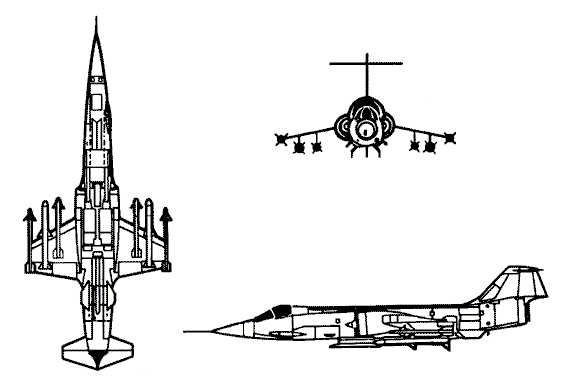
Three-view drawing
History
Origins: what the Korean War pilots asked for
In November 1951 Kelly Johnson, Lockheed's vice president of engineering, toured USAF bases in South Korea to ask fighter pilots what they really needed. They were flying F-86 Sabres against the MiG-15, and many felt the lighter Soviet jet outclimbed and outflew them at height. Their answer was a small, simple aircraft with outstanding performance, above all in speed and altitude. Back in Burbank, Johnson's team, assembled in March 1952, studied more than a hundred layouts ranging from about 8,000 lb to 50,000 lb and settled on the light end of the scale: a fighter of around 12,000 lb with one very powerful engine, the new General Electric J79. The design, carried under the temporary number L-246 and the internal name Model 083, barely changed on its way to becoming the prototype.
Johnson presented the concept to the Air Force on 5 November 1952. It generated enough interest for a lightweight fighter requirement meant to supplement and eventually replace the F-100. Republic, North American and Northrop also competed, but Lockheed's head start proved decisive, and on 12 March 1953 it won a contract for two prototypes, designated XF-104.
Prototypes and testing
Progress was remarkably quick: a mock-up was ready by the end of April 1953 and the two prototypes followed. Since the J79 was not yet available, both used the Wright J65, the American-built Armstrong Siddeley Sapphire. The first aircraft hopped briefly off the runway during taxi trials on 28 February 1954, which did not count as a flight, and on 4 March test pilot Tony LeVier made the official first flight at Edwards, cut short to 21 minutes by a landing gear problem. Less than a year had passed since the contract. The second prototype was lost a few weeks later during gun trials, when the ejection seat hatch blew out, the cockpit lost pressure and the pilot ejected believing the cannon had damaged the aircraft.
The programme was never secret, but no photographs were released until 1956, and at the public unveiling of the YF-104A in April that year the intakes were hidden under metal covers. Seventeen YF-104As were ordered on 30 March 1955; they introduced the J79, a lengthened fuselage to house it, and revised landing gear and intakes. The first flew on 17 February 1956. Testing brought a strengthened airframe, a ventral fin for directional stability at supersonic speed and a boundary layer control system blowing air over the flaps to reduce landing speed. Afterburner trouble with the J79 and the integration of the AIM-9 Sidewinder pushed delivery of the first production F-104A back to 28 January 1958.
A radical design
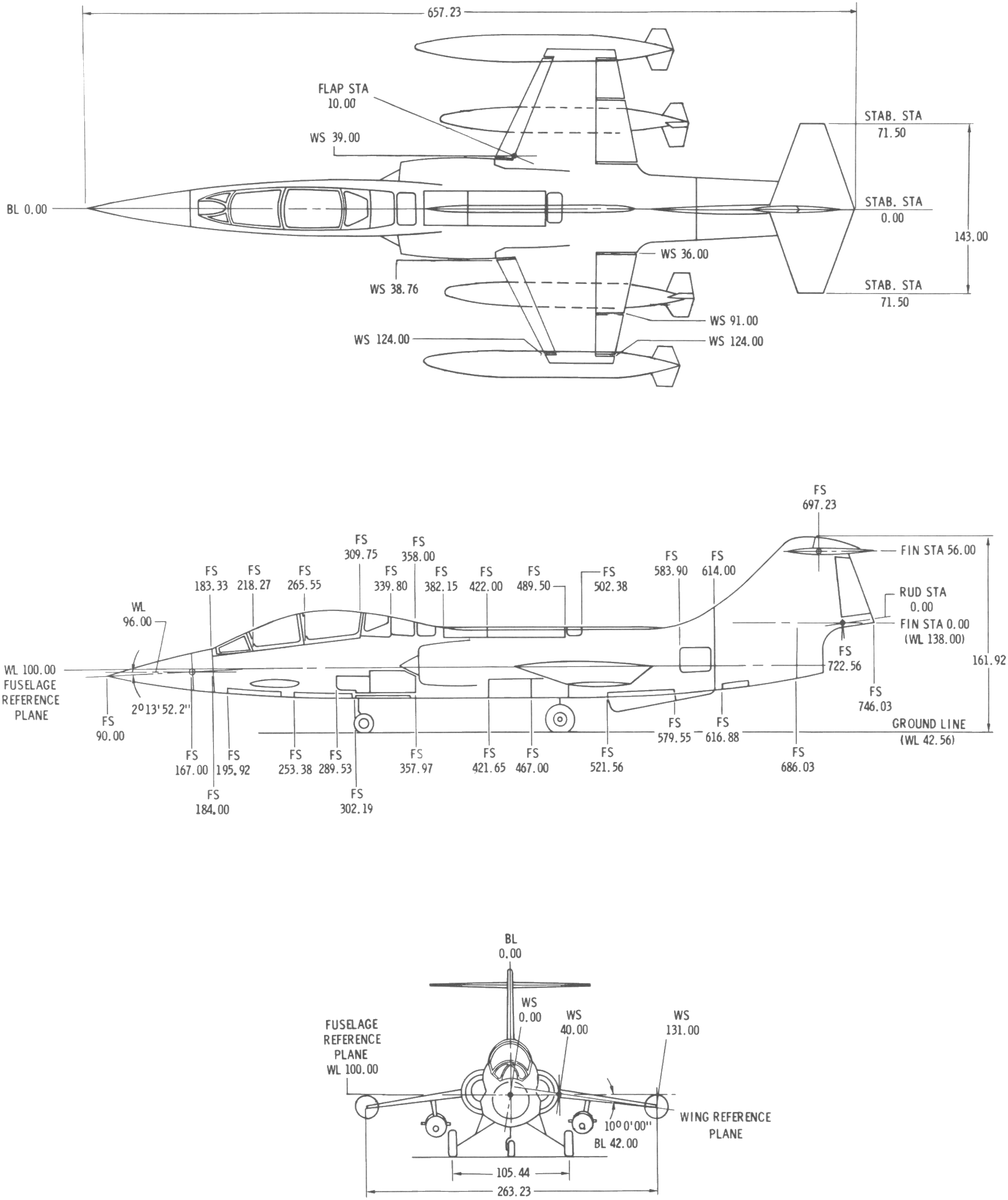
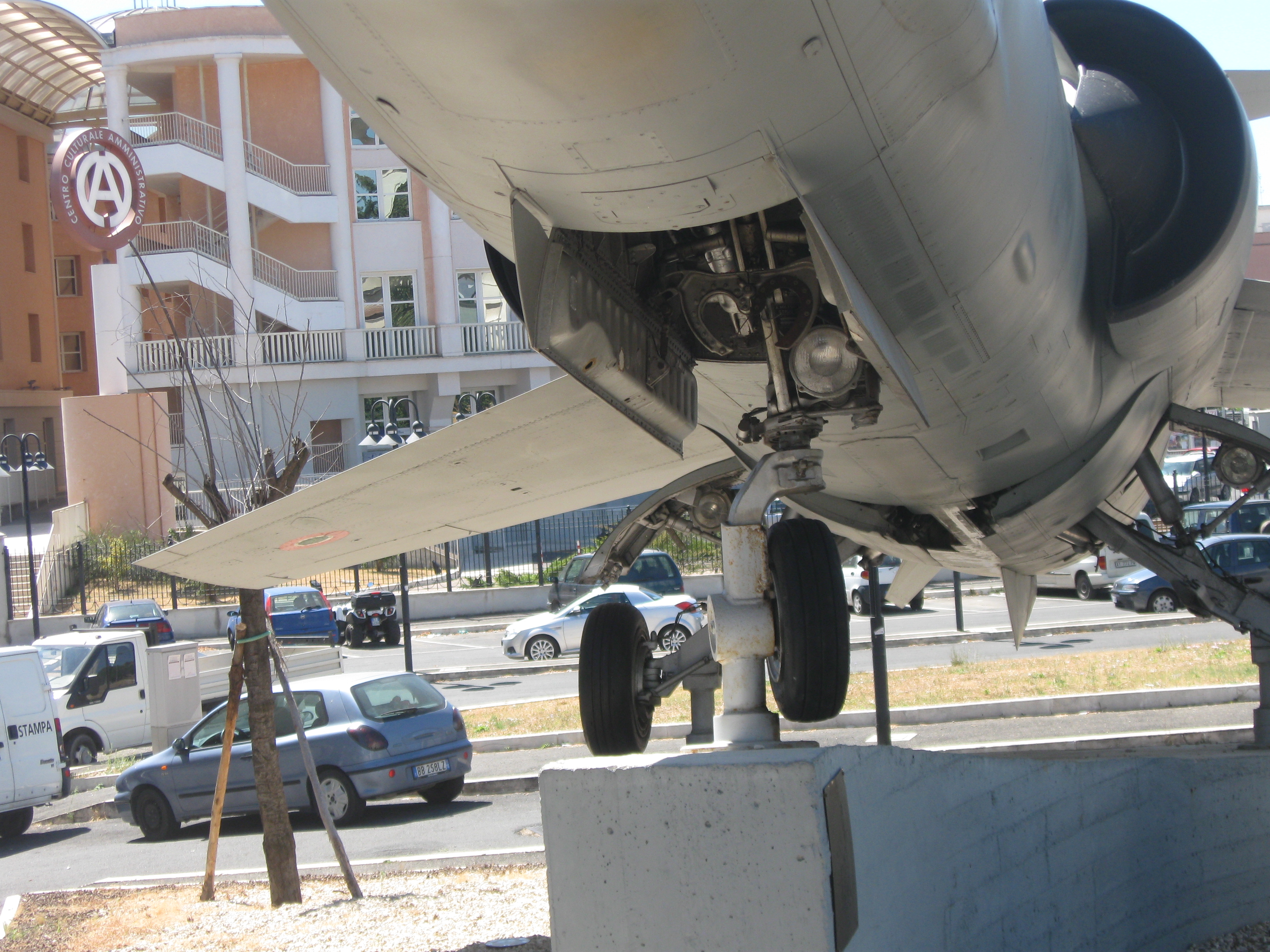
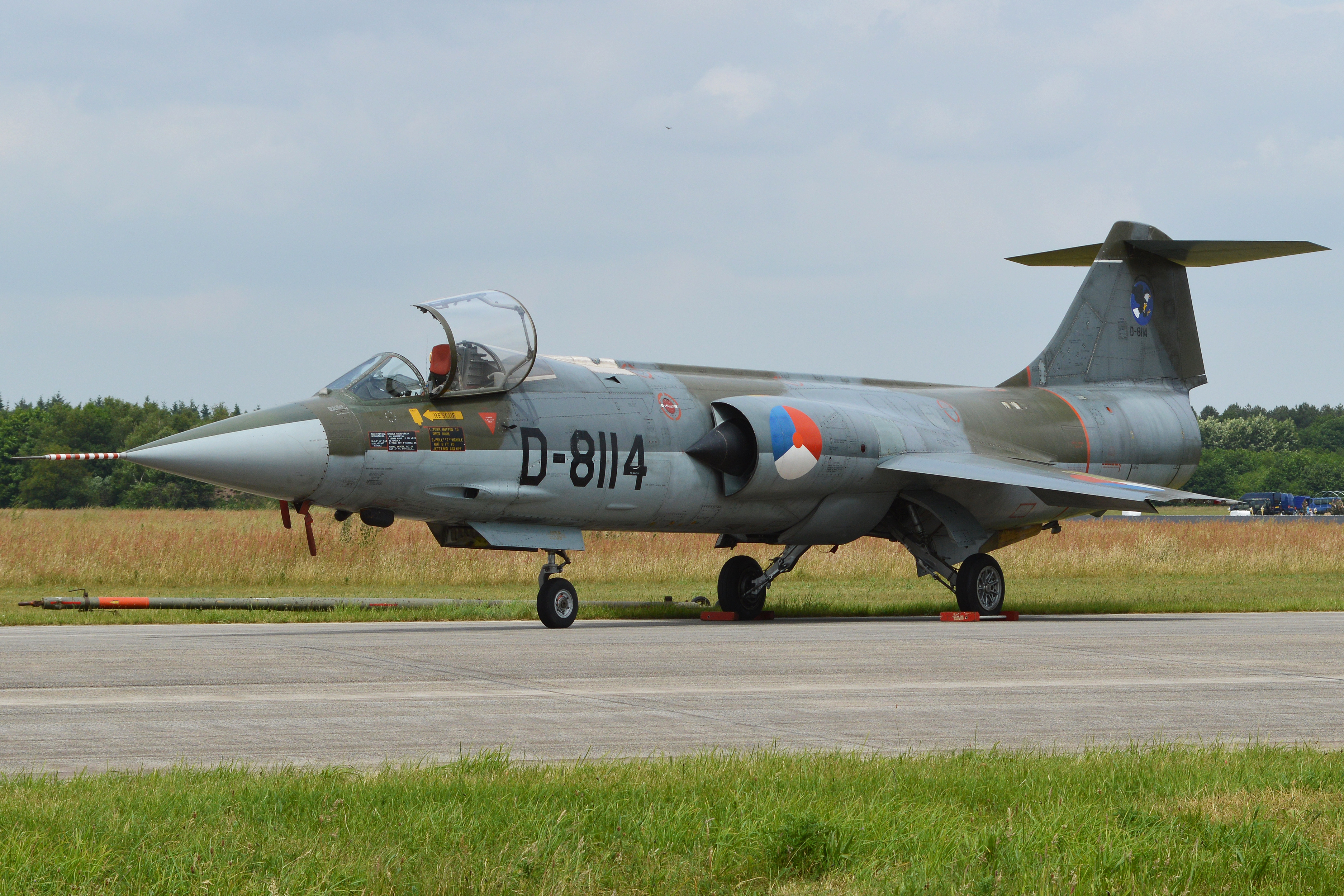
The airframe was all-metal, mostly duralumin with some stainless steel and titanium, and the fuselage was about two and a half times as long as the wingspan. Lockheed's tests, which drew on the unmanned X-7, showed that the most efficient shape for supersonic flight was a very small, straight, trapezoidal and extremely thin wing: its thickness-to-chord ratio was only 3.36%, and its leading edge was so sharp that ground crews fitted guards over it during maintenance. Because almost nothing fitted inside the wing, fuel and landing gear went into the fuselage. The fin was nearly as effective aerodynamically as a wing, so the wings were canted down ten degrees to cancel the rolling effect of rudder inputs, and the all-moving tailplane was mounted on top of the fin.
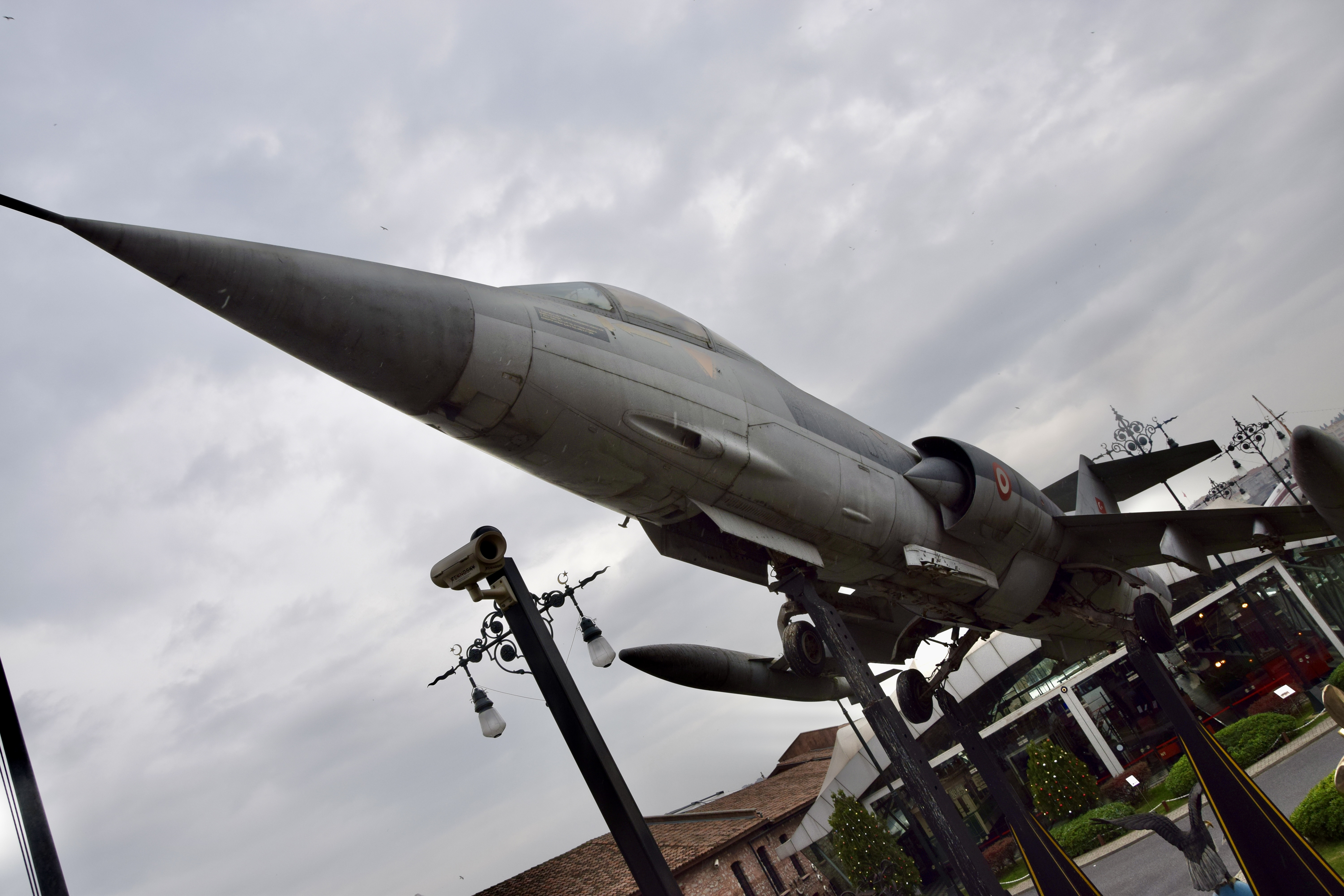
That small, heavily loaded wing came at a cost: very high landing speeds and poor sustained turning. High-pressure air bled from the compressor and blown over the flaps cut touchdown speed by more than thirty knots, but only worked with the engine at high power, so the F-104 landed with plenty of throttle and used a drag chute to stop. In return it accelerated, climbed and ran like few contemporaries. The fixed-cone side intakes were optimised for Mach 1.7, and the design limit was set at Mach 2 because beyond that frictional heating punished both the aluminium skin and the engine itself.
Engine and armament
The J79 combined a seventeen-stage compressor with variable stator blades, a three-stage turbine and an afterburner. Air bled from the last compressor stage fed the blown flaps, cabin pressurisation and air conditioning, the pilot's anti-g suit and radar cooling. The most powerful version, the J79-GE-19, delivered 52.8 kN dry and 79.6 kN in afterburner.
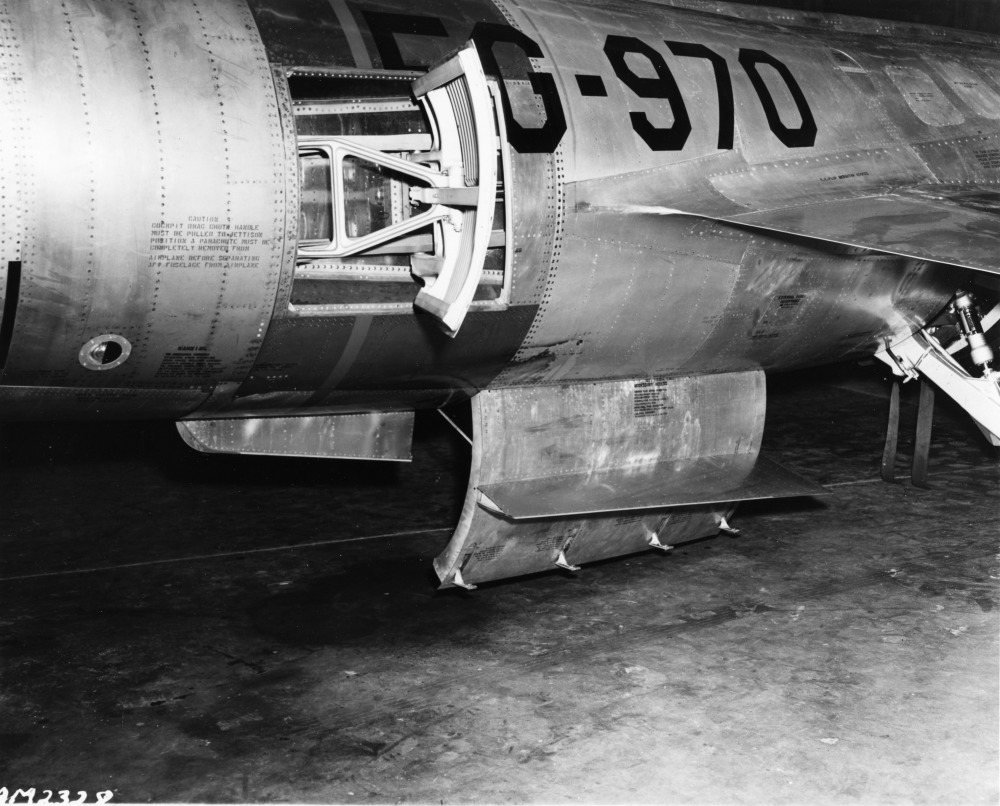
The basic weapon was the 20 mm M61 Vulcan rotary cannon, which the Starfighter was the first aircraft to carry. Early testing exposed feed problems with linked ammunition, whose discarded links could even be sucked into the engine, and a linkless M61A1 was developed for the F-104C; it went on to arm a whole generation of American combat aircraft. Firing at about 6,000 rounds per minute, the gun emptied its 725-round drum in just over seven seconds. The wingtips carried two Sidewinders or fuel tanks, and from the F-104C onwards fuselage and underwing pylons were added for bombs, rocket pods, tanks or a nuclear weapon.
Stopgap interceptor in the USAF
Although conceived as an air superiority fighter, the Starfighter was needed urgently as an interceptor while the F-102 and F-106 ran late, so the Air Force pressed it into Air Defense Command even though its range and armament were poorly suited to the job. On 26 February 1958 the 83rd Fighter Interceptor Squadron at Hamilton became the first operational unit. Three months later engine-related accidents grounded the fleet until the J79-GE-3B was fitted. The Air Force's enthusiasm waned, orders were cut sharply and many aircraft passed to the Air National Guard after less than a year of front-line service.
Even so, two early deployments made the type famous. In September 1958, during the Taiwan Strait crisis, the 83rd's F-104s arrived disassembled aboard C-124 transports, the first time fighters had been moved over long distances by air, and flew Mach 2 runs between the island and the mainland as a show of strength; American commanders credited them with deterring attacks. During the 1961 Berlin crisis, sixty Guard F-104As were likewise airlifted to Europe because of their short range, and impressed with their reaction times and acceleration.
Vietnam and the American finale
In April 1965 the 476th Tactical Fighter Squadron reached Da Nang to escort F-105s and protect the EC-121 airborne early warning aircraft against MiGs. The Starfighters saw little air combat and scored no kills, though their pilots felt the MiGs deliberately avoided them. Between April and December 1965 they flew 2,937 combat sorties, and during a second deployment from June 1966 to August 1967 another 2,269, for a total of 5,206. Fourteen were lost to all causes, one of them shot down by a Chinese J-6 after straying into Chinese airspace. In July 1967 the units converted to the F-4 Phantom II. The last F-104s left regular USAF service in 1969, the Puerto Rico Air National Guard flew them until 1975, and at Luke AFB in Arizona they went on training German pilots until 1983.
From day fighter to the NATO F-104G
In 1957 the German Air Staff asked for one aircraft able to serve as fighter, fighter-bomber and reconnaissance platform. Lockheed largely reworked the airframe, with new forgings, extra skin panels and stronger landing gear, and added a more powerful J79-11A, a larger fin, improved flaps, the NASARR multi-mode radar and Litton's LN-3 inertial navigation system, the first of its kind in operational service. The result was the F-104G, able to carry a nuclear store under the fuselage. Against rivals such as the English Electric Lightning, the F11F-1F Super Tiger and the F-8 Crusader, the Starfighter had the advantage of being almost ready for service, and West Germany chose it in October 1958.
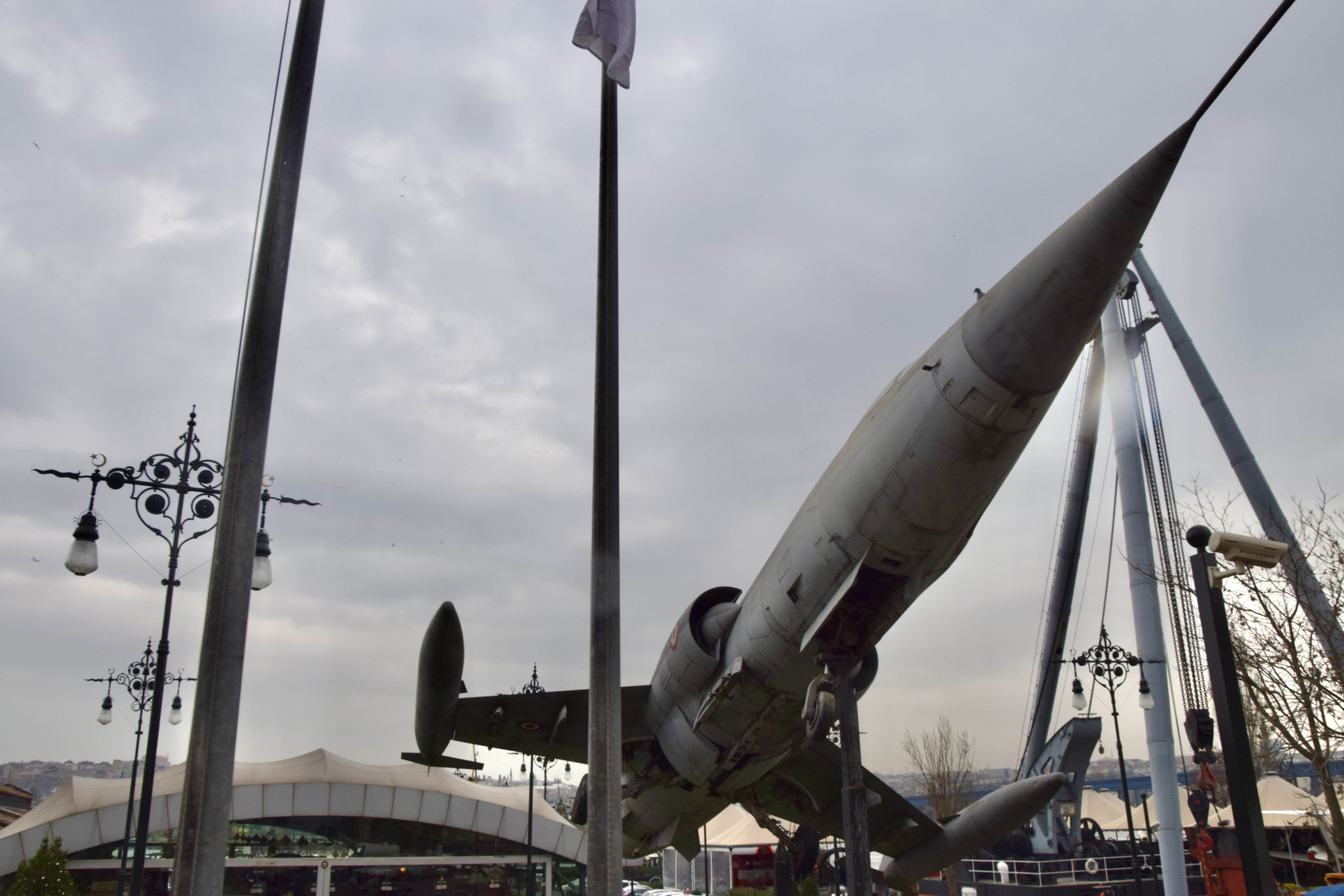
Belgium, the Netherlands and Italy soon followed and formed four industrial groups to build it under licence, with firms such as Messerschmitt, Dornier, Fokker, SABCA and Fiat, coordinated by a joint office in Koblenz. In April 1963 an F-104G was assembled at Erding from parts made in all four countries. BMW, Fabrique Nationale and Alfa Romeo produced 1,225 J79 engines, and Canadair built the CF-104 for Canada as well as components for Europe. Japan produced its own versions, and American military aid placed aircraft with further allies. Fifteen NATO and allied air forces eventually flew it, many for longer than the USAF itself.
Combat in Asia
Pakistan received twelve F-104As and two two-seaters in 1961 for its No. 9 Squadron. In the 1965 war with India it used them as day and night interceptors; Pakistan claims with them the first combat kill by a Mach 2 aircraft, a Sidewinder shot against a Mystère IV, although India disputes the loss. In another fight a Pakistani pilot ended up colliding with a Mystère in a low-speed dogfight, exactly where the F-104 was weakest. In 1971 the type attacked Indian radars and airfields and claimed kills, but also suffered its first losses to the MiG-21. Over Kinmen on 13 January 1967, four Taiwanese F-104Gs engaged J-6 fighters and shot down two, at the cost of one aircraft whose loss was kept from the public. Johnson summed up that battle candidly: they had the enemy beaten on acceleration and altitude, but could not turn with them.
Records
On 7 May 1958 Major Howard C. Johnson took a YF-104A to 27,811 metres, an altitude record for jet aircraft, and on 16 May Captain Walter W. Irwin set the absolute speed record at 2,259.538 km/h over Edwards. Time-to-climb records followed in December 1958, making the Starfighter the first aircraft to hold the speed, altitude and climb records at once. On 14 December 1959 Captain Joe B. Jordan reached 31,513 metres in an F-104C, the first aircraft taking off under its own power to pass 30 kilometres. Jacqueline Cochran set three women's speed records in a TF-104G in 1964, and in 1977 Darryl Greenamyer set a low-altitude speed record of 1,590.45 km/h in an F-104 he had assembled himself from collected parts.
Flying for NASA
NASA operated Starfighters from 1956 to 1994. A YF-104A transferred in August 1956 became the NF-104A, fitted with small hydrogen peroxide thrusters in the nose and wingtips, and gave future X-15 pilots experience in controlling a vehicle beyond the dense atmosphere. F-104s flew chase for countless programmes, launched sounding rockets and, towards the end, tested Space Shuttle thermal tiles. One of the three F-104Ns built for the agency was destroyed in 1966 in a collision with the XB-70 during a photo flight. When the last research mission landed in 1994, NASA had logged more than 18,000 flights on the type.
The widowmaker
In West Germany the Starfighter became a political problem. A newly rebuilt air force with inexperienced pilots and ground crews flew a demanding aircraft mainly as a low-level fighter-bomber in the poor weather of northern Europe, far from the high-altitude interceptor it had been designed to be. The USAF required its F-104 pilots to have at least 1,500 flying hours; German pilots arrived with around 400. Some 292 aircraft and 116 pilots were lost, and in 1966 General Johannes Steinhoff, the new head of the Luftwaffe, grounded the whole fleet until the problems were brought under control. Safety improved over time, although fatigue cracking in the wings later emerged. In 1975 Lockheed agreed to compensate widows and dependants of pilots without admitting liability.
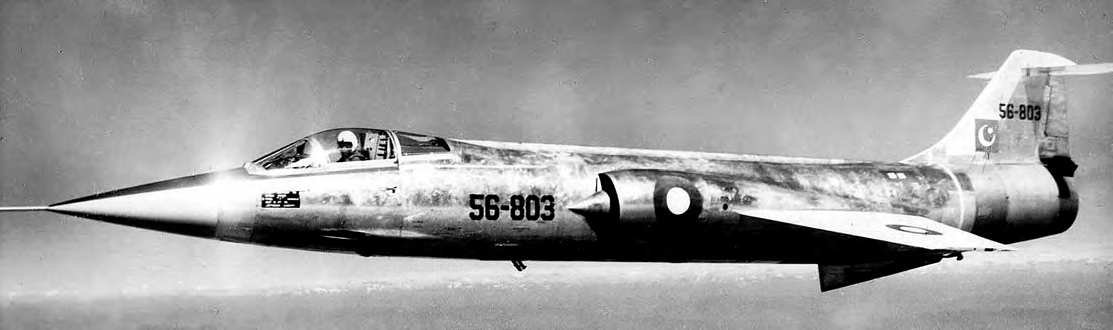
Loss rates varied widely between users: Canada lost more than 46% of its fleet, though it flew its aircraft far more hours; Italy lost 138 of 368; Norway only 6 of 43; and Spain ended seven years of Starfighter service without a single loss. In the USAF the F-104 had the highest accident rate of any Century Series fighter.
Bribery, decline and legacy
The export triumph had a darker side. In 1976 a United States Senate committee found that Lockheed had paid bribes to foreign officials to sell its aircraft, the F-104 among them, and the scandal reached West Germany, Japan and the Netherlands, where Prince Bernhard had to resign as Inspector-General of the armed forces.
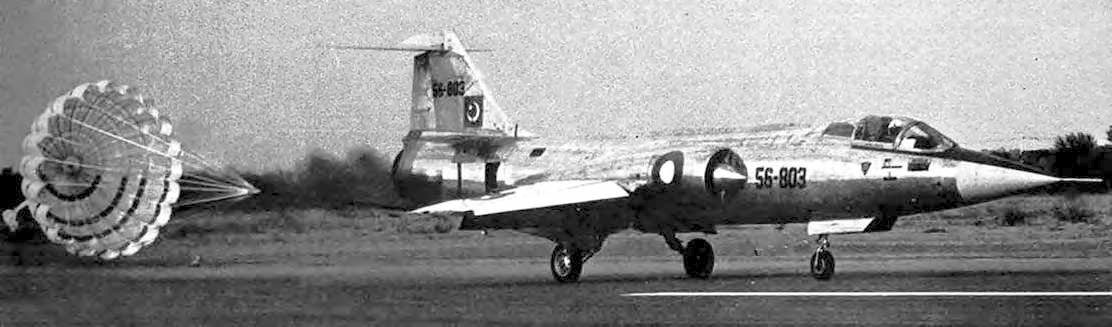
From the late 1970s the F-16 replaced the Starfighter in most countries. The final version, the Aeritalia F-104S, an all-weather interceptor whose radar could guide Sparrow missiles, received the ASA upgrade in the 1980s with a new radar and Aspide missiles, and the Italian Air Force retired it on 31 October 2004, ending the type's military career. Several examples still fly in private hands in the United States, and the F-104 endures as the emblem of an idea pushed to its limit: a huge engine, a pilot and almost no wing, the "missile with a man in it" that Lockheed used to sell it.
Variants
| XF-104 | YF-104A | CF-104 | NF-104A | F-104S | F-104S-ASA | CF-104D | F-104A | F-104B | F-104C | F-104D | F-104DJ | F-104F | F-104G | F-104H | F-104J | F-104N | F-104S-ASA/M | JF-104 | QF-104A | RF-104G | TF-104G | |
|---|---|---|---|---|---|---|---|---|---|---|---|---|---|---|---|---|---|---|---|---|---|---|
| First flight | March 4, 1954 | February 17, 1956 | May 26, 1961 | July 9, 1963 | December 22, 1966 | January 1, 1985 | — | — | — | — | — | — | — | — | — | — | — | — | — | — | — | — |
| Powerplant | 1 × Wright J65 | 1 × turbojet | 1 × Orenda J79-OEL-7 | 2 × General Electric J79-GE-3B + Rocketdyne AR2-3 | 1 × General Electric J79-GE-19 | 1 × turbojet | 1 × Orenda J79-OEL-7 | 1 × turbojet | 1 × turbojet | 1 × turbojet | 1 × turbojet | 1 × turbojet | 1 × turbojet | 1 × General Electric J79-GE-11A | 1 × turbojet | 1 × turbojet | 1 × turbojet | 1 × turbojet | — | 1 × turbojet | 1 × turbojet | 1 × turbojet |
| Thrust per engine | — | 65.8 kN | 70.3 kN | 65.8 kN | 79.6 kN Best value in this row | — | — | — | — | 44.5 kN | — | — | — | 69 kN | — | — | — | — | — | — | — | — |
| Length | — | — | 16.7 m | 16.7 m | 16.7 m | — | — | 16.7 m | — | 16.8 m Best value in this row | — | — | — | 16.7 m | — | — | — | — | — | — | — | — |
| Wingspan | — | — | 6.6 m | 7.9 m Best value in this row | 6.7 m | — | — | 6.7 m | — | 6.6 m | — | — | — | 6.6 m | — | — | — | — | — | — | — | — |
| Height | — | — | 4.1 m | 4.1 m | 4.1 m | — | — | 4.2 m Best value in this row | — | 4 m | — | — | — | 4.1 m | — | — | — | — | — | — | — | — |
| Wing area | — | — | — | 19.8 m² Best value in this row | 18.2 m² | — | — | — | — | 18.2 m² | — | — | — | 18.2 m² | — | — | — | — | — | — | — | — |
| Empty weight | — | — | 6,300 kg | 6,123 kg | 6,750 kg | — | — | — | — | 5,788 kg Best value in this row | — | — | — | 6,350 kg | — | — | — | — | — | — | — | — |
| MTOW | — | — | 13,171 kg | — | 14,060 kg Best value in this row | — | — | — | — | 12,634 kg | — | — | — | 13,166 kg | — | — | — | — | — | — | — | — |
| Top speed | — | — | 1,844 km/h | — | 2,330 km/h | — | — | — | — | 2,124 km/h | — | — | — | 2,459 km/h Best value in this row | — | — | — | — | — | — | — | — |
| Max speed altitude | — | — | — | — | 11,000 m | — | — | — | — | — | — | — | — | — | — | — | — | — | — | — | — | — |
| Cruise speed | — | — | — | — | 981 km/h Best value in this row | — | — | — | — | 821 km/h | — | — | — | — | — | — | — | — | — | — | — | — |
| Cruise altitude | — | — | — | — | 11,000 m | — | — | — | — | — | — | — | — | — | — | — | — | — | — | — | — | — |
| Service ceiling | — | — | 15,240 m | — | 18,000 m | — | — | 17,678 m | — | — | — | — | — | 22,000 m Best value in this row | — | — | — | — | — | — | — | — |
| Initial climb rate | — | — | — | — | — | — | — | — | — | — | — | — | — | 240 m/s | — | — | — | — | — | — | — | — |
| Range | — | — | 2,630 km | — | 2,920 km Best value in this row | — | — | 2,012 km | — | 2,414 km | — | — | — | 2,620 km | — | — | — | — | — | — | — | — |
| Ferry range | — | — | — | — | 2,920 km Best value in this row | — | — | — | — | — | — | — | — | 2,620 km | — | — | — | — | — | — | — | — |
| Combat radius | — | — | — | — | 1,247 km | — | — | — | — | — | — | — | — | — | — | — | — | — | — | — | — | — |
| Crew | 1 Best value in this row | 1 Best value in this row | 1 Best value in this row | 1 Best value in this row | 1 Best value in this row | 1 Best value in this row | 2 | 1 Best value in this row | 2 | 1 Best value in this row | 2 | 2 | 2 | 1 Best value in this row | — | 1 Best value in this row | 1 Best value in this row | 1 Best value in this row | 1 Best value in this row | — | 1 Best value in this row | 2 |
| Units built | 2 | 17 | 200 | 3 | 246 | 150 | 38 | 153 | 26 | 77 | 21 | 20 | 30 | 1,127 Best value in this row | — | 210 | 3 | — | 1 | 22 | 189 | 220 |
Images
Elsewhere
- NASANASA F-104G Starfighter N826NA over the Mojave Desert (1988) ↗
- NASANASA F-104 Starfighter at Dryden Flight Research Center ↗
- Cirrus ImageLockheed F-104 Starfighter photo gallery (NASA and historical photos) ↗
- Wikimedia CommonsLockheed F-104 in the Ames 40x80 Foot Wind Tunnel ↗
- Wikimedia CommonsNASA JF-104A Starfighter in flight ↗
- Museum of Flight Digital CollectionsLockheed F-104A press photo (1957), Peter M. Bowers Collection ↗
- AirHistory.netBelgian Air Force F-104G Starfighter FX12, Royal Army Museum, Brussels ↗
- AirHistory.netGerman Air Force F-104G Starfighter 2649, Military History Museum, Dresden ↗
- AirHistory.netNASA F-104N Starfighter 812 ↗
- JetPhotosBelgian F-104G Starfighter FX12 on display ↗
- National Museum of the U.S. Air ForceF-104 Starfighter at the National Museum of the U.S. Air Force ↗
- Wright-Patterson AFBF-104 Starfighter photo, Wright-Patterson AFB gallery ↗