Lockheed F-104 Starfighter variant
Lockheed F-104 Starfighter CF-104
Canadian Starfighter licence-built by Canadair (CL-90) for the RCAF: derived from the F-104G for nuclear strike and reconnaissance, it served in Europe with NATO from 1962 to 1987.
Lockheed F-104 Starfighter sheet

- May 26, 1961
- First flight
- 200
- Units built
- 2,630 km
- Range
History
The CF-104 was the Canadian version of the Starfighter, licence-built by Canadair in Montreal under the company designation CL-90; the Royal Canadian Air Force first called it the CF-111 and then the CF-104. It stemmed from Canada's redefinition of its NATO role in the late 1950s, with a commitment to a nuclear strike mission, and from the need to replace the Canadair F-86 Sabres used as NATO day fighters. The competition included, among others, the Blackburn Buccaneer, Dassault Mirage IIIC, Fiat G.91, Grumman Super Tiger, Lockheed F-104G, Northrop N-156 and Republic F-105 Thunderchief. The RCAF preferred the F-105 with an Orenda Iroquois engine, but the choice of a strike-reconnaissance aircraft came down to cost as well as capability, and the government requirement for licence manufacture in Canada favoured the Lockheed proposal through its collaboration with Canadair. On 14 August 1959 Canadair was selected to build 200 aircraft for the RCAF and was also contracted to make wing sets, tail assemblies and rear fuselage sections for 66 F-104Gs destined for the West German Air Force.
Based on the F-104G, the CF-104 was optimised for nuclear strike and reconnaissance: it carried the R-24A NASARR radar for the air-to-ground mode and could take a ventral reconnaissance pod with four Vinten cameras. It retained the removable refuelling probe, replaced the fuselage M61A1 cannon with an extra fuel cell and fitted the main gear with longer-stroke liquid springs and larger tyres. The engine was the Orenda-built J79-OEL-7, rated at about 44 kN dry and 70 kN with afterburner. The first Canadian-built CF-104 (12701) flew on 26 May 1961. Canadair ultimately built 200 CF-104s for the Canadian military and 140 F-104Gs for Lockheed, while the 38 two-seat CF-104Ds were built by Lockheed with Canadian engines.
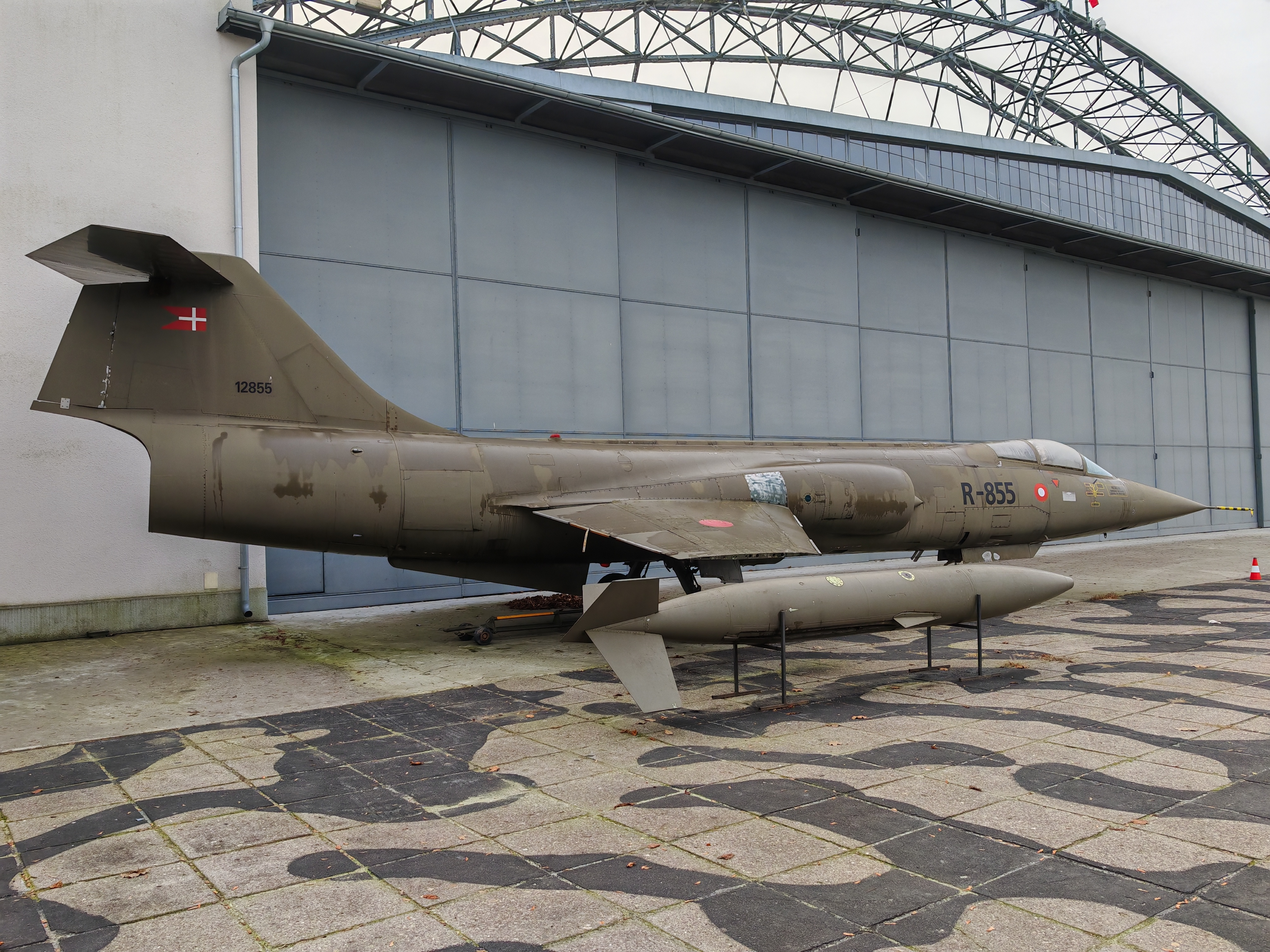
The CF-104 entered Canadian service in March 1962. Designed as a supersonic interceptor, in Canadian hands it was used mainly for low-level strike and reconnaissance. Eight squadrons were based in Europe as part of Canada's NATO commitment, reduced to six in 1967 and to three in 1970. Until 1971 its role included nuclear strike with US-supplied weapons, and over its career it carried the B28, B43 and B57. When the Canadian Forces switched to conventional attack, the M61A1 was refitted and the aircraft received Mk 82 Snakeye bombs, British BL755 cluster bombs and Canadian-designed CRV7 rocket pods. Sidewinders were never carried operationally by Canadian Starfighters, although Norwegian and Danish examples did carry them. The two-seat CF-104D normally carried no armament other than a practice-bomb dispenser.
Low-level attacks were flown visually at about 30 metres above the ground and up to 600 knots; normal attack speed was 540 knots, about 1000 km/h, and evasive manoeuvres could take it supersonic. Its small size, speed and low-level capability made it very hard to attack: according to former pilot Dave Jurkowski, no Canadian CF-104 was ever shot down by air or ground threats in the three Red Flag exercises in which they took part. The Canadians excelled in NATO competitions: from 1964 they attended the AFCENT Tactical Weapons Meet every year, taking best nation in 1965 and first place in the strike event in 1970; in the Royal Flush reconnaissance competition they won in 1968 and took first and second place in 1969, and at the Tiger Meet they won the Silver Tiger Trophy in 1979, 1981 and 1985.
In 25 years of service there were 110 class A accidents that killed 37 pilots, most of them early in the programme; 21 were due to foreign object damage, nearly all bird strikes, and 32 aircraft struck the ground while flying low in poor weather. Even so, the record compared well with the F-86 Sabre, which suffered 282 class A accidents and lost 112 pilots in only 12 years. The press nicknamed it the Widowmaker, a name David Bashow said its pilots never used; they simply called it the 104 or the Starfighter. The New Fighter Aircraft programme chose the CF-18 Hornet as its replacement, which began to take over in 1982; all CF-104s were retired by 1987, and most of the remaining aircraft went to Turkey.
Multimedia


