Fighter · Military · United States
Grumman F-14 Tomcat
- December 21, 1970
- First flight
- 1974
- Introduced
- In service
- Status
- 712
- Units built




-1600.webp)


_on_27_September_2002-1600.webp)


_fly_in_formation_over_the_nuclear-powered_aircraft_carrier_USS_NIMITZ_(CVN-68)_during_a_vis-1600.webp)
-800.webp)
-1600.webp)


%2C_into_positio-1600.webp)

-800.webp)
_launches_from_the_number_three_catapult_aboard_the_nuclear_powered_aircraft_carrier_US-1600.webp)
_Brandon_Meadows_of_Altoona%2C_Pennsylvania%2C_performs_preventive_maintenance_on_an_F-14B_%22Tomcat%22_a-800.webp)
_in_flight%2C_c._1973-1600.webp)


_(18355107845)-800.webp)
_aboard_the_aircraft-1600.webp)
_passes_over_the_nuclear_powered_aircraft_carrier_USS_GEORGE_WASHINGTON_(C-1600.webp)


-1600.webp)
-800.webp)




-800.webp)
.jpg)

_F-14A_Tomcat_aircraft%2C_painted_in_the_Sperry_camouflage_scheme%2C_as_it_approaches_the_nuclear-powered_aircraft_carrier_USS_-1600.webp)
.jpg)
%2C_an_F-14B_Tomcat_attached_to_the_%22Jolly_Rogers%22_of_Fighter_Squadron_One_Zero_Three_(VF-103)%2C_launc-1600.webp)


-800.webp)
_F-14A_Tomcat_aircraft_flies_over_the_electronic_warfare_training_range_during_a_pre-deployment_training_mission_-_DPLA_-_32fbecff9b6a0e87d1bd1e-1600.webp)
-1600.webp)
_F-14B_Tomcat_aircraft_assigned_to_Fighter_Squadron_Three_Two_(VF-32)_launches_from_the_flight_deck_of_the_USN_Nimitz_Class-_-1600.webp)
_launches_from_the_flight_deck_of_the_aircraft_carrier_USS_GEORGE_WASHINGTON_(CVN_7-1600.webp)


-800.webp)
The Grumman F-14 Tomcat was a two-seat, twin-engine, variable-geometry carrier fighter built for one very specific job: to hold off, hundreds of kilometres from the carrier, the Soviet bombers that threatened to swamp an entire naval force with missiles. That mission, fleet air defence, explains almost everything about the aircraft. It explains its size, its crew of two —pilot in front, radar intercept officer behind—, its huge Hughes AN/AWG-9 radar and, above all, the weapon that defined it: the AIM-54 Phoenix, a long-range missile that cruised at close to Mach 5 between 24,000 and 30,000 metres before diving on its target. No other Western fighter of its generation paired that detection range with that shooting range. The Tomcat grew out of the failure of two earlier programmes. The first was the Douglas F6D Missileer, a subsonic missile platform proposed in 1959 and cancelled in December 1961; the second was the F-111B, the naval version of the joint fighter that Defense Secretary Robert McNamara tried to impose on the Navy and the Air Force at once. The F-111B turned out considerably overweight and too sluggish for deck operations, and testimony to Congress by Vice Admiral Thomas F. Connolly, who had flown an F-111A himself, helped decisively to end its funding in May 1968. The Navy then opened the VFX competition; Grumman, which had worked on the F-111B and had been studying alternatives on its own since 1966, won it in January 1969 with the Model 303E. The name Tomcat honoured, among other things, Connolly himself. The first prototype flew on 21 December 1970, barely twenty-two months after contract award, and initial operating capability followed in 1973. Its most visible feature is the swing wing, sweeping between 20° and 68° under automatic control from a central air data computer, with an extra 75° oversweep position for parking on deck. The broad flat fuselage between the two engine nacelles generates 40 to 60 percent of the lift by itself. About a quarter of the structure is titanium, joined by electron-beam welding. The weak point was propulsion: the Pratt & Whitney TF30 turbofans of the F-14A, adopted as an interim fit, proved prone to compressor stalls and were eventually associated with 28 percent of all accidents of the type; Navy Secretary John Lehman bluntly called the combination the worst engine-airframe mismatch in years. The cure was the General Electric F110-GE-400 of the F-14A+ —redesignated F-14B on 1 May 1991— and of the F-14D, which delivered better than 60 percent improvement in climb rate and allowed deck launches without afterburner. In American service the Tomcat first embarked in September 1974 aboard USS Enterprise, with VF-2 "Bounty Hunters" and VF-1 "Wolfpack", and covered the evacuation of Saigon in April 1975. Its only two victorious air combats under the US flag both happened over the Gulf of Sidra: on 19 August 1981, when two VF-41 F-14As shot down two Libyan Su-22s, and on 4 January 1989, when two VF-32 aircraft downed two MiG-23s. During Desert Storm ten squadrons flew 4,124 sorties and lost a single aircraft to hostile fire. From the 1990s the pure interceptor reinvented itself as a precision bomber: clearance for conventional bombs in 1992 and integration of the LANTIRN targeting pod produced the nickname "Bombcat", and over Afghanistan and Iraq the type dropped hundreds of thousands of kilograms of guided weapons. The Navy retired it in 2006 after a final combat mission on 8 February and a farewell ceremony on 22 September. The Tomcat's other life was Iranian. Under the Persian King programme the Shah first ordered thirty aircraft and 424 Phoenix missiles in January 1974, then enlarged the order to eighty fighters and 714 missiles; 79 were delivered before the revolution. Against all expectations those aircraft became the decisive weapon of the war with Iraq, where they accumulated the only real combat record of the AIM-54 and produced the type's only confirmed aces, such as Major Jalil Zandi. Decades of embargo forced Iran to cannibalise airframes, manufacture spares locally and replace the Phoenix with the home-grown Fakour-90 missile. Iran is today the only operator in the world. 712 aircraft were built between 1969 and 1991. US naval aviation replaced the Tomcat with the F/A-18E/F Super Hornet, cheaper to maintain and more versatile, but no successor recovered its interception reach. Its silhouette, made famous by cinema, also turned it into one of the most recognisable military aircraft of the twentieth century.
Category
Grumman F-14 Tomcat in the news
.jpg)
The Tomcat Advancements during the Cold War in Soviet long range patrol and bomber aircraft dictated a requirement for a fleet defense fighter that could engage high-altitude bombers from well…
The Tomcat Advancements during the Cold War in Soviet long range patrol and bomber aircraft dictated a requirement for a fleet defense fighter that could engage high-altitude bombers from well…
.jpg)
The Tomcat Advancements during the Cold War in Soviet long range patrol and bomber aircraft dictated a requirement for a fleet defense fighter that could engage high-altitude bombers from well…
.jpg)
Accounts from its operators help explain how the Tomcat combined fleet defense, operational adaptation and cultural projection — and how its original mission remains distributed among fighters…
The Tomcat Advancements during the Cold War in Soviet long-range patrol and bomber aircraft dictated a requirement for a fleet defense fighter that could engage high-altitude bombers from well…
-1600.webp)

-1600.webp)
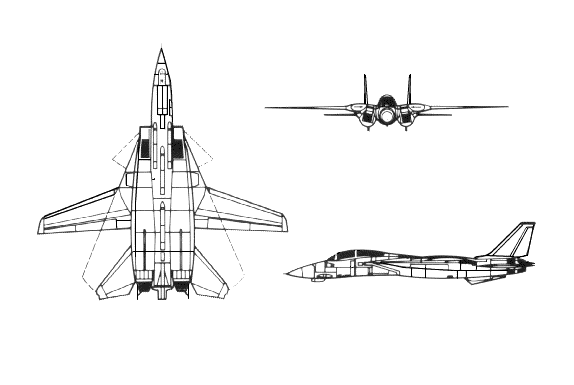
Three-view drawing
.jpg)
_de_un_F-14A_del_VF-14.jpg)
History
An interceptor for the fleet: from the Missileer to the F-111B
The F-14 story begins with an arithmetic problem that worried the US Navy in the late 1950s. Soviet long-range bombers —the Tupolev Tu-16, Tu-22 and later the Tu-22M— did not need to penetrate a carrier group's defensive screen: it was enough to get close enough to release anti-ship cruise missiles and turn away. If the salvo was large enough, close-in defences would saturate. The only workable answer was to shoot down the launch platforms before they launched, and that demanded an aircraft able to patrol far from the fleet, detect formations at enormous ranges and engage several targets at once.
The first attempt to build that idea was the Douglas F6D Missileer, proposed in 1959. It was deliberately unglamorous: subsonic, broad, designed to loiter for hours carrying a powerful radar and very long-range missiles. That very lack of performance killed it, because an aircraft unable to defend itself would be vulnerable as soon as the threat changed, and the programme was cancelled in December 1961.
The second attempt arrived by a political route. Defense Secretary Robert McNamara pushed the TFX programme so that the Air Force and the Navy would share a single airframe, saving on development and production. The naval version, the F-111B, was to inherit the radar and missiles conceived for the Missileer, by then named AN/AWG-9 and AIM-54 Phoenix. The result was an aircraft that kept growing, to a weight hard to reconcile with catapults, arresting gear and carrier approaches. Navy test pilots judged it unsuitable, and Vice Admiral Thomas F. Connolly, who flew an F-111A himself, said so to Congress knowing his candour might cost him his career. In May 1968 Congress cut the F-111B's funding.
The Navy was not starting from scratch. Grumman had worked on the F-111B as an industrial partner and knew its limitations first-hand; since 1966 it had held a study contract exploring alternative configurations that kept the radar-missile pairing but in an airframe conceived from the outset for the deck. In parallel the Navy kept alive the idea of a lighter multi-role fighter under the VFAX label. When the F-111B fell, those threads converged into a single requirement.
VFX: the competition and the Model 303
In July 1968 the Naval Air Systems Command issued the request for proposals for the VFX programme. The specification was demanding and remarkably precise: a tandem two-seater, twin-engined, capable of Mach 2.2, with an internal M61 Vulcan cannon of 20 mm and a secondary mission of close air support. The weapons fit had to accommodate six AIM-54 Phoenix missiles or, alternatively, six AIM-7 Sparrows plus four AIM-9 Sidewinders. In other words, the Navy asked simultaneously for the long-range fleet interceptor and for a dogfighter, the combination the F-111B could never offer.
General Dynamics, Grumman, LTV, McDonnell Douglas and North American Rockwell submitted proposals; four of the five used variable geometry. In December 1968 the Navy narrowed the field to two finalists and in January 1969 chose Grumman's design, the 303E variant of a family of configurations the company had explored patiently. The chosen name, Tomcat, fitted Grumman's feline tradition —Wildcat, Hellcat, Tigercat, Bearcat— and played on "Tom's Cat", a nod to Vice Admiral Connolly; Alley Cat and Seacat were among the discarded alternatives.
_(18355107845).jpg)
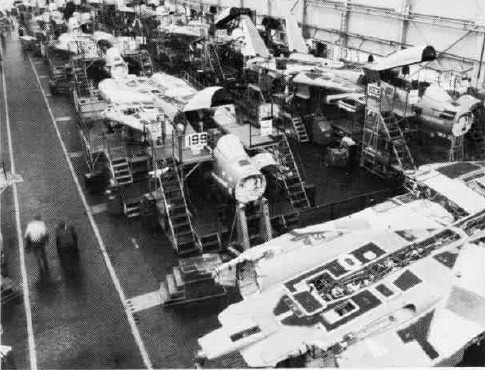
The resulting design carried 16,000 pounds (7,300 kg) of internal fuel and was sized for a service life of 6,000 hours of flight, later extended to 7,200. Grumman took a calculated risk to save time: it skipped a separate prototype phase and built representative pre-production aircraft directly, so that the first twelve machines served both as YF-14A test articles and as the basis of series production. Assembly was split between the company's plants at Bethpage and Calverton, on Long Island.
The first flight took place on 21 December 1970, barely twenty-two months after contract award, a remarkable schedule even for the period. Initial operating capability was declared in 1973. The Marine Corps, which had shown early interest, eventually withdrew from the programme.
Proving the weapon system
The F-14 was less an aircraft with missiles than a weapon system carried on an aircraft, and the test campaign reflected that. AIM-54 firings from the Tomcat began in April 1972. In April 1973 the programme achieved its longest launch, 110 nautical miles (200 km), a distance no other carrier fighter could contemplate.
The decisive demonstration came on 22 November 1973. A single F-14, flying at Mach 0.78 and 24,800 feet (7,600 m), fired six Phoenix missiles in 38 seconds against six separate targets. Four hit, one lost radar lock and one was scored a "no test" because of a target failure, giving an 80 percent success rate among the missiles actually evaluated. It proved that the AN/AWG-9 could guide several weapons simultaneously, and for decades that trial remained the canonical reference for the system's multi-target capability.
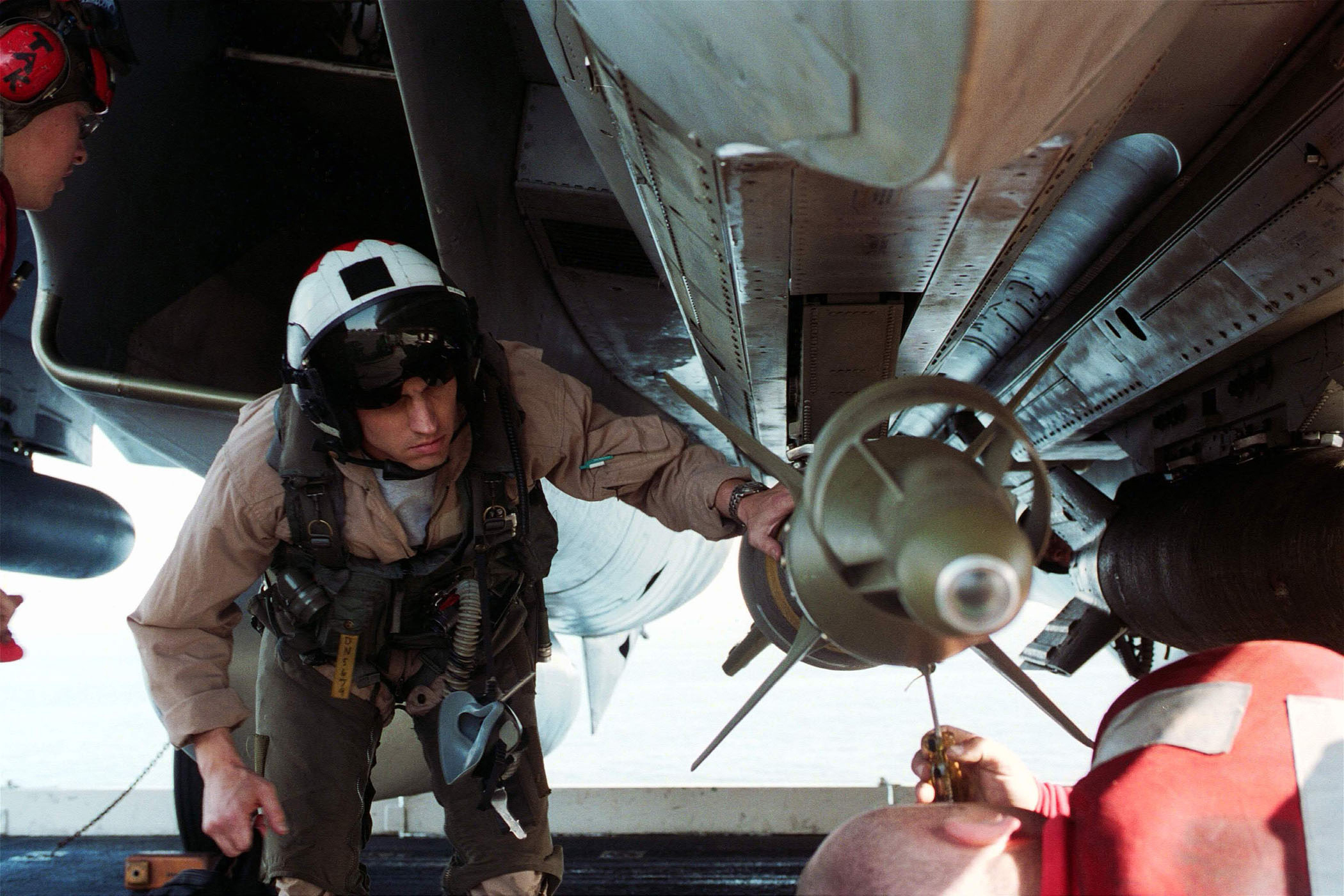
One contrast runs through the whole life of the aircraft and deserves emphasis: that six-missile salvo was never used in combat. The six-Phoenix fit was heavy, expensive and constrained maximum landing weight, so operational loads were far more modest.
Variable geometry and aerodynamic design
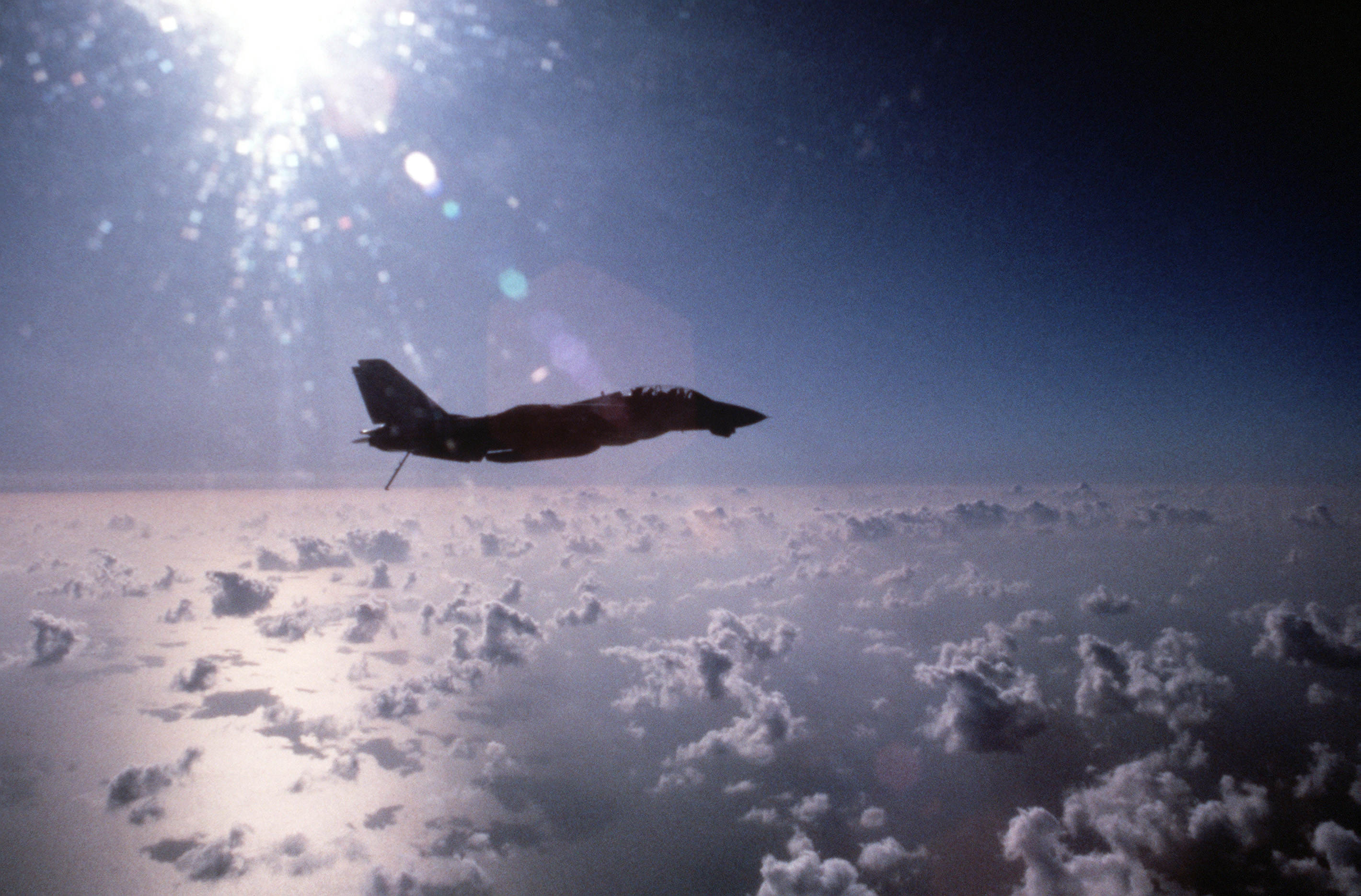
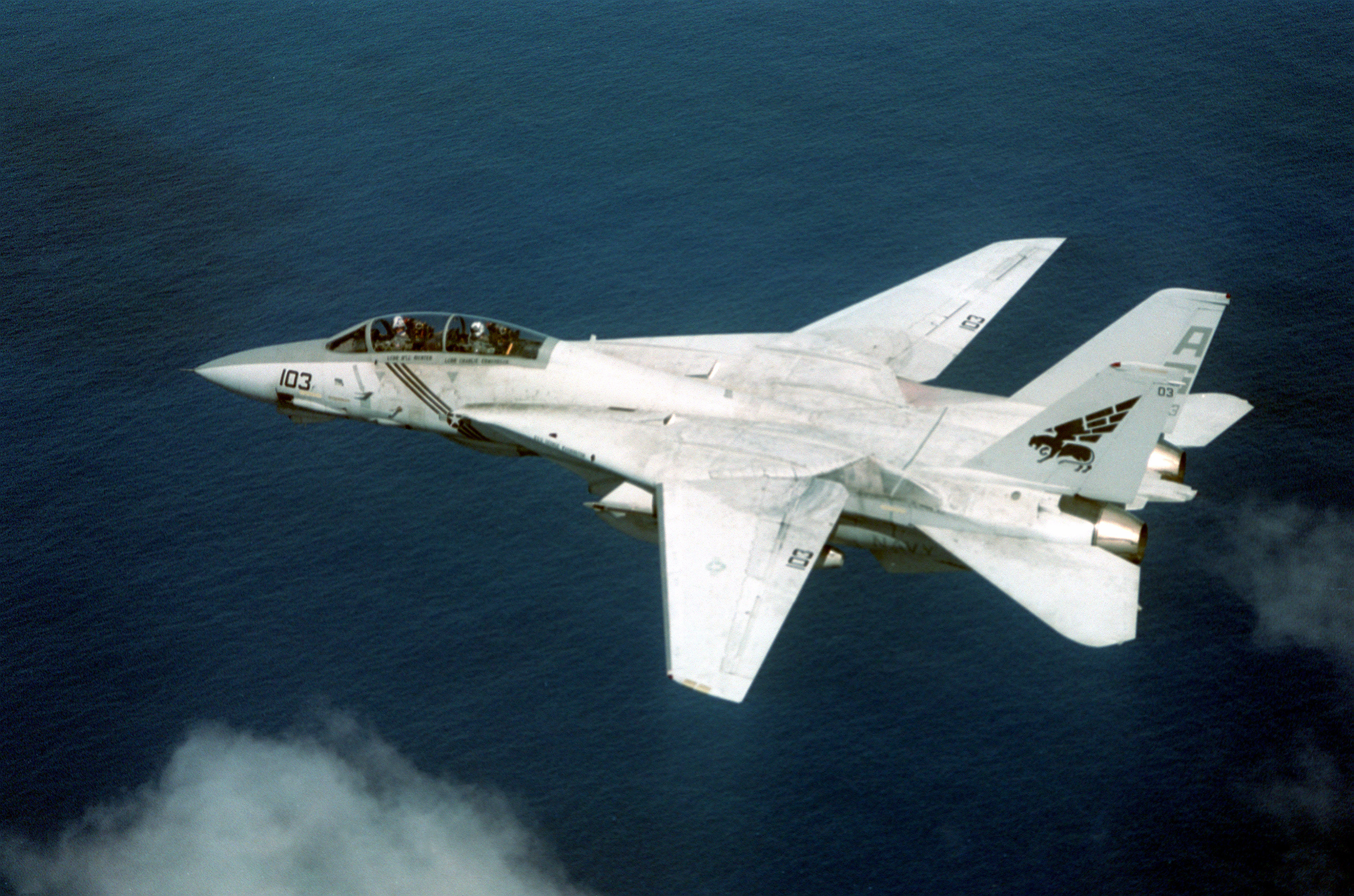
The Tomcat's wing sweeps between 20° and 68°, normally under automatic control from the central air data computer, which schedules sweep against Mach number and altitude to keep the best lift-to-drag ratio. On deck it can reach 75° of oversweep to take up less room, and in the event of a failure the aircraft can land with the wings swept to 68°. Testing even included flight with asymmetrically swept wings without serious consequences. The spoilers are locked out above 57° of sweep, and the high-lift devices have distinct settings for landing —leading-edge slats at 17° and flaps at 35°— and for combat, 7° and 10° respectively.
The broad, flattened fuselage between the two widely spaced engine nacelles is no mere structure: it generates 40 to 60 percent of total lift, which allowed a smaller wing and therefore less supersonic drag. Wing area proper is 52.5 m², but effective area including the lifting body comes to about 94 m². The horizontal stabilators work differentially for roll control, and the outward-canted twin fins provide directional stability at high angles of attack. The tail, mounted well aft, earned the aircraft the in-house nickname "castor tail".
About 25 percent of the structure is titanium, joined by electron-beam welding, then an unusual technique that produced very strong, light wing boxes. The design was stressed for +7.5 g, although the fleet routinely applied a +6.5 g operating limit. The aircraft also carried retractable surfaces in the wing gloves, the glove vanes, which deployed automatically above Mach 1.4 to shift the centre of pressure and allow 7.5 g at Mach 2; they were later disabled because of cost and maintenance complexity. The airframe's toughness was proved in 1991, when an F-14 lost more than half of its right wing in a mid-air collision and still landed.
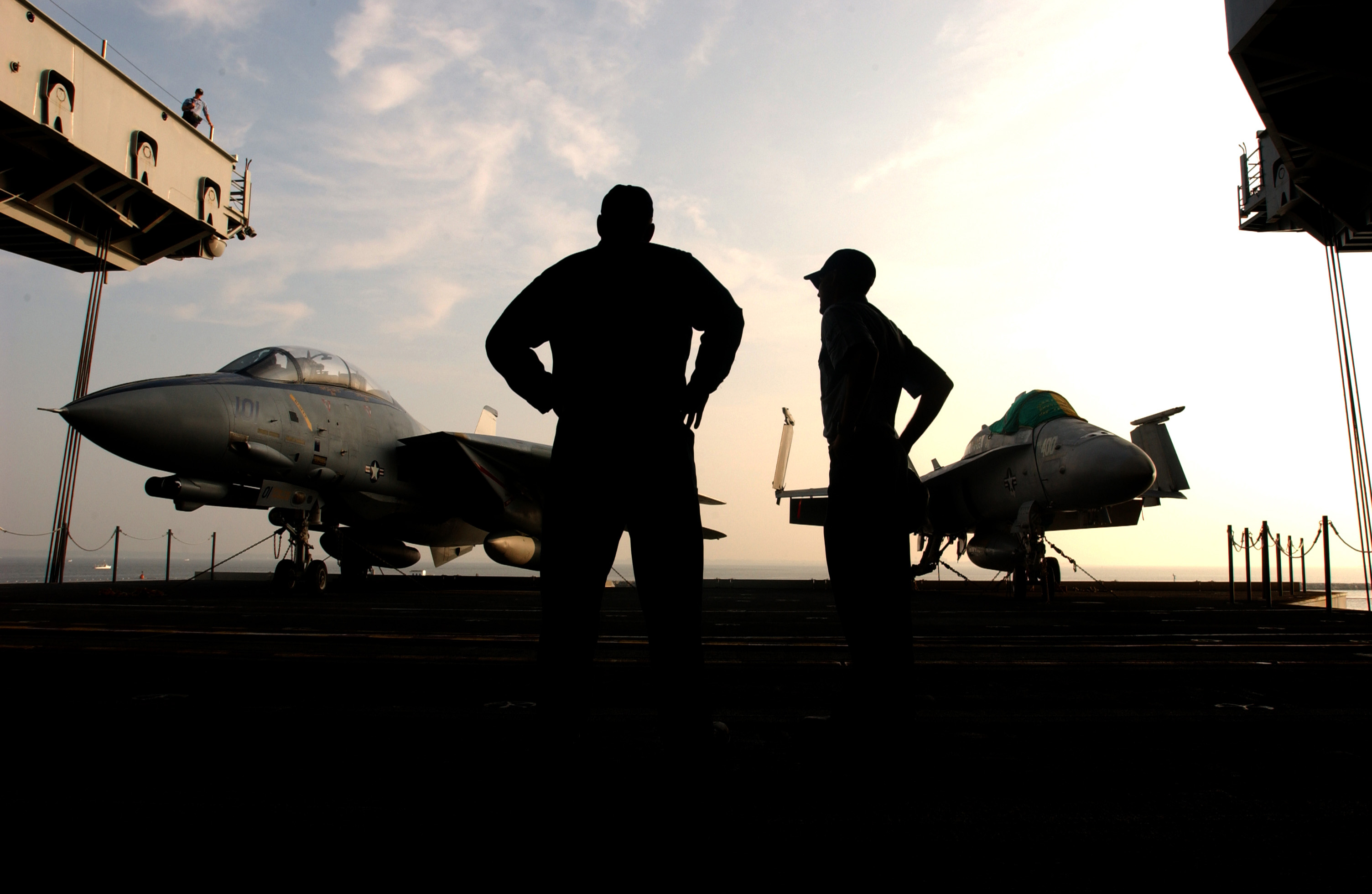
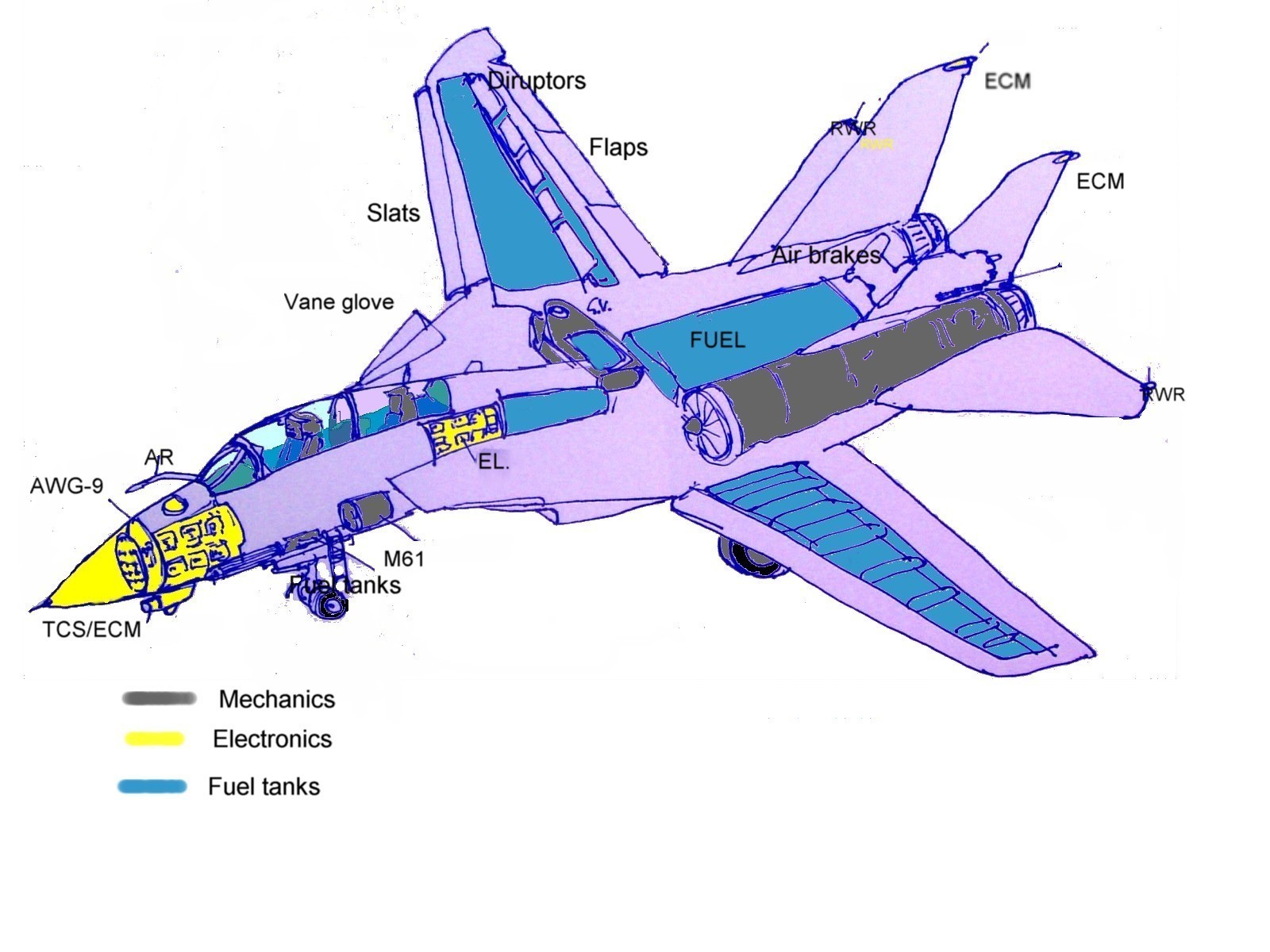
Internal fuel totals 2,400 US gallons (9,100 L), distributed as 290 US gallons (1,100 L) in each wing, 690 US gallons (2,600 L) behind the cockpit and 457 US gallons (1,730 L) in two feeder tanks; it is supplemented by two 267 US gallon (1,010 L) external tanks under the intakes and by a retractable refuelling probe. The maximum speed required by the Navy was Mach 2.4.
Engines
If the wing and the radar were successes, propulsion was the programme's structural flaw. The F-14A was delivered with Pratt & Whitney TF30-P-412A turbofans of 20,900 pounds thrust (93 kN), inherited from the F-111B as an interim solution pending the definitive engine. That definitive engine, the Pratt & Whitney F401 rated at 28,100 pounds (125 kN), was cancelled, and the interim fit stayed for nearly two decades.
The TF30 was sensitive to airflow disturbance at high angles of attack or in yaw, and an asymmetric compressor stall could produce a violent yawing moment capable of developing into a flat spin from which recovery was very difficult. Stalls were more likely above 30,000 feet (9,100 m), and a bleed system had to be added to prevent them during missile launches. In time the engine was associated with 28 percent of all accidents of the type. Navy Secretary John Lehman was blunt before Congress: he called it "probably the worst engine/airframe mismatch" of recent years and, without qualification, "a terrible engine". The later TF30-P-414A eased the problem without solving it.
The definitive answer was the General Electric F110-GE-400, fitted to the F-14A+ and the F-14D. It offered 26,950 pounds of thrust (119.9 kN) uninstalled and 23,400 pounds (104 kN) installed at sea level, rising to 30,200 pounds (134 kN) at Mach 0.9. The everyday difference was enormous: climb rate improved by 61 percent, strike radius grew by roughly 60 percent or, alternatively, allowed one third more time on station, and for the first time the Tomcat could be catapulted without afterburner. Thrust-to-weight ratio rose from 0.56 with the TF30 —against 0.85 for an F-15A— to 0.73 at maximum weight and 0.88 in normal configuration. The new engine had its own scares: after two accidents in 1996, afterburner use below 10,000 feet was banned for more than a year.
Radar, avionics and cockpit
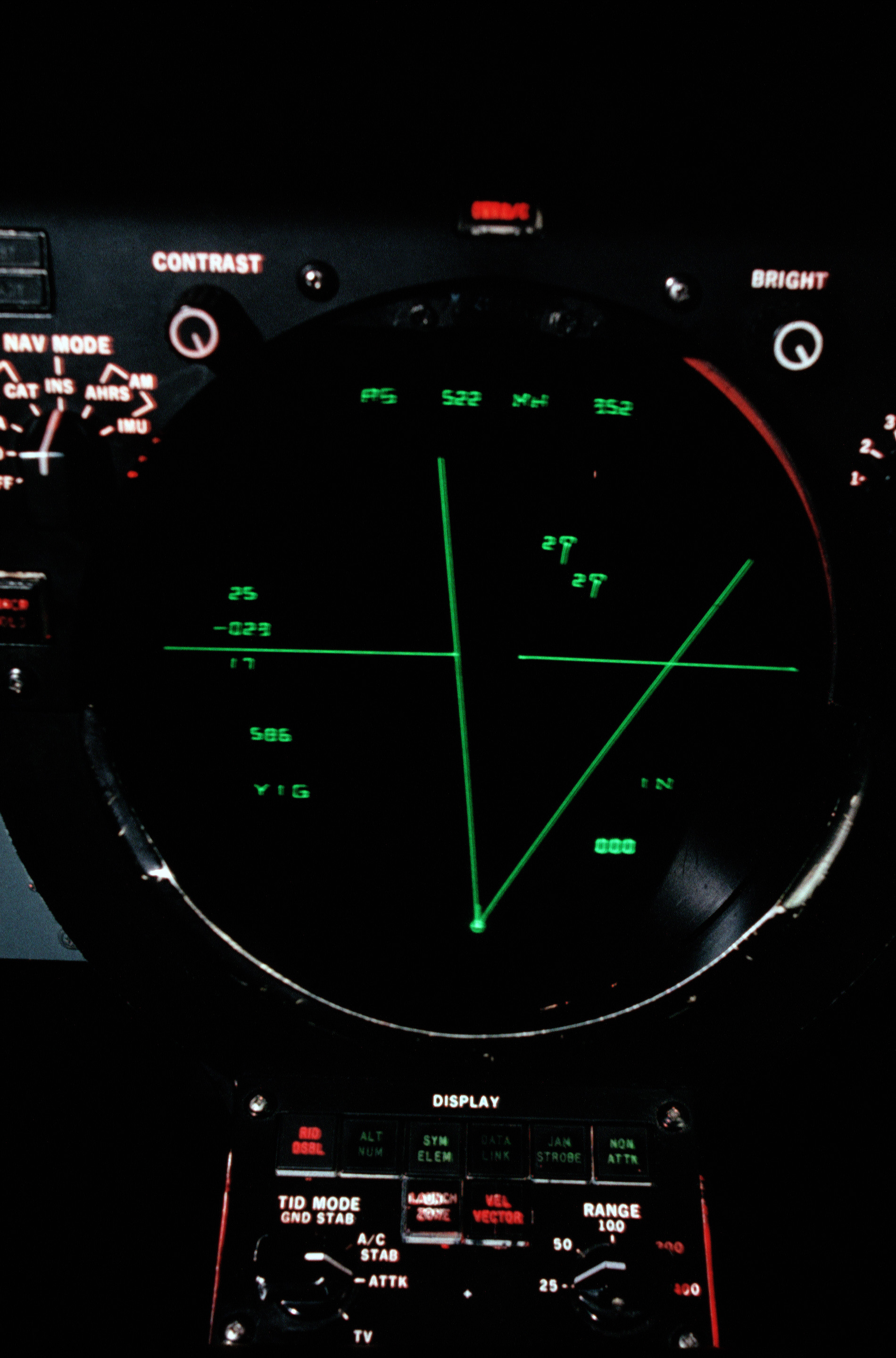
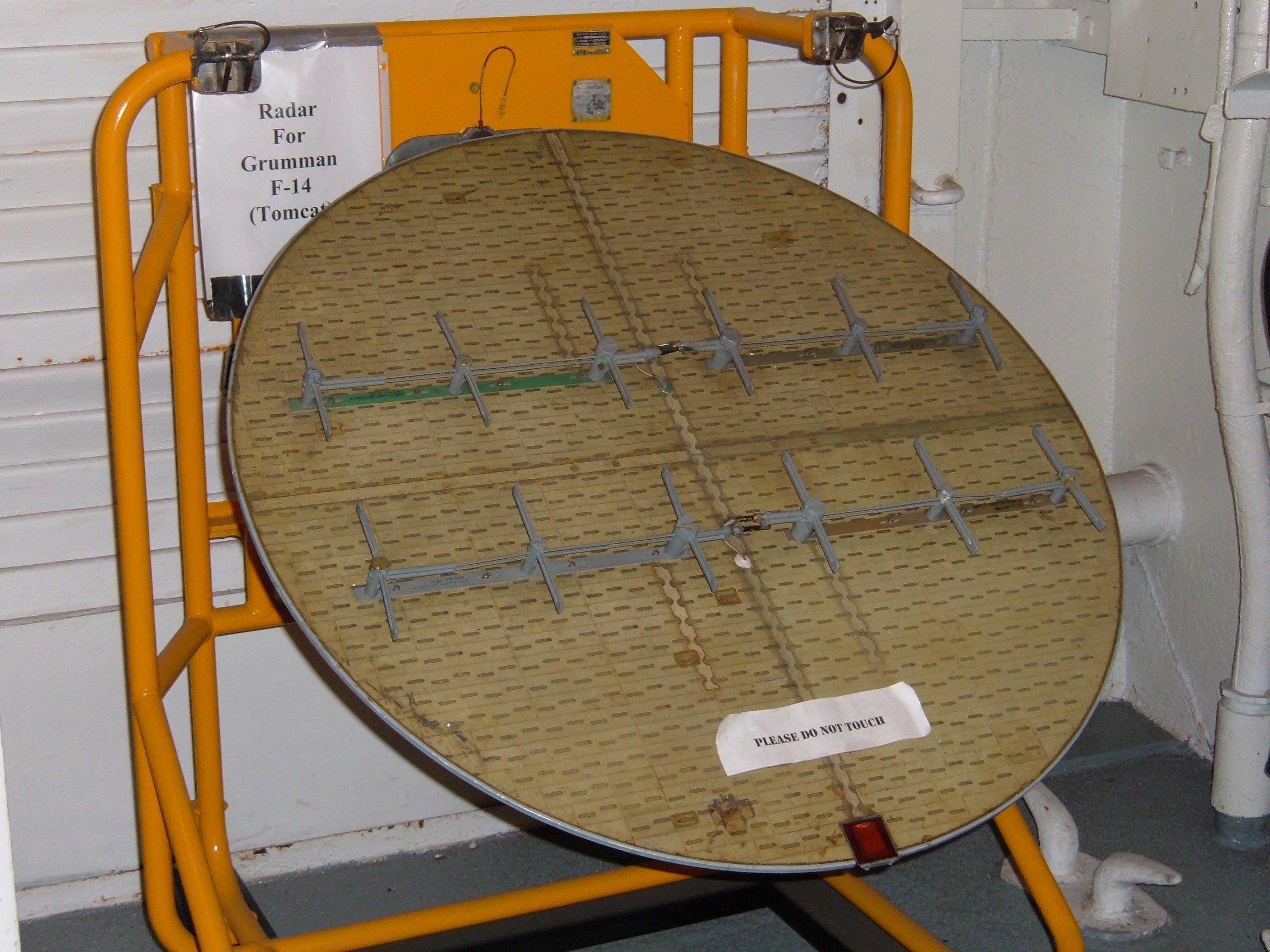
The heart of the Tomcat was the Hughes AN/AWG-9 radar, an X-band set with a 36-inch (91 cm) planar array conceptually inherited from the Missileer and the F-111B but refined into the most capable airborne sensor of its day. It offered several modes: track-while-scan, range-while-search, pulse-Doppler single-target track and identification modes. In track-while-scan it could hold twenty-four contacts and control engagements against six of them at ranges of up to about 60 miles (97 km). On paper the system was capable of working out to 460 miles (740 km), but the antenna limited practical range to some 230 miles (370 km); on the D model, the datalink between aircraft recovered part of that distance by sharing the tactical picture. The F-14D replaced the AWG-9 with the digitally processed AN/APG-71.
%2C_into_positio.jpg)
Wing scheduling and other automatic functions were handled by a Garrett AiResearch central air data computer built around the MP944 chipset, an early application of high-density MOSFET technology often cited among the first microprocessors carried in a combat aircraft.
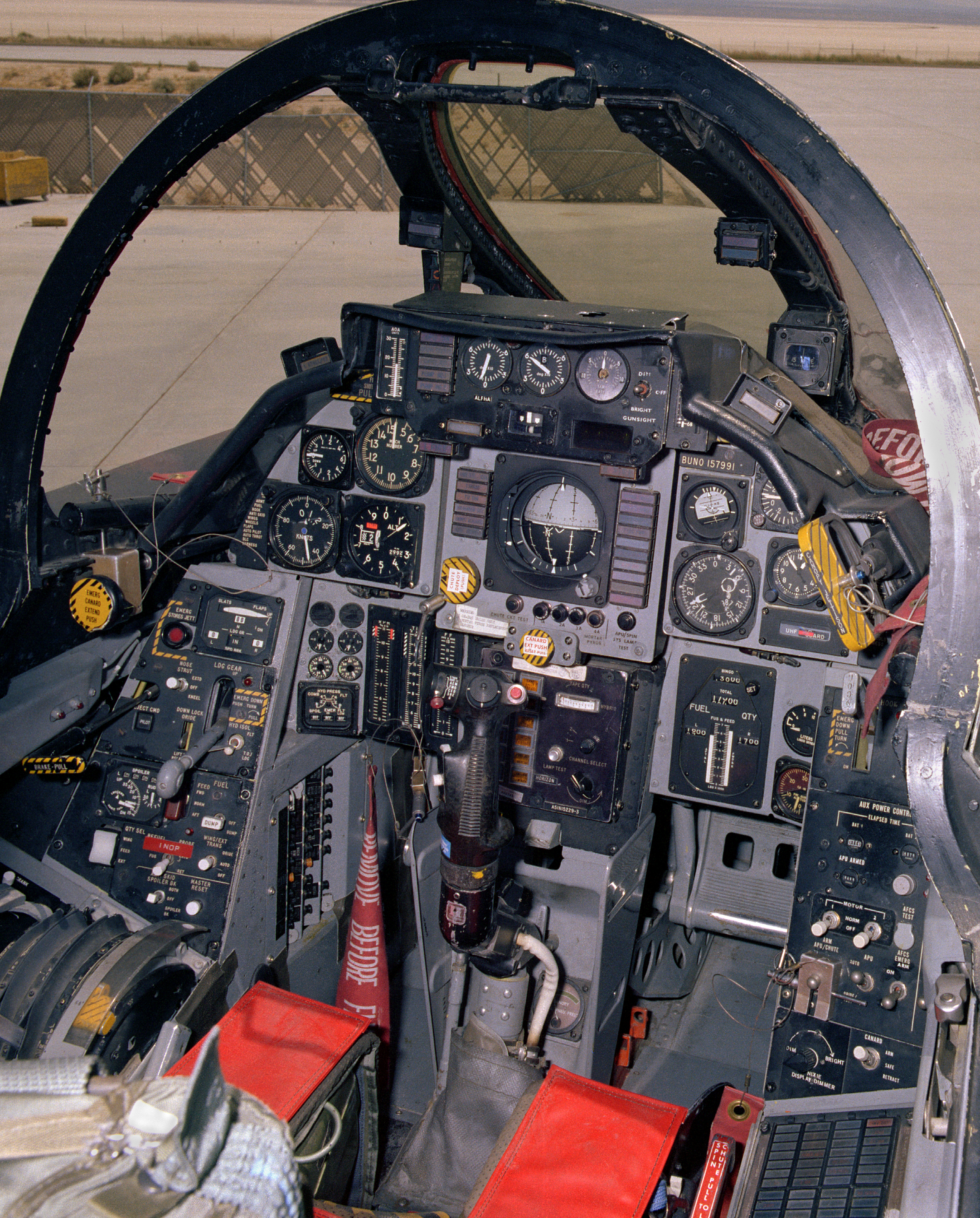
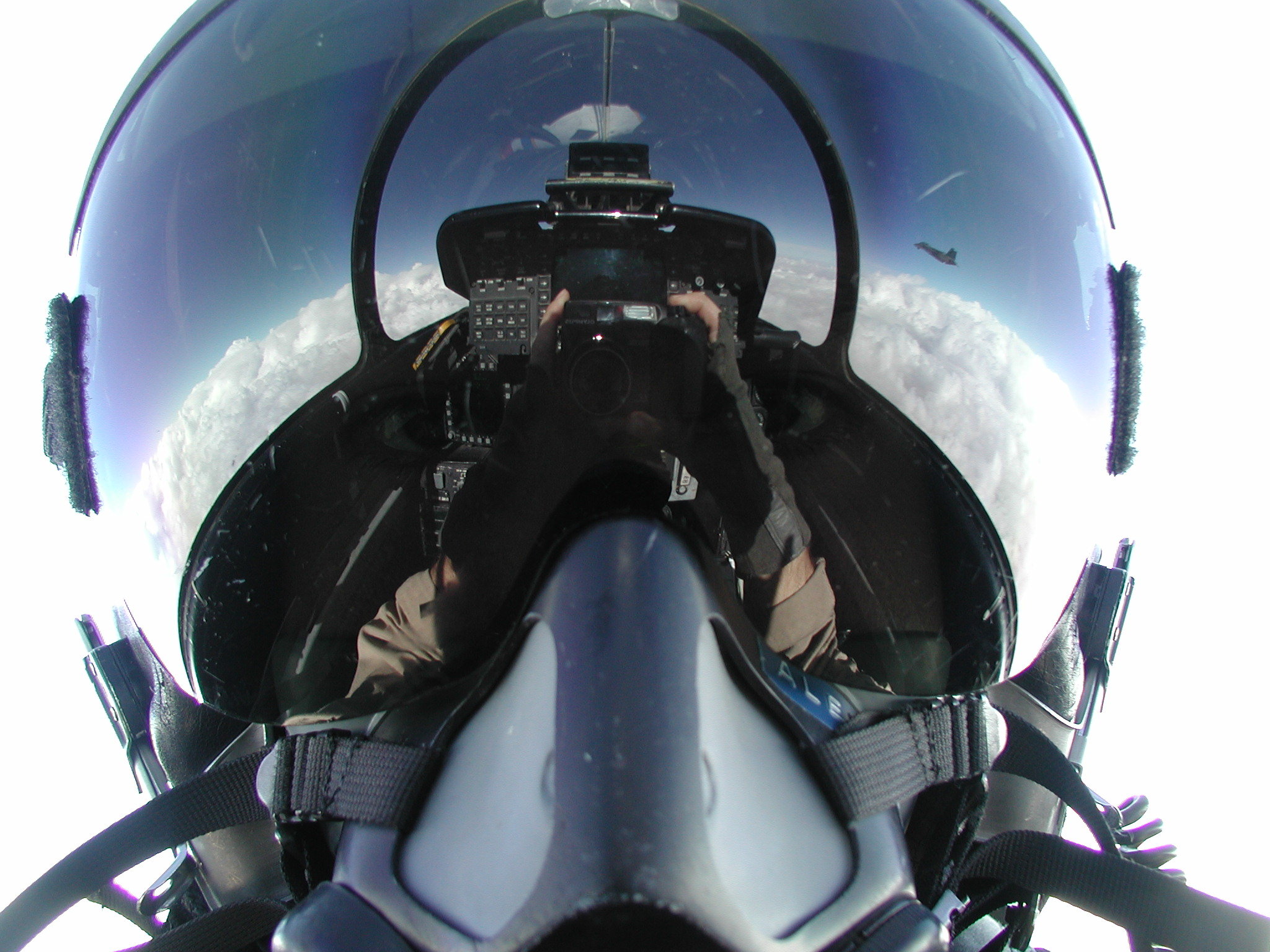
The tandem cockpit put the pilot in front and the radar intercept officer behind, the latter without flight controls but with effective command of the long-range fight. Both sat on Martin-Baker GRU-7A zero-zero seats, usable up to 450 knots, and the rear station had four mirrors on the canopy to offset the limited view aft.
For electronic warfare the aircraft began with the AN/ALR-45/50 radar warning receiver and moved to the AN/ALR-67. The original AN/ALR-23 infrared sensor, based on indium antimonide, proved unreliable and was replaced by the Northrop AAX-1 or TCS optical system, a high-magnification television camera with which the crew could visually identify an aircraft at some 60 miles (97 km): a decisive capability in peacetime, when rules of engagement demanded visual identification before firing. The F-14D added an AN/AAS-42 infrared search and track set alongside the TCS, and the integration of JTIDS and the Link 16 datalink completed its networked capability.
Armament
The Tomcat's armament was layered by range. At the long end sat the AIM-54 Phoenix, conceived against the Soviet Tu-16, Tu-22 and Tu-22M. After launch it climbed and cruised between 80,000 feet (24,000 m) and 100,000 feet (30,000 m) at close to Mach 5, guided by the aircraft's radar, activating its own seeker only about 11 miles (18 km) from the target. The AIM-54A gave way to the AIM-54B in 1983, of limited use, and to the AIM-54C in 1986, with digital electronics and better countermeasures resistance. At medium range the aircraft carried the AIM-7 Sparrow, from the AIM-7E-4 to the AIM-7F in 1976 and the AIM-7M in 1982; at short range the AIM-9 Sidewinder, from the J and H models to the L in 1979 and the M in 1982. The internal 20 mm M61A1 Vulcan, with 675 rounds, closed the sequence.
.jpg)
Total capacity exceeded 14,800 pounds (6,700 kg) of stores across ten hardpoints: six under the fuselage, two under the engine nacelles and two on the wing gloves. In practice the routine load of the late 1970s and the 1980s was two Phoenix, two Sidewinders, three Sparrows, a full gun magazine and two external tanks: a balanced fit that avoided the extreme weight of six Phoenix, a combination that, as noted, was never used operationally.
The Phoenix's American combat record is surprisingly thin. The Navy fired it in anger only twice, both times over Iraq in 1999, and neither launch produced a kill. All the missile's real-world experience belongs, paradoxically, to Iran.
TARPS: the Tomcat as a reconnaissance aircraft
From the late 1970s Grumman developed a tactical reconnaissance pod for the F-14, the TARPS, which entered service in 1981. It housed optical cameras and an infrared line scanner and hung from a dedicated fuselage station. Around 65 F-14As and every F-14D were modified to carry it, and the standard became three capable aircraft in each designated squadron.
.jpg)
Its importance grew by subtraction: when the RF-8G Crusader retired in 1982, the TARPS became the US Navy's primary tactical reconnaissance system, a role it kept for the rest of the Tomcat's life. It received successive upgrades, with the digital TARPS-DI in 1996 and TARPS-CD in 1998, able to transmit imagery in near real time. A large share of the aircraft's missions over Lebanon, the Balkans and Iraq were in fact photographic.
The F-14A+, the F-14B and the F-14D
Tomcat production ran from 1969 to 1991 and totalled 712 aircraft. The bulk were F-14As: 558 for the US Navy and 79 for Iran, delivered in production blocks from F-14A-60 to F-14A-140.
The first substantial evolution touched the engines rather than the avionics. From March 1987 aircraft were delivered with the F110-GE-400 under the F-14A+ designation, renamed F-14B on 1 May 1991. There were 38 new-build aircraft and 43 conversions from F-14As; later, a modernisation programme brought 81 airframes to the F-14B (Upgrade) standard, with new mission avionics, a weapons data computer and electronic warfare improvements.
The F-14D Super Tomcat, delivered from 1991, was the definitive version: AN/APG-71 radar, AN/AAS-42 infrared sensor, AN/ALR-67 receiver, ASPJ active jamming suite, JTIDS datalink, SJU-17(V) NACES seats and a digital flight control system that finally cured the flat-spin tendency. Thirty-seven were built new and 18 converted —designated F-14D(R)— for a total of 55, far short of what had been planned.
From air to ground: LANTIRN and the "Bombcat"
The F-14 was born with a secondary close air support mission that stayed on paper for fifteen years. In 1992, with the Cold War over and the attack fleet shrinking, the Navy cleared the Tomcat to drop conventional bombs. The nickname "Bombcat" caught on at once.
_F-14A_Tomcat_aircraft_flies_over_the_electronic_warfare_training_range_during_a_pre-deployment_training_mission_-_DPLA_-_32fbecff9b6a0e87d1bd1e.jpeg)
The qualitative leap came with the LANTIRN pod, of which the aircraft used only half the system: the AN/AAQ-14 targeting module, without the navigation pod. Integration had to work around a notable obstacle: the F-14 lacked the MIL-STD-1553B data bus the pod expected, so Martin Marietta developed a dedicated interface card and a ten-inch programmable tactical display was fitted in the rear cockpit for the radar intercept officer. At first, carrying LANTIRN and TARPS together was impossible, a limitation resolved later. In 2001 the LANTIRN 40K version appeared, usable up to 40,000 feet (12,000 m), joined by improvements such as T3 and FTI that allowed precise target coordinates to be generated for satellite-guided weapons.
The expansion continued to the end of the aircraft's career: the GBU-38 JDAM was integrated in 2003 and the ROVER III system in 2005, which fed the targeting pod's imagery directly to controllers on the ground. The fleet interceptor ended its life as one of the Navy's best laser designation platforms.
Fleet debut and the Cold War years
The first operational squadrons — VF-2 "Bounty Hunters" and VF-1 "Wolfpack" — embarked in USS Enterprise in September 1974. Their baptism was not a battle but an evacuation: in April 1975, during Operation Frequent Wind, the Tomcats covered the helicopter withdrawal from Saigon and met no air opposition.
_F-14A_Tomcat_aircraft%2C_painted_in_the_Sperry_camouflage_scheme%2C_as_it_approaches_the_nuclear-powered_aircraft_carrier_USS_.jpg)
Cold War routine followed immediately. On 23 April 1976 an F-14 of VF-142 intercepted a Soviet Tupolev Tu-95 "Bear", the type's first such intercept in the Atlantic Fleet, opening a sequence of encounters that would repeat for fifteen years over the North Atlantic, the Mediterranean and the Pacific. Those intercepts were also a counter-intelligence matter: in 1976 an F-14 rolled overboard near Scapa Flow and sank in 580 metres (1,890 feet) of water, and the Navy mounted a multi-million-dollar recovery driven less by the aircraft than by the Phoenix missiles aboard and the risk of Soviet salvage. That same year Operation Fluid Drive took Tomcats to the eastern Mediterranean during the evacuation of American citizens from Lebanon.
Lebanon, Libya and the Mediterranean
The Mediterranean was where the F-14 moved from deterrence to gunfire. Facing Libya, on 21 September 1980, three Tomcats confronted eight Libyan fighters attempting to close on an American RC-135; the episode ended without shots, like most of the thirty-five paired encounters counted in the summer of 1981. On 19 August 1981 the pattern broke: two VF-41 F-14As over the Gulf of Sidra were fired on with an AA-2 "Atoll" from a Libyan Su-22 and answered by shooting down both aircraft with AIM-9L missiles. They were the Tomcat's first kills and the first American kills since Vietnam.
Over Lebanon, between 1982 and 1986, activity was almost entirely reconnaissance. From November 1983 into the spring of 1984, VF-142 and VF-143 from Eisenhower, VF-11 and VF-31 from John F. Kennedy and VF-14 and VF-32 from Independence flew near-daily TARPS missions over Syrian positions. These were not routine sorties: on 3 December 1983 the Tomcats were engaged by Syrian anti-aircraft artillery and by at least ten surface-to-air missiles, and on 14 December the American reply came from the guns of USS New Jersey. In another incident, VF-11 aircraft found themselves facing eight Syrian MiGs and left the encounter without firing.
The rest of the decade piled up high-tension episodes. In April 1983 an SA-2 battery fired at VF-102 F-14s over Berbera at 3,000 metres (10,000 feet). Between 24 July and 14 August 1983 Tomcats took part in Operation Arid Farmer over Chad, and in October of the same year in the invasion of Grenada during Urgent Fury. On 8 to 10 October 1985, after the hijacking of the cruise liner Achille Lauro, the Tomcats intercepted in flight an EgyptAir Boeing 737 carrying the hijackers and forced it to land at Sigonella, in Sicily. On 24 March 1986, during Operation Attain Document, Libya launched SA-5 missiles and a VF-33 F-14 intercepted a Libyan MiG-25; on 15 April the Tomcats covered the El Dorado Canyon strikes.
_fly_in_formation_over_the_nuclear-powered_aircraft_carrier_USS_NIMITZ_(CVN-68)_during_a_vis.jpeg)
In the Persian Gulf, the tanker escort of Operation Earnest Will produced on 8 August 1987 an AIM-7 launch by VF-21 F-14s against two Iranian F-4s, without result. Nimble Archer followed in October 1987 and Praying Mantis in April 1988, both against Iranian installations and naval units.
The Tomcat's second and last victorious combat in American hands came on 4 January 1989 off Libya: two VF-32 F-14As shot down two Libyan MiG-23s, one with an AIM-7 and the other with an AIM-9, in an engagement recorded on tape that became study material on rules of engagement.
Desert Storm
The 1991 Gulf War was the Tomcat's largest deployment. Between 17 January and 28 February, ten squadrons and 99 aircraft in theatre flew 4,124 sorties, mostly escort, combat air patrol and TARPS reconnaissance. It was also an uncomfortable demonstration of its limits: allied coordination, the division of airspace and the massive presence of Air Force F-15s left the F-14 with very few air combat opportunities. On 24 January 1991, in a much-discussed episode, an E-3 vectored Saudi F-15s onto a formation of Iraqi Mirage F1EQs that the Tomcats had detected.
The type's only American kill in the whole campaign came on 6 February 1991, when a VF-1 F-14 destroyed an Iraqi Mil Mi-8 helicopter with an AIM-9. In the other direction, on 21 January 1991 an SA-2 missile shot down near Al Asad the VF-103 F-14A with serial 161430, crewed by Lieutenant Devon Jones and Lieutenant Lawrence Slade. Jones was rescued by special forces after several hours in hostile territory; Slade was taken prisoner and not released until 4 March 1991. It was the only F-14 lost to hostile fire in the war.
No-fly zones and the Balkans
The post-Gulf War years kept the Tomcat busy in the no-fly zones over Iraq: Provide Comfort in the north, Southern Watch in the south and later Northern Watch. They were years of surveillance without air combat, but of enormous accumulated flight hours, and they were also the years in which the aircraft acquired its new identity as a bomber.
.jpg)
The F-14's debut as a guided-weapons carrier came in the Balkans. During Operation Deliberate Force, between August and September 1995, VF-41 aircraft attacked a Bosnian ammunition dump on 5 September with laser-guided bombs designated by F/A-18s, the first time a Tomcat had delivered such weapons in combat; the squadron logged 600 combat flight hours and 530 sorties in the campaign.
December 1998 brought Operation Desert Fox against Iraq. Between 16 and 19 December, a thirty-three aircraft strike package included the first GBU-24 bombs delivered from naval platforms, the first combat employment of the LANTIRN pod aboard an F-14 and the first night-vision devices used by its crews. VF-32 dropped 111,054 pounds (50,373 kg) of ordnance in sixteen strike missions and thirty-eight sorties, and on 19 December VF-213 gave the F-14D its combat debut.
The Iraqi patrols also produced the US Navy's only AIM-54 firings. On 5 January 1999 two AIM-54Cs launched at Iraqi MiG-23s failed when their rocket motors malfunctioned. There was a third launch in September 1999, also without result, on which the sources disagree: the aircraft's general history dates it 14 September 1999 and attributes it to an F-14D of Carrier Air Wing 2 from USS Constellation, while the operational history dates it 9 September 1999 and assigns it to VF-2. Both versions agree on the outcome: no kill.
The patrol cycle left figures that illustrate the workload. On its 1998-99 cruise VF-213 carried out nineteen strikes, released twenty laser-guided bombs with a success rate of 64 percent, took part in eleven combined strikes, flew seventy missions and 230 sorties with more than 615 combat hours, and completed forty-five reconnaissance missions covering more than 580 targets.
In Operation Allied Force over Kosovo, between 9 April and 9 June 1999, VF-14 released 350 laser-guided bombs of 1,000 pounds (450 kg), and VF-41 had the symbolic role of dropping the campaign's last bombs on 9 June.
Afghanistan and Iraq: the Bombcat at its peak
JDAM integration, cleared on 15 February 2001, arrived just in time. The Tomcat's first strikes over Afghanistan, within Operation Enduring Freedom, took place on 7 October 2001, and the first JDAM release from an F-14 followed on 11 March 2002. No fewer than eight squadrons took part in the campaign.
The combined figures for VF-41, VF-14, VF-213, VF-102 and VF-211 exceeded 1,334,000 pounds of ordnance dropped (605,000 kg). VF-11 and VF-143 contributed 64,000 pounds (29,000 kg) and made the type's first combat JDAM releases. VF-213 flew more than 500 sorties and 2,600 hours of combat, dropping 435,000 pounds of bombs (197,000 kg) —452 weapons— in ten weeks, besides dropping the operation's first bombs. VF-102 recorded 680 bombs and 420,000 pounds (190,000 kg), more than 5,000 combat hours and a further 50,000 pounds (23,000 kg). VF-211 accumulated 1,250 sorties, 4,200 combat hours and 100,000 pounds (45,000 kg). VF-14 dropped 174 laser-guided bombs totalling 179,324 pounds (81,340 kg) and lased for other aircraft 28 AGM-65 Maverick missiles and 23 guided bombs. VF-41 exceeded 200,000 pounds (91,000 kg) with 202 laser-guided bombs at an 82 percent hit rate. VF-103, which arrived in June 2002, dropped nothing at all.
In the 2003 invasion of Iraq, VF-31, VF-2, VF-213, VF-32 and VF-154 flew 2,547 combat sorties and released 1,452 bombs, laser-guided, JDAM and conventional Mark 82 alike, losing a single aircraft to engine failure. Recorded missions include the attack on a communications relay at Salman Pak and at Al Hurriyah, and the delivery of four Mark 82 bombs onto Saddam Hussein's presidential yacht Al-Mansur. The campaign also left a dark episode: a mistaken attack by VF-32 on a convoy of American special forces.
The type's last operational deployment ran from September 2005 to March 2006 with VF-31 and VF-213, which together logged 1,163 combat sorties, 6,876 flight hours and 9,500 pounds (4,300 kg) of ordnance dropped over Iraq.
Cancellation and retirement
The F-14's end was decided in budget offices rather than in the air. In 1989 Defense Secretary Dick Cheney halted production after 37 new-build F-14Ds, even though the Secretary of the Navy argued for at least 132 and the original plan had foreseen hundreds. Cheney described the aircraft as "1960s technology" and as a jobs programme, in a controversy in which the decision was estimated to affect some 80,000 jobs. It was the start of Grumman's decline as an independent manufacturer, which would end in its absorption into Northrop Grumman.
The intended successors were cancelled one after another: the VFMX project, the Naval Advanced Tactical Fighter —a carrier version of the F-22 abandoned in 1991 on the assumption that the F-14D would serve until 2015—, the A-12 bomber and the A-X/A-F-X line, cancelled in the 1993 Bottom-Up Review. The Navy ended up committing to the F/A-18E/F Super Hornet.
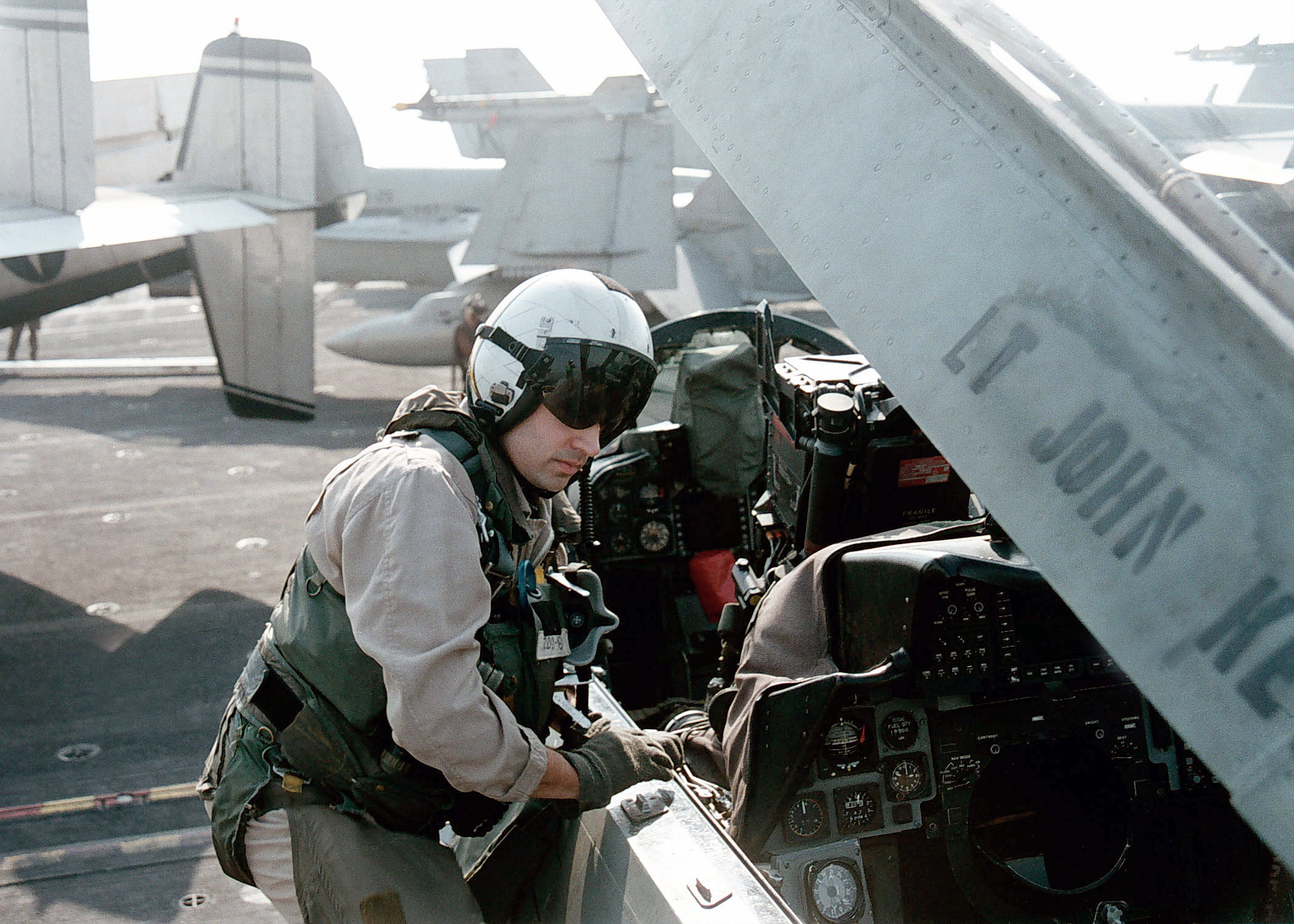
Retirement was carried out with ceremony. The last combat mission was flown on 8 February 2006 from USS Theodore Roosevelt; the final fly-in to Naval Air Station Oceana took place on 10 March 2006; the last catapult launch came on 28 July 2006, flown by Lieutenant Blake Coleman and Lieutenant Commander Dave Lauderbaugh; the official retirement ceremony was held on 22 September 2006 with Lieutenant Commander Chris Richard and Lieutenant Mike Petronis at the controls; and the true last flight was a ferry on 4 October 2006 from Oceana to Republic Airport, on Long Island, where the aircraft had been born.
Surviving airframes went to the 309th AMARG boneyard at Davis-Monthan. In 2007 the decision was taken to shred them physically so that their parts could not reach the Iranian fleet by indirect routes, and in August 2009 the last examples were sent for scrapping in Tucson, leaving barely eleven in storage. On 28 April 2026 the US Senate approved the so-called "Maverick Act", authored by Representative Abraham Hamadeh and sponsored by Senator Tim Sheehy, to transfer three F-14Ds to the U.S. Space & Rocket Center at Huntsville, in Alabama; as of May 2026 it had not yet become law.
Projected variants
A remarkable collection of projects accumulated around the F-14 without reaching production. The original F-14B, not to be confused with the 1991 designation, was the F401-engined prototype that flew in 1973 and whose programme was terminated in April 1974. The F-14C would have added advanced avionics on that basis. The F-14 ADC was proposed with the GAU-7/A 25 mm caseless cannon and F100 engines. Quickstrike was a late-1970s proposal to give the aircraft a real strike capability long before the Bombcat.
The most ambitious projects came in the 1980s and 1990s. The Super Tomcat 21 would have used F110-GE-429 engines, with supercruise at Mach 1.3 and thrust vectoring; the Attack Super Tomcat 21 added an electronically scanned radar from the cancelled A-12; and the ASF-14 proposed an entirely new airframe with the same general configuration. None was built: the Navy preferred to develop the Super Hornet.
Iran: the Persian King programme
Grumman tried to sell the Tomcat to Canada, Germany and Japan without success. The only export customer was Iran, and for a very specific reason: Soviet MiG-25s were overflying the country at heights and speeds the imperial air force could do nothing about. The Shah wanted an interceptor able to reach them. After Richard Nixon's 1972 visit to Tehran and a comparative F-15 and F-14 demonstration at Andrews Air Force Base, Iran chose the Tomcat, whose radar and long-range missile fitted the problem better.
The initial order, signed in January 1974 under the Persian King programme, covered thirty F-14s and 424 AIM-54 missiles for about 300 million dollars, and was later enlarged to eighty fighters and 714 Phoenix missiles, with ten years of spares and engines and the construction of a new air base, Khatami, near Isfahan. Here the sources diverge appreciably: the operational history puts the whole deal at 2 billion dollars and specifies that only 274 missiles were delivered, for 150 million dollars, with 150 blocked by the later embargo and 290 cancelled.
The first aircraft arrived in January 1976 with TF30-414 engines and with part of the classified avionics removed, and twelve more followed the next year. The Iranian aircraft were produced within the American series, in the serial range 160299 to 160377. A crew still in training shot down a drone flying at 15 km altitude (50,000 feet), a result that served as a showcase. In October 1978 two imperial F-14As tracked a Soviet MiG-25 over the Caspian for two minutes, and the overflights ceased: the intended deterrent effect had been achieved without firing. Of the eighty ordered, 79 were delivered; the last was retained in the United States.
Revolution and the war with Iraq
The 1979 revolution left the fleet in a critical state. Purges, executions and exile emptied the pilot corps: of the original class trained in the United States, only two remained in service. When Iraq invaded in September 1980, most of the 77 surviving airframes were unserviceable or had failed radars; a dozen were returned to flight within days, with technical personnel brought back under duress.
The first confirmed kill came on 7 September 1980, and it was not the Phoenix's doing: an F-14 destroyed an Iraqi Mil Mi-25 helicopter with its 20 mm cannon. Six days afterwards Major Mohammad-Reza Attaie downed a MiG-21 with an AIM-54, the missile's first kill in real combat. In July 1982 Captain Hashemi fired a single AIM-54 which, according to reports, may have destroyed two MiG-23s at once. The historian Tom Cooper counts at least fifty Iranian victories during the war's first six months.
The Tomcat became Iran's most valuable weapon and was used accordingly. Besides fighter work it served as an improvised airborne early warning and control aircraft: its radar detected Iraqi formations at ranges no other Iranian asset could match, and its mere presence in an area was often enough for raids to be called off. Patrols stretched to nine hours with aerial refuelling from converted Boeing 707-3J9C and 747-131(SF) tankers. The aircraft covered Kharg Island, vital to oil exports, and the air defence of Tehran.
Keeping them flying was a campaign in itself. The air force aimed to hold sixty operational; by 1984 about forty remained, and by 1986 the figure had fallen to twenty-five or thirty, of which only half were genuinely available. Twenty-five aircraft were assembled for the flypast over Tehran on 11 February 1985, an effort that was equal parts propaganda and logistics. American services estimated that Iran kept between fifteen and twenty flying through cannibalisation. Spares arrived by irregular routes, including the Iran-Contra affair, and through intermediaries in Israel and Saudi Arabia.
Iraq took its toll as well. In December 1980 a MiG-21bis scored the only confirmed F-14 kill credited to that type; on 11 August 1984 a MiG-23ML downed another with an R-60 missile; on 2 September 1986 another MiG-23ML used an R-24T against an F-14 that was defecting. The loss of 17 January 1987 was attributed for years to a MiG-23, but more recent data assign it to an R-40 missile fired by a MiG-25PDS flown by Captain Adnan Sae'ed. The Tomcat's most effective hunters, however, were the Mirage F.1EQs that France supplied to Iraq from 1981, carrying Super 530F and Magic Mk.2 missiles: four confirmed F-14 kills are credited to them.
Figures in dispute
Few aspects of the F-14 are as contested as its record in the Iran-Iraq War, and the available sources do not settle the question. Iran claims at least 160 Iraqi aircraft shot down by Tomcats, of which some 55 are regarded as confirmed, against sixteen aircraft lost, seven of them in accidents. The Iranian breakdown credits 58 kills against MiG-23s —fifteen of which Cooper confirms—, 33 against Mirage F1s, 23 against MiG-21s, 23 against Su-20s and Su-22s, nine against MiG-25s —only one confirmed by Iraqi sources—, five against Tu-22s, two against MiG-27s, one Mi-24, one Mirage 5, one B-6D, one Super Frelon and two unidentified aircraft. In his 2004 book on Iranian F-14 units, Cooper raises the count to 159 victories and describes an extreme case in which a single AIM-54 damaged four aircraft.
The opposing figures are equally emphatic and point the other way. Iraq claimed more than seventy F-14s destroyed. The American foreign broadcast monitoring service estimated between twelve and sixteen Iranian losses. Cooper, cross-checking sources from both sides, counts three aircraft downed by Iraqi pilots, four by Iranian surface-to-air missiles fired in error, two to unknown causes and seven to accidents; in another tally he cites ten confirmed combat losses —one to an engine stall, one unknown, two to Iranian HAWK batteries, two to MiG-23s and four to Mirage F1s— with unconfirmed reports of ten more. At the sceptical extreme, some Western estimates reduce the balance to barely four victories for four or five losses, against an official Iranian estimate of thirty-five to forty-five kills with twelve losses all attributed to engine failure. The honest conclusion is that the order of magnitude remains open, although nearly every source agrees the exchange ratio clearly favoured the Tomcat.
There is somewhat more agreement about the AIM-54. Iran is estimated to have launched between seventy and ninety AIM-54A missiles, with sixty to seventy scoring hits. Almost ninety percent of those shots were taken against fighters and fighter-bombers —not against the high-flying bombers the missile had been designed for— and only about a dozen were used against fast high-altitude targets such as the MiG-25 or the Tu-22. A shortage of thermal batteries forced their use to be suspended in 1986. Facing that gap, from 1985 Iran tested Project Sky Hawk, adapting I-Hawk surface-to-air missiles to the Tomcat; it was successfully tested in 1986 and used in one or two engagements, but was abandoned over guidance problems. An attempt to integrate the Soviet R-27R also failed. Two F-14s defected to Iraq, on 31 August and 2 September 1986, one of them carrying at least one AIM-54A.
The Tomcat's aces
The F-14 is the only fighter of its generation to have produced confirmed aces, and all of them were Iranian. The best known is Major Jalil Zandi, with eight confirmed victories and three probables: four MiG-23s, two Su-22s, two MiG-21s and three Mirage F1s. Assadollah Adeli accumulated five kills; Fereidoun Ali-Mazandarani is credited with between nine and eleven; Fazlollah Javidnia with eleven confirmed and two probable. An Iranian air force pilot interviewed years later claimed sixteen personal victories: eight with the AIM-54, two with the M61A gun and one with an adapted MIM-23 Hawk missile.
The Iranian Tomcat after the war
Once the war with Iraq ended, Iran was left as the world's only F-14 operator and with the problem of keeping it flying under embargo. The aircraft went on doing its job: on 24 July 2002 an F-14A locked its radar onto two Azerbaijani MiG-25s threatening an Iranian P-3F over the Caspian, and the intruders withdrew.
.jpg)
The noose tightened from 2007. In January of that year the US Department of Defense suspended sales of F-14 spares, and in July the physical destruction of stored airframes began to prevent any leakage of components. Estimates of Iranian availability vary widely by source and year: in 2000 fewer than twenty aircraft were said to be airworthy, with reports mentioning only seven airborne at once; in 2008 seven were described as combat-ready; in 2009 a specialist publication put the figure at 44; in January 2013 another spoke of 19 operational; and in 2014 some 28 were said to be in service. The divergence is itself a finding: nobody outside Iran knows the fleet's true state with any precision.
The Iranian answer was local substitution. In 2010 Tehran went so far as to formally request delivery of the eightieth aircraft that had never been shipped; in October of that year it announced that domestically built radars had been fitted; and in 2012 the Mehrabad overhaul centre presented the F-14AM, with locally sourced weapon systems. Adapting Hawk missiles to the aircraft was limited to two rounds per airframe. The real solution was the Fakour-90 missile —"Wisdom-90"—, which combines Hawk guidance with a Phoenix airframe. Series production was first announced in October 2011; the missile was publicly unveiled in April 2017 under President Hassan Rouhani, pre-production rounds were delivered that same year, and on 23 July 2018 Defence Minister Amir Hatami announced mass production, with an order for 100 missiles designated AIM-23B to replace the ageing AIM-7E Sparrows. Iran credits it with a range of 150 km and a speed of Mach 5, although analysts note that it uses the Hawk's M112 rocket motor and that its real range falls short of the original AIM-54.
Accidents continued to mark the fleet: on 26 January 2012 an F-14 crashed near Bushehr, killing both crew, and on 14 May 2019 another suffered a landing accident at Isfahan-Shahid Beheshti from which both crew ejected unhurt. In November 2015 Iranian Tomcats escorted Russian Tu-95, Tu-22M and Tu-160 bombers striking targets in Syria, an improbable image for an aircraft conceived precisely to shoot such types down.
The end came with the Israeli strikes. On 16 June 2025 footage was released of two F-14s destroyed on the ground, and on 21 June of three more. Cooper estimated that Iran retained about ten operational Tomcats before the 2026 war; on 9 March 2026 satellite images showed at least eight destroyed aircraft at Isfahan, some of which, according to Cooper himself, were wooden decoys. The type's last notable public appearance in flight had been a single aircraft in the Iranian Army Day flypast on 18 April 2022.
F-14D specifications
The F-14D Super Tomcat, the definitive version, was 19.13 m long (62 ft 9 in) and 4.9 m high (16 ft). Span varied between 19.545 m with the wings spread (64 ft 1.5 in) and 11.646 m swept (38 ft 2.5 in). Wing area was 52.5 m² (565 sq ft), rising to about 94 m² (1,008 sq ft) if the lifting fuselage is counted.
Empty weight was 19,838 kg (43,735 lb), gross weight 27,669 kg (61,000 lb) and maximum take-off weight 33,725 kg (74,350 lb), with 7,348 kg (16,200 lb) of internal fuel plus two external tanks of 1,010 L (267 US gal) and 797 kg (1,756 lb) each. The two F110-GE-400 engines gave 72.65 kN (16,333 lbf) dry and 119.9 kN (26,950 lbf) with afterburner.
Maximum speed was Mach 2.34, that is 2,485 km/h (1,544 mph; 1,342 kn) at 12,190 m (40,000 ft), and Mach 1.2 —1,470 km/h or 794 kn— at sea level; cruising speed was around 780 km/h (420 kn) and stalling speed 219 km/h (118 kn). Maximum range was 3,000 km (1,600 nmi), and combat radius varied widely with the mission: 932 km (503 nmi) on fighter escort, 378 km (204 nmi) on deck-launched intercept and 280 km (150 nmi) on fleet air defence with 1.91 hours of loiter. Service ceiling exceeded 16,000 m (53,000 ft) and rate of climb 230 m/s (45,000 ft/min). Wing loading was 470 kg/m² (96 lb/sq ft), or 230 kg/m² (48 lb/sq ft) on effective area, and thrust-to-weight ratio 0.88 at gross weight, rising to 1.02 with half fuel. It needed 760 m (2,500 ft) of take-off run and 730 m (2,400 ft) to land, and was cleared to +7.5 g by design with a +6.5 g operating limit.
Fixed armament was a 20 mm M61A1 Vulcan cannon with 675 rounds. The ten hardpoints —six under the fuselage, two under the nacelles and two on the wing gloves— took 6,600 kg (14,500 lb) and included seven LAU-10 launchers for 28 rockets, besides AIM-54, AIM-7 and AIM-9 missiles and, in its final phase, JDAM and Paveway-family bombs.
Legacy
The F-14 left a mark out of all proportion to the 712 aircraft built. Technically it was the last great fleet interceptor and the only platform that put into practice the idea of defeating an attacker before it could launch; no later carrier aircraft has recovered that reach. Industrially, it marked both the zenith and the beginning of the end of Grumman as an independent builder. Operationally, its career traces an unusual arc: an aircraft designed for a very narrow mission that ended, thirty years later, as one of the Navy's best precision bombers.
Its cultural footprint is just as solid. Cinema turned it into an icon through a film set at the Navy's fighter weapons school and shot with real aircraft and crews from VF-51. Among those who took part in that production or flew the type were Robert "Rat" Willard, the film's aerial coordinator and later commander of the US Pacific Fleet, and James A. Winnefeld Jr. "Jaws", who flew with VF-24 and VF-1, commanded VF-211 and later USS Enterprise. The Tomcat also produced astronauts such as Scott Altman, a VF-51 pilot and later a crew member on the STS-109 and STS-125 Hubble servicing missions; Scott Kelly; and Reid Wiseman, who flew with VF-101 and VF-31 before being named commander of the Artemis II mission.
The cost of the programme: Grumman against its own contract
The Tomcat's industrial history is as eventful as its operational one, and in the early years it came close to destroying its maker. The programme was built on a ceiling-price contract that Grumman signed on assumptions about inflation and volume which the 1970s contradicted. At the request of the Congressional Joint Economic Committee, in letters dated April and July 1971, the General Accounting Office reviewed the projected costs and put an uncomfortable picture on the record: in March 1971 Grumman calculated a loss of $367 million if it built 313 F-14As, and of $556 million if the order reached the 469 aircraft then contemplated. The company put at $474 million the ceiling-price reduction it had accepted, while the GAO noted that the early estimates of any weapon system carry a bias shared by the service that wants to field it and the contractor that wants to sell it. A companion staff study by the same office, dated March 1972, reviewed the status of the complete weapon system.
The firm bearing that pressure deserves a paragraph of its own. Grumman, founded on 6 December 1929 by Leroy Grumman and his partners, had moved from the piston-engined carrier fighters of the Second World War to the jets of the 1950s and then to the A-6 Intruder and E-2 Hawkeye in the 1960s; the F-14 and the EA-6B Prowler were its great programmes of the 1970s. Headquarters and engineering sat at Bethpage, on Long Island, with final assembly and testing at the naval weapons station at Calverton on the same island; at its 1986 peak the company employed 23,000 people. The end of the Cold War cut defence spending and triggered a wave of mergers: in 1994 Northrop acquired Grumman for $2.1 billion, topping a $1.9 billion offer from Martin Marietta, to form Northrop Grumman. Almost every Long Island facility closed; the Bethpage plant became a residential and office complex and Calverton an industrial park, where a memorial park now keeps an F-14 on display.
The final fight over the F-14D was documented in detail in a National Defense University case study written in December 1989. According to that work, the original plan had Grumman build 304 new-production D models; in 1986-87 the Navy restructured the programme after a change in its requirements forecasts and cut it to 127 newly manufactured aircraft plus a line remanufacturing existing airframes, at a rate of twelve a year. When the new Secretary of Defense, Richard Cheney, moved in April 1989 to strike the F-14D from the budget and terminate the programme, Congress split: the Senate favoured elimination and the House voted to keep it, and the outcome was authorisation for eighteen F-14Ds. The study stresses that Grumman was fighting not only for the D model but to keep open the production line that made the Tomcat 21 proposal viable.
Fightertown: Miramar, the replacement squadron and Topgun
For twenty-four years the Tomcat had a capital city. Naval Air Station Miramar, in San Diego, welcomed its first F-14s in October 1972 together with VF-124, the fleet replacement squadron charged with training crews on the new fighter, which until then had been teaching the F-8 Crusader. Miramar concentrated the Pacific Fleet's fighters and airborne early warning aircraft — F-4 Phantom II, F-14 Tomcat and E-2 Hawkeye — which is where the "Fightertown" nickname came from. The same base had seen the founding, on 3 March 1969 under the control of VF-121, of the Navy Fighter Weapons School, better known as Topgun: it was the answer to poor air-combat results over Vietnam and it flew at first with A-4 Skyhawks and USAF-borrowed T-38 Talons to mimic the handling of the MiG-17 and MiG-21. The 1993 base realignment commission recommended transferring Miramar to the Marine Corps and moving the Pacific Fleet fighters out; the handover took place in 1996, and Topgun was folded that same year into the Naval Strike and Air Warfare Center based at NAS Fallon, Nevada, renamed in 2016.
Squadrons: the Tomcat's real life in the fleet
Behind the programme milestones lies squadron routine, which explains the aircraft's evolution better than any figure. VF-2 "Bounty Hunters" was established on 14 October 1972 with the F-14A, received its first aircraft in July 1973 and reached full strength of twelve F-14As in the spring of 1974; in Desert Storm it flew more than five hundred combat missions from USS Ranger on escort, reconnaissance and combat air patrol. In April 1996 its F-14Ds were modified to carry the LANTIRN pod, and on 9 September 1999, during Southern Watch, it struck anti-aircraft guns and surface-to-air missile sites around Basra and engaged two Iraqi MiG-23s heading south the same day.
On the east coast, VF-103 was one of the last fighter squadrons to convert to the F-14A, in January 1983, and a month later carried out the first low-altitude AIM-54 Phoenix shot by an east-coast squadron; in 1989 it took the F-14A+, and in 1995 it ran the fleet feasibility testing of the Air Force's LANTIRN targeting pod, a rapid-prototyping effort that opened the door to adoption across the Tomcat community. Its last Tomcat cruise ended in the Persian Gulf aboard USS John F. Kennedy in July 2004, and in October it took part in Operation Phantom Fury over Fallujah. VF-11 converted to the F-14 in 1980, made its combat debut over Lebanon in December 1983, flew Provide Comfort over northern Iraq in May 1991 and in late 1994 adopted night vision goggles, which forced substantial changes to the aircraft's internal lighting; seven hours after the attacks of 11 September 2001 it surged every aircraft from the Kennedy. VF-31 "Tomcatters" received the F-14A in early 1981 and strung together cruises with the Kennedy and the Forrestal, while VF-213 "Blacklions" began converting in September 1976, made its first Tomcat cruise aboard USS Kitty Hawk in October 1977 and added the TARPS mission in December 1981.
One of the hardest and most remembered episodes belongs to that last squadron. Kara Hultgreen, the first woman qualified as an F-14 pilot in the US Navy, was serving with VF-213 when, on 25 October 1994, her aircraft crashed on approach to USS Abraham Lincoln; both crew members ejected, but only the radar intercept officer survived.
Carrier Air Wing Eight closed the cycle. It was the wing whose VF-41 Tomcats downed the Libyan fighters over the Gulf of Sidra in 1981; in January 1999, embarked in USS Theodore Roosevelt, it flew Allied Force through fifty-five consecutive days of combat, 4,300 sorties, 10,000 flight hours and 800 tons of ordnance; and in 2005 it became the last carrier air wing deployed with the Tomcat, taking VF-31 and VF-213 to the Persian Gulf.
Tobruk, 4 January 1989
The Tomcat's second and last engagement against Libyan aircraft is worth telling in detail, because it shows how the radar-missile-crew triad actually worked. That morning the carrier USS John F. Kennedy was steaming towards the eastern Mediterranean for a port call at Haifa, more than 120 miles north of Libya. The easternmost combat air patrol station was held by two VF-32 F-14As with the callsigns Gypsy 207 — crewed by Commanders Joseph Bernard Connelly and Leo F. Enwright, in bureau number 159610 — and by Gypsy 202. At 11:55 local time the controlling E-2 detected two MiG-23MLs taking off from Bomba airfield, near Tobruk, heading north towards the battle group. The Tomcats turned away several times and each time the Libyans corrected back onto them. The air warfare commander aboard the Kennedy gave the crews authority to fire if they judged the MiGs hostile; the Americans armed their weapons with the opposing aircraft less than twenty miles away and a closing rate of a thousand knots. The Libyans kept coming at 550 knots and the F-14s executed a defensive split, turning in opposite directions. After a hard right turn Gypsy 207 gained the rear quadrant of the remaining MiG-23 and Connelly fired an AIM-9 from a mile and a half. The fight took place over the Mediterranean about forty miles (64 km) north of Tobruk, and both MiG-23MLs were shot down. The National Air and Space Museum asked for the aircraft, and the Navy donated bureau number 159610 to the Smithsonian Institution; it is displayed in Chantilly (Virginia), at the Steven F. Udvar-Hazy Center.
The Tomcat as a testbed: NASA and laminar flow
Away from operational service, one F-14A had a second career as a flying laboratory. NASA modified it at the Dryden Flight Research Facility, at Edwards in California, for the Variable-Sweep Transition Flight Experiment (VSTFE), a laminar flow research programme designed to measure how wing sweep affects boundary-layer transition. The aircraft was ideal for the question because it could sweep a continuous range of angles within a single flight, something impossible on a fixed wing. A foam and fibreglass glove was added to the upper surface of the right wing, joining one previously fitted to the left wing, and the result had to be cleared for flutter: NASA technical memoranda document phase 1 in 1987 and phase 2 shortly afterwards. The in-flight boundary-layer transition results were published in 1990 for Mach numbers from 0.60 to 0.79, with flush static orifices, boundary-layer rakes and hot-film anemometry over the glove. In parallel, a NASA contractor report used the F-14A configuration to study, in the transonic regime, the interaction of the wing with nacelles, pylons and winglets.
The Persian Gulf before the storm
The Tomcat's presence in the Persian Gulf did not begin in 1991. On 18 April 1988, four days after USS Samuel B. Roberts struck a mine whose serial numbers matched those seized on an Iranian barge, the United States launched Operation Praying Mantis against Iranian naval targets with several surface action groups and aircraft from the carrier USS Enterprise, escorted by the cruiser USS Truxtun. The embarked aviation involved belonged to Carrier Air Wing Eleven. Iran replied by sending Boghammar speedboats against assorted targets in the Gulf. Three months later, on 3 July 1988, the cruiser USS Vincennes shot down Iran Air Flight 655. Years afterwards the International Court of Justice stated that the American actions against the Iranian oil platforms in October 1987 and in April 1988 could not be justified as necessary measures.
The view from the other side
Iranian figures for the war with Iraq remain disputed, which is reason enough to record what the participants say. In an interview published by The Aviation Geek Club, a former Iranian air force F-14 pilot maintains that across eight years of war Iran lost only five Tomcats to enemy air action, and that four of those losses came from ambushes by several Iraqi Mirage F1s at once, after a lack of intelligence about the type's arrival produced some early surprises. The same account describes a tactic that appears in no kill tally: with almost all AIM-54 stocks expended, the priority became forcing Iraqi missions to abort, and it was enough for the adversary to know a Tomcat was on patrol — or to be locked up by its radar — to turn back. It is a partisan account rather than an independent source, and it should be read alongside the far more conservative Western estimates.
The black market in spare parts
Keeping an American fleet flying under embargo forced Iran to build a network of brokers and front companies, and that effort left a trail through the US courts. According to NPR's account, in 1985 an investigation into F-14 parts stolen from the carrier USS Kitty Hawk ended with eight suspects arrested, and in 1998 an Iranian-born US citizen pleaded guilty to attempting to smuggle components for the aircraft and received a five-year prison sentence plus a $125,000 fine; further arrests followed in later decades. The concern ran so high that when Washington retired its last Tomcats in 2006 it chose to destroy the airframes rather than store or sell them as surplus: as Associated Press reported in 2007, the aircraft were torn apart by a shearing machine using pincers. On the fate of the Iranian examples the accounts diverge: Israel said it had destroyed several on the ground, while the analyst Tom Cooper argues that some of what was shown were wooden decoys that had stood in the same spot for years, and reckons only about ten were operational when the conflict began.
Variants
| F-14A | YF-14A | ASF-14 | Attack Super Tomcat 21 (AST-21) | F-14 ADC | F-14AM | F-14A Plus / F-14B | F-14A/TARPS | F-14B | F-14B (F401) | F-14B (Upgrade) | F-14C | F-14D | F-14D(R) | F-14D Super Tomcat | Grumman F-14 Tomcat | Quickstrike | Super Tomcat | Super Tomcat 21 (ST-21) | |
|---|---|---|---|---|---|---|---|---|---|---|---|---|---|---|---|---|---|---|---|
| First flight | December 21, 1970 | December 21, 1970 | — | — | — | — | — | — | — | — | — | — | — | — | — | — | — | — | — |
| Aircraft type | Production carrier-borne interceptor | Prototype and development airframes | Unbuilt project | Unbuilt project | Unbuilt project | Iranian upgrade | Re-engined production version | — | — | Project not taken to production | Airframe and avionics modernisation | Unbuilt project | — | Rebuild to F-14D standard | Final production version | — | Unbuilt project | — | Unbuilt project |
| Powerplant | Two Pratt & Whitney TF30-P-414A afterburning turbofans, roughly 93.4 kN of reheated thrust each. | Two Pratt & Whitney TF30 afterburning turbofans. | — | — | — | — | Two General Electric F110-GE-400 afterburning turbofans. | — | — | Two Pratt & Whitney F401-400 turbofans (projected). | Two General Electric F110-GE-400 afterburning turbofans. | — | — | Two General Electric F110-GE-400 afterburning turbofans. | Two General Electric F110-GE-400 afterburning turbofans of 119.9 kN each in reheat. | — | — | — | Two General Electric F110-GE-429 turbofans with thrust vectoring nozzles (projected). |
| Powerplant | 2 × Pratt & Whitney TF30-P-414A | 2 × Pratt & Whitney TF30-P-412A | — | 2 × turbofan | 2 × Pratt & Whitney F100 | 2 × turbofan | 2 × General Electric F110-GE-400 | — | — | 2 × Pratt & Whitney F401-400 | 2 × General Electric F110-GE-400 | 2 × turbofan | — | 2 × General Electric F110-GE-400 | 2 × General Electric F110-GE-400 | — | 2 × turbofan | — | 2 × General Electric F110-GE-429 |
| Thrust per engine | 93.4 kN | — | — | — | — | — | 120 kN Best value in this row | — | — | — | — | — | — | — | 120 kN Best value in this row | — | — | — | — |
| Length | 19.1 m | — | — | — | — | — | — | — | — | — | — | — | — | — | 19.1 m Best value in this row | 19.1 m | — | — | — |
| Wingspan | 19.5 m | — | — | — | — | — | — | — | — | — | — | — | — | — | 19.6 m Best value in this row | — | — | — | — |
| Height | 4.9 m | — | — | — | — | — | — | — | — | — | — | — | — | — | 4.9 m Best value in this row | 4.9 m | — | — | — |
| Wing area | 52.5 m² Best value in this row | — | — | — | — | — | — | — | — | — | — | — | — | — | 52.5 m² Best value in this row | 52.5 m² | — | — | — |
| Empty weight | 18,036 kg Best value in this row | — | — | — | — | — | — | — | — | — | — | — | — | — | 19,838 kg | 18,036 kg Best value in this row | — | — | — |
| MTOW | 33,724 kg | — | — | — | — | — | — | — | — | — | — | — | — | — | 33,725 kg Best value in this row | 31,945 kg | — | — | — |
| Top speed | 2,517 km/h Best value in this row | — | — | — | — | — | — | — | — | — | — | — | — | — | 2,485 km/h | 2,486 km/h | — | — | — |
| Max speed altitude | 12,200 m | — | — | — | — | — | — | — | — | — | — | — | — | — | 12,190 m | — | — | — | — |
| Cruise speed | — | — | — | — | — | — | — | — | — | — | — | — | — | — | 780 km/h | — | — | — | — |
| Service ceiling | 15,240 m | — | — | — | — | — | — | — | — | — | — | — | — | — | 16,000 m Best value in this row | — | — | — | — |
| Initial climb rate | — | — | — | — | — | — | — | — | — | — | — | — | — | — | 230 m/s | — | — | — | — |
| Range | 2,963 km | — | — | — | — | — | — | — | — | — | — | — | — | — | 3,000 km Best value in this row | — | — | — | — |
| Combat radius | 930 km | — | — | — | — | — | — | — | — | — | — | — | — | — | 932 km Best value in this row | 725 km | — | — | — |
| Range conditions | Range of 2,963 km according to the flugzeuginfo.net data sheet. | — | — | — | — | — | — | — | — | — | — | — | — | — | Range of 3,000 km; combat radius of 932 km on the fighter escort mission. | — | — | — | — |
| Armament | One 20 mm M61 Vulcan rotary cannon; AIM-54 Phoenix, AIM-7 Sparrow and AIM-9 Sidewinder air-to-air missiles. | — | — | — | — | — | — | — | — | — | — | — | — | — | One 20 mm M61A1 Vulcan rotary cannon with 675 rounds; ten hardpoints with capacity for 6,600 kg of ordnance and tanks; AIM-54 Phoenix, AIM-7 Sparrow and AIM-9 Sidewinder missiles. | — | — | — | — |
| Max weapons load | 6,700 kg Best value in this row | — | — | — | — | — | — | — | — | — | — | — | — | — | 6,600 kg | — | — | — | — |
| Payload | 0 kg | — | — | — | — | — | — | — | — | — | — | — | — | — | — | — | — | — | — |
| Cargo capacity | A carrier-based fighter with no cargo hold and no passenger cabin: it carries neither passengers nor payload. Its hardpoints under the fuselage and under the wing gloves are reserved for weapons and external fuel tanks. | — | — | — | — | — | — | — | — | — | — | — | — | — | — | — | — | — | — |
| Crew | 2 Best value in this row | 2 Best value in this row | 2 Best value in this row | 2 Best value in this row | 2 Best value in this row | 2 Best value in this row | 2 Best value in this row | — | — | 2 Best value in this row | 2 Best value in this row | 2 Best value in this row | — | 2 Best value in this row | 2 Best value in this row | 2 Best value in this row | 2 Best value in this row | — | 2 Best value in this row |
| Passengers | 0 | — | — | — | — | — | — | — | — | — | — | — | — | — | — | — | — | — | — |
| Units built | 637 Best value in this row | 12 | — | — | — | — | 38 | — | — | — | — | — | — | — | 37 | — | — | — | — |
Images
Elsewhere
- DVIDSF-14 Tomcat despega del USS Nimitz en el golfo Pérsico (1997) ↗
- DVIDSF-14D Tomcat expuesto en Arnold AFB en memoria de Kara Hultgreen ↗
- DVIDSF-14D Tomcat en pasada rasante junto al USS Dwight D. Eisenhower (2006) ↗
- DVIDSF-14 Tomcat a plena potencia antes de catapultarse desde el USS Theodore Roosevelt (1999) ↗
- DVIDSF-14A Tomcat en operaciones nocturnas a bordo del USS Enterprise (2000) ↗
- DVIDSF-14D Tomcat en silueta sobre el golfo Pérsico (2005) ↗
- DVIDSF-14D Tomcat en silueta al atardecer tras una jornada de vuelo ↗
- Naval History and Heritage CommandF-14A Tomcat (BuNo 157984), quinto ejemplar construido, National Naval Aviation Museum ↗
- Naval History and Heritage CommandF-14D Tomcat en el National Naval Aviation Museum ↗
- Naval History and Heritage CommandF-14A Tomcat en pedestal expositor, National Naval Aviation Museum ↗
- Naval History and Heritage CommandF-14 Tomcat del VF-2 a bordo del USS Enterprise (CVAN-65), fotografía histórica ↗
- NASAF-14 Tomcat de pruebas de la NASA ↗
Show the 10 more
- NASA ArmstrongF-14 Tomcat del Armstrong Flight Research Center de la NASA ↗
- NASA / Internet ArchiveF-14 Tomcat de la NASA, archivo fotográfico ECN-12451 ↗
- Cradle of Aviation MuseumYF-14A, tercer prototipo de preproducción, Cradle of Aviation Museum ↗
- Museum of FlightGrumman F-14A Tomcat en el Museum of Flight de Seattle ↗
- Smithsonian National Air and Space MuseumF-14A Tomcat emergiendo de un cono de vapor transónico (1987) ↗
- Smithsonian National Air and Space MuseumF-14D(R) Tomcat, variante de reconocimiento TARPS, en el Udvar-Hazy Center ↗
- Smithsonian National Air and Space MuseumF-14 Tomcat expuesto en el Udvar-Hazy Center del Smithsonian ↗
- Wikimedia CommonsF-14A Tomcat de la Fuerza Aérea iraní aterrizando en Mehrabad ↗
- Wikimedia CommonsF-14 Tomcat de la IRIAF, Irán ↗
- Wikimedia CommonsF-14 Tomcat equipado con el pod de reconocimiento TARPS ↗









![Grumman F-14 Tomcat - A Short History of the Cold War Jet [NEW VERSION]](https://i.ytimg.com/vi/N6F5JmeAI-I/hqdefault.jpg)








![F-14 TOMCAT Full Afterburner Take off 1996 [Long]](https://i.ytimg.com/vi/JNrck2VLai4/hqdefault.jpg)

