Airliner · Civil · France
Concorde
- March 2, 1969
- First flight
- 1976
- Introduced
- 2003
- Retired
- 20
- Units built
-1600.webp)

-1600.webp)
-1600.webp)


-1600.webp)


-1600.webp)

-1600.webp)
-1600.webp)


-1600.webp)




-800.webp)
%2C_Brooklands_Museum%2C_Surrey%2C_UK-1600.webp)


-1600.webp)


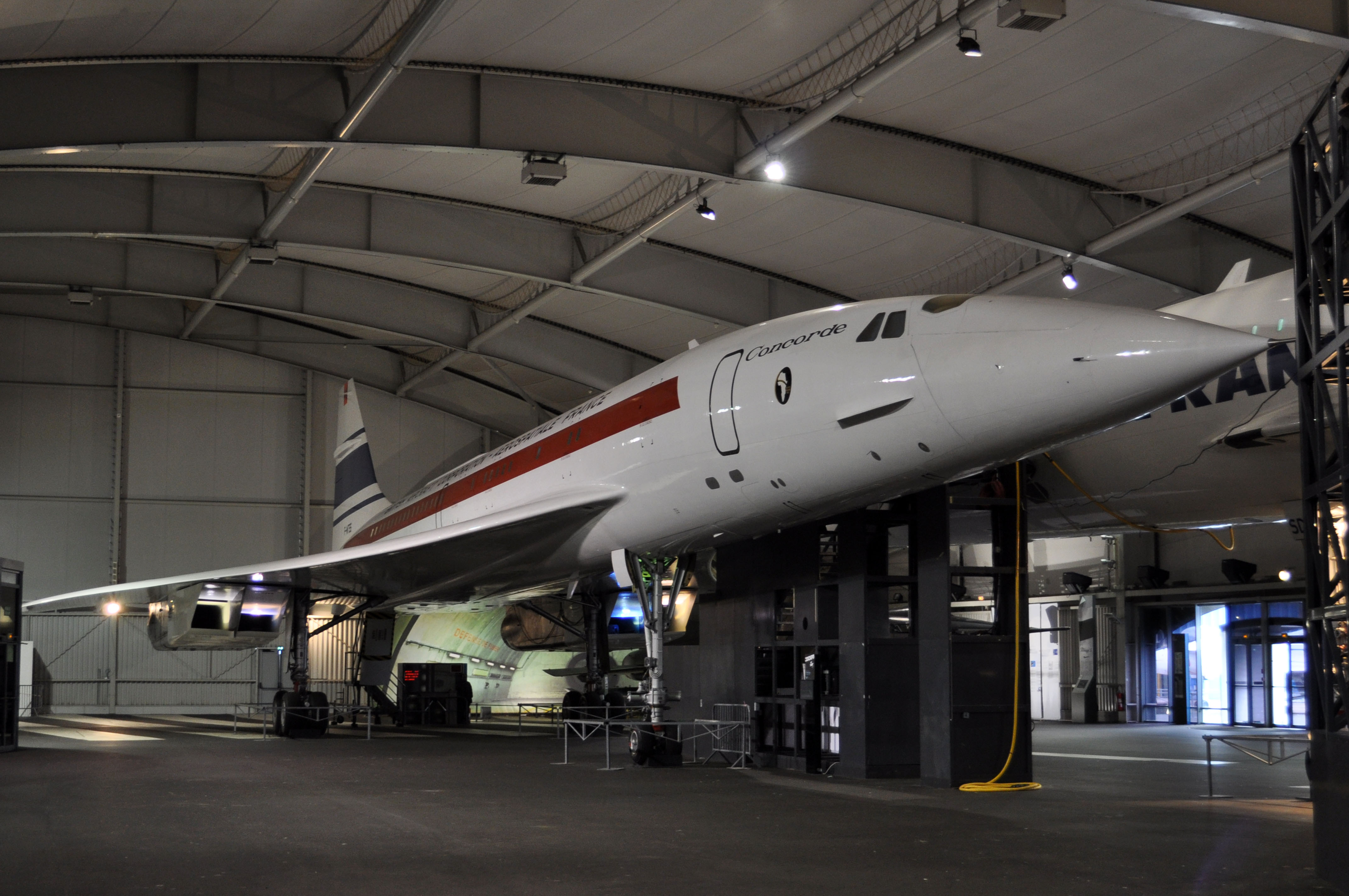
Concorde is the supersonic airliner jointly developed by France and the United Kingdom, and the only one to sustain a long commercial career. It grew out of the intergovernmental agreement of November 1962, drafted as a treaty so that neither partner could walk away without a heavy political price, and split the work between Sud Aviation — later Aérospatiale — and the British Aircraft Corporation, with the engines entrusted to Bristol Siddeley, later Rolls-Royce, and to Snecma. Technically it is a slender ogee delta with a drooping nose and four reheated Olympus 593 turbojets, able to cross the Atlantic at a little over twice the speed of sound. Its cruising speed was set not by available thrust but by heat: the aluminium alloy skin could sustain about 127 °C, and that limit pegged the aircraft at Mach 2.02. Variable-geometry intakes, governed by the first digital processors with full authority over an essential system in a passenger aircraft, supplied most of the installed thrust in cruise. It first flew in March 1969 and entered service on 21 January 1976 with British Airways and Air France simultaneously. The sonic boom, which barred supersonic flight over inhabited land, confined it to oceanic routes; the oil crisis destroyed its economic premise and only twenty airframes were built. The transatlantic axis to New York, opened in 1977 after a legal battle, was its only consistently profitable route. The crash of Air France Flight 4590 at Gonesse in July 2000 — the type's only fatal accident — combined with the collapse of premium transatlantic traffic and the cost of keeping a tiny, ageing fleet flying, led to its retirement in 2003. Its legacy lies not in a descendant that never came but in the engineering and the symbolism it left behind: almost half a century later it remains the benchmark any supersonic transport project has to beat.
Related events
- First flight of Concorde
- First flight of the British-built Concorde 002
- Concorde 001 goes supersonic for the first time
- Concorde enters service with Air France and British Airways
- Fastest transatlantic airliner crossing
- Crash of Air France Flight 4590
- Concorde returns to commercial service
- Air France's last commercial Concorde flight
- British Airways retires Concorde from service
- Concorde's final flight to Filton
Related sheets
Category
Concorde in the news
Concorde's iconic droop-nose mechanism explained.
.jpg)
FLUG REVUE celebrates its 70th anniversary. Over the decades, more than 200 aircraft and helicopters have been tested and flown, from gliders to the Concorde. To mark the anniversary…
With aircraft deliveries constrained, airlines are increasingly using GSSA-led interline partnerships to access markets without adding physical lift. Group Concorde says nearly one-third of its…
.jpg)
Group Concorde has been appointed GSSA for Vietjet Air Cargo in Japan and Indonesia, effective August 2026, taking responsibility for sales, customer engagement and market development in both…
History
An aircraft born of a double national ambition
By the late 1950s Britain and France had arrived separately at the same conclusion: the next leap in air transport would come from speed rather than from cost. The British committee that studied supersonic transport reckoned that such an aircraft could match the economics of subsonic jets, because each airframe would fly more revenue trips per day and a smaller fleet would serve the same network. The arithmetic held only while fuel remained a small share of operating costs, a condition the following decade destroyed.
The studies ran into a physical obstacle that could not be argued away: at supersonic speed the lift-to-drag ratio is roughly half that of a subsonic design, so the aircraft needs far more thrust for its size. The answer came from slender delta aerodynamics and specifically from the ogee wing proposed by Dietrich Küchemann, whose curved leading edge sheds stable vortices that keep the aircraft flying at a high angle of attack on approach without conventional high-lift devices. Both the British and the French teams converged on that shape.
The 1962 treaty
Neither country could fund the programme alone. On 29 November 1962 the two governments signed a joint development agreement deliberately drafted as an international treaty, with no cheap way out: walking away would cost as much politically as carrying on. On the British side the work fell to the British Aircraft Corporation, itself the recent merger of several historic firms; on the French side to Sud Aviation, later absorbed into Aérospatiale. The powerplant went to Bristol Siddeley — later taken over by Rolls-Royce — and to France's Snecma.

France had no modern large jet engine of its own and had already bought British engines for the Caravelle, so a British turbojet was the obvious choice. So was the speed ceiling: fixing it around Mach 2 allowed the skin to stay in aluminium alloy rather than the steel or titanium demanded by the rival American project. That apparently conservative decision is what let the European aircraft fly years earlier and actually enter service.
Aerodynamics, structure and heat
Concorde is a lesson in compromise. The very long, very slender fuselage chases a high fineness ratio to cut wave drag; the complex ogee wing seeks the best possible lift for the least penalty; and the aircraft was trimmed without deflecting control surfaces, pumping fuel between tanks to move the centre of gravity as the centre of pressure shifted aft in supersonic flight. In exchange, only a modest payload could be carried compared with a subsonic jet of the same weight.
Kinetic heating set the real speed limit. The aluminium alloy used throughout, relatively cheap and easy to work, could sustain about 127 °C at the nose over the aircraft's life, and that figure — not available thrust — pegged the cruise at Mach 2.02. Every flight put the airframe through two full cooling-and-heating cycles, which forced the fatigue modelling onto a test rig that repeatedly heated and cooled a full-size wing section. The structure was designed for a life of 45,000 flying hours, and the fuselage stretched by several centimetres in cruise.

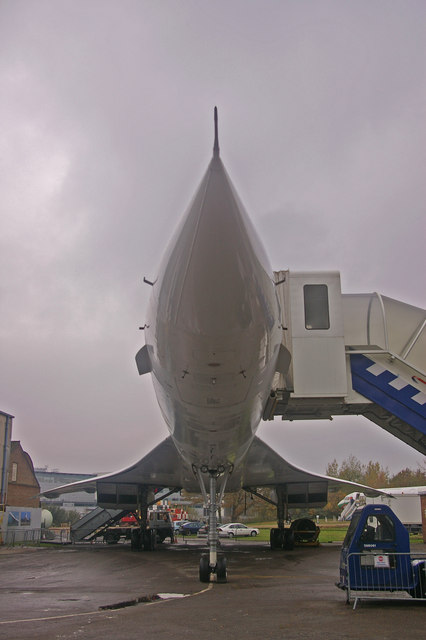
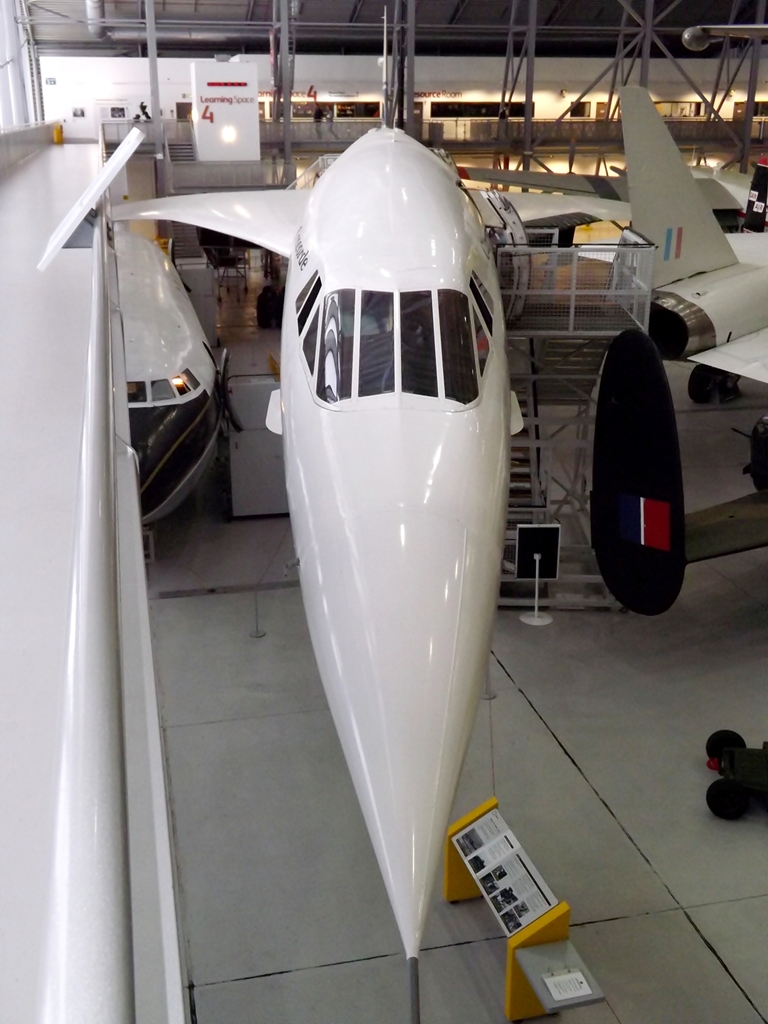
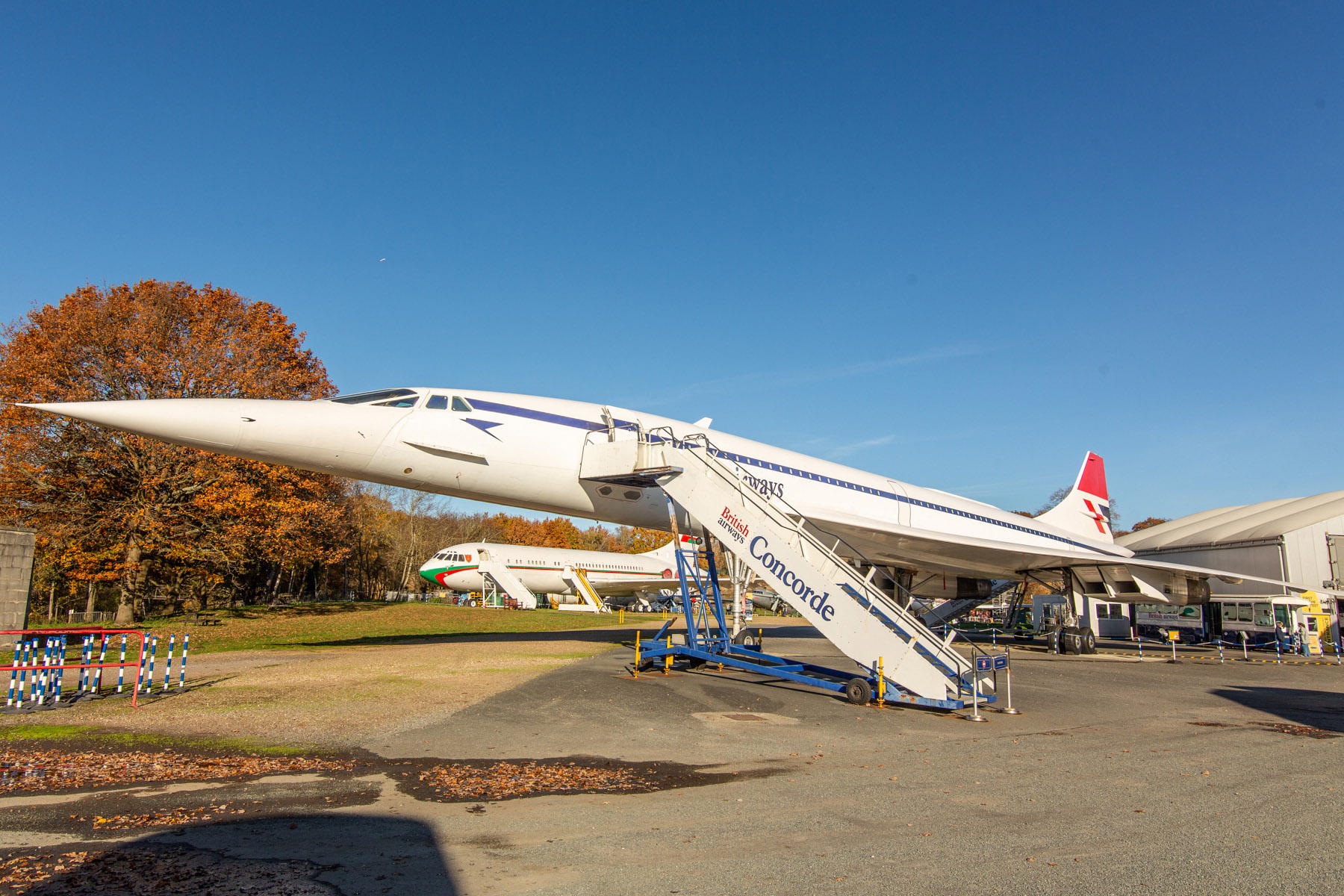
The drooping nose solved another contradiction: the sharp profile supersonic flight demanded left the crew without useful forward vision on approach, with the delta-winged aircraft strongly nose-up, so nose and visor hinged down for landing and faired back in for cruise.
The powerplant
At a Royal Aeronautical Society symposium held in December 1960 the propulsion options for a supersonic transport were debated. Turbofans were rejected because their larger cross-section produced excessive drag, and developing a wholly new engine for a single aircraft would have been prohibitively costly. The choice therefore fell on the Olympus, a turbojet already flying in the prototype of the TSR-2 supersonic strike bomber, which evolved into the reheated Rolls-Royce/Snecma Olympus 593.
The real feat was not the engines but the intakes. Each nacelle carried movable ramps governed by digital control units — the first use of a digital processor with full authority over an essential system in a passenger aircraft — which slowed the flow to subsonic speed before the compressor and, in cruise, generated most of the installed thrust. Interference between adjacent powerplants at high speed meant the aircraft had to be certified aerodynamically as a twin above a certain Mach number. Reheat was used only for take-off and transonic acceleration; the supersonic cruise was dry.
Testing, certification and entry into service
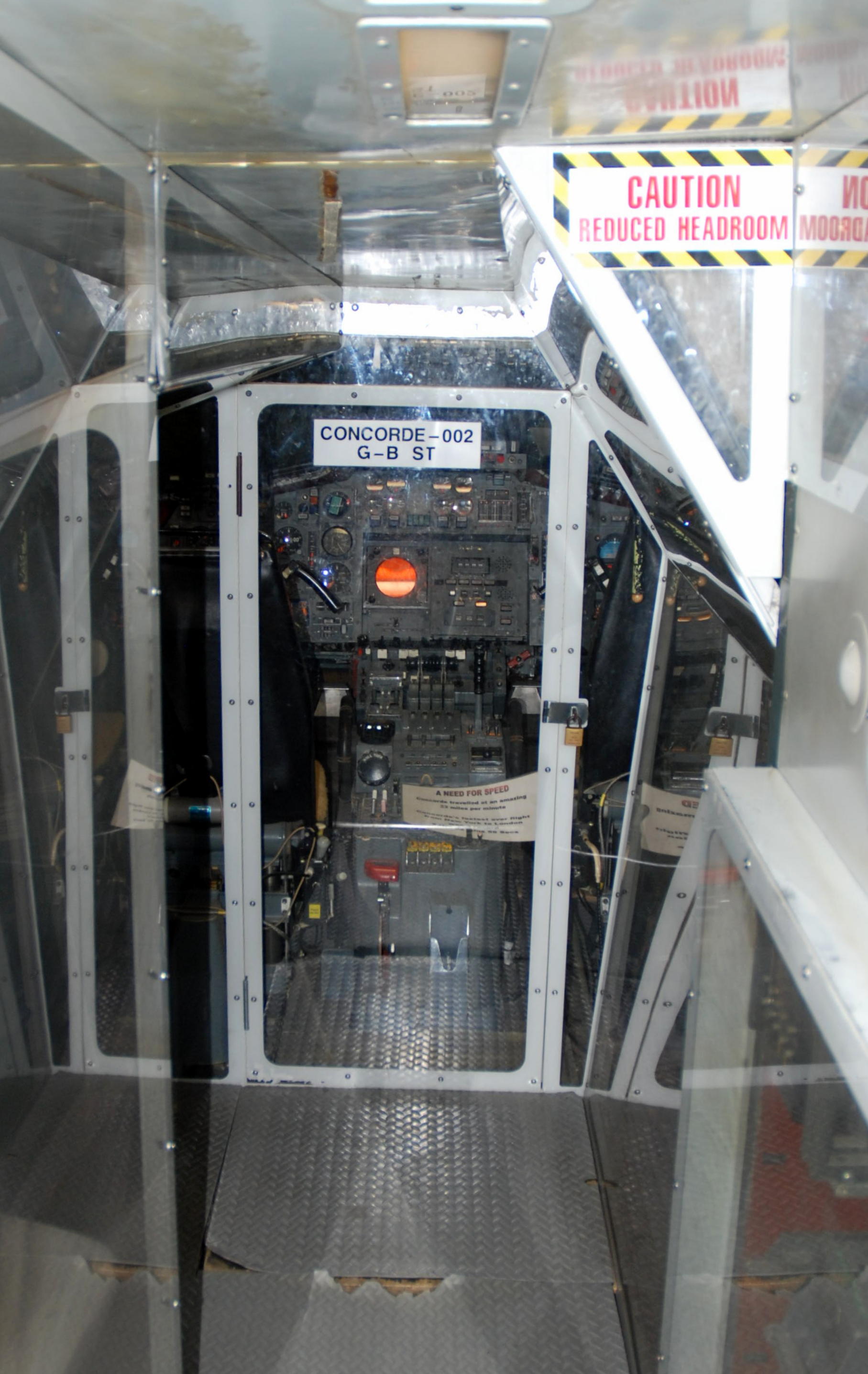
The French prototype 001 flew from Toulouse on 2 March 1969 and the British 002 followed from Filton that April. On a test flight in March 1974 a Concorde reached its highest recorded speed, well above the authorised cruise, at an altitude no airliner has matched. After a long and expensive test programme, commercial service began simultaneously on 21 January 1976: British Airways from London to Bahrain and Air France from Paris to Rio de Janeiro. Only twenty airframes were ever built, counting prototypes, pre-production and production aircraft.
Sonic boom, politics and routes
The obstacle that sank the commercial forecasts was social rather than technical. The sonic boom ruled out supersonic flight over inhabited land, confining the aircraft to oceanic routes and cancelling its advantage on the great continental markets. In the United States, local and political opposition delayed its arrival: service to Washington Dulles opened in 1976, but New York was won only in 1977 after a legal fight with the port authority. The London and Paris axis to New York became the only consistently profitable route, sustained by passengers paying for time saved, which turned the aircraft into a status symbol rather than a mass transport.
The oil crisis destroyed the original economic premise and airline orders evaporated. The two operators took their aircraft on highly unusual terms and for years worked tiny fleets at an intensity no other airliner would have tolerated.
Gonesse and the end
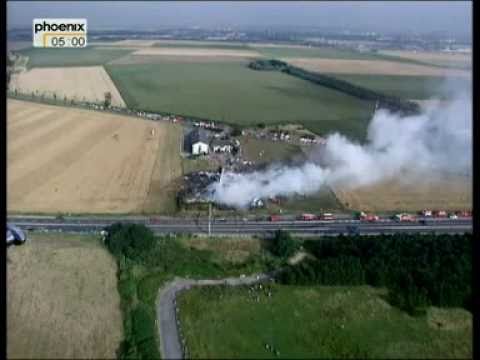
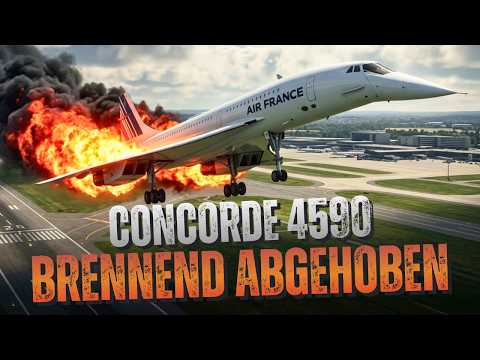
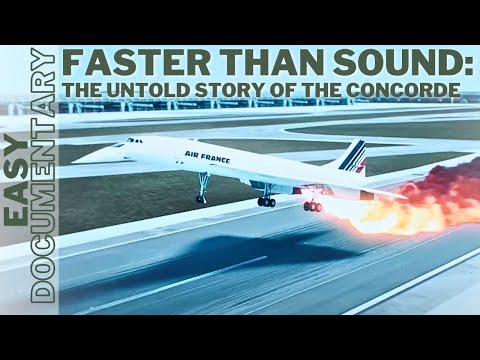
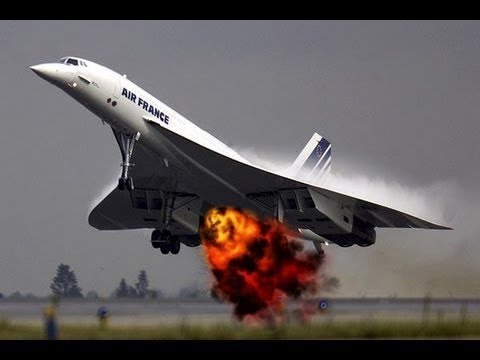
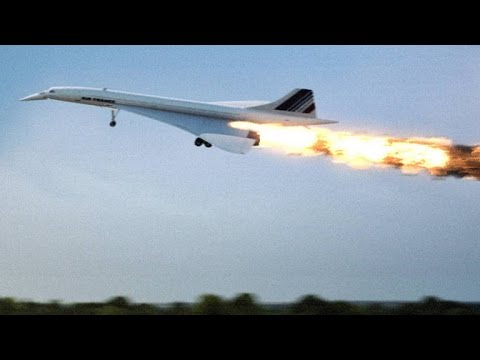
On 25 July 2000, Air France Flight 4590 crashed shortly after taking off from Paris for New York. A metal strip shed by another aircraft on the runway burst a tyre; the fragments thrown against the underside of the wing ruptured a tank and started an uncontrollable fire. It was the type's only fatal accident, and it came at the worst possible moment. The fleet returned to service after a modification programme — tank liners, reinforced tyres, protected wiring — but the premium transatlantic market had already collapsed and the maintenance cost of a tiny, ageing fleet was unsustainable. Air France and British Airways withdrew the aircraft in 2003.
Legacy
Concorde was one of only two supersonic transports to operate commercially; the other, the Soviet Tupolev Tu-144, flew first but had a short commercial career and a markedly shorter range. Most surviving airframes are now spread across museums in France, the United Kingdom and the United States, among them the Smithsonian and Seattle's Museum of Flight. Its real legacy lies not in a descendant that never came but in the engineering it left behind: digital intake control, electrical flight controls on a civil aircraft, centre-of-gravity management by fuel transfer, and an understanding of thermal fatigue no other civil programme has needed since.
Variants
| Concorde 001 (F-WTSS) | Concorde 002 (G-BSST) | Concorde 101 (G-AXDN) | Concorde 102 (F-WTSA) | Concorde 201 (F-WTSB) | Concorde 202 (G-BBDG) | Concorde (serie) | Concorde B (proyecto) | |
|---|---|---|---|---|---|---|---|---|
| First flight | March 2, 1969 | April 9, 1969 | December 17, 1971 | January 10, 1973 | December 6, 1973 | December 13, 1974 | January 31, 1975 | — |
| Aircraft type | — | — | — | — | — | — | Supersonic passenger transport aircraft | — |
| Powerplant | — | — | — | — | — | — | Four reheated Rolls-Royce/Snecma Olympus 593 Mk 610 turbojets, paired in underwing nacelles with digitally governed variable-geometry intakes. Reheat was used for take-off and transonic acceleration; the supersonic cruise was dry, with the intakes providing most of the installed thrust. | — |
| Powerplant | — | — | — | — | — | — | 4 × Rolls-Royce/Snecma Olympus 593 Mk 610 | — |
| Thrust per engine | — | — | — | — | — | — | 169 kN | — |
| Length | — | — | — | — | — | — | 61.7 m | — |
| Wingspan | — | — | — | — | — | — | 25.6 m | — |
| Height | — | — | — | — | — | — | 12.2 m | — |
| Wing area | — | — | — | — | — | — | 358 m² | — |
| Empty weight | — | — | — | — | — | — | 78,700 kg | — |
| MTOW | — | — | — | — | — | — | 185,070 kg | — |
| Top speed | — | — | — | — | — | — | 2,179 km/h | — |
| Cruise speed | — | — | — | — | — | — | 2,158 km/h | — |
| Service ceiling | — | — | — | — | — | — | 18,300 m | — |
| Initial climb rate | — | — | — | — | — | — | 25.4 m/s | — |
| Range | — | — | — | — | — | — | 7,222 km | — |
| Range conditions | — | — | — | — | — | — | Range sufficient for the North Atlantic non-stop; longer routes such as Paris-Rio de Janeiro required a technical stop. Cruise trim was achieved by transferring fuel between tanks to move the centre of gravity, without deflecting control surfaces. | — |
| Armament | — | — | — | — | — | — | None: a civil passenger transport, unarmed and without hardpoints. | — |
| Max weapons load | — | — | — | — | — | — | 0 kg | — |
| Cargo capacity | — | — | — | — | — | — | Passenger cabin seating up to 128 in a high-density layout (92-120 in the usual Air France and British Airways arrangements), with limited hold volume because of the slender fuselage. No consulted source publishes a maximum payload figure, so it is left unrecorded. | — |
| Crew | 3 Best value in this row | 3 Best value in this row | 3 Best value in this row | 3 Best value in this row | 3 Best value in this row | 3 Best value in this row | 3 Best value in this row | — |
| Passengers | — | — | — | — | — | — | 128 | — |
| Units built | 1 | 1 | 1 | 1 | 1 | 1 | 14 Best value in this row | 0 |
Images
Elsewhere
- JetPhotosConcorde G-BOAE British Airways ↗
- JetPhotosConcorde F-BVFC Air France ↗
- JetPhotosConcorde G-BOAC British Airways ↗
- Airliners.netConcorde British Airways en Heathrow ↗
- Airliners.netConcorde Air France ↗
- FlickrConcorde Air France F-BVFF en Charles de Gaulle ↗
- FlickrConcorde F-BVFC Air France 209 ↗
- Wikimedia CommonsConcorde G-BOAC British Airways en Bâle-Mulhouse ↗
- Wikimedia CommonsConcorde G-BOAD British Airways en Sídney ↗
- Key AeroConcorde en foco ↗
- Getty ImagesConcorde Air France, colección Getty ↗
- Wikimedia CommonsConcorde - plano de tres vistas (lateral, superior, frontal) ↗
























![CONCORDE: storia, tecnica e motivi del ritiro dell'aereo supersonico [Weesk 20]](https://i.ytimg.com/vi/qHitvf73iV0/hqdefault.jpg)


![Segundos Fatais [Queda Avião Concorde] - Documentário Dublado - Dosc Pro](https://i.ytimg.com/vi/zUQHhtzL5VQ/hqdefault.jpg)