Concorde variant
Concorde 202 (G-BBDG)
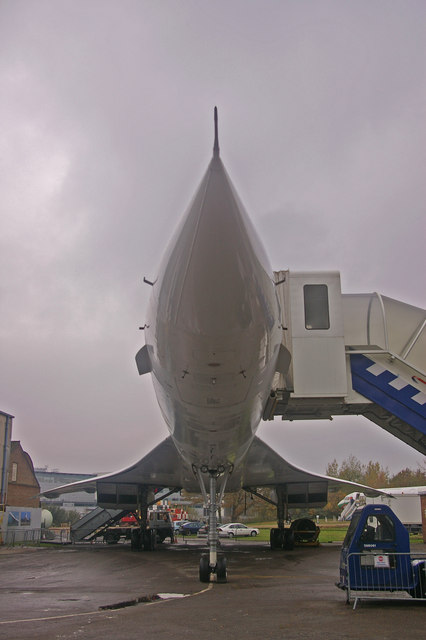
The second production Concorde assigned to development, built at Filton and flown on 13 December 1974. It flew 1,282 hours until 1981, then served as a spares source for British Airways and was restored at Brooklands Museum.
.jpg)
- December 13, 1974
- First flight
- 1
- Units built
History
The British twin of 201
Concorde 202, registered G-BBDG, was the sixth and last of the Concorde development aircraft and the second of the two built to production standard. It first flew on 13 December 1974 from Filton to RAF Fairford, the base where the programme's British flight test activity was concentrated. Together with the French 201 it carried the certification workload of the definitive aircraft, needed because the production machines differed in many ways from the original prototypes.
Testing a mature aeroplane
The work of 202 focused on the aircraft as it would fly in airline service: the airframe with the definitive wing planform, the four Olympus 593 engines with reheat, the digitally controlled intakes and the onboard systems. The production Concorde had problems that could only be characterised in flight: kinetic heating that took the nose tip to 127 °C and stretched the airframe, fuel transfer between tanks to move the centre of gravity without deflecting control surfaces, the brakes — carbon, with forced cooling — and the undercarriage of an aircraft that rotated to a high pitch angle on take-off, and the droop nose with visor that made approach visibility possible from so slender a fuselage. It was also demanding on the runway: with maximum load it required 3,600 m.

G-BBDG last flew on 24 December 1981, after logging 1,282 flying hours. Its career was shorter than that of the French 201, but its useful life did not end there.
Spares source and restoration
Withdrawn from flying, the aircraft was stored in a hangar at Filton Airfield and British Airways used it as a source of spare parts for its operational Concorde fleet. In practice it became a strategic component reserve for a type of which only twenty examples existed and whose supply chain had closed years earlier; Air France did something equivalent with F-BVFD, retired in 1982 and broken up in 1994.
In May and June 2004, after the final retirement of the type, 202 was sectioned and moved by road to the Brooklands Museum at Weybridge, Surrey. There it was restored and opened to the public in the summer of 2006. Of the twenty Concordes built, eighteen still exist and sixteen are on display to the public.
What was certificated with 202
Concorde 202 flew at the moment when the programme moved from testing to operations. The type entered service on 21 January 1976 with British Airways and Air France simultaneously, and the transatlantic routes — Washington Dulles from 24 May 1976 and New York JFK from 17 October 1977 — became its real market. The aircraft that 202 helped to certificate had fly-by-wire controls, analogue electronic engine controls, three inertial navigation platforms and an automatic flight control system with dual autopilots and full autoland.
Twenty airframes and no more
The decision to use G-BBDG as a spares source follows from the arithmetic of the programme: only twenty Concordes were built, fourteen of them for commercial service, and production closed with G-BOAF in 1979. With no assembly line, retired aircraft were the only reserve of parts. G-BOAG of British Airways was in fact restored using parts taken from Air France's F-BVFD.
Brooklands
After its road move in 2004 and subsequent restoration, 202 opened to the public at the Brooklands Museum in the summer of 2006, on a site that was one of the cradles of the British aircraft industry.
%2C_Brooklands_Museum%2C_Surrey%2C_UK.jpg)
Multimedia
%2C_Brooklands_Museum%2C_Surrey%2C_UK-1600.webp)


-800.webp)
