Concorde variant
Concorde (serie)
The production standard Concorde: fourteen commercial aircraft delivered to British Airways and Air France between 1975 and 1979, with four Olympus 593 Mk 610 engines, 92-128 seats and Mach 2.02 cruise. They flew in service from 21 January 1976 to 24 October 2003.

- January 31, 1975
- First flight
- 14
- Units built
- 7,222 km
- Range
- 128
- Passengers
History
Fourteen aircraft for two airlines
Of the twenty Concordes built, fourteen went into commercial service: seven for British Airways (G-BOAC, G-BOAA, G-BOAB, G-BOAD, G-BOAE, G-BOAG and G-BOAF) and seven for Air France (F-BTSC, F-BVFA, F-BVFB, F-BVFC, F-BVFD, F-BTSD and F-BVFF). The first to fly was F-BTSC, on 31 January 1975 from Toulouse; the last was G-BOAF, on 20 April 1979 from Filton. The French aircraft were assembled at Toulouse and the British ones at Filton, keeping the industrial split of the 1962 treaty to the very end.
The definitive standard
The production aircraft were different in many ways from the prototypes, to the point of forcing a re-examination of entire areas of the design for certification. The production standard had four Rolls-Royce/Snecma Olympus 593 Mk 610 turbojets with reheat, rated at 140 kN dry and 169.3 kN with afterburner, fed by variable-ramp intakes governed by digital control units. The aircraft was 61.66 m long, spanned 25.6 m and stood 12.2 m high, with 358.25 m² of wing area; it weighed 78,700 kg empty and up to 185,070 kg at take-off. It carried a crew of three — two pilots and a flight engineer — and 92 to 120 passengers, up to 128 in a high-density layout. Maximum speed was 2,179 km/h and the operating limit Mach 2.04 on temperature grounds; in service it cruised at Mach 2.02 to extend airframe life. Service ceiling was 18,300 m and range 7,222 km, enough for the North Atlantic and little more.
Commercial service
Scheduled service began on 21 January 1976 with British Airways and Air France simultaneously. The real market turned out to be the transatlantic one: flights to Washington Dulles started on 24 May 1976 and to New York JFK on 17 October 1977. Sonic boom ruled out supersonic flight over populated land, which confined the type to transoceanic routes. There were joint-service experiments, such as G-BOAD painted in Singapore Airlines colours on one side for the Bahrain-Singapore route, and promotional tours such as F-BTSD in Pepsi livery in 1996.
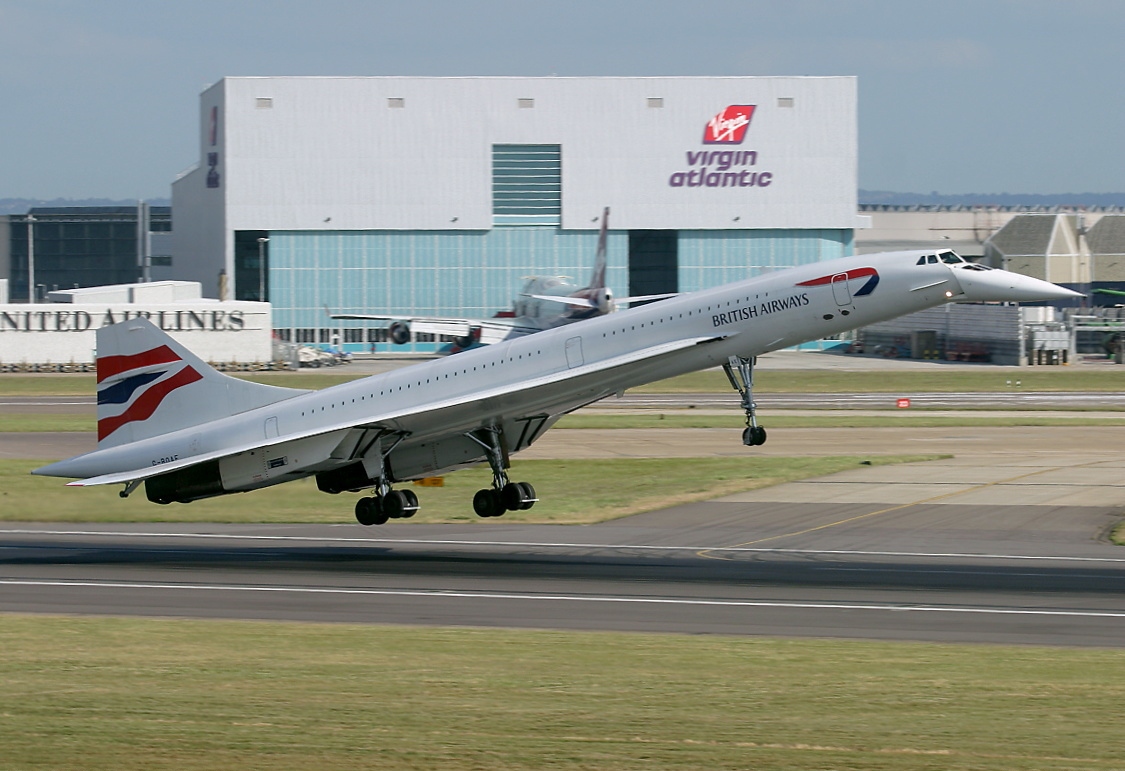
The airframes accumulated very uneven totals. G-BOAD flew the most, at 23,397 hours, followed by G-BOAE with 23,376 and G-BOAA with 22,768. F-BVFD, by contrast, was retired in 1982 with only 5,814 hours after a heavy landing at Dakar, and was broken up in 1994, the only Concorde ever scrapped.
Accident and retirement
On 25 July 2000 F-BTSC crashed at Gonesse, near Le Bourget, operating Air France Flight 4590, killing 113 people. It was the only Concorde destroyed in a crash. The fleet was grounded and several aircraft never flew again: G-BOAA and G-BOAB never received the post-accident modifications.
Commercial service ended in 2003. Air France flew its last revenue service on 31 May and British Airways on 24 October. The final ferry flights took the aircraft to museums in five countries; sixteen of the twenty Concordes are on public display today.
The airframes, one by one
Each airframe had its own story. G-BOAC (204), first flown on 27 February 1975, was the flagship of the British Airways fleet because of its BOAC registration and is displayed today at Manchester after 22,260 hours. G-BOAA (206) flew 22,768 hours and travelled by sea and road to the Scottish National Museum of Flight in 2004. G-BOAB (208) remains at Heathrow. G-BOAD (210) made the fastest Atlantic crossing by any Concorde on 7 February 1996, in 2 hours, 52 minutes and 59 seconds, and is displayed at the Intrepid museum in New York. G-BOAE (212) ended up in Barbados; G-BOAG (214) at the Museum of Flight in Seattle; G-BOAF (216), the last built and the last retired, at Bristol.
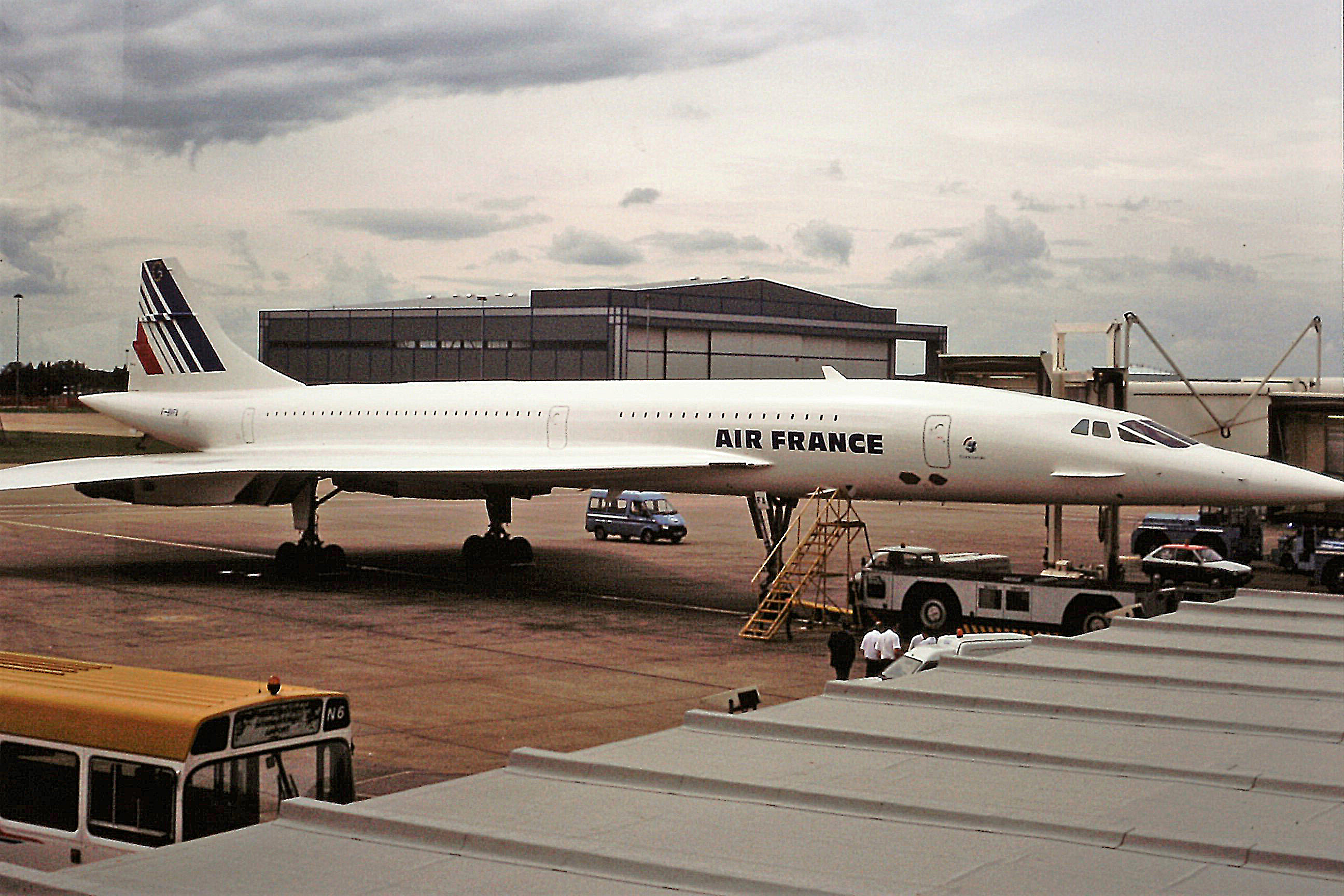
On the French side, F-BVFA (205) flew around the world in 41 hours and 27 minutes in 1988 and is at the Smithsonian's Udvar-Hazy Center; F-BVFB (207) was sold for one euro to the Sinsheim museum, where it shares a hall with a Tu-144; F-BVFC (209) is at Aeroscopia; F-BTSD (213) flew in Pepsi livery and holds round-the-world records in both directions; F-BVFF (215) stayed at Paris Charles de Gaulle after its last overhaul.
Multimedia


