sono stato sul Concorde! 🤯 Ecco i segreti dell'aereo supersonico amato da tutti
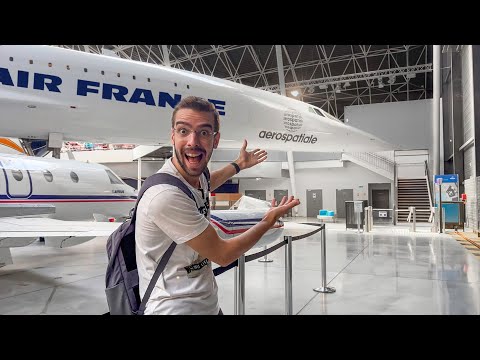
Video from the channel Marco Romboli about Concorde, linked on its Above Ten Thousand entry. Duration: 15:17. Language: Italian. Video type: Onboard.
What it covers
The video tours, inside and out, the two Concordes preserved at the Aeroscopia museum in Toulouse, next to the airport where Airbus is headquartered. The first has no airline cabin layout: it carries test instrumentation along the cabin walls, and the author presents it as a test aircraft. The second preserves the Air France passenger cabin.
Details shown
Notable features include windows the size of a palm, the low cabin height, narrow seats in two-and-two rows on either side of the aisle, and Mach number indicators for passengers. The author explains that the fuselage expanded from aerodynamic heating in cruise, which is why the seat floor was mounted on rails. In the cockpit, the Mach indicators and the controls for the nose and visor can be seen. On the outside, he reviews the variable-geometry air intake, which slows the air to subsonic speed before the compressor, and the afterburners, used on take-off and to go supersonic. He also shows the thrust reversers, the tail wheel that protected against tail strikes on high angle-of-attack landings, and the tail cone tank, to which fuel was transferred to shift the centre of gravity when exceeding Mach 1.
Context
The Concorde first flew in 1969 and entered commercial service in 1976 with two simultaneous flights: Air France's Paris–Rio de Janeiro route and British Airways' London–Bahrain route. The author presents it as a programme sustained by the UK and French governments, in contrast to the Soviet Tupolev and the Boeing and Lockheed supersonic projects, which were abandoned due to their cost.