Airliner · Civil · France
Airbus A310
- April 3, 1982
- First flight
- 1983
- Introduced
- In service
- Status
- 255
- Units built
-1600.webp)

-1600.webp)
-1600.webp)


_CA-01_-_MSN_372_(7158600154)-1600.webp)

_at_Hannover_(CC_BY-SA_2.0)-1600.webp)
-800.webp)
_%E2%80%94_Das_Cockpit_des_Parabelfliegers_-_50375105997-1600.webp)
-800.webp)
_%E2%80%94_Airbus_A310-304_(cn_498%2C_F-WNOV)_2016-06-03_Andre_Gerwing_Collection_ID_000390-1600.webp)
-800.webp)

_%E2%80%94_A310_ZE-RO-G_nach_der_Lan-dung-1600.webp)
-1600.webp)

-800.webp)
_%E2%80%94_Der_Novespace-Parabelflieger_am_Hangar-1600.webp)


-800.webp)

_%E2%80%94_Landung_des_AirZeroG_am_Flughafen_Paderborn-Lippstadt-1600.webp)
_%E2%80%94_A310_ZERO_G_interior-1600.webp)

-1600.webp)
-800.webp)

-1600.webp)
-%2C_Schoenefeld_(P1180706)-1600.webp)
-1600.webp)
-1600.webp)
_%E2%80%94_Airbus_A310-304_(cn_498%2C_F-WNOV)_2024-06-09_Andre_Gerwing_Collection_ID_020879-1600.webp)
-1600.webp)
-1600.webp)

_%E2%80%94_F-WNOV_A310-304_Zero_G_at_BOD_260615_(19120223058)-1600.webp)

_%E2%80%94_Airbus_A310_AirZeroG%2C_Schoenefeld_(ILA43871)-1600.webp)
-1600.webp)
_%E2%80%94_Airbus_A310_AirZeroG_(F-WNOV)-%2C_Schoenefeld_(P1180699)-1600.webp)
-1600.webp)
-1600.webp)

-1600.webp)
_%E2%80%94_Die_Kennung_des_Novespace-Parabelflugzeugs-1600.webp)
The Airbus A310 is a wide-body airliner designed and manufactured by Airbus Industrie GIE, then a consortium of European aerospace manufacturers. It grew out of the recognition that there was demand for an aircraft smaller than the A300, the world's first twin-jet wide-body. Keeping the same eight-abreast cross-section, the A310 is 6.95 m shorter than the initial A300 variants, has a smaller wing — down from 260 to 219 m² — and a longer range, up to 5,150 nautical miles. The programme was launched on 7 July 1978 with orders from Swissair and Lufthansa. The first prototype flew on 3 April 1982 and the type received its certificate on 11 March 1983, entering revenue service with Swissair in April of that year. Its direct rival was the Boeing 767-200, introduced six months earlier. The A310 brought in a two-crew glass cockpit, later adopted on the A300-600 with a common type rating, and could seat 220 passengers in two classes or 240 in all-economy. Its longer range and ETOPS certification opened transatlantic routes to it, and it was also offered as a freighter and in military guises: the A310 MRT multi-role transport and, developed from it, the A310 MRTT multi-role tanker transport. Airbus replaced it in the range with the A330-200, which shares its fuselage cross-section. A total of 255 aircraft were built, the last delivered in June 1998; as of January 2025 only 33 remained in service.
Related sheets
Category
Airbus A310 in the news
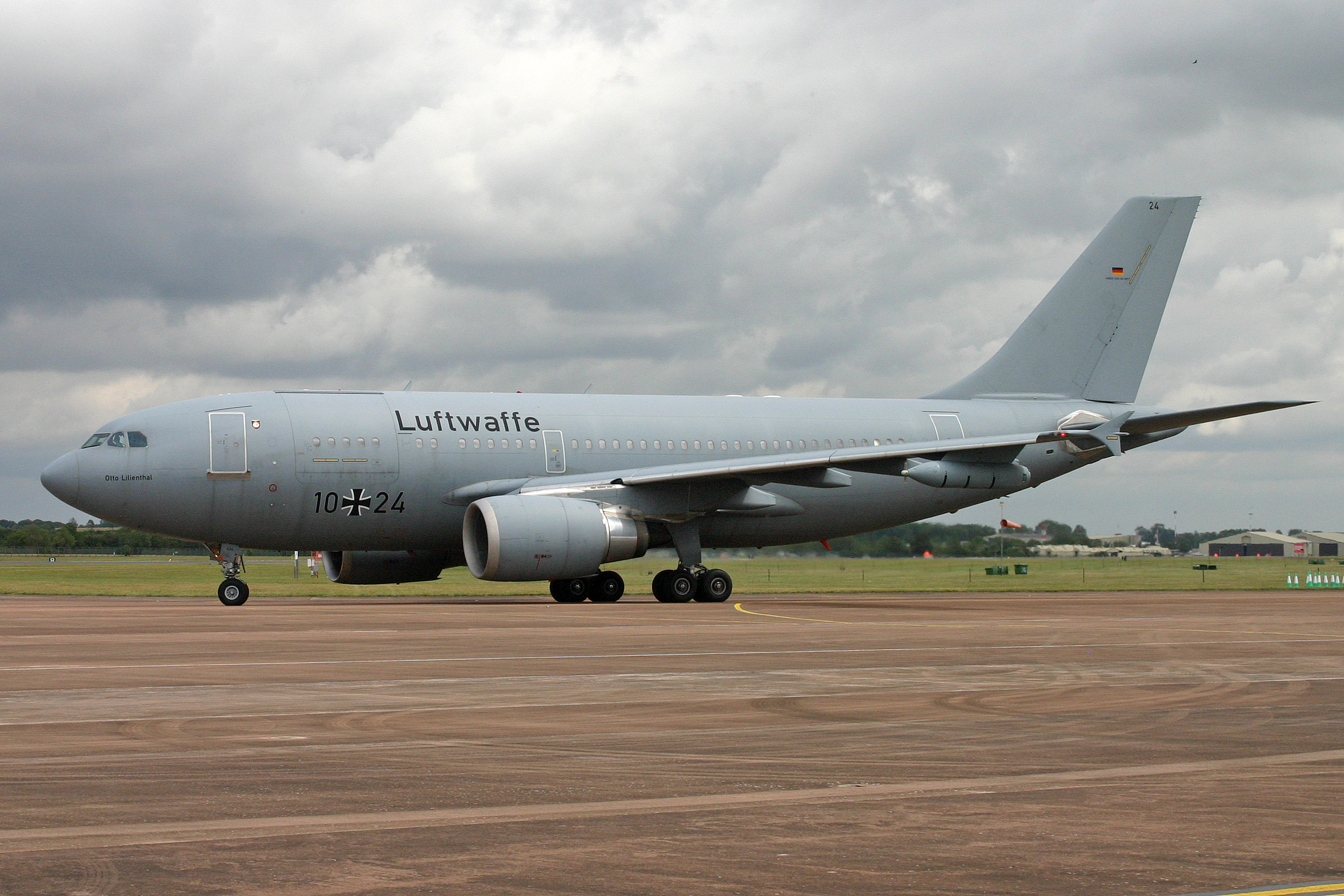
The Ministry of Defence is preparing to replace the two Airbus A310 used to transport authorities with two new MRTT+ aircraft in mixed VIP configuration. According to ABC's edition…
_%E2%80%94_Airbus_A310_AirZeroG%2C_Schoenefeld_(ILA43871).jpg)
The company Gestair has remained the only firm continuing in the procedure to secure the new framework agreement for the upkeep of the Falcon 900, Airbus A310) and T.20 aircraft…
_%E2%80%94_Das_Cockpit_des_Parabelfliegers_-_50375105997.jpg)
We continue our deep dive into the development of the refuelling boom for Airbus's MRTT programme, which we started last July. Before the A330 MRTT became the aircraft…
Three-view drawing

_07.jpg)
History
A smaller A300
The A310 traces back to the A300 itself. That first twin-engine wide-body sold reasonably well — 561 aircraft delivered over its production life — but as it entered service it became clear that there was also a sizeable market for something smaller: some operators lacked the traffic to justify the A300, while others wanted more frequency even at a higher seat-distance cost, notably Swissair and Lufthansa. At the same time Airbus was under pressure to prove it was more than a single-aircraft manufacturer. The consortium revisited early design studies from the A300 programme and concentrated on the option known as the A300B10MC — minimum change — with capacity cut to a maximum of 220 passengers.
The British return and the launch
The programme was caught up in European industrial politics. The United Kingdom had withdrawn from the A300 project on 10 April 1969, and by the late 1970s British inflation, running at around 35 per cent during 1979–80, was pushing development costs up. Hawker Siddeley, the A300 wing subcontractor, merged with three other British firms in 1977 to form British Aerospace. At the 1978 Farnborough Air Show, British Secretary of State for Industry Eric Varley announced that BAe would rejoin Airbus Industrie as a full partner from 1 January 1979, taking a 20 per cent shareholding and a full part in the development and manufacture of the A310. Swissair and Lufthansa had drawn up a joint specification on 9 June 1978; Swissair became the first airline to place a firm order, for ten aircraft with ten more on option, and Lufthansa followed with a $240 million ten-aircraft order. On 7 July 1978 Airbus decided to put the A310 into production.
Service and the end of the line
Two versions were planned at first, the regional A310-100 and the transcontinental A310-200, but weak demand for the former led Airbus to stop offering it during 1979, and none were ever built. When the -200 prototype flew on 3 April 1982 the type had already accumulated orders and options for 181 aircraft from fifteen airlines worldwide, a better start than the A300 itself. Swissair became the launch operator in April 1983. In 1988 an A310 delivered to Interflug became the first Airbus for an Eastern-bloc airline.
Successor and legacy
Demand began to slacken in the early 1990s and no new passenger orders were placed in the late 1990s, partly because of the newer A330. The final delivery was made on 15 June 1998 to Uzbekistan Airways; between 1983 and 1998, 255 A310s were delivered. Production of the A310 and the A300 ceased during July 2007. Together the two types established Airbus as a competitor to Boeing and let it press on with the A320 and A330/A340 families.
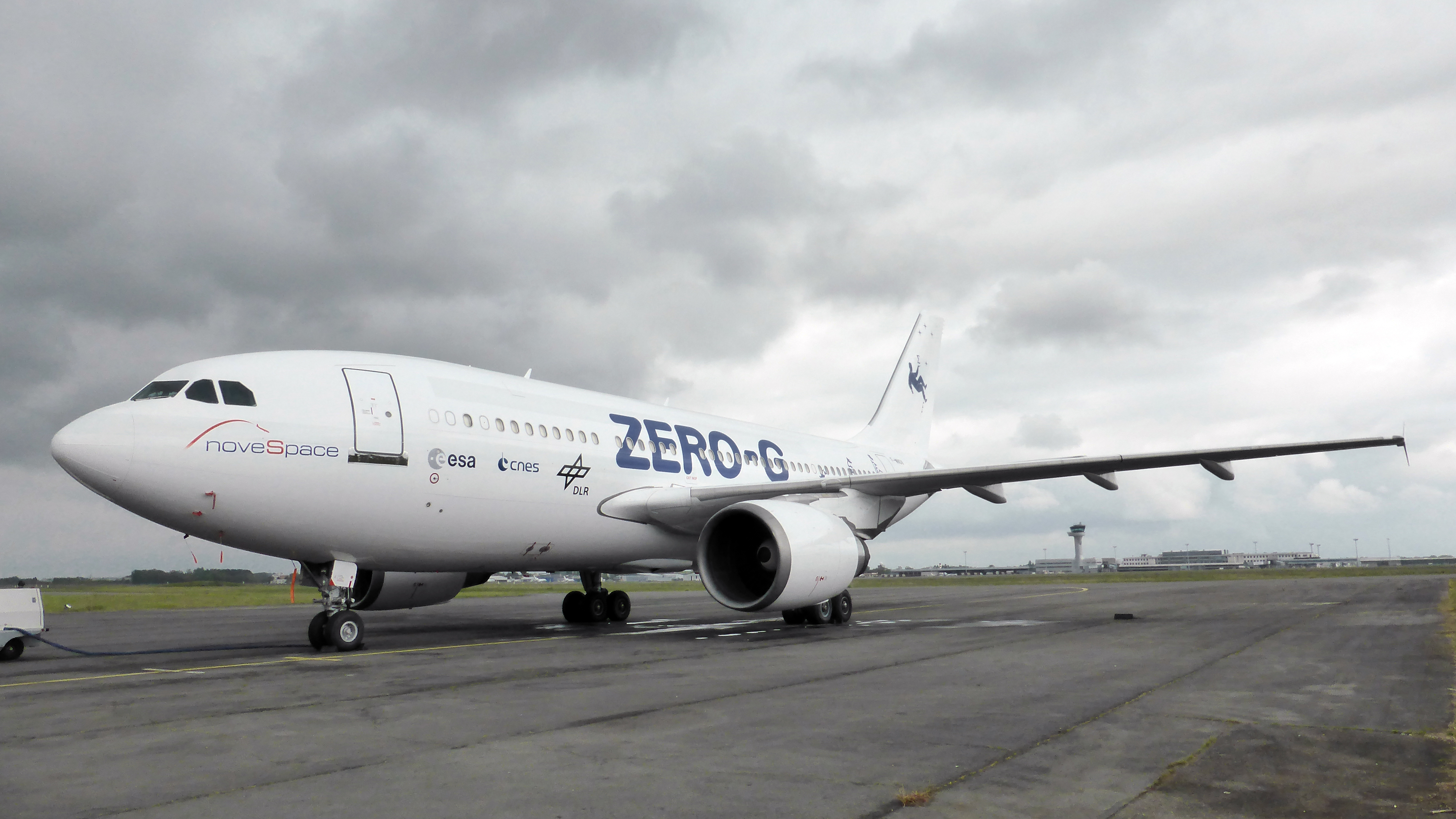
Variants
| A310-200 | A310-300 | A310 MRT/MRTT | A310-100 | A310-200C | A310-200F | A310-300C | A310-300F | A310C-200 | A310F-200 | A310 Zero G | |
|---|---|---|---|---|---|---|---|---|---|---|---|
| First flight | April 3, 1982 | July 8, 1985 | March 25, 1999 | — | — | — | — | — | — | — | — |
| Aircraft type | Twin-engine wide-body medium-haul airliner | Twin-engine wide-body medium/long-haul airliner | Multi-role military transport and tanker derived from the A310-300C | — | Passenger-to-cargo convertible twinjet derived from the A310-200 | Freighter obtained by converting a passenger A310-200 | Passenger-to-cargo convertible twinjet derived from the A310-300 | Freighter obtained by converting a passenger A310-300 | — | — | Flying laboratory for parabolic microgravity flights, based on an A310-304 airframe |
| Powerplant | 2 × turbofans, with four certified powerplants depending on the sub-model: General Electric CF6-80A3 of 217.9 kN on the A310-203, Pratt & Whitney JT9D-7R4D1 of 213.6 kN on the A310-221, JT9D-7R4E1 of 222.5 kN on the A310-222 and General Electric CF6-80C2A2 of 233.35 kN on the A310-204. | 2 × General Electric CF6-80C2A8 turbofans rated at 257.4 kN each for take-off (25,740 daN in the EASA type-certificate data sheet). The -300 series was also certified with the CF6-80C2A2 (233.35 kN) on the A310-304, the Pratt & Whitney JT9D-7R4E1 (222.5 kN) on the A310-322, the PW4152 (231.31 kN) on the A310-324 and the PW4156A (249.08 kN) on the A310-325. | 2 × General Electric CF6-80C2A2 turbofans rated at 233.35 kN each for take-off (23,335 daN in the EASA type-certificate data sheet), the same engines already fitted to the airline A310-304s that were converted. | — | 2 × General Electric CF6-80A3 turbofans rated at 217.9 kN each for take-off (21,790 daN in the EASA type-certificate data sheet). | 2 × turbofans, the same as on the donor airframe: General Electric CF6-80A3 (217.9 kN), CF6-80C2A2 (233.35 kN) or Pratt & Whitney JT9D-7R4D1 (213.6 kN) and JT9D-7R4E1 (222.5 kN). | 2 × turbofans, with the -300 series powerplants: General Electric CF6-80C2A2 (233.35 kN) and CF6-80C2A8 (257.4 kN) or Pratt & Whitney JT9D-7R4E1 (222.5 kN), PW4152 (231.31 kN) and PW4156A (249.08 kN). | 2 × turbofans, the same as on the -300 series airframe it comes from: General Electric CF6-80C2A2 (233.35 kN) and CF6-80C2A8 (257.4 kN) or Pratt & Whitney JT9D-7R4E1 (222.5 kN), PW4152 (231.31 kN) and PW4156A (249.08 kN). | — | — | 2 × General Electric CF6-80C2A2 turbofans rated at 233.35 kN each, the standard powerplant of the A310-304 the aircraft comes from. |
| Powerplant | 2 × General Electric CF6-80A3 / CF6-80C2A2 · Pratt & Whitney JT9D-7R4D1 / JT9D-7R4E1 | 2 × General Electric CF6-80C2A8 | 2 × General Electric CF6-80C2A2 | — | 2 × General Electric CF6-80A3 | 2 × General Electric CF6-80A3 / CF6-80C2A2 · Pratt & Whitney JT9D-7R4D1 / JT9D-7R4E1 | 2 × General Electric CF6-80C2A2 / CF6-80C2A8 · Pratt & Whitney JT9D-7R4E1 / PW4152 / PW4156A | 2 × General Electric CF6-80C2A2 / CF6-80C2A8 · Pratt & Whitney JT9D-7R4E1 / PW4152 / PW4156A | — | — | 2 × General Electric CF6-80C2A2 |
| Thrust per engine | — | 257 kN Best value in this row | 233 kN | — | 218 kN | — | — | — | — | — | 233 kN |
| Length | 46.7 m | 46.7 m | 46.7 m | 47.2 m Best value in this row | 46.7 m | 46.7 m | 46.7 m | 46.7 m | — | — | 46.7 m |
| Wingspan | 43.9 m Best value in this row | 43.9 m Best value in this row | 43.9 m Best value in this row | 43.9 m Best value in this row | 43.9 m Best value in this row | 43.9 m Best value in this row | 43.9 m Best value in this row | 43.9 m Best value in this row | — | — | 43.9 m Best value in this row |
| Height | 15.9 m Best value in this row | 15.9 m Best value in this row | 15.9 m Best value in this row | 15.8 m | 15.9 m Best value in this row | 15.9 m Best value in this row | 15.9 m Best value in this row | 15.9 m Best value in this row | — | — | 15.9 m Best value in this row |
| Wing area | 219 m² | 219 m² | 219 m² | 220 m² Best value in this row | 219 m² | 219 m² | 219 m² | 219 m² | — | — | 219 m² |
| Empty weight | — | 79,207 kg | — | 75,389 kg Best value in this row | — | — | — | — | — | — | — |
| MTOW | 144,000 kg | 164,000 kg Best value in this row | 164,000 kg Best value in this row | 121,000 kg | 142,000 kg | — | 164,000 kg Best value in this row | 164,000 kg Best value in this row | — | — | — |
| Top speed | — | 869 km/h | — | — | — | — | — | — | — | — | — |
| Max speed altitude | — | 10,000 m | — | — | — | — | — | — | — | — | — |
| Cruise speed | — | 835 km/h | — | — | — | — | — | — | — | — | — |
| Cruise altitude | — | 10,000 m | — | — | — | — | — | — | — | — | — |
| Service ceiling | 12,530 m Best value in this row | 12,530 m Best value in this row | 12,530 m Best value in this row | — | 12,530 m Best value in this row | 12,530 m Best value in this row | 12,530 m Best value in this row | 12,530 m Best value in this row | — | — | 12,530 m Best value in this row |
| Initial climb rate | — | 15.8 m/s | — | — | — | — | — | — | — | — | — |
| Range | 6,482 km | 9,540 km Best value in this row | 8,889 km | 3,395 km | — | 5,950 km | — | — | — | — | — |
| Ferry range | — | — | 13,000 km | — | — | — | — | — | — | — | — |
| Combat radius | — | 0 km | — | — | — | — | — | — | — | — | — |
| Range conditions | A medium-haul series: it lacks the horizontal-stabiliser trim tank with which the -300 series extends its endurance. Maximum take-off weight runs from the 132,000 kg of the basic version to the 144,000 kg of weight variant 11. | Range of 9,540 km with 243 seats in a single-class layout. What sets the -300 series apart from the -200 is the fuel tank fitted in the horizontal stabiliser, which stretches the range without changing the external dimensions. | Operational range of 8,889 km and 13,000 km on a ferry flight without load. As a tanker it delivers up to 33 tonnes of fuel on a 3,000-nautical-mile mission. | — | It keeps the medium-haul range of the -200 series. Maximum take-off weight reaches 142,000 kg in weight variant 04. | It carries a full load up to 5,950 km, the range ceiling of the -200 airframe without the stabiliser trim tank. | It retains the horizontal-stabiliser fuel tank characteristic of the -300 series and its 164,000 kg maximum take-off weight. | The horizontal-stabiliser tank and the higher maximum weights let it fly markedly longer legs than the A310-200F with the same load. | — | — | It flies no scheduled routes: it works parabola campaigns inside reserved airspace. Each manoeuvre lasts about 70 seconds and includes 1.8 g pull-ups and 22 seconds of weightlessness accurate to ±0.02 g. |
| Armament | None: this is a civil passenger transport with no provision for weapons. | None: this is a civil passenger and cargo transport with no provision for weapons. | None. It carries no weapons: its job is troop and cargo transport, medical evacuation and, in the MRTT version, air-to-air refuelling through two hose-and-drogue pods under the wings. | — | None: this is a civil transport with no provision for weapons. | None: this is a civil freighter with no provision for weapons. | None: this is a civil transport with no provision for weapons. | None: this is a civil freighter with no provision for weapons. | — | — | None: this is a civil research aircraft with no provision for weapons. |
| Max weapons load | 0 kg Best value in this row | 0 kg Best value in this row | 0 kg Best value in this row | — | 0 kg Best value in this row | 0 kg Best value in this row | 0 kg Best value in this row | 0 kg Best value in this row | — | — | 0 kg Best value in this row |
| Payload | 32,834 kg | 37,293 kg | — | — | — | — | — | 40,600 kg Best value in this row | — | — | — |
| Cargo capacity | Maximum payload of 32,834 kg. The lower holds are the same as those of the -300 series: 112.2 m³ of usable volume across the forward, aft and bulk compartments. | Maximum payload of 37,293 kg, the difference between the 116,500 kg maximum zero-fuel weight of weight variant 13 and the 79,207 kg operational empty weight with CF6-80 engines. The lower holds add up to 112.2 m³ of usable volume across the forward, aft and bulk compartments. | Alternative passenger, cargo or medical layouts, including intensive-care stations and stretchers. The conversion starts from A310-300C airframes, which already come with a main-deck cargo door. | — | It differs from the A310-200 in the upper-deck cargo door, which allows the cabin to be swapped between passenger and freight layouts following the approved conversion manual. In mixed configuration it takes up to 155 passengers. | No factory freighter was built: this version is an Elbe Flugzeugwerke passenger-to-freighter conversion, with a main-deck cargo door 3.58 m wide by 2.57 m high, hydraulically operated and electrically controlled. | It pairs a main-deck cargo door with a strengthened floor so the cabin can switch between passengers and freight, while keeping the 112.2 m³ of usable lower-hold volume. These are the airframes that were later turned into military tankers. | An Elbe Flugzeugwerke passenger-to-freighter conversion with a maximum payload of 40,600 kg and a 3.58 × 2.57 m main-deck door. Against the A310-200F it gains range, higher structural weight limits and the stabiliser trim tank. | — | — | The cabin was stripped to leave 200 m³ and roughly 100 m² of usable experiment floor, seating 43 occupants in the usual layout and 51 at most. |
| Crew | 2 Best value in this row | 2 Best value in this row | 2 Best value in this row | — | 2 Best value in this row | 2 Best value in this row | 2 Best value in this row | 2 Best value in this row | — | — | 2 Best value in this row |
| Passengers | — | 243 | — | — | — | — | — | — | — | — | — |
Images








![German Air Force / Luftwaffe A310 (Interflug) Adventure to Georgia ULTIMATE COCKPIT MOVIE [AirClips]](https://i.ytimg.com/vi/4OilAOsM34I/hqdefault.jpg)