Airbus A310 variant
Airbus A310 Zero G
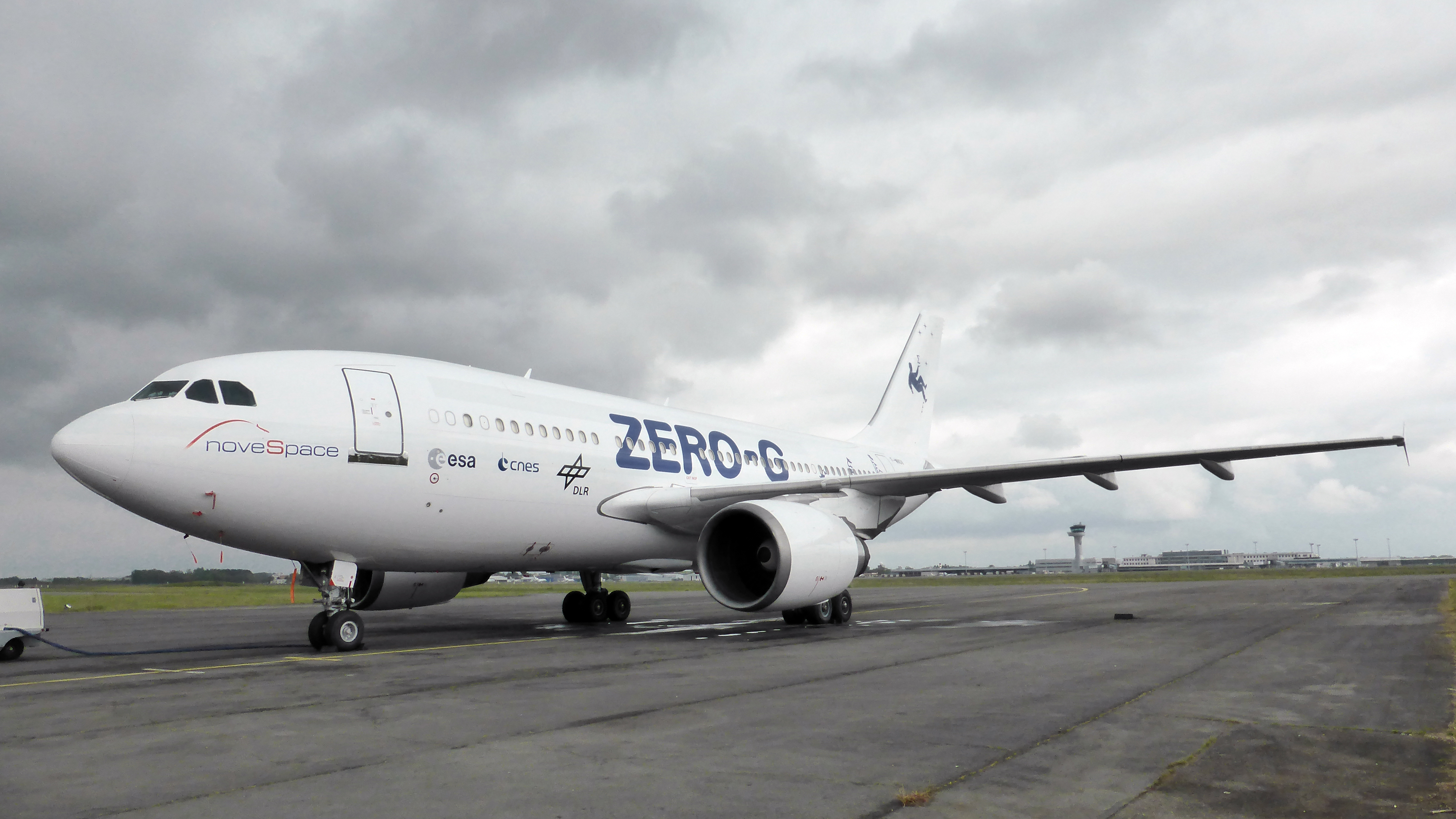
The former German government "Konrad Adenauer", an A310-304 converted into Novespace's parabolic flight aircraft, successor to the A300 Zero-G.
-1600.webp)
History
From state aircraft to weightlessness laboratory
The A310 Zero G is a single A310 airframe: an A310-304, serial number 498, registered F-HNOV, which the French company Novespace has operated since 2015 as a parabolic flight aircraft, a flying laboratory in which scientists, astronauts and members of the public can float for about twenty seconds per manoeuvre without leaving the atmosphere. It is not a production version but the conversion of an existing airframe, and its story is that of an aircraft that lived two very different lives before taking up controlled falling.
Interflug and the "Chancellor Airbus"
The aircraft left the Airbus production line in June 1989 and was delivered on 24 June 1989 to Interflug, the airline of the German Democratic Republic, which used it for East German government leaders until 1991. After reunification, on 27 August 1991 it became the property of the German Air Force, with the military serial 10+21 and the name "Konrad Adenauer", in honour of the post-war chancellor. Stationed at Cologne-Bonn airport for the Federal Ministry of Defence, between 1993 and 2011 it carried Federal Chancellors and ministers on journeys and state visits; according to Novespace, they included Chancellor Angela Merkel.
A successor for the A300 Zero-G
Novespace, a subsidiary of CNES, the French space agency, based at Bordeaux-Mérignac, had until then flown the A300 Zero-G, an A300 built in 1973. After 5200 flights, 4200 flight hours and 13,180 parabolas, that aircraft was retired from scientific service on 31 October 2014. DLR, the German Aerospace Center, which had worked with Novespace on parabolic flights since 1999, supported the search for a replacement: according to Ulrike Friedrich, head of its programme, the challenge was to locate an affordable aircraft that had not accumulated too many flight cycles, because take-offs and landings put the heaviest loads on the structure. The roughly 26-year-old "Konrad Adenauer" met those requirements best. Novespace bought it for about 2.5 million euros and took it over on 24 June 2014, exactly 25 years after its first delivery.
The conversion in Hamburg
From 3 September 2014 to 18 March 2015, Lufthansa Technik overhauled the aircraft in Hamburg, returned it to the civil configuration required by the European Union Aviation Safety Agency (EASA) and adapted it to parabolic flight with some 1350 modifications. Most concerned the cabin: its forward section became an experiment area stripped of seats and stowage, with about 100 m² of floor and 200 m³ of volume (20 m long, 5 m wide and up to 2.25 m high), padded on floor, walls and ceiling, with handrails, straps and safety nets fore and aft. LED lighting, 230 V electrical panels and gas extraction ports were added, while seats were kept at the rear for take-off and landing. The structure, engines and systems were left unmodified; special instruments, including an accelerometer, were fitted in the cockpit so the parabolas can be flown precisely, and the maintenance programme was adapted to the loads of this kind of flying. Since 18 March 2015 the aircraft has been based at Bordeaux-Mérignac.
How a parabola is flown
According to Novespace, the aircraft, powered by two General Electric CF6-80C2 engines, starts from about 6000 m and 830 km/h, pulls up to 50° and begins the parabola at about 7600 m; at the top it reaches about 8500 m and 380 km/h, and it pulls out at 42° nose-down. Each manoeuvre lasts about 70 s and gives 22 seconds of weightlessness with an accuracy of ±0.02 g, preceded and followed by phases at 1.8 g; it can also reproduce lunar gravity (0.16 g for 25 s) or Martian gravity (0.38 g for 35 s). A series of 30 parabolas adds up to 11 minutes of weightlessness. Three pilots fly in the cockpit, one controlling roll, one pitch and the third engine thrust, with four cabin crew behind; the aircraft takes 12 to 15 experiments, with up to 4000 kg of total mass, and about 40 scientists per flight. Novespace describes it as the world's largest zero-gravity aircraft in passenger capacity and experiment area.
Science campaigns and other uses
After test and training flights in April 2015, the first scientific campaign, run jointly by DLR, ESA and CNES, Novespace's three research partners, was scheduled for 5, 6 and 7 May 2015, with 12 experiments on board and 31 parabolas per day. A typical campaign, according to ESA, consists of three flights and a week of preparation on the ground. The aircraft kept flying through the pandemic: in November 2020 ESA flew its 73rd parabolic flight campaign, dedicated to the Fly Your Thesis! university programme, and in May 2021 its 75th, the third under COVID-19 restrictions, with daily testing and masks worn on board at all times. Besides scientific flights, it performs recreational flights under the Air Zero G brand and special-effects work for cinema, such as for The Mummy (2017).
Multimedia


-1600.webp)
-1600.webp)
-%2C_Schoenefeld_(P1180706)-1600.webp)
-800.webp)
_%E2%80%94_Landung_des_AirZeroG_am_Flughafen_Paderborn-Lippstadt-1600.webp)
_%E2%80%94_F-WNOV_A310-304_Zero_G_at_BOD_260615_(19120223058)-1600.webp)
_%E2%80%94_Die_Kennung_des_Novespace-Parabelflugzeugs-1600.webp)
_%E2%80%94_Der_Novespace-Parabelflieger_am_Hangar-1600.webp)
_%E2%80%94_Das_Cockpit_des_Parabelfliegers_-_50375105997-1600.webp)
_%E2%80%94_Airbus_A310_AirZeroG_(F-WNOV)-%2C_Schoenefeld_(P1180699)-1600.webp)
_%E2%80%94_Airbus_A310_AirZeroG%2C_Schoenefeld_(ILA43871)-1600.webp)
_%E2%80%94_Airbus_A310-304_(cn_498%2C_F-WNOV)_2024-06-09_Andre_Gerwing_Collection_ID_020879-1600.webp)
_%E2%80%94_Airbus_A310-304_(cn_498%2C_F-WNOV)_2016-06-03_Andre_Gerwing_Collection_ID_000390-1600.webp)
_%E2%80%94_A310_ZERO_G_interior-1600.webp)
_%E2%80%94_A310_ZE-RO-G_nach_der_Lan-dung-1600.webp)