Airbus A310 variant
Airbus A310 MRT/MRTT
Military conversion of the A310-300 for the Luftwaffe and the Royal Canadian Air Force: a multi-role transport (MRT) for passengers, cargo and medical evacuation and, after a second rebuild, a tanker with two air-to-air refuelling pods (MRTT).
_Airbus_A310_MRTT.png)
- March 25, 1999
- First flight
- 8,889 km
- Range
History
One aircraft for several missions
The A310 MRT (Multi-Role Transport) and the A310 MRTT (Multi-Role Tanker Transport) did not come new off the Toulouse line: they are specialist military conversions of existing A310-300 airliners, in their A310-304 version. The idea was to cover with a single type tasks that had previously needed several: troop transport, cargo, medical evacuation and, in the MRTT, air-to-air refuelling. The first user was the German Luftwaffe.
The Luftwaffe MRT
The German MRTs were created in the late 1990s from second-hand A310-300s bought from Lufthansa. The work was shared between EADS's Elbe Flugzeugwerke in Dresden and Lufthansa Technik in Hamburg. The first MRT flight took place on 25 March 1999 with 10+24 "Otto Lilienthal". Its most visible feature is the large, vertically opening main-deck cargo door on the front left side of the fuselage, which even allows loading by overhead crane. After a reconfiguration of three to seven days the aircraft can fly as a passenger transport with up to 214 seats, as a freighter for standard pallets with up to 57 passengers, or as an ambulance aircraft; with auxiliary tanks it reaches 10,000 km. The four German aircraft (10+24 to 10+27) were flown by the Defence Ministry's Flugbereitschaft. One of the sources credits the Luftwaffe with seven A310 MRTs, four of which became tankers; the list of registrations identifies only these four as MRTs.
The tanker conversion
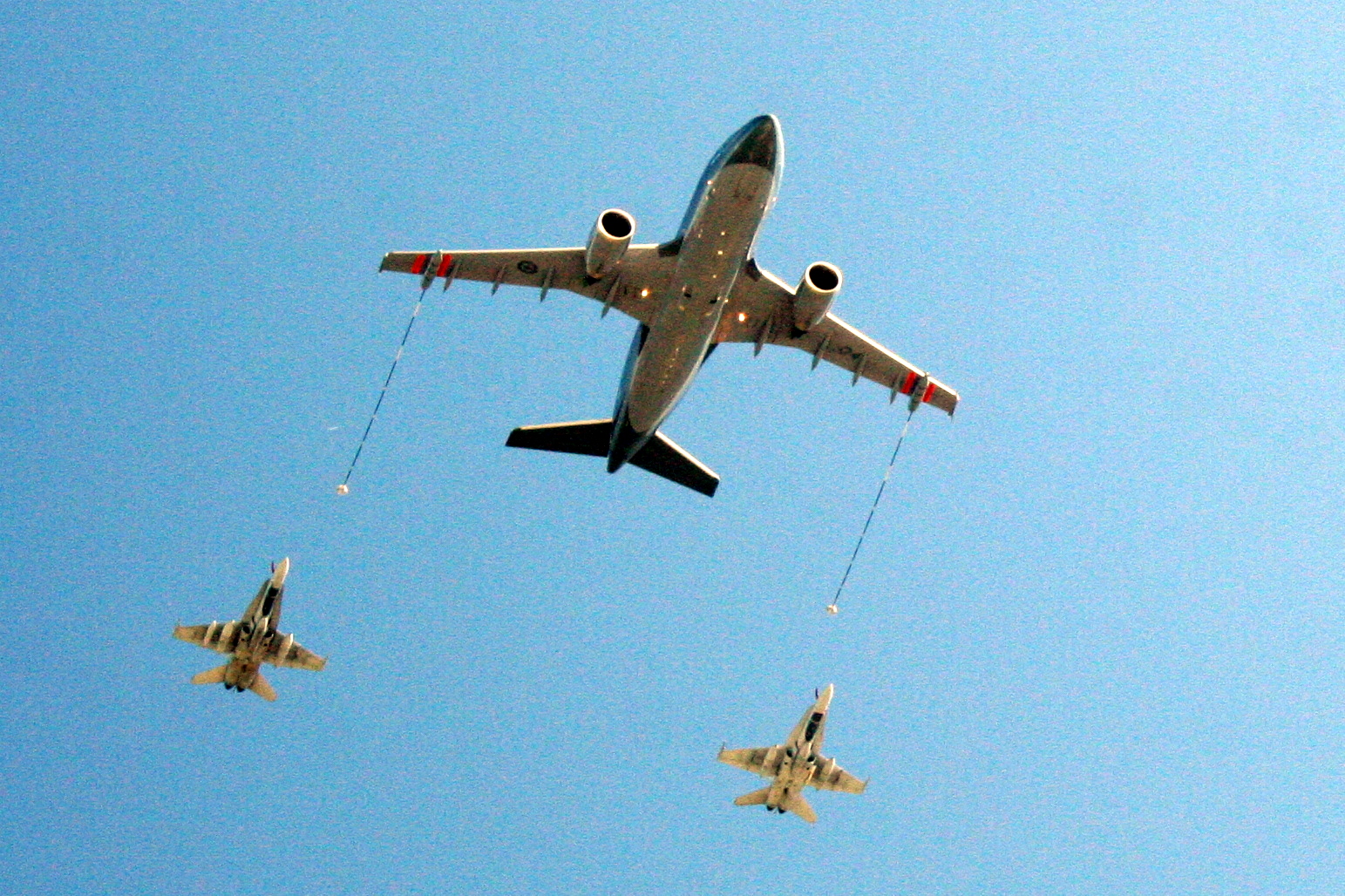
The MRTT adds air-to-air refuelling to the MRT. The rebuild, involving Airbus Military, Airbus Deutschland and Lufthansa Technik, includes two Flight Refuelling (now Cobham) Mk 32B hose-and-drogue pods under the wings, close to the tips, which can unreel up to 23 m of hose and serve two receivers at once; a fuel operator station in the cockpit, behind the captain, controlling the offload, cameras, military radios and exterior lighting; reinforced wings and floor; and minor cockpit changes. Design of the pods and wing reinforcement was subcontracted to ITD, then part of the Industria de Turbo Propulsores group. The night-vision-capable video system used to monitor the contact was developed by the German FTI Group and integrated in 2008. The crew is three: two pilots and the refuelling operator, although the pilots can run every refuelling function if that station is switched off.
Fuel for receivers is drawn from the centre tank, and up to five additional tanks of 7,200 litres each, 36,000 litres in all, can be fitted in the lower hold. German and Canadian aircraft carry only four, because their maximum take-off weight is 157 t rather than the 164 t needed for five. The Luftwaffe MRTT therefore holds 89,890 litres (about 72 t): 61,090 litres of standard fuel plus 28,800 in the extra tanks. It can transfer 65 t of fuel 1000 km from its base, or 30 t over an extended radius of 4600 km, at up to 1600 litres per minute per side. As a freighter it carries up to 37 t; in a mixed layout, 54 troops and 12 pallets. If required it reverts to MRT or medical standard in five days by removing three tanks and the pods and deactivating the refuelling computers.
Deliveries and German service
The first example, 10+27 "August Euler", was unveiled in 2003 at the Dresden plant; the first flight as an MRTT dates from December of that year and deliveries to the Luftwaffe began in October 2004. In June 2007 EADS delivered the first MRTT with new mission avionics, which allowed it to be assigned to the NATO Reaction Forces. First operational use came on 4 February 2009, still within the testing phase: an MRTT refuelled three Eurofighters of Jagdgeschwader 73 "Steinhoff" on their transfer from Laage to Yelahanka, near Bangalore (India), a route of nearly 8,200 km with a stop at Al Dhafra (United Arab Emirates), to present the fighter in India's MMRCA competition. By the end of 2010 all German MRTs had been brought to MRTT standard.
The MedEvac ambulance version, fitted to four aircraft, was the first aircraft designed to treat several intensive-care patients in flight: up to six patient transport units plus 38 further stretcher cases, or a maximum of 56 stretchers without those units. The Luftwaffe always kept one on standby at Cologne-Wahn, ready to launch at 24 hours' notice, and NATO allies also called on it. Retirement of the last A310 MedEvac, "Hermann Köhl", was planned for February 2022, but the war in Ukraine extended its use until June 2022.
Canada's CC-150 Polaris
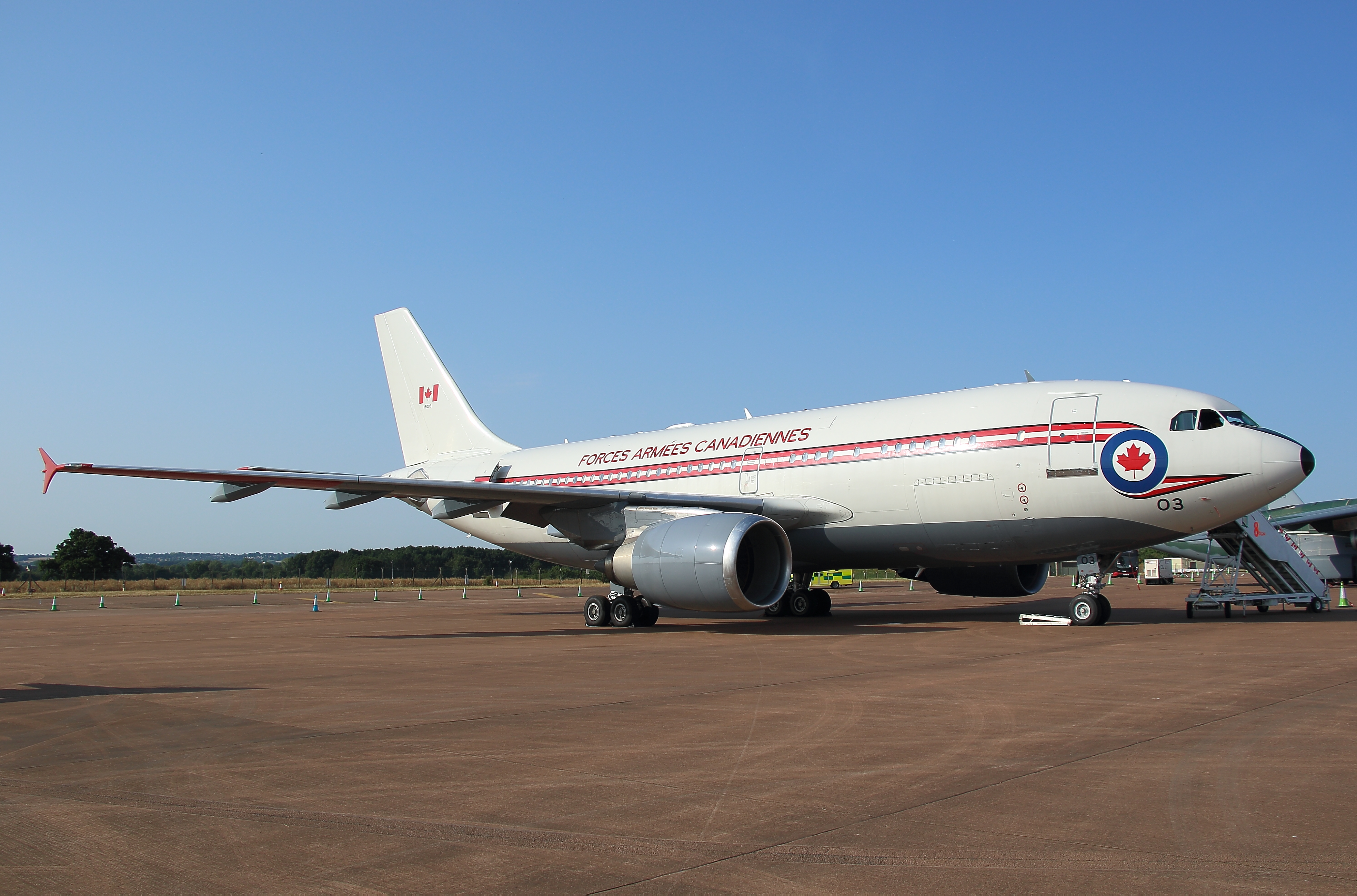
Canada bought from Canadian Airlines five A310-300s delivered to Wardair in 1987 and 1988; after conversion for military use they entered service between December 1992 and August 1993 as the CC-150 Polaris. Four (15002 to 15005) were brought to Combi-Freighter standard with a reinforced floor and side cargo door, and 15001 was configured as a VIP transport. They replaced the CC-137, whose last transport and tanker examples were retired in 1997. In 2008 aircraft 15003 and 15004 became tankers, with hose-and-drogue pods and new mission avionics, under the MRTT programme launched by the German requirement; they were designated CC-150T, and the first completed acceptance trials in May 2008. One source instead dates the delivery of the first Canadian MRTT to October 2004, the same date as the first German one. They can ferry four CF-18s non-stop across the Atlantic over a 4,630 km leg.
The Polaris fleet flies with 437 Transport Squadron from CFB Trenton, Ontario. In 2011 the two CC-150Ts supported the CF-18s enforcing the no-fly zone over Libya (Operation Mobile and Operation Unified Protector). On 22 July 2023 aircraft 15003 suffered severe tail damage in Guam in a rollaway collision with a French A400M, and in November 2023 the decision was taken to scrap it there. In 2021 Canada began replacing the fleet, whose service life was set to end in 2027, and on 14 July 2022 it contracted the first two A330-200s of the Strategic Tanker Transport Capability project. VIP aircraft 15001 was retired in 2025 and is preserved at the National Air Force Museum of Canada.
Assessment
According to the sources at least six MRTTs were completed, four German and two Canadian, three converted in Dresden and three in Hamburg. Chile ordered two and later cancelled them, and Pakistan ordered MRTT capability on an A310. Its natural successor is the A330 MRTT, compared with which the A310 MRTT is 30% smaller by maximum take-off weight.
Multimedia


