Aereo di linea · Civile · Regno Unito
Hawker Siddeley Trident
- 9 gennaio 1962
- Primo volo
- 1964
- Entrata in servizio
- In servizio
- Stato
- 117
- Esemplari costruiti
-1600.webp)
-1600.webp)
-1600.webp)
-1600.webp)
_British_Airways._(5651204998)-1600.webp)
-1600.webp)
-1600.webp)


-1600.webp)
-1600.webp)
_at_Pisa-1600.webp)
-1600.webp)
-1600.webp)
-1600.webp)
-1600.webp)
-1600.webp)
-1600.webp)

-1600.webp)
%2C_ex-BKS_and_Northeast-1600.webp)


_at_Salzburg-800.webp)


%2C_China_PP1334738458-800.webp)
-1600.webp)


-800.webp)


-1600.webp)
-1600.webp)

_ex_British_Airways._(5652804430)-1600.webp)

-1600.webp)


-1600.webp)
-1600.webp)
-1600.webp)

_1990-04-29_Andre_Gerwing_Collection_ID_006399-1600.webp)


-1600.webp)

-1600.webp)


-1600.webp)
-1600.webp)


-1600.webp)

-1600.webp)
_of_Northeast_Airlines%2C_c.1971-72-800.webp)
-1600.webp)
%2C_Manchester_Airport_Runway_Park_-_geograph.org.uk_-_3736233.jpg)


-1600.webp)


_(2)-1600.webp)


-1600.webp)

-1600.webp)
-1600.webp)
-1600.webp)
-800.webp)

-1600.webp)
-1600.webp)
L'Hawker Siddeley Trident è un trireattore britannico a corto e medio raggio che volò per la prima volta il 9 gennaio 1962 ed entrò in servizio con British European Airways il 1º aprile 1964. Ne furono costruite 117 unità e gli ultimi esemplari furono ritirati nel 1995.
Eventi correlati
Schede correlate
Categoria
Storia
Il Trident fu progettato su misura per British European Airways, che cercava un jet veloce per la sua rete europea a corto e medio raggio. Il risultato fu un trireattore con tre motori Rolls-Royce Spey raggruppati in coda e impennaggio a T, una configurazione che avrebbe condiviso con il suo grande concorrente, il Boeing 727. Il primo volo ebbe luogo il 9 gennaio 1962 e BEA lo mise in servizio il 1º aprile 1964, due mesi dopo il 727.
Il suo contributo più duraturo fu tecnologico: il Trident fu pioniere dell'atterraggio automatico nell'aviazione commerciale, e nel 1965 divenne il primo aereo di linea a completare un atterraggio cieco in servizio con passeggeri, aprendo la strada all'operatività con minimi meteorologici sempre più bassi. Fu inoltre il primo aereo commerciale equipaggiato con un registratore di dati di volo ad accesso rapido.
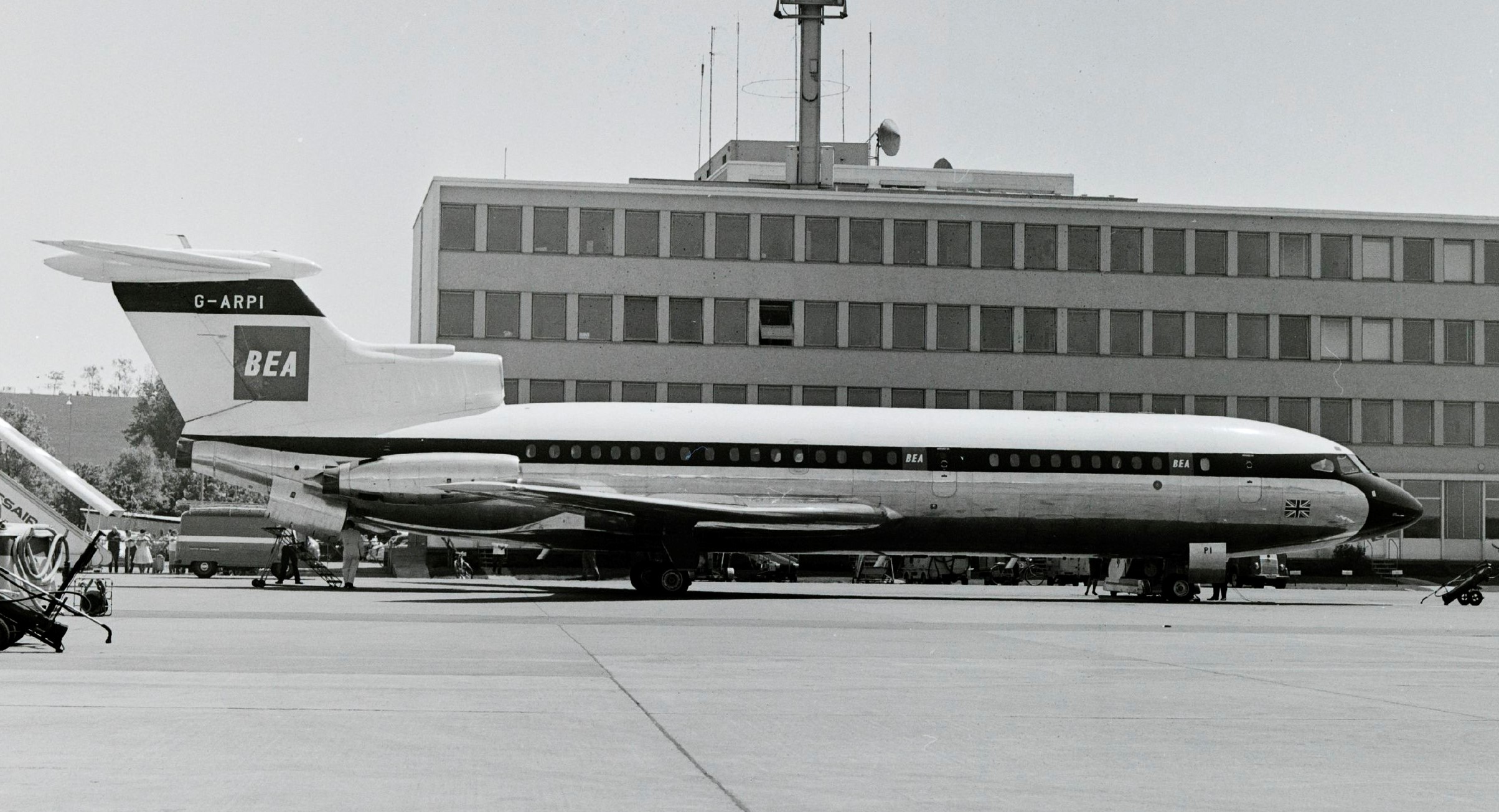
Calibrato in eccesso sulle esigenze di BEA, il Trident ebbe un percorso commerciale limitato: ne furono costruite 117 unità fino al termine della produzione nel 1978, con la cinese CAAC come principale cliente d'esportazione accanto all'operatore di lancio. Gli ultimi esemplari smisero di volare nel 1995, data che segnò il loro ritiro definitivo dal servizio.
Varianti
| Trident 1C | Trident 1E | Trident 2E | Trident 3B | Super Trident 3B | Trident 1A | Trident 1F | |
|---|---|---|---|---|---|---|---|
| Primo volo | 9 gennaio 1962 | 2 novembre 1964 | 27 luglio 1967 | 11 dicembre 1969 | 9 luglio 1975 | — | — |
| Tipo di aeromobile | — | — | — | — | — | Short/medium-haul airliner (unbuilt project) | Short/medium-haul airliner (unbuilt project) |
| Apparato propulsivo | — | — | — | — | — | 3 × Rolls-Royce Spey 510 turbofans of 47.6 kN (10,700 lbf) each, an uprated Spey 505 proposed for this variant. | 3 × Rolls-Royce Spey 511 turbofans of 50.7 kN (11,400 lbf) each, the same engines as the Trident 1E. |
| Motorizzazione | 3 × Rolls-Royce Spey RB.163-1 Mk 505-5 | 3 × Rolls-Royce Spey RB.163-25 Mk 511-5 | 3 × Rolls-Royce Spey RB.163-25 Mk 512-5W | 3 × Rolls-Royce Spey RB.163-25 Mk 512-5W + Rolls-Royce RB162-86 booster | 3 × Rolls-Royce Spey RB.163-25 Mk 512-5W + Rolls-Royce RB162-86 booster | 3 × Rolls-Royce Spey 510 | 3 × Rolls-Royce Spey 511 |
| Spinta unitaria | 46,3 kN | 50,7 kN | 53,2 kN Valore migliore della riga | 53,2 kN Valore migliore della riga | 53,2 kN Valore migliore della riga | 47,6 kN | 50,7 kN |
| Lunghezza | 35 m | 35 m | 35 m | 40 m Valore migliore della riga | 40 m Valore migliore della riga | — | — |
| Apertura alare | 27,4 m | 29 m | 29,9 m Valore migliore della riga | 29,9 m Valore migliore della riga | 29,9 m Valore migliore della riga | — | — |
| Altezza | 8,2 m | 8,2 m | 8,2 m | 8,6 m Valore migliore della riga | 8,6 m Valore migliore della riga | — | — |
| Superficie alare | 126 m² | 132 m² | 136 m² Valore migliore della riga | 136 m² Valore migliore della riga | 136 m² Valore migliore della riga | — | — |
| Peso a vuoto | 30.300 kg Valore migliore della riga | 31.800 kg | 33.200 kg | 37.600 kg | — | — | — |
| MTOW | 52.163 kg | 58.060 kg | 64.637 kg | 68.039 kg Valore migliore della riga | — | 54.431 kg | 59.874 kg |
| Velocità massima | — | — | 974 km/h Valore migliore della riga | 972 km/h | — | — | — |
| Quota di velocità massima | — | — | 7620 m | — | — | — | — |
| Velocità di crociera | 937 km/h | 937 km/h | 959 km/h Valore migliore della riga | 917 km/h | 917 km/h | — | — |
| Quota di crociera | 9144 m | 9144 m | 9145 m | 9144 m | 9144 m | — | — |
| Tangenza operativa | 10.668 m Valore migliore della riga | 10.668 m Valore migliore della riga | 10.668 m Valore migliore della riga | 10.668 m Valore migliore della riga | 10.668 m Valore migliore della riga | — | — |
| Velocità di salita iniziale | — | — | — | 15 m/s | — | — | — |
| Autonomia | 3260 km | 3540 km | 4350 km Valore migliore della riga | 3593 km | 3380 km | 2897 km | — |
| Raggio d'azione | 0 km Valore migliore della riga | 0 km Valore migliore della riga | 0 km Valore migliore della riga | 0 km Valore migliore della riga | 0 km Valore migliore della riga | 0 km Valore migliore della riga | 0 km Valore migliore della riga |
| Condizioni di autonomia | — | — | — | — | — | The enlarged wing and centre-section tank raised gross weight to 54,431 kg and projected range to 2,897 km (1,800 miles), still short of what American Airlines wanted; it chose the Boeing 727 instead. | Intended to give BEA more range than the 1E; the changes piled up until the project was renamed Trident 2E, and no 1F was ever built. |
| Armamento | — | — | — | — | — | None | None |
| Carico bellico massimo | 0 kg Valore migliore della riga | 0 kg Valore migliore della riga | 0 kg Valore migliore della riga | 0 kg Valore migliore della riga | 0 kg Valore migliore della riga | 0 kg Valore migliore della riga | 0 kg Valore migliore della riga |
| Carico utile | — | — | 21.156 kg | — | — | — | — |
| Capacità di carico | — | — | — | — | — | Project offered to American Airlines with the Trident 1C cabin, a larger wing and more fuel; none was ever built. | 1964 project with the fuselage stretched by 2.8 m and up to 128 seats in the original five-abreast layout; BEA planned ten with options on fourteen more. |
| Equipaggio | 3 Valore migliore della riga | 3 Valore migliore della riga | 3 Valore migliore della riga | 3 Valore migliore della riga | 3 Valore migliore della riga | 3 Valore migliore della riga | 3 Valore migliore della riga |
| Passeggeri | 109 | 149 | 149 | 180 Valore migliore della riga | 180 Valore migliore della riga | — | 128 |
| Esemplari costruiti | 24 | 15 | 50 Valore migliore della riga | 26 | 2 | 0 | 0 |
Immagini


