NASA · United States
Project Mercury
- 26
- Launches (as of February 23, 2026)
- 6
- Crewed missions
- August 21, 1959
- First launch
- May 15, 1963
- Last launch
-1600.webp)
-1600.webp)

-1600.webp)
-3_flight-1600.webp)

.jpg)
-1600.webp)


-1600.webp)


-1600.webp)
-1600.webp)
-1600.webp)

-1600.webp)


-1600.webp)

-1600.webp)
-1600.webp)
%2C_12_Aug._1959.jpg)
-1600.webp)


-1600.webp)

-1600.webp)

-1600.webp)
-1600.webp)

-1600.webp)

-800.webp)


-1600.webp)

-1600.webp)


-1600.webp)


-1600.webp)
-1600.webp)
-1600.webp)

-1600.webp)


-1600.webp)


-1600.webp)
.jpg)


-1600.webp)
-800.webp)

-1600.webp)
-3_-_CAPE-1600.webp)
-1600.webp)

-1600.webp)

-1600.webp)
-1600.webp)
-800.webp)


-1600.webp)
%2C_mechanical_astronaut_flight_attempt-1600.webp)

-1600.webp)
_vehicle%2C_Jan._31%2C_1961-800.webp)
-1600.webp)

-1600.webp)
-1600.webp)


-1600.webp)
-1600.webp)
-800.webp)

-1600.webp)
-1600.webp)

-2_%E2%80%93_Cape-800.webp)


-1600.webp)
-1600.webp)
-2_flight-800.webp)


-800.webp)
-1600.webp)


.jpg)
-1600.webp)
-1600.webp)

-1600.webp)
-1600.webp)
-1600.webp)
-1600.webp)

-800.webp)

-1600.webp)

-800.webp)


-1600.webp)


-1600.webp)
-2-800.webp)
-1600.webp)
-1600.webp)
.jpg)

-1600.webp)
-1600.webp)
-1600.webp)

-1600.webp)
-1600.webp)

-1600.webp)
-1600.webp)


-800.webp)
-1600.webp)


-800.webp)


_spacecraft_(s61-04667)-800.webp)
___MNTV_(Mercury_Network_Test_Vehicle).jpg)
-1600.webp)
-1600.webp)

-1600.webp)
-3_Flight_-_Cape-1600.webp)
-1600.webp)
-1600.webp)

-2_%E2%80%93_Loaded_on_Ship_%E2%80%93_Chimp_%22Ham%22-800.webp)


-1600.webp)
-1600.webp)
-1600.webp)

-1600.webp)


-1600.webp)
-1600.webp)


-1600.webp)
-1600.webp)

-1600.webp)
-1600.webp)

-1600.webp)
-1600.webp)
-1600.webp)
-1600.webp)


-1600.webp)


-1600.webp)
-800.webp)
-1600.webp)


-1600.webp)
-1600.webp)

-1600.webp)

-800.webp)
_---_Astronaut_John_H-1600.webp)

-1600.webp)


-1600.webp)

.jpg)


-800.webp)

_---_Astronauts_Virgil_I-800.webp)

-3_-_%22FREEDOM_7%22_-_CAPE-1600.webp)
-1600.webp)


_---_Department_of_Defense_(DOD)_recovery_personnel_and_spacecraft_technicians_from_NASA_and_McDonnell_Aircraft_Corp.%2C_inspe-800.webp)
-1600.webp)
-1600.webp)


-1600.webp)


-3_Flight-1600.webp)

-1600.webp)
_---_Following_the_successful_MA-6_mission%2C_astronaut_John_H-1600.webp)

-1600.webp)
-1600.webp)


-800.webp)

-1600.webp)
-1600.webp)
-1600.webp)
-1600.webp)


-1600.webp)

-2_capsule-800.webp)
-1600.webp)
Project Mercury was the first crewed spaceflight programme of the United States and the first great undertaking of NASA as a civilian agency. Begun in 1958, the year the agency itself was created, and completed in 1963, it drew on the work of more than two million people across government bodies and much of the aerospace industry in the space of five years. Its aims were stated plainly at project go-ahead and never changed: place a crewed spacecraft in orbital flight around the Earth, investigate what a human being could actually do in the environment of space, and recover both the pilot and the spacecraft safely. The programme inherited more than a decade of NACA research at the Langley and Ames laboratories into reentry shapes, aerodynamic heating and multistage solid-fuel research rockets, and it inherited two military missiles that became its launch vehicles: the Army's Redstone for the ballistic hops and the Atlas, descended from the Convair MX-774, for orbital flight. On that basis the Space Task Group formed at Langley under Robert R. Gilruth settled on a small blunt-body capsule recovered at sea and placed it with McDonnell Aircraft Corporation, chosen as prime contractor early in 1959 after a competition that drew in most of the American airframe industry. The flight sequence that followed was long and deliberately cautious. Twenty uncrewed missions flew before any astronaut did: escape-system tests launched by the Little Joe booster from Wallops Island, qualification flights of the capsule and its heat shield, Redstone and Atlas development launches, one flight on a Scout vehicle and a beach abort that used no launch vehicle at all. Several of those missions failed outright or met only part of their objectives, and it was precisely those failures — a structure that gave way, a vehicle destroyed in flight, a separation that did not happen — that shaped the final design before a life was put at risk. The six crewed flights ran from May 1961 to May 1963 and totalled fifty-three hours, fifty-five minutes and twenty-seven seconds. Alan Shepard opened the series with the suborbital hop of Freedom 7; Virgil "Gus" Grissom repeated the profile aboard Liberty Bell 7; John Glenn became the first American to orbit the Earth in Friendship 7 in February 1962; Scott Carpenter flew the same three orbits in Aurora 7; Walter Schirra doubled the duration with the six orbits of Sigma 7; and Gordon Cooper closed the programme with the twenty-two orbits of Faith 7. Mercury turned a hypothesis into a demonstrated fact: a person could function in weightlessness, fly the spacecraft and come home. The seven astronauts chosen in 1959 became the core from which the Gemini and Apollo crews were later drawn, and the capsule, the pressure suit, the worldwide tracking network and the sea-recovery procedure became the pattern on which the whole of subsequent American human spaceflight was built.
Objectives
The objectives of Project Mercury, as stated by NASA at project go-ahead, were three and never changed: to place a crewed spacecraft in orbital flight around the Earth; to investigate a human being's performance capabilities and ability to function in the environment of space; and to recover both the pilot and the spacecraft safely. All three were met: orbital flight came with Friendship 7 in 1962, the study of human performance in weightlessness was an explicit purpose of the Carpenter and Cooper missions, and all six crews — and most of the capsules — were recovered at sea. Source: NASA, "Project Mercury Objectives and Guidelines".
Rockets
Missions of Project Mercury
| Mission number | Missions | Launch date | Launch vehicle | Crew size | Duration | Outcome |
|---|---|---|---|---|---|---|
| 1 | Little Joe 1 | August 21, 1959 | Little Joe | — | 0 min | Failure |
| 2 | Big Joe 1 | Sep 9, 1959, 8:19 AM | Atlas D (10-D) | — | 13 min | Partial success |
| 3 | Little Joe 6 | October 4, 1959 | Little Joe | — | 5 min | Partial success |
| 4 | Little Joe 1A | November 4, 1959 | Little Joe | — | 8 min | Partial success |
| 5 | Little Joe 2 | December 4, 1959 | Little Joe | — | 11 min | Success |
| 6 | Little Joe 1B | January 21, 1960 | Little Joe | — | 8 min | Success |
| 7 | Beach Abort | May 9, 1960 | — | — | 1 min | Success |
| 8 | Mercury-Atlas 1 | July 29, 1960 | Atlas D (50-D) | — | — | Failure |
| 9 | Little Joe 5 | November 8, 1960 | Little Joe | — | 2 min | Failure |
| 10 | Mercury-Redstone 1 | November 21, 1960 | Redstone | — | 0 min | Failure |
| 11 | Mercury-Redstone 1A | December 19, 1960 | Redstone | — | 15 min | Success |
| 12 | Mercury-Redstone 2 | January 31, 1961 | Redstone | — | 16 min | Partial success |
| 13 | Mercury-Atlas 2 | February 21, 1961 | Atlas D (67-D) | — | 17 min | Success |
| 14 | Little Joe 5A | March 18, 1961 | Little Joe | — | — | Partial success |
| 15 | Mercury-Redstone BD | Mar 24, 1961, 5:30 AM | Redstone | — | 8 min | Success |
| 16 | Mercury-Atlas 3 | Apr 25, 1961, 4:15 PM | Atlas D (100-D) | — | 7 min | Failure |
| 17 | Little Joe 5B | April 28, 1961 | Little Joe | — | 5 min | Partial success |
| 18 | Mercury-Redstone 3 | May 5, 1961 | Redstone | 1 | — | Success |
| 19 | Mercury-Redstone 4 | July 21, 1961 | Redstone | 1 | 15 min | Success |
| 20 | Mercury-Atlas 4 | Sep 13, 1961, 2:04 PM | Atlas D (88-D) | — | 1 hr 49 min | Partial success |
| 21 | Mercury-Scout 1 | November 1, 1961 | Scout | — | 1 min | Failure |
| 22 | Mercury-Atlas 5 | November 29, 1961 | Atlas D (93-D) | — | 3 hr 20 min | Success |
| 23 | Mercury-Atlas 6 | February 20, 1962 | Atlas D | 1 | 4 hr 55 min | Success |
| 24 | Mercury-Atlas 7 | May 24, 1962, 12:45 PM | Atlas D | 1 | 4 hr 56 min | Success |
| 25 | Mercury-Atlas 8 | October 3, 1962 | Atlas D | 1 | 9 hr 13 min | Success |
| 26 | Mercury-Atlas 9 | May 15, 1963, 1:04 PM | Atlas D | 1 | 1 day 10 hr | Success |
History
An inheritance from the NACA
Mercury was not improvised in the shock of 1957. The NACA laboratories had been working for years on the very problems that would later decide the shape of the capsule. At Langley, the Pilotless Aircraft Research Division had been developing multistage solid-fuel research rockets since 1952 to probe hypersonic flight, firing four- and five-stage vehicles from Wallops Island at speeds no wind tunnel could reproduce. Between 1952 and 1956, Langley and Ames personnel studied the aerodynamic characteristics of reentry configurations systematically, and in its early studies Langley identified the greatest obstacle at once: aerodynamic heating. Until that was solved, the design of a practical spacecraft was, in its own words, impractical. To attack it, both laboratories built high-temperature jets, tunnels and other facilities for materials and structures research at hypersonic speeds during 1955 and 1956.
The two missiles that would become the programme's launch vehicles were maturing in parallel. Convair's MX-774, first test-fired in 1948 and shelved soon afterwards, was revived in 1951 under the name Atlas; its first launch attempt from Cape Canaveral ended in an explosion shortly after lift-off, and the second vehicle was also destroyed. The Redstone, whose development had begun in 1950, was first test-fired at the Cape in the first half of the decade, and in 1956 the Army Ballistic Missile Agency was activated at Huntsville to complete it and to develop the Jupiter. Neither missile had been conceived to carry people: Mercury adopted them and had to put both through a full man-rating effort.
.jpg)
The bridge between research and programme was built by the internal presentations on manned orbital flight that Maxime A. Faget and other Langley engineers circulated in the late nineteen-fifties, and by the Special Committee on Space Technology that the NACA established in November 1957 to delineate the problems that had to be solved to make space flight a practical reality. When the NACA became NASA in 1958, that groundwork already existed and already had owners.
The Space Task Group and the choice of contractor
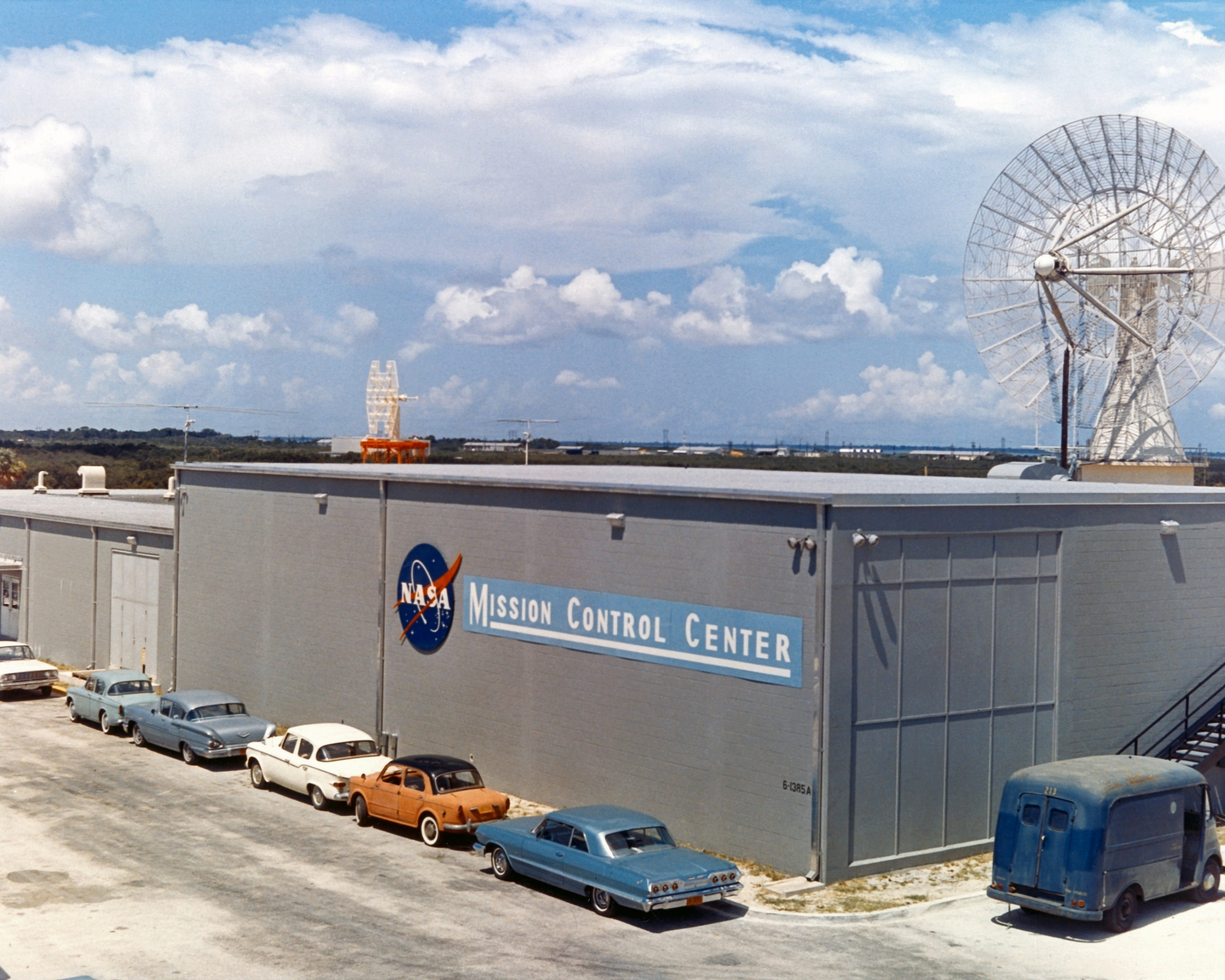
The organisation that ran Mercury was formed at Langley late in 1958 as the Space Task Group, led by Robert R. Gilruth, who would remain responsible for the project throughout its life. At NASA Headquarters, Abe Silverstein and George Low oversaw the programme and set the schedule for evaluating and negotiating the manned satellite capsule.
The capsule competition was run under specification S-6 and drew eleven bidders: AVCO, Chance-Vought, Convair, Douglas, Grumman, Lockheed, Martin, McDonnell, North American, Northrop and Republic. The Space Task Group first laid down the procedures for the technical assessment of the proposals, and the Source Selection Board at Headquarters — Silverstein, Ralph Cushman, George Low, Walter Schier, DeMarquis Wyatt and Charles Zimmerman — reported its findings on 9 January 1959: McDonnell Aircraft Corporation would be prime contractor for the Mercury spacecraft. Technical and legal negotiations opened five days later and were completed on 26 January. McDonnell estimated at the time that the first three spacecraft could be delivered in ten months; the programme would need considerably longer.
One early technical decision captures the project's temperament. At a Space Task Group meeting it was agreed to negotiate with McDonnell for a design that could be fitted with either a beryllium heat sink or an ablation heat shield, because Gilruth, as project director, held that for safety both should be available. Subcontracting followed the same instinct for spreading risk: the stabilisation system went to Minneapolis-Honeywell, and manufacture was concentrated at the McDonnell plant in St. Louis.
There was even an attempt to rename the programme. In December 1958 a proposal circulated at Headquarters to change "Project Mercury" to "Project Astronaut"; it went nowhere, and the messenger of the gods kept the job.
The objectives, and what they excluded
The three objectives fixed at project go-ahead — crewed orbital flight, investigation of human performance in space, and safe recovery of man and machine — were valuable above all for what they left out. Mercury did not attempt orbital manoeuvring, rendezvous or long duration. It set out to show that the whole chain, from lift-off to recovery at sea, worked with a person inside it. That deliberate narrowness is what made a five-year programme possible.
The Mercury Seven
Pilot selection began with paperwork. In the first fortnight of February 1959, some five hundred service records were reviewed and roughly a hundred and ten men appeared to qualify. Interviews in Washington were followed by medical examinations and stress testing, and on 9 April 1959, at a press conference, the nation met the seven chosen as its nominees for the first human voyages into space: Malcolm Scott Carpenter, Leroy Gordon Cooper, John H. Glenn, Virgil I. "Gus" Grissom, Walter M. Schirra, Alan B. Shepard and Donald K. "Deke" Slayton. The official chronology records the internal effect: now that men had been chosen as the focal point of the whole effort, new spirits animated the Space Task Group.
All seven were military test pilots, and none was a passenger. They worked on cockpit layout, on the definition of the controls and on the training of ground teams, dividing the technical territory among themselves. Slayton was grounded by a heart condition and never flew in Mercury; his flight came many years later on the Apollo-Soyuz Test Project. The other six flew one mission each, and several went on to later programmes: Grissom to Gemini III and Apollo 1, Schirra to Gemini VI-A and Apollo 7, Cooper to Gemini V, Shepard to Apollo 14, and Glenn, far later, to the Shuttle mission STS-95.
Little Joe: testing escape without spending an Atlas
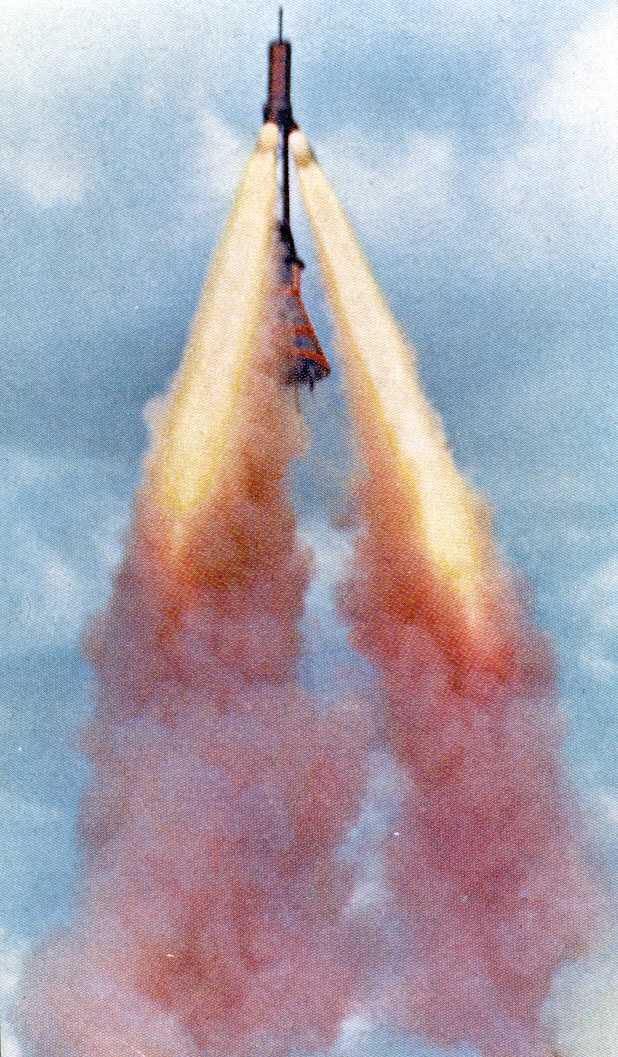
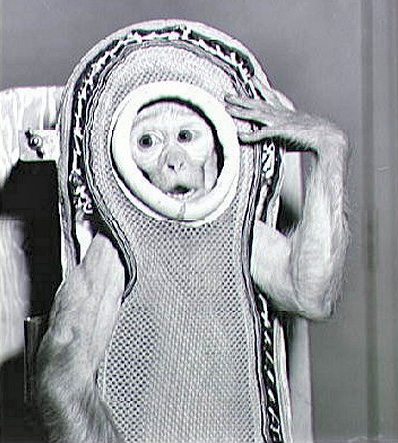
Testing the capsule's escape system called for a cheap, available rocket able to carry a boilerplate to the harshest dynamic-pressure conditions of the ascent. The answer was Little Joe, a solid-fuel vehicle designed for exactly that. The bidders' briefing was held in October 1958; the airframe contract went to North American Aviation at the end of December and the letter of intent was placed on the last day of the year. The vehicle stood forty-eight feet tall and just under seven feet across, clustering four Pollux and four Recruit solid motors, and the Space Task Group ordered all the major motors early so as not to jeopardise the test schedule. Launches were made from Wallops Island with technical support from Langley Research Center, and some flights carried biological payloads: pigs and small primates were planned, and in practice the monkeys Sam and Miss Sam flew.
The Little Joe series was a catalogue of lessons. The first vehicle, LJ-1, never left the pad in August 1959: the escape rocket fired by itself half an hour before the scheduled launch and took the boilerplate with it. Later flights probed escape at different altitudes and dynamic pressures, alternating success and failure, until the tower had shown it could pull the capsule off the booster at the worst possible moment of the climb.
Big Joe, Redstone and the development flights
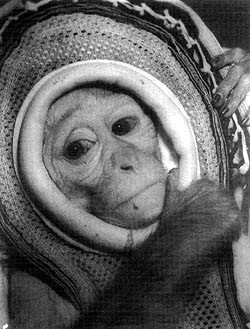
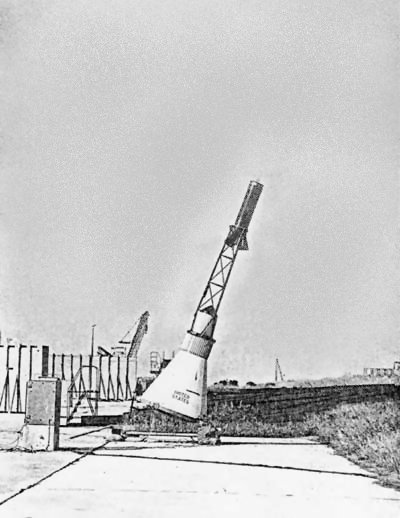
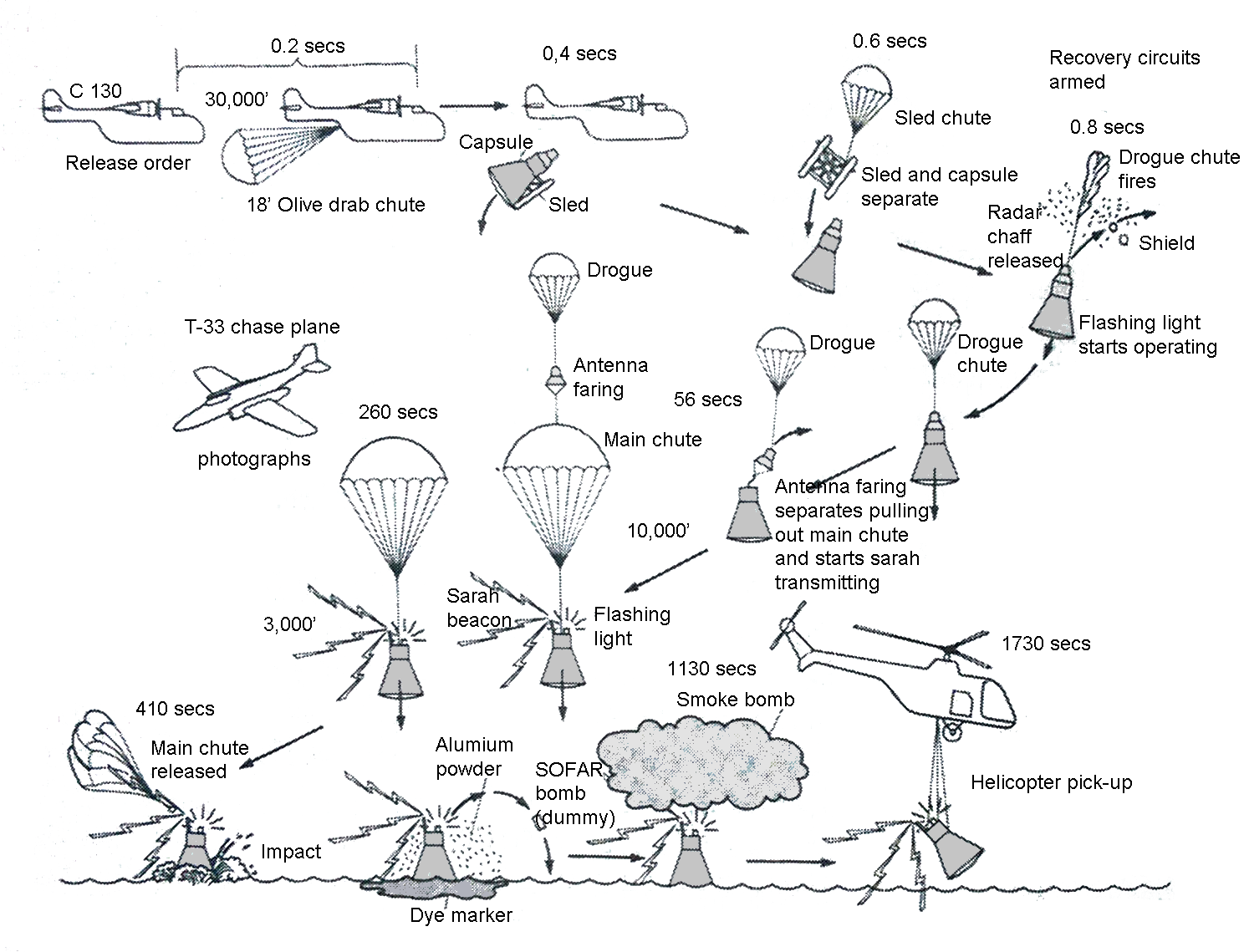
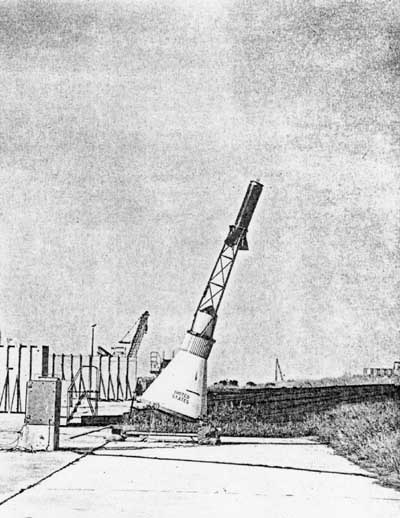
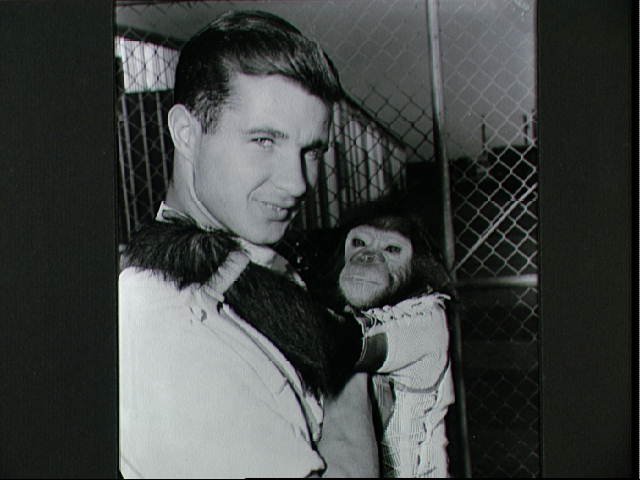
Heat-shield qualification came with Big Joe, a September 1959 flight launched by an Atlas for which the Space Task Group leaned on the instrumentation facilities of the Lewis centre. Qualification of the Mercury-Redstone, which was to carry the first American on a ballistic trajectory, ran in parallel. The first attempt, MR-1, produced in November 1960 one of the most remembered episodes of the programme: the engine cut off a few centimetres off the pad, the rocket settled back down, and the escape tower fired away on its own, leaving the capsule sitting intact on the vehicle. MR-1A repeated the flight successfully in December. In January 1961, MR-2 carried the chimpanzee Ham on a more energetic profile than planned, and its results argued for inserting one further development flight, MR-BD, before risking a pilot. That decision — taken with the Soviet Union close behind — delayed the first American crewed flight by weeks.
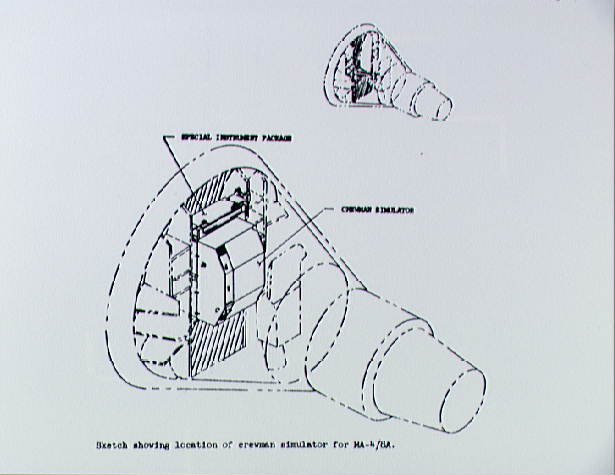
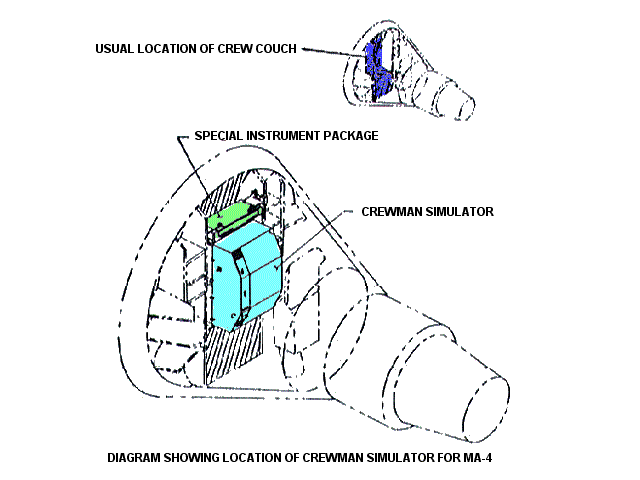
The Atlas branch was rougher. MA-1 was destroyed in flight in July 1960; MA-2 flew well in February 1961; MA-3 had to be destroyed in April 1961 when the vehicle failed to follow its flight programme; MA-4 finally placed a capsule in orbit in September 1961 and it was recovered, though sources differ on how successful the mission is deemed to have been; and in November 1961 MA-5 carried the chimpanzee Enos, who completed two orbits instead of the three planned because of a vehicle problem but came back healthy. The development census was completed by one Scout launch, MS-1, intended to check out the tracking network, and by the Beach Abort test, in which the capsule was pulled off the sand by its own tower with no launch vehicle at all.
The six crewed flights
On 5 May 1961, Alan Shepard flew Freedom 7 on a ballistic arc of a little over a quarter of an hour and became the first American in space. In July, Virgil Grissom repeated the profile in Liberty Bell 7; the capsule sank after splashdown when the hatch blew prematurely, and the pilot was pulled from the water.
The qualitative leap came on 20 February 1962, when John Glenn circled the Earth three times aboard Friendship 7 and became the first American to orbit. In May, Scott Carpenter flew the same three orbits in Aurora 7, devoting much of the flight to experiments and observation at a cost in propellant that forced a manual reentry and a long splashdown. On 3 October 1962, Walter Schirra flew six orbits in Sigma 7 in what was then the longest American orbital flight, executed with an almost demonstrative economy of propellant. The programme closed in May 1963 with Faith 7: Gordon Cooper completed twenty-two orbits, spent more than a day in space and had to fly the reentry by hand after an electrical failure. Together the six missions accumulated fifty-three hours, fifty-five minutes and twenty-seven seconds of crewed flight.
What Mercury left behind
The official summary describes a first American manned space flight project successfully accomplished in a five-year period of dynamic activity that brought together more than two million people from many major government agencies and much of the aerospace industry. Mercury left no permanent infrastructure and no reusable vehicle: it left certainties. That a human being can work in weightlessness without serious degradation; that a small ballistic-reentry capsule is a viable answer; that sea recovery works; that a worldwide tracking network and a flight control organisation are as much part of the spacecraft as the heat shield. Gemini and Apollo were built on those certainties, and the same men who established them flew on.
Images
Elsewhere
- Smithsonian National Air and Space MuseumMercury Capsule — pieza genérica de la cápsula, National Air and Space Museum ↗
- Smithsonian National Air and Space MuseumPrimate Capsule, Mercury — cápsula de pruebas con primates, National Air and Space Museum ↗
- NASA HistoryProject Mercury Overview — Summary ↗
- NASA HistoryProject Mercury Overview — Objectives and Guidelines ↗
- NASA History40th Anniversary of the Mercury Seven ↗
- WikipediaProject Mercury ↗
- Space.comProject Mercury — America's 1st crewed space program ↗
- March to the Moon (Indiana State Museum)Project Mercury History ↗
- Wikimedia CommonsAstronaut Scott Carpenter during centrifuge training ↗
- Digital Public Library of AmericaPhotograph of Astronaut Virgil I. Grissom Preparing for Testing in the Centrifuge ↗