Project Mercury · NASA · Uncrewed
Mercury-Atlas 1
- July 29, 1960
- Launch date
- Failure
- Outcome


-1600.webp)

Mercury-Atlas 1 (MA-1) was the first attempt to fly together the two pieces of hardware meant to place an American in orbit: the McDonnell-built Mercury capsule and the Atlas launch vehicle derived from Convair's D-series missile. It lifted off from Launch Complex 14 at Cape Canaveral on 29 July 1960, uncrewed and without a launch escape system, and it ended in failure fifty-eight seconds later when the rocket suffered a structural failure while passing through the region of maximum dynamic pressure. Atlas was not a comfortable choice but the only available one. Redstone was enough for ballistic hops lasting a few minutes, yet orbital velocity demanded a different class of vehicle, and in the American inventory of the day only the Atlas D could supply that energy while also offering a long run of development flights from which data could be harvested. The price of that choice was the rocket's ancestry: it had been designed as a weapon, its balloon-like pressurised tanks had paper-thin walls, its reliability was still immature and its flight record included frequent explosions, so an entire human-rating programme stood between the missile and a spacecraft, let alone a passenger. MA-1's flight plan called for a demanding suborbital re-entry. NASA's stated objectives were to qualify the spacecraft and Atlas combination, recover the capsule, establish the structural integrity of the capsule and of its afterbody shingles under the most severe heating an orbital launch abort could produce — 51 thermocouples were installed for the purpose — measure the flight dynamics of the capsule during re-entry, verify the recovery systems and familiarise project personnel with launch and recovery operations. The payload was spacecraft number 4 and launch vehicle 50-D. None of it was ever tested. The morning was rainy and overcast, the vehicle disappeared from sight twenty-six seconds after liftoff, and at T+58 seconds telemetry recorded a severe axial disturbance followed roughly a second later by the pressure difference between the tanks collapsing to zero, loss of thrust, loss of telemetry and multiple returns on radar. The capsule kept working and transmitting until it struck the ocean around 220 seconds into the flight; its parachutes never deployed because the abort had come far too early. The flight lasted 3 minutes and 18 seconds, reached an apogee of 13 kilometres and fell 9.6 kilometres downrange. The investigation, fed by wreckage salvaged from the sea floor, pointed at the interface between capsule and rocket: the launch vehicle's skin immediately below the spacecraft had given way under the combination of drag, acceleration and bending loads. Out of that finding came skin doublers, the stainless steel band fitted to MA-2's Atlas 67-D, the recall of 77-D in favour of the thick-skinned 100-D, and the shallower trajectories that kept this failure mode from ever recurring on a Mercury-Atlas flight. MA-1 was, in that sense, an expensive but timely failure: it exposed the weak point while nobody was yet aboard.
Payload
The payload of MA-1 was the spacecraft itself: Mercury capsule No. 4, built by McDonnell Aircraft, with a launch mass of 1,154 kg and with no crew, no animal and no dummy aboard. It flew without the launch escape tower; a fiberglass fairing was fitted in its place to occupy the space of the missing system. The capsule carried live separation rockets but dummy retrorockets, and several systems were left uninstalled as unnecessary on an uncrewed flight, among them the cabin pressurization system and the astronaut couch. The instrumentation was aimed at reentry heating: 51 thermocouples were installed to measure afterbody heating rates, and onboard telemetry recorded the spacecraft's behaviour until it struck the ocean. The recovery system, parachutes included, was also aboard, though it never deployed because the Atlas failure came too early in the ascent. With that equipment the mission was to qualify the spacecraft and Atlas combination, recover the capsule, determine the structural integrity of the Mercury capsule structure and its afterbody shingles under the maximum heating conditions of an orbital launch, measure afterbody heating rates and flight dynamics during reentry, and establish the adequacy of the capsule recovery systems.
History
The only rocket that could reach orbit
When NASA defined Project Mercury there was no American civilian launch vehicle designed to put a human being into orbit. Redstone was adequate for ballistic hops of a few minutes, but orbital velocity demanded a different class of machine, and the only one with that kind of energy was the Atlas D missile built by Convair. The choice was not arbitrary: Atlas was the sole vehicle in the United States arsenal capable of placing the spacecraft in orbit, and it also carried a substantial flight history from which NASA could draw data without paying for every test itself. The alternatives were to wait years for the next-generation Titan II ICBM to become operational, or to develop a dedicated crewed launch vehicle from scratch, and neither fitted the schedule of the space race.
There was a technical argument for Atlas over Titan as well. Its stage-and-a-half configuration ignited all of its engines on the ground, so the entire propulsion system could be checked out before release; on a two-stage vehicle the upper stage does not light until there is no going back. For a programme that intended to put people on top, that ability to test for hardware problems during pre-launch checks weighed heavily.
The drawback was the rocket's origin. Atlas had been designed as a weapon system, and a weapon's reliability does not have to be perfect — good enough will do — which in practice meant launches that frequently ended in explosions. Shortly after the vehicle was selected for the programme in early 1959, the Mercury astronauts were taken to watch the second D-series test, which blew up a minute into flight. It was the fifth consecutive complete or partial failure of the series. The booster was nowhere near reliable enough at that point to carry a nuclear warhead or an uncrewed satellite, let alone a human passenger. Convair estimated 75 % reliability by early 1961 and 85 % by the end of that year, and the plans to human-rate the vehicle were still essentially on the drawing board.
A steel balloon with a capsule on top
Atlas was a large, complex vehicle with five engines, two of which were jettisoned in flight, a sophisticated guidance system and, above all, balloon tanks that required constant internal pressure in order not to collapse. That is the key to almost the whole story of MA-1: the rocket's structure does not stand on its own, it stands on the pressure of its own propellants. The stainless steel skin is so thin that the rigidity of the assembly depends on the difference between internal and external pressure, and any load exceeding what that pressure can resist produces immediate buckling.
Onto that pressurised cylinder a capsule had to be bolted whose aerodynamic shape was nothing like a missile's warhead, and the whole stack had to ride through maximum dynamic pressure at the pitch angle imposed by an orbital launch trajectory. Neither Big Joe nor MA-1 flew with reinforced skin along the whole vehicle: both boosters carried slightly thicker gauge on the RP-1 fuel tank, but the liquid oxygen tank retained the standard thin-gauge skin of the D-series missile. There, directly beneath the spacecraft, lay the point MA-1 would test without anyone expecting it to be the one that failed.
Big Joe and the questions still open
The immediate precedent was Big Joe 1, launched on 9 September 1959 from the same LC-14 pad atop Atlas 10-D with a boilerplate Mercury capsule. Its purpose was to test the spacecraft's ablative heat shield, afterbody heating, re-entry dynamics, attitude control and recovery capability, and it was the first launch of a spacecraft in Project Mercury. Two flight readiness firings preceded it: the first, on 1 September, ended right after T-0 when the ignition stage delay timer commanded shutdown because neither sustainer nor main engine ignition followed normal vernier ignition; the second, on 3 September, ran normally through transition to main stage and shut down after roughly nineteen seconds.
The flight itself, at 08:19 GMT, was a partial success. At the two-minute mark telemetry showed that the booster section had failed to jettison, and the dead weight of the engines left velocity below plan. A chain of consequences followed: guidance did not generate the sustainer cutoff signal scheduled for T+270 seconds because the required altitude and velocity had not been reached, cutoff instead came from LOX depletion at T+293 seconds, the range safety manual fuel cutoff command had no effect because the helium control gas needed to close the propellant valves had been exhausted, and no capsule separation signal was generated either, so ground crews had to tear the spacecraft free by repeatedly firing its reaction control thrusters until the propellant ran out. Even so, the boilerplate landed some 500 miles (800 kilometres) short of the target, was recovered in good condition and validated the ablative heat shield; the backup plan for a beryllium shield was scrapped. The ballistic flight had covered 2,292 kilometres to an altitude of 140 kilometres.
Big Joe had therefore answered the thermal question. What remained open was the structural and operational one: whether a production Mercury capsule, with its real geometry and real mass, could ride an Atlas through the full ascent and survive the most severe re-entry an abort could impose.
Spacecraft number 4 and vehicle 50-D
MA-1's payload was spacecraft number 4 and launch vehicle 50-D. The capsule was deliberately incomplete: it carried live separation rockets but dummy retrorockets, and several systems irrelevant to an uncrewed flight were left out, among them cabin pressurisation and the astronaut couch. It was, however, heavily instrumented for the thermal objective, with 51 thermocouples installed to measure afterbody heating rates during re-entry.
The most debated decision was to fly without the launch escape tower. In its place a fiberglass fairing was fitted on top of the capsule to occupy the space of the missing system. Convair's engineers had argued that the escape system should fly both on aerodynamic grounds and for the sake of gathering data in the real configuration, but Mercury programme officials ruled against it. The abort detection system also flew in an intermediate configuration: the Abort Sensing and Implementation System, which monitored the Atlas and was meant to trigger an abort on detecting a malfunction, had already been carried on a handful of Atlas missile research flights and on MA-1 flew open loop — able to generate an abort signal but not to send a cutoff command to the propulsion system. Closed-loop operation would not come until MA-3.
.jpg)
NASA's stated objectives for the flight were to qualify the spacecraft and Atlas combination, recover the capsule, determine the structural integrity of the Mercury capsule and its afterbody shingles under the maximum heating conditions an orbital launch could produce, determine afterbody heating rates during re-entry, determine the flight dynamic characteristics of the capsule during re-entry, determine the adequacy of the recovery systems, and familiarise Project Mercury personnel with launch and recovery operations.
The morning of 29 July 1960
Launch day at Cape Canaveral was rainy and overcast. The weather did not prevent flying, but it did prevent seeing, and in 1960 optical observation of the ascent — tracking cameras included — was as much a part of a test's instrumentation as telemetry. A number of Mercury engineers objected to launching for exactly that reason: if anything went wrong there would be no imagery with which to reconstruct it. The objection did not prevail, and Atlas 50-D lifted off from LC-14 on 29 July 1960.
Twenty-six seconds into the flight the vehicle entered cloud and vanished. From that moment on, everything known about the flight arrived by radio.
Fifty-eight seconds
Telemetry showed an Atlas performing normally up to T+58 seconds, with no sign of trouble whatsoever, and at that instant it recorded a severe axial disturbance. Roughly one second later the pressure difference between the RP-1 and LOX tanks dropped to zero; loss of engine thrust and loss of telemetry followed, and radar began to show multiple objects where there had been one. The vehicle was passing through maximum dynamic pressure at an altitude of about 30,000 feet (9.1 kilometres) and 11,000 feet (3.4 kilometres) downrange. Some witnesses claimed to have heard an explosion, but this could not be verified.
Later analysis separated two distinct disturbances. The first, at T+58.5 seconds, caused the instantaneous loss of telemetry measurements from the forward part of the booster. The second occurred at T+59.4 seconds, after the engine cutoff attributed to ASIS. Propulsion did not appear to have been affected by the initial event. Capsule gyroscope data suggested the stack had pitched over by as much as 10°.
Reconstruction ran into an instrumentation limit: unlike the research and development Atlas D missiles, which flew loaded with telemetry probes, 50-D carried only fifty measurements. Moreover, the last 1.2 seconds of data were questionable because of open circuits left in the booster by the disturbance. The vehicle appeared to be on a steady flight path when telemetry was lost altogether at T+60 seconds.
The capsule, by contrast, behaved well to the end. Its data recorded violent motion immediately after booster telemetry was lost, but the spacecraft otherwise kept functioning normally and transmitting until it hit the ocean around 220 seconds after liftoff, roughly 6 miles (9.7 kilometres) downrange. The parachute system never deployed because the abort had happened too early in the launch. The flight lasted 3 minutes and 18 seconds, reached an apogee of 13 kilometres and travelled 9.6 kilometres downrange; the spacecraft weighed 1,154 kilograms and NASA recorded a maximum velocity of about 1,701 miles per hour.
Salvage from the sea floor
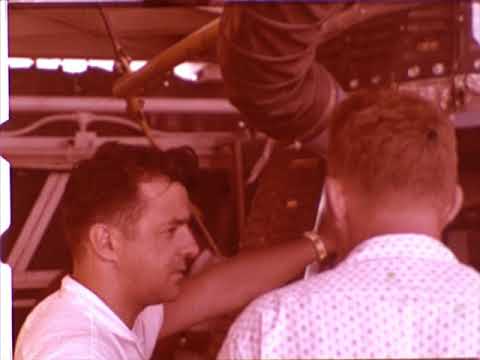
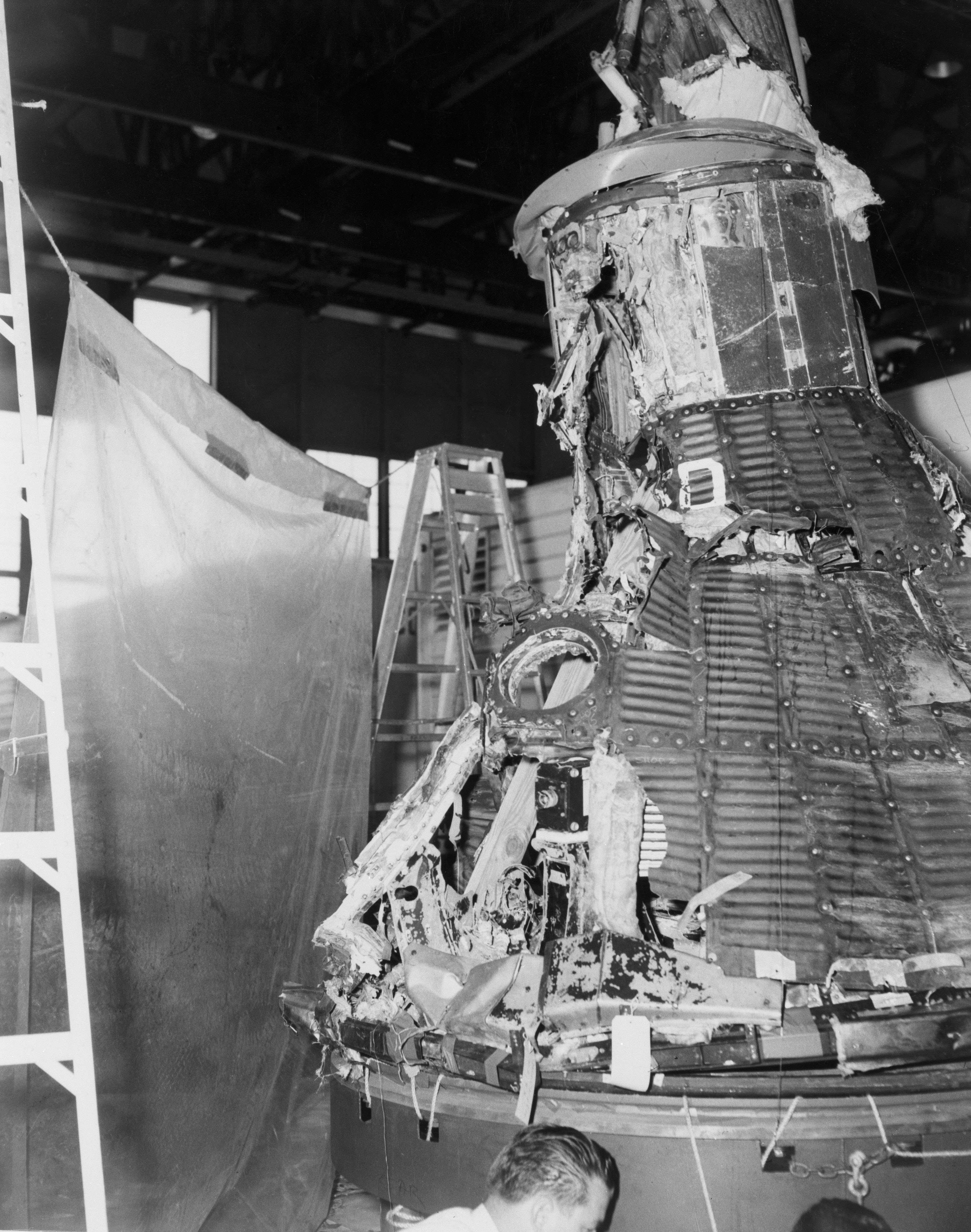
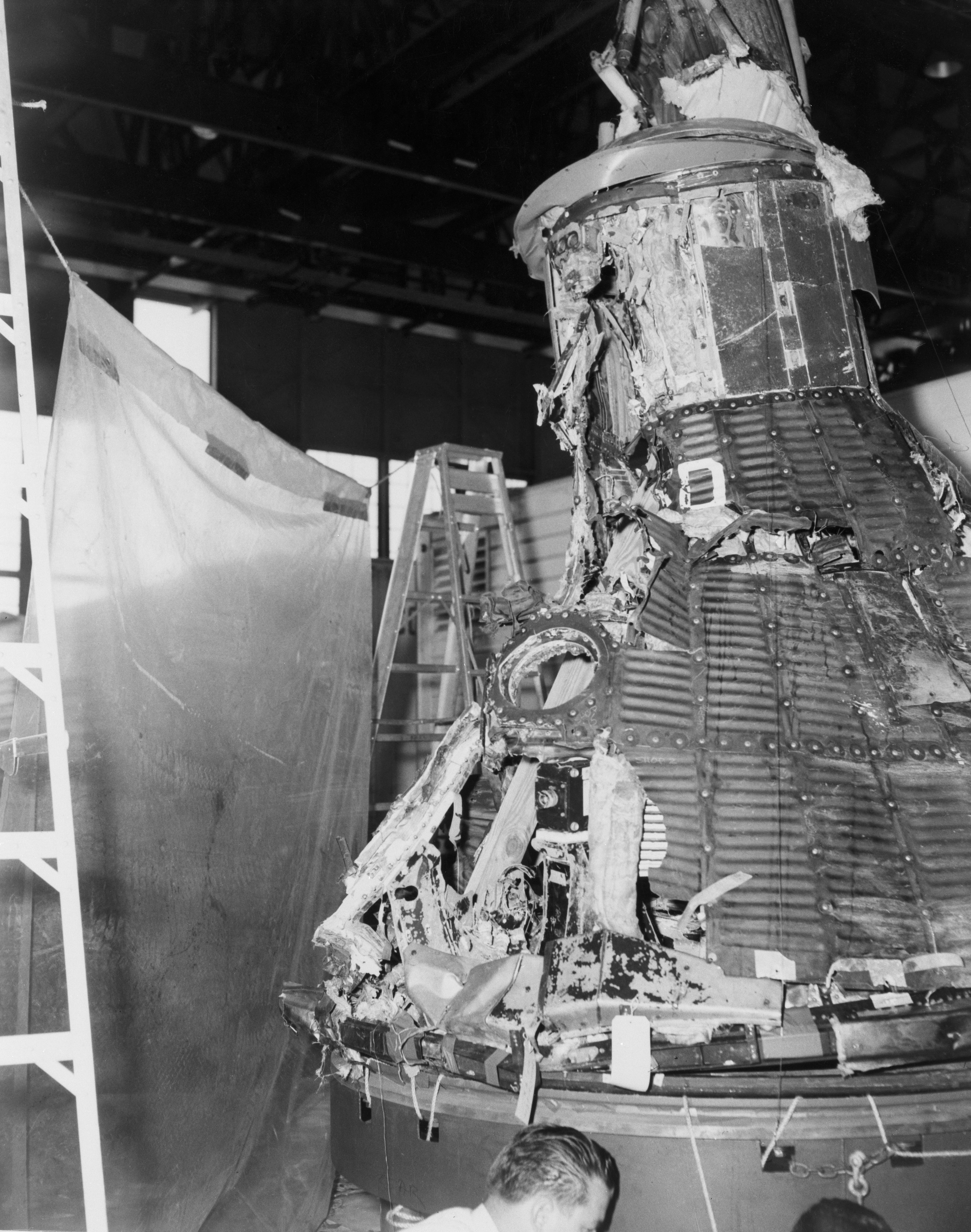
With no imagery of the ascent, the investigation depended on whatever could be recovered from the bottom. Salvage brought up the capsule, the Atlas booster engines and the liquid oxygen vent valve. Owen Maynard, a NASA engineer working on Mercury systems, led the recovery of the spacecraft from the sea floor and made a 30-foot (9.1-metre) free dive to locate one particular missing component.
Examination of the hardware gave two contrasting results. The engines showed no damage beyond deformation caused by impact with the ocean, which argued against propulsion as the origin of the accident. The LOX vent valve and a still-attached segment of piping, on the other hand, showed noticeable fatigue cracks. The remains of spacecraft number 4 were reassembled for study.
Why it broke
The first suspicion was that the fiberglass fairing placed over the capsule in lieu of the absent escape system had torn loose and punctured the Atlas LOX tank. The hypothesis was reasonable, but Maynard's postflight calculations pointed somewhere deeper: the launch vehicle's skin just below the spacecraft would have buckled under the combined drag, acceleration and bending loads, a set of stresses exceeding the resisting tensile stress that internal pressurisation could provide in that area. In other words, the rocket did not fail from an impact or an engine malfunction, but because at the joint with the capsule the structure was being asked for more than its margin allowed. Maynard would later observe in an oral history interview that the problem of mating the Mercury capsule to the Atlas was far from properly resolved at the time of MA-1.
A second suspicion also lingered: that the absence of the launch escape system had degraded the aerodynamic profile of the stack — precisely what Convair's engineers had argued before the flight when they asked for the tower to be carried.
What MA-1 changed on later Atlas vehicles
On the strength of that finding NASA imposed two substantial changes on subsequent Mercury-Atlas launch vehicles. The first was structural: add doublers to the skin in the critical area beneath the spacecraft and thicken the liquid oxygen tank skin, which until then had been the standard missile gauge. The second concerned trajectory: shallow the ascent profile to reduce pitch angle rate and with it the bending stress on the vehicle.
Putting this into practice took time, because the rockets already existed. Atlas 100-D would be the first thick-skinned booster delivered. In the meantime MA-2's booster, 67-D, was still a thin-skinned model and had to be modified: a stainless steel reinforcing band was installed around the vehicle between stations 502 and 510 — the interface between capsule and booster — with a thin sheet of asbestos between the band and the tank skin, expressly as a precaution against the kind of failure MA-1 had suffered. Atlas 77-D, originally intended to fly MA-3 and inspected at factory rollout in September 1960, was recalled shortly afterwards when the MA-1 postflight findings came out, and was replaced by 100-D. Later still, on MA-7, the LOX tank skin was thickened further, because operational Mercury spacecraft carried more equipment and consumables than the research ones and capsule weight kept growing.
Proof that the diagnosis was right arrived on 21 February 1961 at 14:10 UTC, when MA-2 lifted off from LC-14 into a clear blue sky quite unlike MA-1's fog. The blockhouse waited tensely for the vehicle to pass through the critical max q region, and when it did the launch team's reaction was one of enormous relief and celebration. MA-2 flew a successful suborbital mission lasting 17 minutes 56 seconds, reached 114 miles (183 kilometres) altitude and 13,227 miles per hour (21,287 kilometres per hour), sustained a peak acceleration of 15.9 g and was recovered 1,432 miles (2,305 kilometres) downrange. All test objectives were met and the only notable problem was some propellant slosh. The MA-1 failure mode never recurred.
Assessment and legacy
MA-1 is counted as a failure and a failure it was: spacecraft number 4 and Atlas 50-D were lost, no re-entry data were obtained, neither the afterbody shingles nor the recovery systems were tested, and not one of the declared objectives was achieved. Yet the flight did, unintentionally, what no planned test had managed: it demonstrated that the joint between capsule and launch vehicle was unresolved, and it did so on a flight with nobody aboard, while eighteen months still remained before the first crewed orbital mission.
That is the pattern running through the whole uncrewed Mercury series, and the reason these flights deserve to be told in the same detail as the crewed ones: Big Joe validated the heat shield at the cost of a failed separation, MA-1 exposed the structural weak point at the cost of the entire vehicle, and each finding translated into different hardware on the next rocket. From MA-1 came the steel band on 67-D, the recall of 77-D, the earlier introduction of the thick-skinned 100-D and the shallower trajectories that accompanied the rest of the programme.
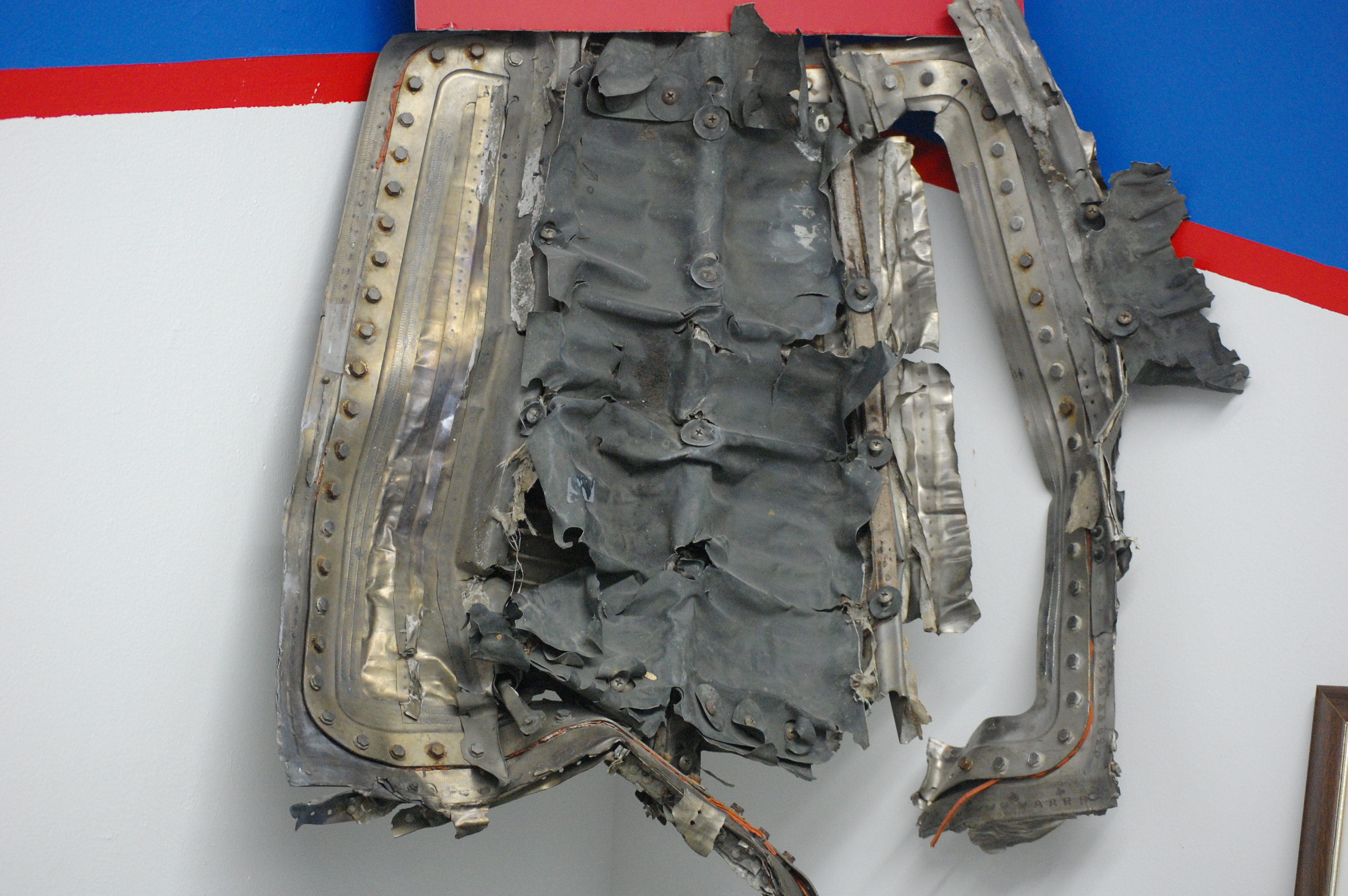
Physical traces of the spacecraft survive: pieces of Mercury number 4 are displayed at the Cosmosphere in Hutchinson, Kansas, and the hatch is held by the American Space Museum in Titusville, Florida.
Images
Elsewhere
- Space.comSpace History Photo: MA-1 Capsule Reassembled After Explosion ↗
- AmericaSpaceThe Story of the Vanishing Rocket: Remembering the MA-1 Mission, 60 Years On ↗
- Smithsonian National Air and Space MuseumFragments, Capsule, Mercury MA-1 ↗
- CosmosphereWhat a Cool Wreck! ↗
- Flickr — NASA on The CommonsMercury-Atlas 1 Launch ↗
- Flickr — NASA on The CommonsMA-1 Capsule Reassembled After Explosion ↗
- Next SpaceflightMercury-Atlas 1 (MA-1) ↗
- WikipediaMercury-Atlas 1 ↗
- Drew Ex MachinaThe Disappointing Flight of NASA's Mercury-Atlas 1 ↗
- Space Launch NowAtlas LV-3B | Mercury-Atlas 1 ↗