Project Mercury · NASA · Uncrewed
Beach Abort
- May 9, 1960
- Launch date
- 1 min
- Duration
- Success
- Outcome
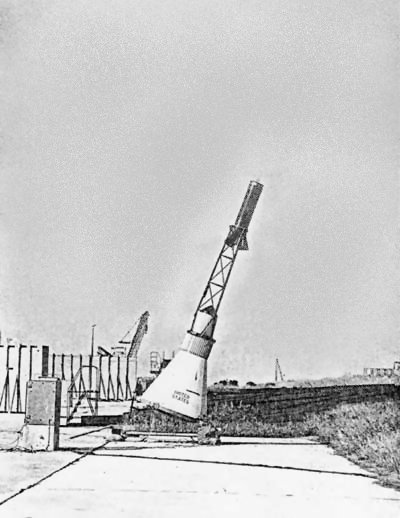
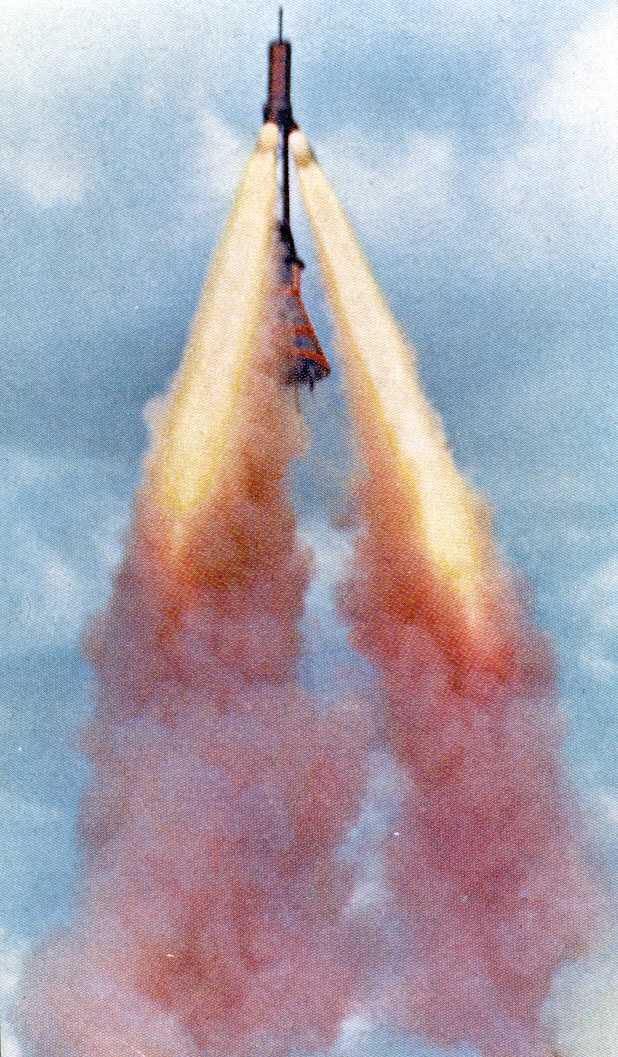
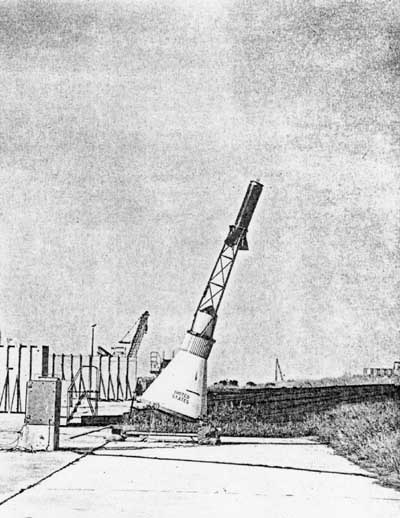
Beach Abort was the uncrewed test in which NASA showed, on 9 May 1960 at Wallops Island, Virginia, that the Mercury spacecraft's escape tower could pull the capsule off the pad and set it down in the sea without any launch vehicle underneath it. There was no booster at all: the spacecraft lifted off from ground level on the thrust of its own tower motor. It was a deliberate rehearsal of the worst emergency the programme could imagine, the one engineers called an off-the-pad abort, in which the failure happens while the rocket is still standing motionless and the capsule has neither altitude nor speed to work with. The stated objectives were three and very precise: to evaluate the performance of the escape system, of the parachute and landing system, and of recovery operations in that particular situation. The vehicle flown was not a ballasted mock-up, as in the preparatory shots, but Mercury spacecraft number 1, the first article off McDonnell's production line. The test therefore examined the emergency device and the real flight vehicle meant to carry it at the same time. The flight lasted one minute and sixteen seconds. The capsule reached an apogee of roughly 751 metres and a peak speed of 436 metres per second, traced a short arc over the Atlantic and splashed down some 0.97 kilometres from where it had started. A Marine Corps helicopter picked it up seventeen minutes after lift-off. The parachute system worked, and the spacecraft was in good enough condition to be sent back to McDonnell for a structural integrity check. The result was officially rated a success, but the test left one uncomfortable observation behind: when the tower separated it did not move away from the capsule by as much as engineers wanted, and the separation distance was judged insufficient. That clearance margin, together with the thrust alignment of the escape motor, remained under study for the rest of the programme and fed both the Little Joe flight campaign and the safe-separation work being done in parallel by the Space Task Group, McDonnell and the Marshall Space Flight Center. Seven months later the abort mode rehearsed on the beach fired for real and without warning: on 21 November 1960, during Mercury-Redstone 1, the booster engine shut down just after ignition and the escape tower blasted off on its own, leaving the capsule sitting on the launch vehicle. Beach Abort was thus far more than a formality: it was the one occasion on which the complete pad-abort sequence — escape, parachutes, splashdown and rescue — was verified from beginning to end and in the right order. Spacecraft number 1 survives on display at the New York Hall of Science, in Corona Park, New York.
Payload
The payload of the Beach Abort was the very spacecraft the test was meant to qualify: Mercury capsule No. 1, the first off McDonnell Aircraft's production line and the first of the production series to fly an abort test, after the earlier beach firings had used structural mock-ups (boilerplate capsules), one of them instrumented to measure sound pressure level and vibration. Nobody was aboard, and there was no dummy, no animal and no scientific experiment: this was a systems test, and what was measured was the behaviour of the vehicle itself. Mounted above the capsule's aerodynamic shield was the complete launch escape system in production configuration — a lattice tower carrying, at its top, the three-nozzle solid-propellant motor built by the Grand Central Rocket Company of Redlands, California — which provided the only propulsion of the flight, with no launch vehicle underneath. The capsule also carried the parachute and landing system that had to slow it down and keep it afloat until recovery, one of the three stated objectives of the test alongside escape-system performance and recovery operations. The sources record a launch mass of 1,007 kilograms for the spacecraft and a total payload weight of 1,154 kilograms. The capsule came through the flight in good condition: it went back to the McDonnell plant for an integrity test and is today on display at the New York Hall of Science.
History
What a pad abort is, and why it had to be flown
A launch escape system exists for exactly one purpose: to pull the crew compartment away, fast, from the rocket carrying it at the moment that rocket stops being a vehicle and becomes a tank of propellant about to let go. On Mercury the job was done by a lattice tower mounted above the capsule with a solid-propellant motor at the top, which on ignition dragged the spacecraft up and off to one side, away from the fireball.
Within that general duty, the hardest case is not the failure that happens during ascent but the one that happens before the rocket has moved at all. A failure high up leaves room to work: the spacecraft already carries energy, there is time for parachutes and there is open ocean ahead. A failure on the pad leaves nothing. The capsule is stationary, a few metres above the ground, sitting on a fuelled booster; the escape system has to hand it, in an instant, all the altitude and all the downrange distance it needs to get a parachute open and reach the water. That condition — the off-the-pad abort — is what sizes the escape motor, and what decides whether the tower is decoration or a lifeboat.
Which is why the case could not be settled on paper. A real tower had to be fired on a real spacecraft with no booster underneath, and the whole chain observed: ignition, climb, tower jettison, drogue, main parachute, splashdown, flotation and pickup. Any link that failed turned the escape into a different accident, no less fatal.
The hardware: the Mercury escape tower
What was tested was a tubular structure mounted above the capsule's aerodynamic shield, carrying at its far end a solid-propellant motor with three nozzles arranged so that the exhaust cleared the spacecraft and so that the thrust line was canted slightly, taking the stack off the vertical of the pad. The motor was built by the Grand Central Rocket Company of Redlands, California, and it went through a qualification campaign of its own: the Arnold Engineering Development Center fired it to verify altitude ignition and to establish the combustion-chamber-pressure-versus-time curve, and in the altitude wind tunnel at the Lewis Research Center three escape motors were fired on a spacecraft model under high-altitude conditions, one of them on a four-component balance to measure thrust misalignment. Those tests were completed at the end of July 1960 and concluded that the motor met its operational requirements.
The concern with misalignment was not academic. In the first full-scale test simulating a pad-abort situation, conducted at Wallops Island by the Pilotless Aircraft Research Division of Langley with a spacecraft of full weight and size, the flight was essentially straight for the first fifty feet and then the vehicle pitched through several turns and impacted a short distance from the shore. The failure was traced to the loss of a graphite insert from one of the three abort rocket nozzles, which threw the thrust off axis. It was an early and cheap lesson in how little it takes for an escape system to send a capsule in the wrong direction.
The preparatory shots on the beach
So the May flight sat on top of a staircase of tests fired from the same stretch of sand. After that first failure came a pad-abort flight of a boilerplate spacecraft already fitted with the production version of the escape tower and rocket; that flight succeeded and was the first operational test of the Grand Central motor. Next came a second beach abort test with another boilerplate, this one instrumented to measure sound pressure level and vibration, whose purpose was to characterise the acoustic and vibration environment the capsule experienced while the abort rocket burned; the results went into an internal Langley memorandum dated October 1959. That series of shots from the beach was, quite literally, the run-up to the Little Joe campaign, in which the same system would be exercised in flight on a booster of its own.
The mission's name comes from all this. Beach abort: the pad was the sand of Wallops Island and the stage was the Atlantic shoreline. The phrase was coined to set those shots apart from the in-flight aborts to be demonstrated by the Little Joe vehicles and from the real thing, should it ever come, at Cape Canaveral.
The test of 9 May 1960
On 9 May 1960 McDonnell's first production spacecraft was launched from Wallops Island with its own escape rocket as the sole propulsive force. The official designation was the beach-abort test, and its objectives, as stated, were performance evaluation of the escape system, of the parachute and landing system, and of recovery operations in an off-the-pad abort situation.
The sequence ran as planned. The tower lit and carried the capsule from ground level to an apogee of the order of 751 metres at a peak speed of 436 metres per second; the stack arced out over the sea, the tower separated, the parachute system deployed and the spacecraft splashed down about 0.97 kilometres from the launch point. The whole flight, from ignition to water contact, took one minute and sixteen seconds. That brevity is the defining feature of this kind of test: a pad abort is decided within that handful of seconds.
Recovery counted as part of the test on equal terms with the flight. A Marine Corps helicopter located and lifted the capsule seventeen minutes after launch, a figure that mattered as much as the apogee: in a real abort there would be an astronaut inside, and the rescue procedure had to be timed and rehearsed rather than improvised.
Result, reservations and technical consequences
The test was rated a success. The spacecraft flew, the tower worked, the parachutes opened, the capsule floated and the helicopter took it out of the water; all four items under examination responded. Capsule number 1 was afterwards returned to the McDonnell plant for an integrity test, which says something about the condition it came back in.
The reservation concerned tower jettison: the separation distance between tower and capsule turned out to be insufficient. In a pad abort the tower must move away cleanly and fall well clear, because the capsule is following it and is about to fill that same volume of air with parachute canopy. The matter was not closed by the test. Safe separation of the spacecraft from its launch vehicle and from the escape system itself became the subject of extensive studies by the Space Task Group, Convair-Astronautics, Space Technology Laboratories, McDonnell and the Marshall Space Flight Center, written up in internal project papers on Mercury-Redstone separation distance, on the statistical dispersion of that distance, and on the thrust eccentricity of the escape rocket relative to the Atlas booster.
That is the lasting value of Beach Abort: less the demonstration that the system worked — which was more or less expected — than the measurement of the margins with which it worked, putting numbers on what until then had been estimates.
From the beach to the real thing: Mercury-Redstone 1
Seven months after the Wallops flight, the abort mode that had been rehearsed fired without anybody asking for it. On 21 November 1960, during the launch attempt of Mercury-Redstone 1, the Redstone engine shut down just after ignition, with the vehicle still on the pad, and the escape system fired and blasted itself off the spacecraft. The tower flew alone; the capsule, instead of being pulled away, stayed exactly where it was, on top of a loaded booster, and streamed its parachutes over the pad. This was the episode the programme came to know as the four-inch flight.
The contrast with Beach Abort explains both why the May test had been necessary and why it was not sufficient. On the beach the sequence ran in the right order and with the capsule firmly attached to the tower; at the Cape it ran out of order, the tower separating before it had pulled anything. The escape system did what its timing logic told it to do, and what was exposed was not the Grand Central motor but the logic deciding when it should fire and in what order the elements should part company. Corrections followed and were embodied before the crewed series flew, and the pad-abort case was exercised again, this time integrated into the vehicle's own command chain, in the qualification flights that preceded the missions with an astronaut aboard.
Spacecraft number 1 after the test
The vehicle that flew Beach Abort had a second life as a museum piece. After its integrity test at McDonnell, Mercury spacecraft number 1 — the first of the production series and the only one that ever flew with no booster beneath it — ended up on display at the New York Hall of Science in Corona Park, New York, suspended from the ceiling with an escape tower of undocumented provenance attached to it. It is a small point, and very much of its period in space museography, but worth recording: the tower now seen above that capsule is not necessarily the one that lifted it off the sand at Wallops Island.
Where Beach Abort sits in Project Mercury
In the roster of Mercury flights, Beach Abort occupies an odd place. It was neither an orbital nor a suborbital launch in the usual sense, it carried no booster and it chased neither altitude nor speed: it was a subsystem test driven to the worst corner of its envelope. For precisely that reason it tends to fall off mission lists and to appear only in passing in accounts of the programme, which jump from the Little Joe vehicles to the crewed Mercury-Redstone flights.
Yet without that minute and sixteen seconds of flight the programme would have entered its crewed phase never having verified, end to end, the only manoeuvre capable of saving an astronaut at the worst possible moment: the interval between booster ignition and the instant the vehicle starts to move. In that sense Beach Abort is one of the cheapest and most profitable tests in the whole of Project Mercury.
Images
