Project Mercury · NASA · Uncrewed
Mercury-Atlas 5
- November 29, 1961
- Launch date
- 3 hr 20 min
- Duration
- Success
- Outcome


-1600.webp)

-1600.webp)
-1600.webp)
-1600.webp)
-1600.webp)

-1600.webp)
-1600.webp)
-1600.webp)
-1600.webp)
-1600.webp)
-1600.webp)

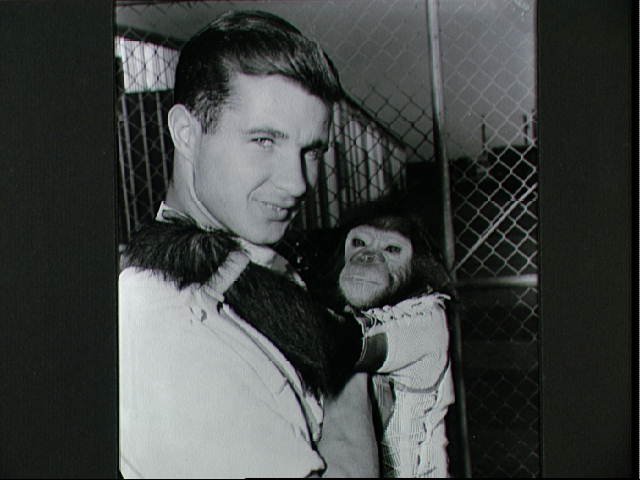
Mercury-Atlas 5 (MA-5) was the final full orbital rehearsal of Project Mercury before an American flew around the Earth. It lifted off from Launch Complex 14 at Cape Canaveral on November 29, 1961, pairing Mercury spacecraft No. 9 with Atlas booster 93-D and carrying a single occupant: a chimpanzee named Enos. Three orbits were planned and two were flown, yet the mission did what it had been argued for — proving, with a living passenger and in the very profile intended for the crewed flight, that capsule, launch vehicle and worldwide tracking network were ready. The flight came at an awkward moment. The Soviet Union had already orbited Yuri Gagarin and Gherman Titov, while the two American crewed flights had been suborbital hops of a quarter of an hour. Inside NASA there was genuine debate over spending another spacecraft and another Atlas on an uncrewed mission; headquarters questioned the wisdom of flying one more. Those running Mercury insisted that orbiting a chimpanzee first was an indispensable checkout of the whole system before risking an astronaut, and said so publicly ahead of launch. Spacecraft No. 9 had reached the Cape on February 24, 1961, and needed forty weeks of preparation, the longest pad period in the programme, largely because its assignment kept changing: an instrumented ballistic flight, then a ballistic primate flight, then a three-orbit instrumented mission, and finally the orbital flight Enos flew. It was also the second "Mark II" capsule, with the large square window and explosive-bolt hatch, and that window had yet to face the heat of an orbital reentry. Enos, bought by the U.S. Air Force in April 1960 and trained for more than a thousand two hundred hours, performed his learned psychomotor tasks in orbit even though a fault in the equipment delivered seventy-six electric shocks for correct answers. Two failures piled up during the second orbit: a metal chip in a fuel supply line disabled one of the clockwise roll thrusters, and the suit-circuit heat exchanger began to freeze. Flight Director Christopher Kraft ordered retrofire at the end of the second orbit rather than risk running the attitude-control gas dry. The capsule splashed down in the Atlantic south of Bermuda and the destroyer USS Stormes recovered it; Enos emerged in excellent physical condition, though he had torn off every medical electrode. With the MA-5 data in hand, NASA announced on December 6, 1961, that the first crewed orbital flight would fly early in 1962, and on the day of the flight itself John Glenn was named as its pilot, with Scott Carpenter as backup.
Payload
The payload of Mercury-Atlas 5 was capsule No. 9, second of the "Mark II" Mercury spacecraft, with the larger square window and explosive-bolt hatch; it reached Cape Canaveral on February 24, 1961 and took forty weeks of preparation, the longest in the programme. The occupant was Enos, a chimpanzee from Cameroon originally logged as chimpanzee No. 81, purchased by the U.S. Air Force on April 3, 1960 and about five years old at the flight; NASA's chronology gives his weight as 37.5 pounds, while the Wikipedia article says "just under 40 pounds (18 kilograms)". He arrived with more than 1,250 hours of training between the University of Kentucky and Holloman Air Force Base and was inserted into the spacecraft in his suit-couch about five hours before launch. NASA stated the objective as a primate test of the environmental control system in orbit: that couch-suit circuit and the biomedical instrumentation —medical electrodes and a urine collection device, all of which Enos had removed by the time he was recovered— were central to the payload. The psychomotor equipment required him to operate levers in response to specific cues, with a mild shock to the soles of the feet as the penalty for a wrong answer; a fault inverted the programmer's logic and Enos took seventy-six shocks while answering correctly. The spacecraft carried 61.5 pounds (27.9 kg) of attitude control fuel. The launch mass of 1,331 kg comes from the Wikipedia infobox and is not supported by the NASA sources.
History
Behind in orbit, and an argument inside NASA
By November 1961 the orbital scoreboard read badly for the United States. The Soviet Union had flown Yuri Gagarin on Vostok 1 and Gherman Titov on Vostok 2, both in orbit, while the American crewed flights of Alan Shepard and Virgil Grissom had been ballistic arcs lasting a quarter of an hour. The pressure to put an astronaut in orbit was intense, and NASA was genuinely divided about whether to spend another Mercury spacecraft and another Atlas on a flight with nobody aboard. Headquarters questioned the wisdom of the manned spaceflight centre launching yet another uncrewed Mercury mission.
The programme's own managers prevailed. They regarded a primate flight as a necessary preliminary checkout of the entire Mercury system before a human being was risked, and NASA's public affairs office put that argument on the record in a press release issued before launch. The reasoning was engineering rather than publicity: the previous mission, Mercury-Atlas 4 of September 13, 1961, had carried a mechanical crewman simulator through a single orbit with an apogee of 123 nautical miles and a perigee of 86, but a simulator consumes no oxygen, produces no metabolic heat and cannot show that the environmental control system will keep an occupant alive and working for hours.
Spacecraft No. 9: forty weeks and four assignments
The vehicle flown as MA-5 was Mercury spacecraft No. 9, delivered to Cape Canaveral on February 24, 1961. Its stay was the longest of the programme — forty weeks of preparation, according to the launch site summary in the official project chronology — and the reason was less a technical problem than a run of changed assignments. No. 9 was configured first for an instrumented suborbital flight, then for a suborbital chimpanzee flight, then for a three-orbit instrumented mission, and at last for the orbital chimpanzee flight it actually made. It had originally been intended for MA-4, but spacecraft No. 8 flew that mission instead, refitted after the failed MA-3 launch.
.jpg)
Its technical significance went beyond its passenger. No. 9 was the second of the "Mark II" Mercury capsules, with a larger square window and an explosive-bolt hatch, where the older "Mark I" had small port windows and a heavy locking mechanism. Grissom had already flown a Mark II on the ballistic MR-4 flight, but nobody had yet exposed that big window to the far greater heat of a return from orbit. MA-5 was the chance to test it before Glenn's life depended on it.
Atlas 93-D and confidence in the booster
The launch vehicle was Atlas 93-D. It passed factory roll-out inspection at Convair on October 1, 1961 — having arrived at Cape Canaveral back in August — was erected on Launch Complex 14 on October 6, and was formally delivered for the mission on October 9. MA-4's success in September had restored confidence in Atlas reliability after an uneven record. The Flight Safety Review Board met on November 28, the eve of the launch, to review nine Atlas space and missile flights since its previous meeting in August; four failures among them had been caused by an Atlas malfunction.
The board's file included missile 26E, which lost sustainer thrust after booster engine cutoff on September 10 with the cause still under investigation, and vehicle 32E, destroyed shortly after launch on November 10 with the loss of a squirrel monkey carried as a biological payload — a mishap put down to a random quality control issue that would not affect the far more closely supervised Mercury boosters. Flight control system malfunctions on MIDAS 4 and SAMOS 4 also remained unexplained.
.jpg)
Several changes followed from that record. Although MA-4 had performed well, the vibration levels during the first twenty seconds after liftoff still caused concern, so the booster's autopilot was slightly modified. The range safety system was altered so a manual cutoff command could be sent to the sustainer engine, guarding against an over-accelerating engine boosting the capsule into a higher orbit than planned. A compact all-solid-state telemetry unit replaced the bulky vacuum-tube package, and 93-D was the second D-series Atlas fitted with the Spin Motor Rotation Detection system, intended to confirm proper gyroscope operation before launch.
A flight plan drawn as a copy of Glenn's
MA-5 was planned as a close approximation of the coming crewed MA-6 mission. It would launch from Complex 14 on a heading 72.51 degrees east of north. Orbital insertion would occur 480 miles (770 km) from Cape Canaveral, at an altitude of 100 miles (160 km) and a speed of 25,695 feet per second (7,832 m/s). Retrofire was scheduled for 4 hours, 32 minutes and 26 seconds after launch, with landing 21 minutes and 49 seconds later. Reentry temperatures were expected to reach 3,000 °F (1,650 °C) on the heatshield, 2,000 °F (1,090 °C) on the antenna housing, 1,080 °F (582 °C) on the cylindrical section and 1,260 °F (682 °C) on the conical section. The spent Atlas sustainer was expected to reenter after some nine and a third orbits.
Mission rules for MA-5 were published on September 18, 1961, and revised on October 16 and 25 and again on November 11. The data acquisition plan followed on October 20. On flight day the Mercury astronauts manned the capsule communicator positions at six stations of the worldwide tracking network, so the mission doubled as training for the people who would later do that job during crewed flights. A month earlier, on November 1, the attempt to orbit Mercury-Scout 1 with a communications package to qualify the network's radar tracking had ended when the vehicle developed erratic motions and was destroyed by the range safety officer 43 seconds into flight. No further attempts were made: MA-4 and MA-5 themselves showed that the network met every requirement.
Enos: origin, selection and training
The occupant of MA-5 was not Ham, the chimpanzee of the January 1961 ballistic flight MR-2, but Enos, a different animal with a far more demanding preparation behind him. He came from Cameroon, was originally logged as chimpanzee No. 81, and was purchased by the U.S. Air Force on April 3, 1960. He was about five years old at the time of the flight. His training ran to more than 1,250 hours split between the University of Kentucky and Holloman Air Force Base, and it was deliberately harder than Ham's because an orbital flight meant much longer exposure to weightlessness and to higher sustained g loads.
.jpg)
The project chronology records that between June 21 and July 15, 1961, the chimpanzees of the Mercury-Atlas animal programme were acclimatised to noise and vibration and put through centrifuge runs at the University of Southern California, and that two of the animals flew weightlessness parabolas aboard a C-131 aircraft. The same status reports note that the animals were trained on advanced psychomotor problems: these were not passive passengers but subjects taught to work in flight.
On October 29, 1961, three chimpanzees and twelve medical specialists moved into quarters at the Cape to prepare for the mission. Enos was chosen only three days before launch; his backups, in order of possible call-up, were Duane, Jim, Rocky and Ham himself, the MR-2 veteran. The name Enos means "man" in Hebrew.
The psychomotor tasks in orbit
The scientific point of the flight lay not only in the occupant's physiology but in his ability to work. Enos was to run in orbit the same repertoire of psychomotor tasks he had learned on the ground, operating levers in response to specific cues within a conditioning programme in which wrong answers drew a mild electric shock to the soles of the feet. If a trained animal could hold that performance in weightlessness, inside a pressure suit, through the noise and vibration of ascent, there was a solid basis for saying a human pilot could fly.
What happened in flight gave the demonstration a cruel twist. A fault in the task equipment inverted the programmer's logic, so Enos took seventy-six electric shocks while answering correctly. He kept working. One history of primatology judged that he conscientiously carried out every task he had been taught across a flight of more than three hours, in spite of the electronic malfunctions. NASA's own reports state the outcome plainly: the chimpanzee performed his psychomotor duties and, on recovery, was found to be in excellent physical condition.
Countdown and ascent
On November 29, 1961, about five hours before launch, Enos and his suit-couch were inserted into the spacecraft. Holds during the countdown added up to 2 hours and 38 minutes. Liftoff came at 15:08 UTC. The modified autopilot evidently did its job: vibration stayed within comfortable levels and the boost phase was uneventful, with all Atlas systems performing excellently and no performance deviations of any significance. Booster engine cutoff came at T+130 seconds, sustainer and vernier cutoff at T+300 seconds, and capsule separation two seconds after that.
.jpg)
The Atlas placed MA-5 in an orbit of 99 by 147 miles (159 by 237 km), close to the planned one. The occupant took a peak of 6.8 g during booster acceleration and 7.6 g under the sustainer. The turnaround and damping manoeuvre after separation used 6 pounds (2.7 kg) of the 61.5 pounds (27.9 kg) of control fuel aboard, slightly less than MA-4 had spent on the same manoeuvre.
First orbit: a system behaving itself
Settled into its 34-degree orbital attitude, the spacecraft needed only 1.5 pounds (0.68 kg) of thruster fuel to hold position through the whole first orbit. At the end of that orbit controllers noticed the onboard clock was running 18 seconds fast and, as the capsule passed over Cape Canaveral, sent a command to correct it. Mercury Control received word that every spacecraft system was in good condition. With an orbital period of 88.44 minutes, Enos completed his first circuit of the Earth in a little under an hour and a half.
Second orbit: two failures at once
As MA-5 crossed the Atlantic tracking ship at the start of the second orbit, indications arrived that inverter temperatures were rising, and Canary Island trackers confirmed the environmental control system malfunction. Abnormal heating was not new — on earlier flights inverters had kept working or had been switched to standby — so there was no alarm at Mercury Control. Over Muchea, in Australia, high thruster signals and capsule motion excursions were detected, though other data indicated the 34-degree orbital mode was being held. At Woomera no attitude control problems showed up, and the earlier reports were discounted.
.jpg)
It was at the Canton Island station that Mercury Control grasped that the attitude control system was malfunctioning. A metal chip in a fuel supply line had disabled one of the clockwise roll thrusters. Without it the spacecraft drifted off its normal attitude until the automatic stabilization and control system swung it back to the 34-degree orbital position, whereupon the cycle began again. The drift-and-correct sequence repeated nine times before retrofire, and once more between retrofire and the 0.05 g telemetry signal. The surviving thrusters burned 9.5 pounds (4.3 kg) of fuel through the second orbit keeping the capsule aligned: each loss of attitude cost more than a pound (0.45 kg), against the 1.5 pounds consumed across the entire first orbit.
The environmental control system failed alongside it. The couch-suit circuit temperature climbed quickly from 65 to 80 °F (18 to 27 °C), a sign that the heat exchanger was freezing. Enos's body temperature rose to 99 °F (37 °C) and then to 100 °F (38 °C), and the medical observers began to worry. It stabilized at 100.5 °F (38.1 °C), an indication that the environmental system had begun working again. The cooling appeared to correct itself; the attitude trouble did not.
The decision to come home early
As the spacecraft neared Hawaii on the second orbit, the medical monitors were willing to let Enos continue for a third: the occupant was holding up. The engineering team, however, feared that the stuck thruster would keep eating fuel until the capsule ran out of attitude control gas — the very gas needed to orient the vehicle for retrofire and reentry. Their advice was to end the flight.
Flight Director Christopher Kraft alerted the Hawaii controllers to stand by to initiate retrofire and bring the spacecraft down in the Pacific if necessary, and warned the controllers at Point Arguello, California, to be ready as MA-5 passed overhead. He chose to let the flight run to the normal second-orbit retrofire position near California so the capsule would land in the Atlantic primary recovery area. Twelve seconds before that point was reached, Kraft decided to bring Enos back; Arnold Aldrich, chief flight controller at Point Arguello, sent the command. A three-orbit mission became a two-orbit one.
Reentry, splashdown and recovery
One further attitude control excursion occurred early in reentry; after that, descent and recovery were uneventful. The destroyers USS Stormes and USS Compton and a P5M aircraft were waiting at Station 8, the predicted landing point. Three hours and thirteen minutes after launch, and nine minutes before splashdown, the aircraft spotted the capsule at 5,000 feet (1,500 m) descending on its main parachute, roughly 250 miles south of Bermuda. The sighting was relayed to Stormes and Compton, 30 miles (48 km) away. Every recovery aid worked except the SARAH beacon. The aircraft circled and reported the landing events, staying until Stormes arrived an hour and fifteen minutes after impact.
.jpg)
The destroyer hauled the capsule aboard with Enos inside. On deck the hatch was blown by its explosive bolts, fired from outside by pulling a lanyard; the detonation cracked the spacecraft's picture window. The flight had lasted 3 hours, 20 minutes and 59 seconds, covering two orbits and 50,892 statute miles (81,902 km) on a profile of 147.4 statute miles apogee by 99.5 perigee.
The occupant's condition
Spacecraft and chimpanzee both came through in good shape. Enos, admittedly, had managed to remove every medical electrode and the urine collection device, which says something about his mood after the wait — accounts note he had grown angry and frustrated during the roughly three hours before seamen reached him. The capsule was taken aboard Stormes in the late afternoon and his Air Force handlers carried him below deck at once. The destroyer put him ashore at the Kindley Air Force Base hospital in Bermuda, where he was found to be in good shape. On December 1, 1961, Enos left Bermuda for Cape Canaveral and, eventually, for Holloman.
Official reports summed the result up without qualification: the chimpanzee performed his psychomotor duties and on recovery was in excellent physical condition. Enos died on November 4, 1962, of dysentery caused by a shigellosis resistant to the antibiotics of the day. He had been under constant observation for the two months before his death, and pathologists at Holloman found no symptom that could be attributed or related to his space flight of the year before.
The system declared ready
The technical verdict on MA-5 was that the flight had been highly successful and that the Mercury spacecraft was well qualified to support a crewed orbital mission. Both of the failures that shortened it — the disabled roll thruster and the overheating inverter in the electrical system — could have been dealt with had an astronaut been aboard, able to switch systems and to fly the manual control modes. That was not a rhetorical consolation but a statement of Mercury's design philosophy: automation flew the spacecraft, and the pilot was the final redundancy.
.jpg)
On that same November 29, 1961, John Glenn was selected as pilot of the first crewed orbital flight with Scott Carpenter as his backup, and training for the two began immediately, while the other five astronauts spread through the engineering and operational groups of the newly renamed Manned Spacecraft Center to prepare the mission. Atlas 109-D, assigned to MA-6, arrived at Cape Canaveral on November 30. On December 6, NASA headquarters announced that the first crewed orbital flight was scheduled for early 1962 — a decision taken once the MA-5 data showed that spacecraft, launch vehicle and tracking network were ready. Glenn flew on February 20, 1962. The dress rehearsal with Enos aboard had done exactly what its defenders promised: it wrung out the failures on a flight where no human life was at stake.
Images
Elsewhere
- STARS - University of Central FloridaChimpanzee Enos for Project Mercury Flights ↗
- STARS - University of Central FloridaChimpanzee Enos for Project Mercury After Orbits (aboard USS Stormes) ↗
- AlamyEnos the astrochimp in training ↗
- AlamyFlight couch that contained Enos aboard Mercury-Atlas 5 (Cosmos Discovery exhibition) ↗
- Smithsonian National Air and Space MuseumCapsule, Mercury, MA-5 ↗
- OakTrust - Texas A&M University LibrariesMercury Atlas 5 launch, Pad 14 ↗
- AmericaSpaceChimpanzee Enos, the Mighty Atlas' first living passenger, is readied for his 29 November 1961 launch on MA-5 ↗
- Smithsonian National Air and Space MuseumEnos, the Forgotten Chimp ↗
- SYFY WIREChimps in Space: Remembering Enos, the Chimpanzee Who Orbited the Earth ↗
- Wikimedia CommonsChimpanzee Enos with handler before Mercury-Atlas 5 flight ↗
- Wikimedia CommonsMeet Chimpanzee Enos ↗
- Wikimedia CommonsChimpanzee Enos being prepared for insertion into the Mercury-Atlas 5 capsule ↗