Project Mercury · NASA · Uncrewed
Mercury-Atlas 4
- Sep 13, 1961, 2:04 PM
- Launch date
- 1 hr 49 min
- Duration
- Partial success
- Outcome
-1600.webp)
-1600.webp)
-1600.webp)


-1600.webp)

-1600.webp)
-1600.webp)
-1600.webp)
-1600.webp)


-1600.webp)
-1600.webp)


-1600.webp)
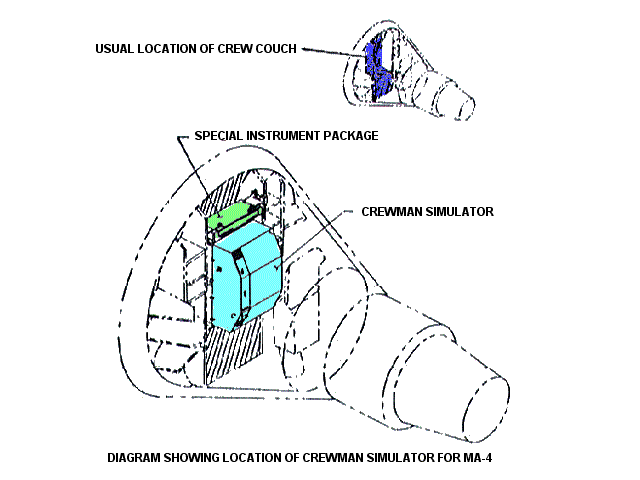
Mercury-Atlas 4 (MA-4) was the first Project Mercury flight to place a crewable capsule into Earth orbit. It lifted off from Launch Complex 14 at Cape Canaveral on 13 September 1961 with nobody aboard, riding Atlas 88-D and carrying spacecraft number 8A, and completed a single circuit of the planet before splashing down in the Atlantic. Every successful flight of the programme until then had been suborbital: the ballistic hops of the Redstone series, including the crewed flights of Alan Shepard and Virgil Grissom, and the Little Joe escape tests. MA-4 was therefore the dress rehearsal for the mission profile that John Glenn and his colleagues would later fly. The flight was shaped by the failure of Mercury-Atlas 3, whose launch vehicle had to be destroyed in April 1961 after it failed to execute its programmed pitch and roll manoeuvre. That accident forced a thorough review of the Atlas autopilot and cost months of schedule, but it also produced an unexpected dividend: the MA-3 capsule, pulled clear of the rocket by its escape tower and recovered almost intact, could be repaired and flown again. Refurbished as spacecraft 8A, it replaced spacecraft number 9 in the MA-4 assignment. In the pilot's couch rode a crewman simulator, the mechanical astronaut of NASA's own chronology, a device that consumed oxygen and returned carbon dioxide and water vapour so that the environmental control system worked against a realistic metabolic load. It shared the cabin with dedicated noise and vibration instrumentation, radiation sensors, three cameras, a life support system and two voice tapes whose sole purpose was to let every station of the worldwide tracking network check its link with the spacecraft. The flight lasted one hour, forty-nine minutes and twenty seconds. After a single orbit the onboard timing device fired the retrorockets, and the spacecraft came down in the Atlantic east of Bermuda, where the destroyer USS Decatur picked it up in good condition. The deviations were minor: a small leak in the oxygen system, loss of voice contact over Australia, the failure of an inverter in the environmental control system, and a turnaround manoeuvre that took considerably longer than expected to point the heat shield forward. NASA formally rated the mission partially successful because of those anomalies, while the preliminary report sent to the administrator described it as highly successful in every respect that mattered: the Atlas had shown itself ready for crewed flight, the spacecraft systems behaved well, and the tracking network performed excellently. On that basis Mercury-Atlas 5, the orbital flight of the chimpanzee Enos, was cleared, and the road to the first American crewed orbital mission was open.
Payload
The MA-4 payload was not an outside experiment but the spacecraft itself: NASA lists it as "Spacecraft number 8A", the Mercury capsule recovered from the aborted MA-3 and refurbished, delivered to Cape Canaveral on 11 May 1961 after eighteen weeks of preparation and, in NASA's summary, "refitted and flown same configuration"; it was the last of the older models, with small port windows, no landing bag and a heavy locking mechanism on the hatch. It flew on Atlas launch vehicle 88-D, and NASA's stated objective was spacecraft environmental control in orbit. In the seat rode a mechanical crewman simulator — the "mechanical astronaut" of NASA's chronology — which consumed oxygen and returned the products of human respiration to the cabin so that the scrubbers faced the workload of a real person. With it went the life support system, two voice tapes whose sole task was to transmit so that each tracking-network station could check its link, three cameras, with which the mission obtained pictures of Earth, and special instrumentation to monitor noise, vibration and radiation levels. Despite the leak found in flight, the oxygen aboard would have sufficed for at least eight orbits. Wikipedia credits the vehicle with a launch mass of 1,224.7 kg, a figure that does not appear in the NASA documentation consulted.
History
What still had to be proved after Mercury-Atlas 3
By the time MA-4 reached the pad, Project Mercury had solved the suborbital problem and left the orbital one open. Capsules had flown and returned on ballistic trajectories, the escape tower had been exercised under severe loads by the Little Joe series, and two astronauts, Alan Shepard and Virgil Grissom, had made their fifteen-minute hops on the small Redstone. What nobody had demonstrated was that the whole chain, Atlas launch vehicle, spacecraft, environmental control system, retrorockets, heat shield and a worldwide network of ground stations, could hold together through the hours of an orbital flight.
The previous attempt, Mercury-Atlas 3, had ended in April 1961 with the vehicle destroyed by the range safety officer after it failed to begin its programmed pitch and roll. The investigation pointed to a voltage transient that had upset the onboard programmer, a mechanism suspiciously similar to the one that had prevented staging on the Big Joe flight. An Atlas investigation board convened in May of that year and isolated three probable causes from the test data. The practical result was a list of modifications to the autopilot and the programmer that had to be validated in flight before anyone rode the rocket.
.jpg)
Schedule pressure compounded the technical debt. The Soviet Union had orbited Yuri Gagarin in April and Gherman Titov in August, the latter for a full day. The United States had yet to complete a single circuit of the Earth. Despite its modest billing as an uncrewed test, MA-4 was the examination that would decide whether the Atlas could be considered fit to carry people.
Spacecraft 8A: a recovered and rebuilt capsule
The most unusual feature of the mission is that the spacecraft that flew was not the one originally planned. MA-4 was to have used capsule number 9, but the MA-3 accident put an uncommon opportunity on the table: that flight's capsule had been dragged clear of the launch vehicle by its escape tower before the destruct command, had fallen into the sea and had been recovered with limited damage. Refurbished and renumbered 8A, it became the MA-4 payload.
The capsule also belonged to the older generation of the design. It was the last of the models with small porthole-style side windows, no landing bag to cushion impact, and a heavy locking mechanism on the hatch. The astronauts had already asked for, and won, a proper forward-facing window and a quick-opening hatch, so the spacecraft flying MA-4 was not exactly the one they would occupy. For the purpose of this flight the difference hardly mattered: what was under test were the systems, not the ergonomics of the cabin.
Spacecraft 8A was delivered to Cape Canaveral on 11 May 1961 for the uncrewed orbital mission of the mechanical astronaut. Reusing it saved months of manufacturing in a programme running late and, incidentally, offered tangible evidence of the vehicle's toughness: a capsule that had survived a violent abort and immersion in the sea could fly again.
Atlas 88-D and the autopilot fixes
MA-4 flew on Atlas 88-D, one of the thick-skinned vehicles Convair built specifically for Mercury, with heavier tank walls to carry the spacecraft and its escape tower. Its factory roll-out inspection took place on 29 and 30 June 1961, and delivery to Cape Canaveral did not follow until 15 July, a timetable that reflects how much the MA-3 findings had forced to be redone.
.jpg)
The main modifications concerned the autopilot and the programmer. Because a transient voltage was suspected of having caused the MA-3 programmer malfunction, Convair equipped the autopilot to counteract that class of disturbance, and the programmer's ability to reset itself in flight was to be removed. That was not an abstract worry: an Atlas launched in July with the MIDAS 3 satellite had suffered a programmer reset at staging which did not stop it reaching orbit, but which was investigated thoroughly precisely because of the Mercury problem.
Preparation was anything but smooth. Trouble with the Atlas autopilot, including the replacement of a defective yaw rate gyro, caused a series of delays. The launch, originally intended for 22 August, slipped. Then came a more awkward quality problem: the brand of transistor used in both the Atlas and the spacecraft turned out to be prone to forming solder balls, and the entire last week of August was spent laboriously repairing them.
One underlying concern MA-4 could not settle: rough combustion and gyroscope malfunctions had destroyed two Atlas E vehicles in June. The Spin Motor Rotation Detection System, invented to keep an Atlas from lifting off with an improperly operating gyroscope, was only then being phased in and would not appear on a Mercury vehicle until MA-5.
The mechanical astronaut and the onboard instrumentation
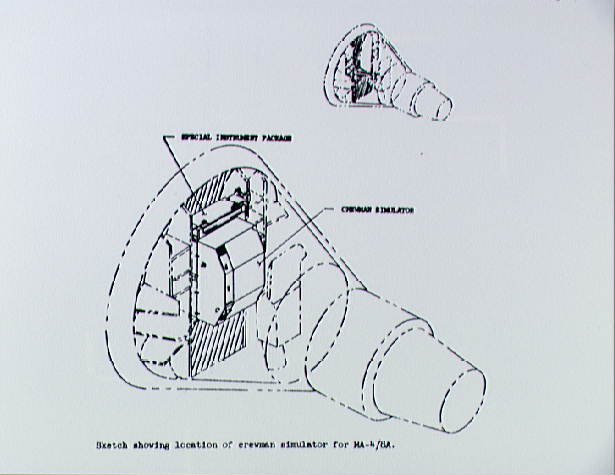
The MA-4 payload was assembled around one very concrete question: can the environmental control system keep up with a human being through an orbital flight? To answer it, a crewman simulator was installed in the couch, able to consume oxygen and return the products of human respiration so that the scrubbers and the oxygen circuit worked against a realistic load rather than an empty cabin.
.jpg)
Riding with it were vibration and noise instrumentation fitted specially for the flight, sensors to monitor radiation levels, three cameras and the complete life support system. Radiation and noise mattered for obvious medical reasons; vibration mattered because nobody yet knew how violent the early part of an Atlas ascent would feel to a human passenger.
The second major objective did not travel inside the spacecraft but was spread across the planet. MA-4 was the orbital test of the Mercury worldwide tracking network, the chain of stations and ships that had to hold continuous contact with the astronaut, receive his telemetry and pass commands up to him. Two voice tapes were carried for no other purpose than to transmit so that each station could verify its link. Responsibility for operating that network had been assigned on 1 July 1961 to the Goddard Space Flight Center, with the proviso that during active missions control reverted to Space Task Group personnel. Prelaunch mission rules were published on 1 June and the recovery requirements on 8 June.
The flight: ascent, orbit and anomalies
MA-4 lifted off from Launch Complex 14 at Cape Canaveral on 13 September 1961. The ascent went well and the thick-skinned Atlas rode through maximum dynamic pressure without damage. The one genuinely unpleasant feature was the level of vibration between roughly five and twenty seconds into flight, uncomfortably high, which would prompt further tweaks to the Atlas autopilot afterwards.
.jpg)
Once in orbit the spacecraft separated from the booster and performed the turnaround that leaves it flying backwards with the heat shield forward. That manoeuvre took about fifty seconds instead of the usual twenty. At a few points in the flight the attitude became slightly unstable because two thrusters failed, causing momentary telemetry dropouts.
Overall spacecraft performance was good despite oxygen consumption running higher than expected. Ground controllers did not treat it as serious: the supply was sufficient for at least eight orbits, far beyond the single one planned. The official chronology sums the flight up with three slight deviations: a small leak in the oxygen system, loss of voice contact over Australia, and the failure of an inverter in the environmental control system.
The orbit reached is quoted with slightly different figures depending on the unit and the source. NASA's chronology gives an apogee of 123 nautical miles and a perigee of 86; NASA's uncrewed missions summary expresses it as 142.1 statute miles apogee and 98.9 perigee, the values equivalent to those stored on this entry. The same summary gives an orbital period of 92 minutes and 28 seconds.
Retrofire, reentry and splashdown
After one orbit the onboard orbital timing device fired the retrorockets as planned, with no human intervention. Reentry occurred about one hour and twenty-eight minutes after liftoff, and the spacecraft splashed down in the Atlantic east of Bermuda. Total flight time was one hour, forty-nine minutes and twenty seconds.
.jpg)
The distance of the landing point from Bermuda is quoted differently by different sources: the chronology says 161 miles east of the island, while other accounts give 176 miles, equivalent to 283 kilometres. The discrepancy does not change the relevant fact: the capsule came down inside the planned area and close to the recovery forces.
Recovery
The destroyer USS Decatur, some 34 miles from the landing point, picked the capsule up one hour and twenty-two minutes after splashdown. The spacecraft was found in good condition, with little damage attributable to liftoff, orbit or reentry, a result that reinforced confidence in the heat shield and the structure.
Recovery was itself part of the test programme. In those same weeks the inflatable flotation collar that surface teams attach to sustain the spacecraft's buoyancy was being evaluated, and after the loss of Liberty Bell 7 in July the Space Task Group announced on 22 September that a thirty-inch diameter balloon would be installed in the spacecraft to allow ship recovery should a helicopter be forced to drop it.
What the post-flight analysis showed
Examination of the recovered capsule explained the anomalies precisely. The oxygen rate handle had been dislodged by liftoff-induced vibration and had cracked a valve open: oxygen escaped to space at a rate too low to trigger the telemetry warning measurement, though it did light the oxygen warning lamp in the cabin. The handle was later redesigned to be harder to move accidentally.
.jpg)
The slow turnaround to point the heat shield forward was traced to an open circuit in the pitch gyro. And the problem judged most serious was not an onboard failure at all but the liftoff vibration between about five and twenty seconds, which led to a few more small modifications of the Atlas autopilot.
With that evidence in hand, Manned Spacecraft Center director Robert Gilruth expressed his confidence that the booster was now rated for human flight and that a human passenger would have survived the mission. The preliminary results memorandum sent to the NASA administrator on 15 September 1961 concluded that the Atlas had performed well and was ready for crewed flight, that the spacecraft systems had operated well, and that the worldwide tracking network and telemetry had performed excellently.
What MA-4 cleared
The immediate effect of MA-4 was to unblock the rest of the sequence. Mission rules for Mercury-Atlas 5, the orbital flight with the chimpanzee Enos aboard, were published just five days later, on 18 September 1961, and revised three more times before the flight. Atlas 93-D, assigned to MA-5, passed its factory roll-out inspection on 1 October and reached Cape Canaveral on 9 October. The MA-5 data acquisition plan was prepared on 20 October. The schedule, in other words, stopped being on hold.
MA-4 also gave confidence to widen the programme's horizon: on 25 October 1961 NASA Headquarters formally approved the extended range or one-day mission programme, whose tracking requirements had already been discussed months earlier between the Space Task Group and Goddard.
.jpg)
It is worth noting that NASA's own sources do not agree on the formal verdict. The uncrewed missions summary classifies the flight as partially successful, consistent with the outcome recorded on this entry, while the programme chronology describes it as highly successful. The two are reconcilable if one accepts that the primary objectives were met and that the anomalies, real and several though they were, never threatened the flight.
Legacy
Mercury-Atlas 4 is the mission that turned Mercury into an orbital programme. It was the first Mercury spacecraft to reach Earth orbit, the first real test of the worldwide tracking network under orbital conditions, and the flight validation of the fixes born from the MA-3 failure. Its capsule carries an uncommon story too: a vehicle that failed, was fished out of the sea, was repaired, and flew again to succeed.
Uncrewed flights are often dismissed as formalities. MA-4 shows the opposite. Without that solitary orbit of September 1961, with a dummy breathing in the couch and two voice tapes talking to stations scattered around the world, neither the flight of Enos on MA-5 nor that of John Glenn would have had the ground on which to be authorised.
Images
Elsewhere
- Smithsonian National Air and Space MuseumEarth Path Indicator, Mercury 4 (MA-4) ↗
- NASA Scientific Visualization StudioVintage Photos of Earth at Night — NASA's Mercury-Atlas 4 Mission ↗
- AlamyLaunch of Mercury-Atlas 4, Cape Canaveral Air Force Station, Florida, USA, 13 September 1961 (Alamy R90H73) ↗
- AmericaSpaceMA-4 takes flight from Cape Canaveral's Launch Complex 14, 13 September 1961 — AmericaSpace ↗

