Project Mercury · NASA · Uncrewed
Little Joe 5A
- March 18, 1961
- Launch date
- Partial success
- Outcome


Little Joe 5A (LJ-5A) was the sixth flight of Project Mercury's Little Joe series and the second attempt at a test NASA had failed to complete: a launch escape demonstration at the point of maximum dynamic pressure using a production Mercury spacecraft. It lifted off uncrewed from Wallops Island, Virginia, on 18 March 1961, carrying McDonnell-built spacecraft No. 14 atop a Little Joe booster. The purpose was to demonstrate the structural integrity of the capsule and its escape system when an abort is triggered at the most demanding instant of an Atlas ascent, where speed and atmospheric density combine to impose the highest aerodynamic loads of the entire climb. The flight repeated Little Joe 5, flown on 8 November 1960 with spacecraft No. 3, which had ended with the escape rocket firing prematurely, the capsule failing to separate from the booster and the whole stack destroyed on impact with the Atlantic. That mission's objectives had gone unmet and a repeat was planned. LJ-5A therefore carried the burden of answering an open question about the very system meant to save an astronaut's life at the worst possible moment of a launch. The 18 March flight began normally, but nineteen seconds after lift-off the escape tower fired prematurely, in a sequence closely resembling the November failure. The abort command was given and the launch vehicle-adapter clamp ring released as intended, yet the spacecraft stayed on the booster because the escape motor had already been expended. Separation had to be forced with the retrorockets, and the command went out before the flight reached its apex, so the parting was a violent one. Even so, LJ-5A ended better than its predecessor: the parachutes deployed at about 40,000 feet and the capsule was recovered with only superficial structural damage. It reached roughly 12 km in altitude and a range of about 29 km, with a maximum speed of 1,783 miles per hour (2,869 km/h) and an acceleration of 8 G. NASA logged the mission as partially successful: the spacecraft survived, but the test objectives were not met. The immediate consequence was a third attempt. The same capsule, refitted and redesignated No. 14A, was delivered back to Wallops Island on 4 April 1961 for the Little Joe 5B mission, which flew on 28 April and succeeded. That spacecraft, the only one in the programme to fly twice, is preserved on display at the Virginia Air and Space Center in Hampton, Virginia.
Payload
The payload of LJ-5A was a production Mercury spacecraft, No. 14, built by McDonnell Aircraft and delivered to Wallops Island on 20 January 1961 for the maximum dynamic pressure abort test, after eight weeks of preparation at the launch site. NASA lists it explicitly as the flight's payload (“Payload: Spacecraft number 14”) and records the mission as unmanned: there was no crew, no animal and no dummy aboard. Wikipedia gives its launch mass as 1,141 kg. Riding atop the capsule was the complete escape system, tower and escape motor, whose behaviour was the very object of the test along with the sequential system and the recovery system; the objectives also included demonstrating the performance of a particular landing-bag configuration and determining the effects of the flight profile on spacecraft equipment and systems not otherwise required for the first-order test objectives. After the escape motor fired prematurely and the capsule was separated on a ground command, the parachutes deployed at about 40,000 feet and the spacecraft was recovered with only superficial structural damage; it was refitted and flown again on LJ-5B, a mission for which NASA's chronology identifies it as spacecraft No. 14A, and it is now displayed at the Virginia Air and Space Center in Hampton, Virginia.
History
What went wrong on Little Joe 5
Little Joe 5 was the first flight in the series to use a McDonnell production Mercury capsule rather than a boilerplate. Spacecraft No. 3, originally delivered to Langley in July 1959 for noise and vibration testing, was erected on the Wallops Island launcher on 27 September 1960, and the flight took place on 8 November of that year to check the spacecraft in an abort simulating the most severe launch conditions.
The ascent was normal until 15.4 seconds after lift-off, when the escape rocket motor ignited prematurely. The sequence unravelled completely: the capsule never detached from the launch vehicle, and the entire stack was destroyed on impact with the ocean. Only debris from the spacecraft and the booster was recovered from the sea floor for post-flight analysis. The flight reached roughly 16.2 km in altitude and a range of about 20.9 km, far from the intended profile.
NASA's analysis did not settle on a single cause but on three possibilities pointing at the same component. The first was failure of the limit switches on the spacecraft-to-adapter clamp ring. The second, failure of the equivalent switches on the escape tower clamp ring. The third, improper rigging of those switches in either location, such that vibration or structural deflection during ascent could close them on their own and trigger the escape sequence early. Since the test objectives had not been met, a repeat of the mission was planned.
From failure to repeat: preparing LJ-5A
The capsule chosen for the second attempt was No. 14, also a production article, delivered to Wallops Island on 20 January 1961 for the maximum dynamic pressure abort test. The choice mattered: repeating the test with a series spacecraft rather than a boilerplate was the only way to draw conclusions about the real behaviour of the structure that would eventually fly with an astronaut inside.
The institutional sources consulted describe the LJ-5 failure and the decision to refly, but do not detail what specific modifications were made to the limit switches, their rigging or the wiring of the escape sequence before LJ-5A. That point is recorded here as a gap: the flight's outcome suggests the measures taken were not enough, but their exact nature is not asserted without a source.
The programme context in those weeks was one of intense pressure. On 31 January 1961 Mercury-Redstone 2 had flown with the chimpanzee Ham aboard, a flight in which the propulsion system performed well above plan and which forced a review of the suborbital crewed schedule. On 21 February, Mercury-Atlas 2 had been a success. The first crewed mission, Mercury-Redstone 3, was set for May. The escape system was the one piece that had still not demonstrated what it was supposed to demonstrate.
Test objectives
The stated purpose of LJ-5A was, above all, to demonstrate the structural integrity of the spacecraft and the escape system during an escape manoeuvre initiated at the highest dynamic pressure anticipated during an Atlas launch for orbital flight. NASA classified it as a maximum dynamic pressure escape and impact test.
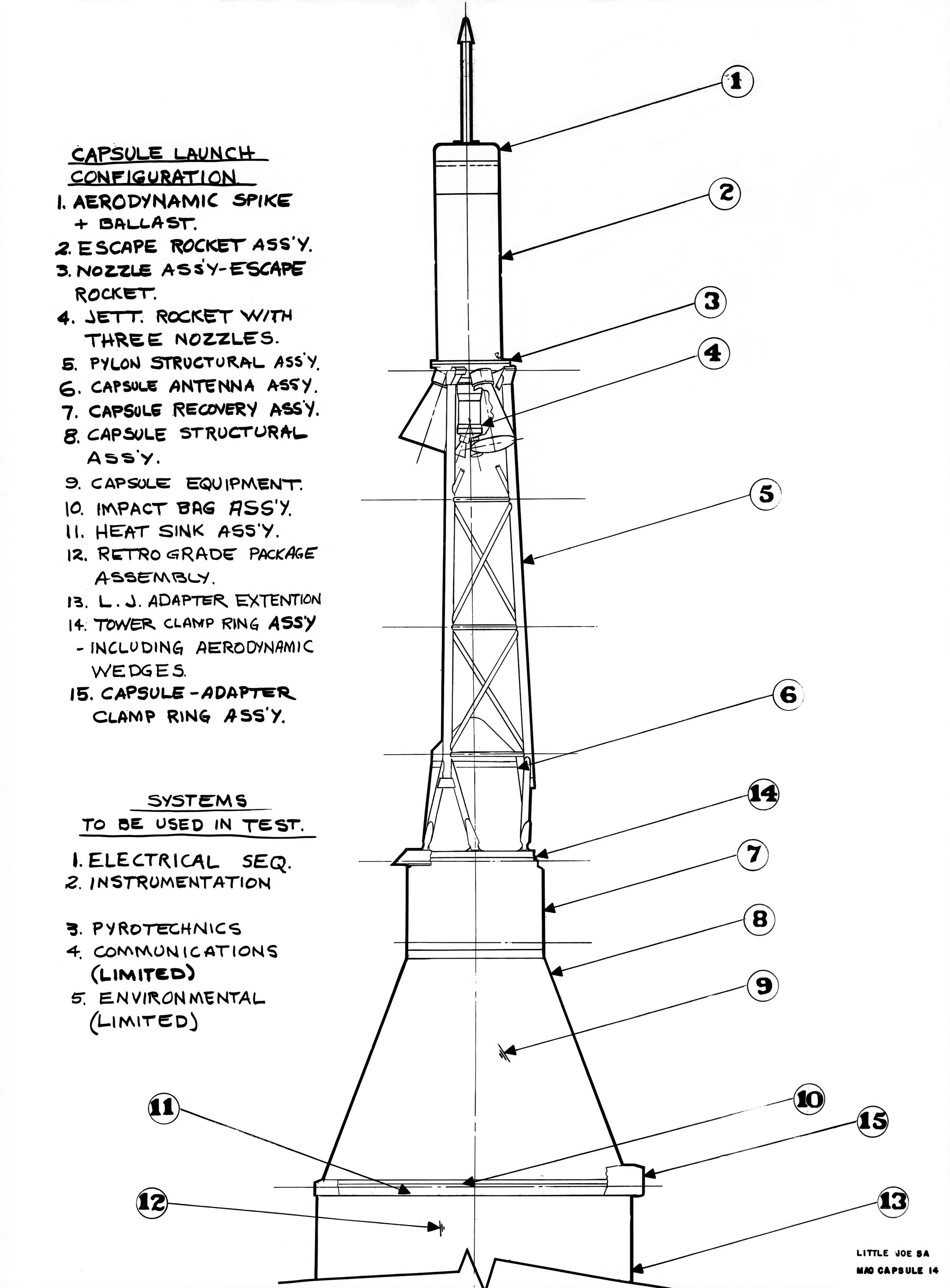
That point in the ascent, known as max Q, is the instant when the product of air density and the square of velocity peaks, and with it the aerodynamic load on the structure. An abort begun there subjects the capsule and its tower to the worst possible combination: the tower must drag the spacecraft off the rocket at very high acceleration while still-dense air pushes sideways on a long, slender stack. On LJ-5A the recorded dynamic pressure was 1,580 psf and the maximum acceleration 8 G. The booster was Little Joe No. 7, a solid-propellant rocket conceived precisely for this class of test: cheap, launchable from Wallops Island and able to put the capsule into the flight regime of interest without spending an Atlas on it.
The flight of 18 March 1961
LJ-5A lifted off from Wallops Island on 18 March 1961, the sixth mission of the Little Joe series. Lift-off was normal. Nineteen seconds later the escape tower fired prematurely, in a situation NASA's own chronology describes as closely resembling the previous November's flight.
From that moment the flight became an exercise in controlled improvisation from the ground. The signal to initiate the abort manoeuvre was given and the launch vehicle-adapter clamp ring released as intended, but the spacecraft stayed on the launch vehicle: the escape motor had already been expended in the premature ignition and no thrust remained to pull it away. Capsule and booster were still flying together with a spent tower — exactly the scenario that had destroyed LJ-5.
The difference lay in the response. A command was sent to separate the capsule using the retrorockets, and it was transmitted before the flight reached its apex, which was where separation had been planned. The result was a separation described as rather violent, but an effective one: the capsule came free of both booster and escape tower, and could enter the recovery sequence. The flight reached roughly 12 km in altitude and a range of about 29 km, with a maximum speed of 1,783 miles per hour (2,869 km/h).
Recovery and the state of the capsule
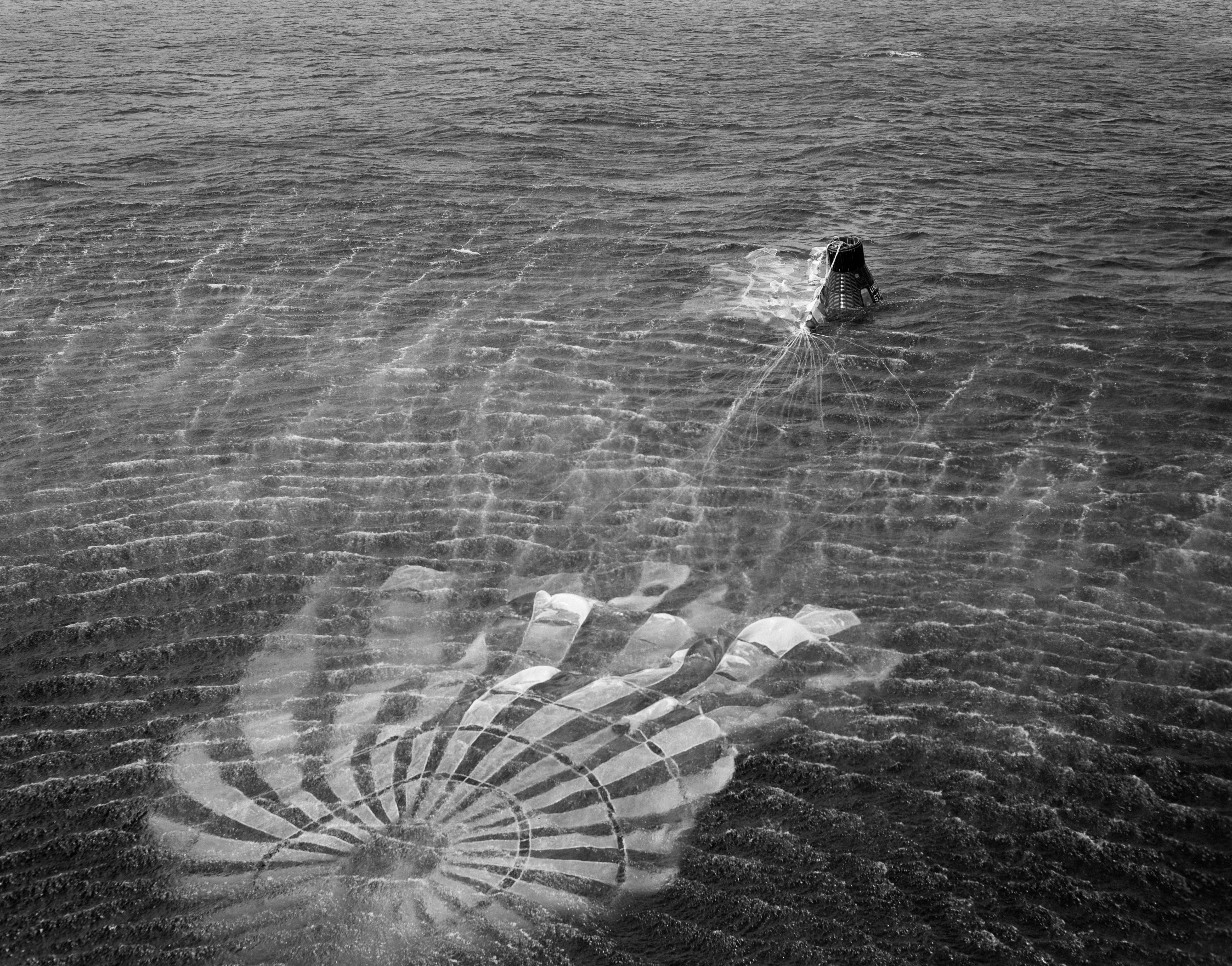
The parachutes deployed at about 40,000 feet and the spacecraft descended normally to the sea. The capsule was recovered, and the post-flight inspection produced the most valuable result of the whole exercise: despite the premature ignition, the forced separation and having flown attached to the booster for much of the trajectory, spacecraft No. 14 had suffered only superficial structural damage.
That was not the result being sought, but it said something worthwhile in itself about the robustness of the McDonnell structure. NASA logged the mission as partially successful and stated explicitly that the test objectives had not been met: the maximum dynamic pressure escape test still had not been performed under the intended conditions, because the tower had fired at the wrong moment and could not demonstrate what it was meant to demonstrate.
The third attempt: Little Joe 5B
The decision that followed was to try a third time, and to do it with the same spacecraft. Capsule No. 14, refitted and redesignated 14A, was delivered back to Wallops Island on 4 April 1961 for the Little Joe 5B mission, another maximum dynamic pressure abort test.
LJ-5B flew on 28 April 1961 and this time the mission succeeded: the spacecraft was recovered after a flight reaching about 4.5 km in altitude and a range of some 14 km, with a maximum speed of 1,780 miles per hour and an acceleration of 10 g. The profile, lower and shorter than LJ-5A's, corresponded to an abort initiated earlier in the trajectory. LJ-5B closed out Project Mercury's Little Joe series.
The LJ-5, LJ-5A, LJ-5B sequence is probably the clearest example of the method by which Mercury was built: a test fails, is repeated, fails again in much the same way, and is repeated a third time until the data is obtained. The three flights spanned a little under six months, from November 1960 to April 1961, in parallel with the Redstone and Atlas missions preparing the first crewed flight.
Legacy
Spacecraft No. 14 is the only Mercury capsule to have flown twice — on LJ-5A and LJ-5B — and is preserved on display at the Virginia Air and Space Center in Hampton, Virginia, a short distance from the Langley centre where the programme had taken shape.
Beyond the artefact, LJ-5A left two lessons. The first, negative: a repeated failure in the same part of the system, with the tower firing early for a second consecutive time, showed the problem had not been fully understood after LJ-5. The second, positive and in a way reassuring: the capsule structure withstood a sequence of events far worse than planned — premature ignition, flight attached to the booster, and a violent separation away from the planned point — and reached the water fit to fly again. Six weeks after LJ-5A, with the Little Joe series closed, Alan Shepard flew Freedom 7 with an escape tower over his head.
Images