Project Mercury · NASA · Uncrewed
Mercury-Redstone 2
- January 31, 1961
- Launch date
- 16 min
- Duration
- Partial success
- Outcome
-2_capsule-800.webp)
-1600.webp)
-2-800.webp)
-800.webp)
-1600.webp)
-2_%E2%80%93_Loaded_on_Ship_%E2%80%93_Chimp_%22Ham%22-800.webp)
-800.webp)

-1600.webp)
.jpg)
.jpg)


-2_%E2%80%93_Cape-800.webp)
-1600.webp)
_vehicle%2C_Jan._31%2C_1961-800.webp)

-2_flight-800.webp)
_spacecraft_(s61-04667)-800.webp)
-800.webp)
Mercury-Redstone 2 (MR-2) was the ballistic primate flight that Project Mercury placed between spacecraft qualification and the first crewed mission. It lifted off from Cape Canaveral on 31 January 1961 from Launch Complex 5, carrying Mercury spacecraft number 5 and, as its occupant, Ham, a 37-pound chimpanzee. The flight was not a gesture: its approved objectives were to obtain physiological and performance data on a primate in ballistic space flight, to qualify the environmental control system and the aeromedical instrumentation, to qualify the landing bag system, to partially qualify the voice communication system, to qualify the mechanically actuated side hatch, and to obtain a closed-loop evaluation of the booster automatic abort system. The mission departed from its planned trajectory almost immediately. During powered flight the propulsion system delivered considerably more thrust than planned, and early depletion of the liquid oxygen produced the signal that separated the spacecraft from the launch vehicle a few seconds ahead of schedule. The over-acceleration, combined with the velocity added by the escape rocket, carried the capsule higher and farther than intended: roughly 157 statute miles of altitude, about 253 km, and a range on the order of 418 to 422 statute miles, some 679 km, over 16 minutes and 39 seconds, with a maximum dynamic pressure of 575 pounds per square foot and a peak deceleration of 14.7 g. Recovery was no less eventful. Touchdown came at 12:12, with the capsule about 60 miles from the nearest recovery ship, the destroyer Ellison. A P2V search aircraft sighted it twenty-seven minutes later, floating upright and alone in the Atlantic, and the Navy dispatched helicopters from the next closest vessel, the LSD Donner. Wave action punched two holes in the titanium pressure bulkhead, the capsule capsized, and water entered through an open relief valve; by the time it was hoisted aboard at 2:52 it had taken on some 800 pounds of sea water. Ham, by contrast, was recovered in good condition. The official verdict was blunt: the spacecraft succeeded, the launch vehicle only partly. Marshall Space Flight Center and the Space Task Group, reviewing MR-2 together with the earlier Mercury-Redstone 1A, listed problems that had to be fixed before a man flew on the vehicle: jet-vane chatter caused by structural feedback into the control system, instrument compartment vibration, and failure of the thrust controller system. Engineers concluded that the fixes could not be accepted without being flown, so one more flight, the Mercury-Redstone Booster Development test of 24 March 1961, was scheduled and flown before the first crewed mission. MR-BD met all of its objectives and the launch vehicle was man-rated for the planned suborbital flights; on 5 May 1961 MR-3, Alan Shepard's Freedom 7, flew. The biomedical programme continued on the orbital side with the chimpanzee Enos aboard Mercury-Atlas 5, and its results were eventually gathered in a dedicated technical report on the project's ballistic and orbital chimpanzee flights.
Payload
The payload of MR-2 was Mercury spacecraft number 5 with a living occupant aboard: Ham, a 37-pound chimpanzee according to the project chronology. NASA's page on the uncrewed missions puts it just as dryly -«Payload: Spacecraft number 5, Launch Vehicle MR-2»- and describes the animal as a biomedical test subject. Spacecraft number 5 was delivered to the Marshall Space Flight Center on 30 September 1960 for booster compatibility checks and reached Cape Canaveral on 11 October 1960 for the ballistic-primate mission, with 16 weeks of preparation before the launch of 31 January 1961. On 2 December 1960 the Space Task Group forwarded to Marshall the weight and balance values for capsule 5, but the mass figures do not appear in the material consulted and are not reproduced here. Inside rode the environmental control system and the aeromedical instrumentation the flight was meant to qualify, the landing bag system, the mechanically actuated side hatch and the voice communication system, all declared mission objectives. The occupant did not travel as inert cargo: the animal programme required psychomotor tasks in flight, although the specific device installed for Ham is not broken out in the sources. As for the booster, the chronology assigns MR-2 Redstone launch vehicle number 2, delivered to Cape Canaveral on 20 December 1960, while NASA's page records «Redstone (3)»: both designations are given.
History
Mercury's biomedical programme and where MR-2 fits
Project Mercury never assumed that a human being would simply survive a launch, several minutes of weightlessness and a ballistic re-entry. It treated the question as something to be measured, with instruments and with living passengers aboard real flight hardware rather than simulators. That is why animals appear in the test sequence at all. Little Joe 1-B flew from Wallops Island with the rhesus monkey 'Miss Sam' aboard as part of the escape-system test series, and the Redstone branch of the programme set aside an entire flight, the second of its series with a qualified spacecraft, for a primate: Mercury-Redstone 2.
The sequence was deliberately cumulative. Mercury-Redstone 1A, flown on 19 December 1960, listed among its objectives the qualification of the spacecraft-booster combination for the Mercury-Redstone mission and, explicitly, the qualification of the flight system for the primate flight scheduled shortly afterwards. That flight reached 130.68 statute miles of altitude and 234.8 statute miles of range, with a cutoff velocity noted as slightly higher than normal, a minor observation at the time that would return with far more force on MR-2. With spacecraft and launch vehicle already flown together, MR-2 was to add the missing variable: a live, instrumented occupant inside a life-support system working in flight.
The occupant and his training
The project's institutional chronology identifies the MR-2 occupant as Ham, a 37-pound chimpanzee, and does so consistently from the logistical entries of 1960 onward: spacecraft number 5 is assigned from the outset to the 'ballistic-primate (Ham) mission'. The detail matters because much of the later popular literature blurred both the identity and the numbers of this flight; what follows is taken from the programme's own records.
.jpg)
On training, the available institutional source describes the regime of the programme's chimpanzees in general terms: acclimation to noise and vibration and centrifuge runs at the University of Southern California, parabolic flights by two of the animals aboard a C-131 aircraft for weightlessness exposure, and training in advanced psychomotor problems. It should be said plainly that the chronology places that description within the animal programme attached to the Mercury-Atlas branch, the one that would culminate in Enos's orbital flight; the specific detail of Ham's own preparation is not broken out in the sources consulted and is declared here as a gap. What is documented is the shape of the task: these animals did not travel as inert cargo but were expected to perform psychomotor work in flight, so that the measurement was not merely survival but performance under acceleration, weightlessness and re-entry.
Spacecraft number 5 and the launch vehicle
MR-2's material preparation can be followed closely in the project chronology. Mercury spacecraft number 5 was delivered on 30 September 1960 to Marshall Space Flight Center for booster compatibility checks, and was shipped from there to Cape Canaveral on 11 October 1960 for the ballistic primate mission. On 2 December 1960 the Space Task Group forwarded to Marshall the calculated weight and balance values for capsule 5 on MR-2. On 20 December 1960 the Redstone launch vehicle assigned to the chimpanzee flight was delivered to Cape Canaveral.
One preparation detail shows how much visibility into booster behaviour was already wanted. At the fifth Mercury Coordination Meeting, the Army Ballistic Missile Agency proposed installing an open-circuit television system on the second and third Mercury-Redstone flights, MR-2 and MR-3, in order to observe and relay launch vehicle information. Concern about watching the Redstone in flight, in other words, did not begin with MR-2's outcome; it was there beforehand.
The stated objectives
The programme's objectives document lists six for MR-2, and they read best as what they were, a list of qualifications outstanding before a crewed flight. First, obtain physiological and performance data on a primate in ballistic space flight. Second, qualify the environmental control system and the aeromedical instrumentation, the equipment that would keep an occupant alive and monitored. Third, qualify the landing bag system, the device meant to cushion the impact with the water. Fourth, partially qualify the voice communication system. Fifth, qualify the mechanically actuated side hatch, the astronaut's way out. Sixth, obtain a closed-loop evaluation of the booster automatic abort system, that is, exercise the full detection-and-response chain against a failure.
.jpg)
Five of the six bear directly on the safety and habitability of crewed flight. MR-2 was not a zoological experiment; it was the dress rehearsal of the cabin.
31 January 1961: the flight
MR-2 lifted off from Cape Canaveral on 31 January 1961 from Launch Complex 5. During the powered phase the thrust of the propulsion system was considerably higher than planned. A second, linked anomaly followed: early depletion of the liquid oxygen produced the signal that separated the spacecraft from the launch vehicle a few seconds ahead of plan. In practice the vehicle pushed harder, and for less time, than the flight plan called for.
The immediate consequence was over-acceleration. Combined with the velocity contributed by the escape rocket, it carried the capsule to a higher altitude and a longer range than planned. The programme's flight data give MR-2 roughly 157 statute miles of altitude, a range on the order of 418 statute miles, a duration of 16 minutes and 39 seconds, a maximum dynamic pressure of 575 pounds per square foot and a peak deceleration of 14.7 g. NASA's published mission summary for the uncrewed flights gives the range as 422 statute miles and a lower altitude figure of 127 statute miles; the discrepancy is recorded, and the figure used here is the one from the programme's flight data table.
That 14.7 g peak is the day's most eloquent number. For comparison, MR-1A had been designed around a re-entry deceleration of approximately 11 g, and the booster development flight that followed MR-2 recorded 11 g. Ham took a substantially higher load than nominal because of a launch vehicle anomaly, not by design.
Recovery in the Atlantic
Touchdown came at 12:12, with the capsule about 60 miles from the nearest recovery ship, the destroyer Ellison: the long trajectory had put the spacecraft outside the area where it was expected. Twenty-seven minutes after impact a P2V search aircraft found it floating upright and alone in the Atlantic. The Navy dispatched helicopters from the next closest ship, the LSD Donner.
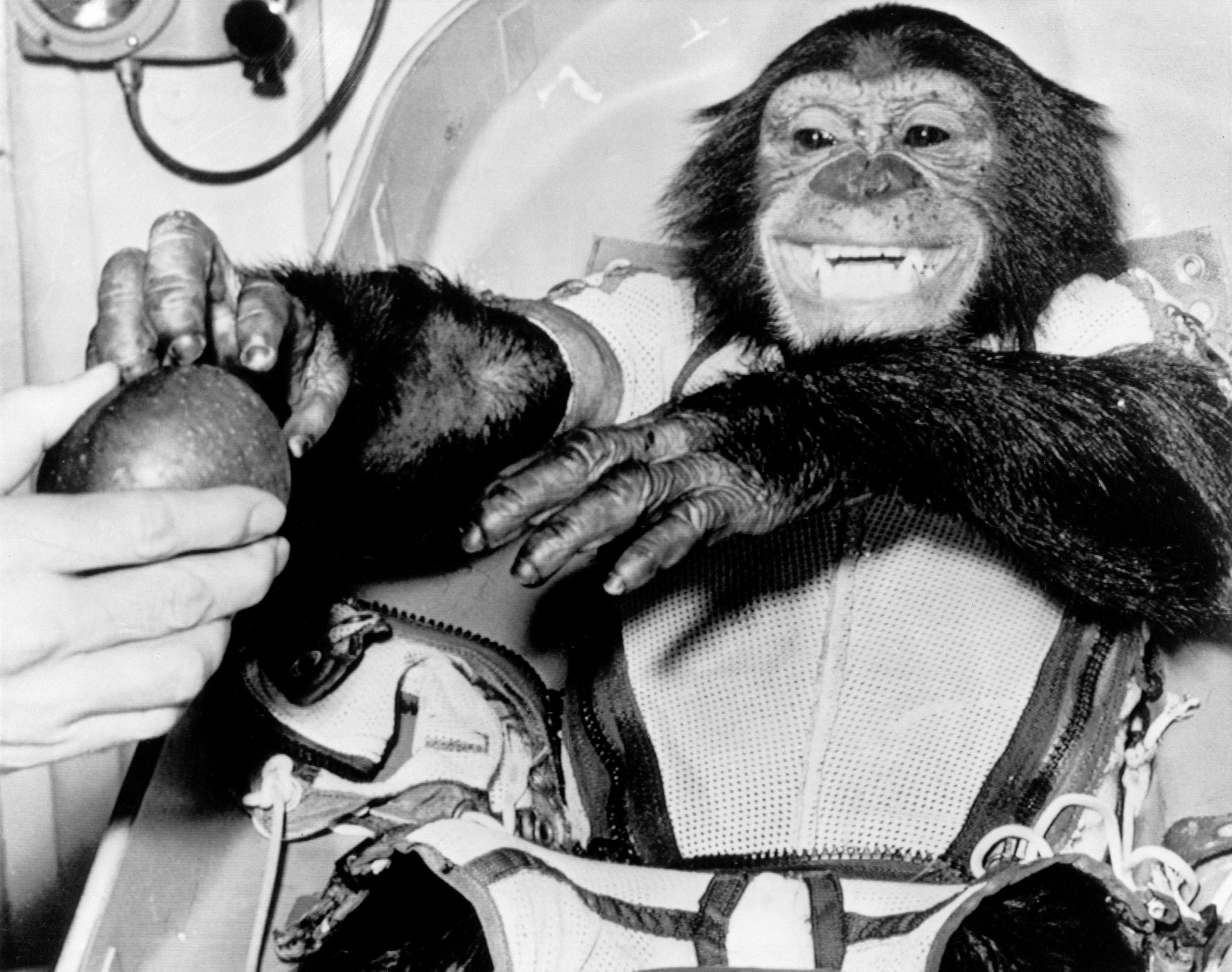
The sea, meanwhile, was working against the capsule. Wave action punched two holes in the titanium pressure bulkhead and eventually capsized it; water entered through an open relief valve. By the time the spacecraft was recovered at 2:52 it had taken some 800 pounds of sea water aboard. Despite the leaks and the flooding, recovery was completed and Ham was brought out in good condition. The chronology records, with a dryness rare in an official document, that the chimpanzee appeared to be in good physiological condition but that when he was shown the spacecraft some time later it was visually apparent that he had no further interest in cooperating with the space flight programme.
From MR-2 to MR-BD: why another flight was inserted
The formal result separated the two systems cleanly: the spacecraft was successful, the launch vehicle only partially so. That asymmetry drives everything that followed. The capsule's objectives had been met, the occupant had come back alive and well, and the life-support system had worked; but the Redstone had over-thrust, run out of liquid oxygen early and sent the spacecraft onto a trajectory that was not the computed one.
.jpg)
Reviewing launch vehicle behaviour on MR-1A and MR-2 together, officials at Marshall Space Flight Center and the Space Task Group concluded that a number of problems needed correcting before crewed flight. Those named were jet-vane vibration, instrument compartment vibration and failure of the thrust-controller system, along with several other areas requiring attention. The technical description of the first is telling: structural feedback into the control system producing vane chatter.
Engineering groups studied the problems and formulated proposed solutions. The decision that defines this episode is what came next: it was felt that the corrections could not be accepted without being flown. An additional launch was therefore scheduled and carried out, the Mercury-Redstone Booster Development test, whose stated objective was precisely to investigate the corrections to the booster problems arising from the MR-2 flight. MR-BD lifted off on 24 March 1961 from Launch Complex 5 with a boilerplate spacecraft, reached 113.5 statute miles of altitude and 307 statute miles of range in 8 minutes and 23 seconds with a peak deceleration of 11 g, and met all of its test objectives. As a result of that test the launch vehicle was man-rated for the planned suborbital flights.
In other words, an entire launch was interposed between MR-2 and the first American crewed flight, not as a scientific mission but as verification of fixes. MR-3, Alan Shepard's Freedom 7, flew on 5 May 1961, a little over three months after Ham's flight and six weeks after MR-BD.
Assessment and legacy
The programme's verdict on MR-2 was that, despite the over-acceleration factor, the flight was considered successful. The wording is not complacent: it acknowledges the anomaly and holds that the objectives justifying the flight had been achieved. The spacecraft had kept an occupant alive and in good condition under a higher than nominal load, the landing bag and the side hatch had passed their tests, and the automatic abort system had been evaluated closed-loop. Above all, the flight had exposed a launch vehicle defect that, had it not surfaced with a chimpanzee aboard, would have surfaced with an astronaut.
.jpg)
The biomedical programme continued after MR-2. On the orbital side, Mercury-Atlas 5 carried the chimpanzee Enos, weighing 37.5 pounds, through two orbits on 29 November 1961; the mission was cut from the three orbits planned because of a roll reaction jet failure and an overheating inverter in the electrical system, difficulties that, it was noted at the time, an astronaut aboard could have corrected. Enos performed psychomotor duties during the flight and was found in excellent physical condition on recovery, and with that the Mercury spacecraft was judged well qualified to support crewed orbital flight. The results of both chimpanzee flights, ballistic and orbital, were later gathered in the programme's technical report number 138. Enos died in November 1962 at Holloman Air Force Base, New Mexico, of an antibiotic-resistant shigella dysentery; officials at the aeromedical research laboratory stated that his illness and death were in no way related to his orbital flight of the year before.
Seen from today, MR-2 is the mission that best illustrates Mercury's method: fly the failure before a person flies it, never accept a correction without verifying it in flight, and absorb the schedule cost that follows. In January 1961, with the space race at its tightest, that cost was an entire launch and several weeks of delay on the first crewed mission.
Images
Elsewhere
- NASA Image and Video LibraryLaunch – "Ham" – Mercury-Redstone (MR)-2 ↗
- NASA Image and Video LibraryChimpanzee "Ham" during preflight activity prior to Mercury-Redstone 2 ↗
- Wikimedia CommonsHam and his handler before the MR-2 flight ↗
- Wikimedia CommonsGrave of Ham the Astrochimp, International Space Hall of Fame ↗
- Wikimedia CommonsHam (GPN-2000-001002) ↗
- Wikimedia CommonsMercury-Redstone 2 recovery ↗
- National Archives CatalogChimpanzee in Molded Couch ↗
- National Archives CatalogChimpanzee in Pressurized Couch ↗
- Digital Public Library of AmericaHam the Chimpanzee reaching for an apple after landing safely inside a Mercury capsule ↗
- Digital Public Library of AmericaMercury-Redstone II mission – Earth observations (frame 1) ↗
- Digital Public Library of AmericaMercury-Redstone II mission – Earth observations (frame 2) ↗
- Digital Public Library of AmericaMercury-Redstone II mission – launch pad photo ↗
Show the 5 more
- Smithsonian NASMCapsule, Mercury, MR-2 (Smithsonian NASM, inv. A19680267000) ↗
- Smithsonian NASMHeatshield, Capsule, Mercury, MR-2 (Smithsonian NASM, inv. A19680267001) ↗
- Flickr — NASA (nasa2explore)S61-01942 — Launch of the Mercury-Redstone 2 (MR-2) vehicle, 31 enero 1961 ↗
- Flickr — NASA (nasa2explore)S63-20800 — Chimpanzee "Ham" being assisted into his spacesuit before MR-2 ↗
- Flickr — NASA (nasa2explore)S63-20805 — Chimpanzee "Ham" during preflight training activity before MR-2 ↗