Project Mercury · NASA · Crewed
Mercury-Atlas 7
- May 24, 1962, 12:45 PM
- Launch date
- 1
- Crew size
- 4 hr 56 min
- Duration
- Success
- Outcome

-1600.webp)
-1600.webp)
-1600.webp)

-1600.webp)
-1600.webp)
-1600.webp)
-1600.webp)


-1600.webp)


-1600.webp)
-1600.webp)
-1600.webp)
Mercury-Atlas 7 was the fourth crewed flight of Project Mercury and the second American orbital mission. It lifted off from Launch Complex 14 at Cape Canaveral on 24 May 1962 atop an Atlas LV-3B, vehicle 107-D, carrying a single crewman in the pilot's seat: Navy Lieutenant Commander M. Scott Carpenter. The spacecraft was McDonnell-built Mercury capsule number 18, which Carpenter named Aurora 7. The flight lasted four hours and fifty-six minutes and completed three orbits, repeating the profile John Glenn had flown three months earlier. The mission had not originally been Carpenter's. Deke Slayton was the pilot first assigned, with Wally Schirra as his backup, and Slayton had already chosen the name Delta 7 for his capsule because this was to be the fourth crewed flight and delta is the fourth letter of the Greek alphabet. Idiopathic paroxysmal atrial fibrillation, detected during a run on the g-loading centrifuge, removed him from flight status. Rather than promote the backup, NASA handed the flight to Carpenter, who had served as Glenn's backup on Mercury-Atlas 6, had trained alongside him and was regarded as the astronaut best prepared to repeat that profile. Where Mercury-Atlas 6 had existed to prove that an American could orbit and return, Mercury-Atlas 7 was the first flight of the programme designed around a scientific payload of its own. The plan called for the first study of a liquid behaving in weightlessness, the release of a thirty-inch mylar sphere divided into coloured panels and tethered to the capsule on a hundred-foot line, terrestrial and meteorological photography with hand-held cameras, identification of the airglow layer Glenn had reported, and an attempt to sight a flare fired from the ground. Carpenter received specific training for several of these observations. The flight also exposed the limits of the capsule's automatic control system. An intermittently malfunctioning pitch horizon scanner, later described in the postflight analysis as mission critical, drove an anomalous expenditure of hydrogen peroxide that neither the pilot nor the ground noticed in time. At retrofire the spacecraft was pointed twenty-five degrees to the right of the true retrograde vector, the retrorockets fired three seconds late, and the manual propellant tank that the gauge showed as partly full was in fact empty. The errors compounded, and Aurora 7 splashed down some four hundred kilometres beyond the planned point, north-east of Puerto Rico, leaving Carpenter in his life raft for close to three hours before he was picked up. How the flight should be judged split NASA at the time and still divides those who took part. The official report recorded that the pilot had adequately compensated for the malfunction and that all primary objectives had been met; flight director Christopher C. Kraft wrote in his 2001 memoir that he swore Carpenter would never fly again, and titled that chapter "The Man Malfunctioned". Carpenter replied in public that without a human aboard the capsule and the whole mission would have been lost. He never flew in space again: in 1964 he took leave to join the Navy's SEALAB programme, where a training injury left him permanently unfit for spaceflight.
Payload
Aurora 7 flew on Mercury spacecraft No. 18, built by McDonnell Aircraft and launched by Atlas 107-D; the Wikipedia infobox gives it a mass of 2,975 lb (1,350 kg) and lists the control fuel as 35 lb (16 kg) for the automatic system and 24.9 lb (11.3 kg) for the manual one. Pre-flight changes added a "low-level commutator" that recorded temperatures at twenty-eight points on the spacecraft, and a six-by-six-inch white patch was painted on the exterior to compare shingle temperatures with the adjacent oxidised surface. The scientific payload was the point of the flight: a tethered 30-inch mylar balloon divided into five sections —uncoloured aluminium, yellow, orange, white and a phosphorescent coating—, folded with its gas expansion bottle inside the antenna canister in a two-pound package, on a 100-foot (30 m) nylon line and fitted with a strain gauge to measure aerodynamic drag; a closed glass bottle to observe the behaviour of a liquid in weightlessness; a special light meter to measure the visibility of a flare fired from the ground; hand-held cameras for terrestrial and meteorological photography; and observation of the airglow layer. The only crew member aboard was pilot Scott Carpenter, carrying bioinstrumentation whose telemetered data was at times uncertain, and the first solid food of the programme: freeze-dried cubes in a plastic bag coated with an anti-crumbling agent, a candy bar that melted in cabin temperatures of up to 102 °F, and a xylose capsule.
History
A mission that changed pilots before it flew
Project Mercury's schedule assigned the fourth crewed flight to Donald K. "Deke" Slayton, with Wally Schirra as his backup. Slayton had gone as far as choosing his spacecraft's name — Delta 7, delta being the fourth letter of the Greek alphabet and this the fourth flight with a man aboard. During a training run on the g-loading centrifuge he was found to have idiopathic paroxysmal atrial fibrillation, an intermittent arrhythmia of unknown origin, and NASA removed him from flight status.
The choice of replacement did not follow the logic that later became standard in crewed programmes. Instead of promoting the designated backup, the agency gave the mission to M. Scott Carpenter, who had been John Glenn's backup on Mercury-Atlas 6. The reasoning was operational: Carpenter had trained alongside Glenn throughout the preparation for that flight, knew the three-orbit plan better than anyone except Glenn himself, and was considered the astronaut best prepared to repeat it. Schirra would fly later, on Mercury-Atlas 8.
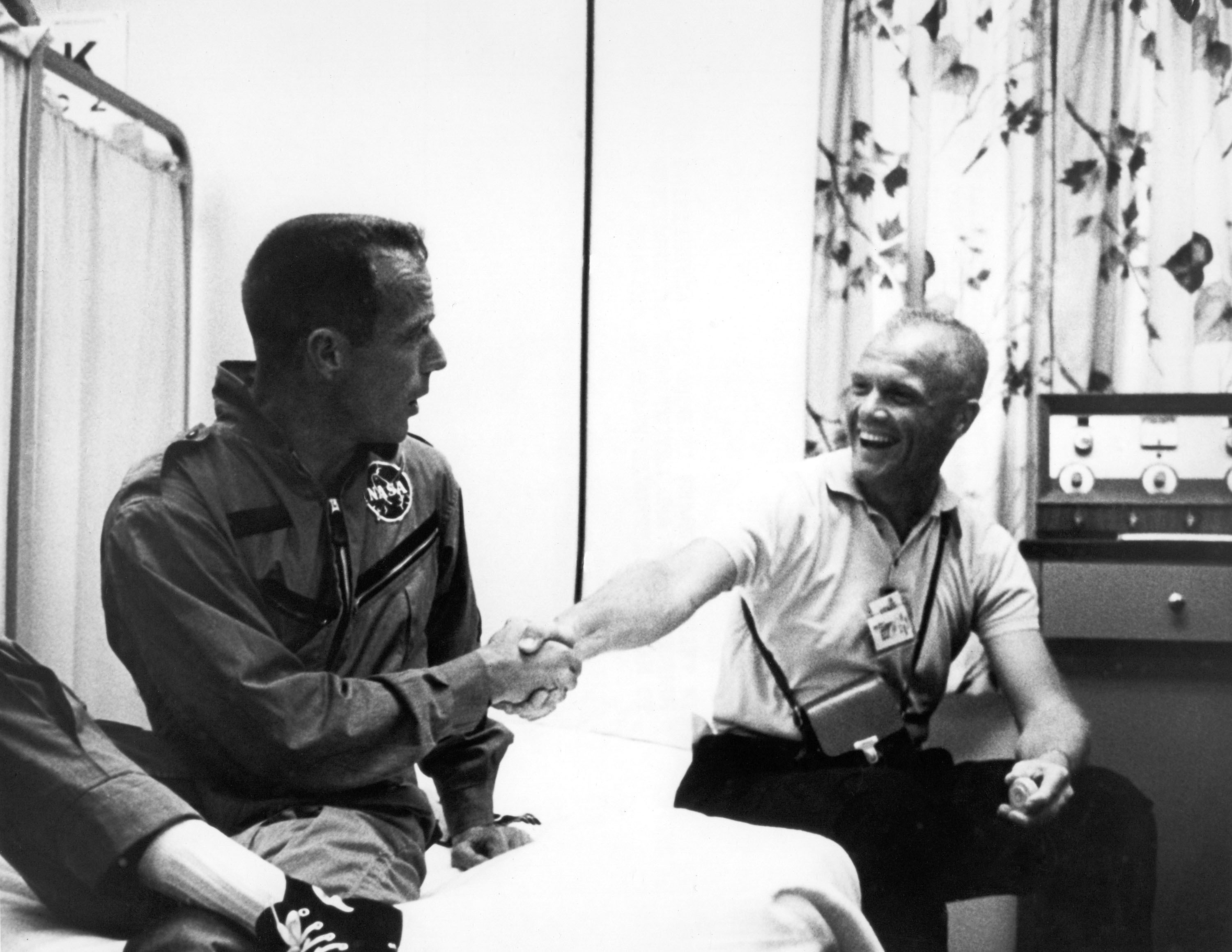
Carpenter renamed the spacecraft Aurora 7 — aurora for the open sky and the dawn, as a symbol of the dawn of a new age, and seven for the seven astronauts of the Mercury group. The coincidence with his boyhood address in Boulder, Colorado, at the corner of Aurora Avenue and Seventh Street, fed a more picturesque explanation for decades. Speaking at the Boulder Theater in 2003, Carpenter said he had not made the connection himself until friends pointed it out after the flight; on other occasions he denied outright that the name came from the street.
Capsule number 18 and Atlas 107-D
The spacecraft flown was Mercury capsule number 18, built by McDonnell Aircraft and delivered to Cape Canaveral on 15 November 1961. During checkout the periscope was changed and work was done on the drogue parachute circuit to keep it from firing prematurely, as had happened on the previous flight. A device known as a low-level commutator was added to record temperatures at twenty-eight positions on the spacecraft — instrumentation intended to explain the vehicle's thermal behaviour as missions grew longer. That sensor installation and the parachute circuit fix were what pushed the launch back into May.
The launch vehicle was an Atlas LV-3B, vehicle 107-D, rolled out of the Convair factory in San Diego on 25 February 1962 and delivered to the Cape on 6 March. Differences from Glenn's booster were minor. It had been agreed that the insulation blanket in the tank bulkhead was unnecessary and would be dropped on subsequent Mercury-Atlas vehicles, though 107-D still carried it; the liquid oxygen tank skin was thickened once again because of the growing weight of the capsule as missions became more ambitious.
On 16 May the Flight Safety Review Board reviewed the twelve Atlas flights since Glenn's launch and the anomalies that gave cause for concern. Four had suffered major in-flight malfunctions, three of them traced to random quality-control defects unlikely to appear in the far more closely supervised Mercury production line. Two events worried the board more: an Atlas that exploded almost immediately after liftoff on 9 April, and another that exploded during a static firing test at Sycamore Canyon on 13 May. The cause was not yet clear and was provisionally attributed to rough combustion, an old problem that had destroyed several earlier Atlas vehicles. NASA concluded that such a failure was unlikely on a Mercury-Atlas, because those vehicles were held down for three seconds before launcher release and used a different engine start sequence; later analysis showed the two explosions had an entirely different cause. The explosion of the first Atlas-Centaur shortly after liftoff on 8 May caused another brief alarm until postflight analysis placed the fault with the Centaur stage rather than the Atlas.
The tracking network
A worldwide arrangement of ground stations and ships, the Mercury network, was set up to give continuous coverage of the spacecraft. For Mercury-Atlas 7 it comprised fifteen Mercury sites reinforced by several Atlantic Missile Range stations and the Goddard Space Flight Center. Capsule communicators were distributed among them: Gus Grissom worked from Cape Canaveral and Alan Shepard from California.
.jpg)
One small piece of that preparation took on a life of its own. Choosing a wristwatch for the flight, Carpenter asked Breitling for a twenty-four-hour dial rather than the usual twelve, since orbital flight offers no day or night to anchor the reading. The company produced a twenty-four-hour Navitimer whose bezel slide rule was widened at the astronaut's request so that it could be worked with the thick gloves of a pressure suit.
The science programme
Mercury-Atlas 7 was the first mission of the programme whose declared focus was scientific. The flight plan brought together the first study of a liquid behaving in weightlessness, carried out on a sealed glass bottle; terrestrial and meteorological photography with hand-held cameras; visibility measurements of a flare fired from the ground using a special light meter; a study of the airglow layer Glenn had observed, for which Carpenter received specific training; and the tethered balloon experiment.
The balloon was a thirty-inch inflatable mylar sphere, folded and packed with its gas expansion bottle in the antenna canister; the whole package weighed two pounds. It was divided into five sections of different colours — uncoloured aluminium, yellow, orange, white and a phosphorescent coating that appeared white by day and blue by night — and was to be cast off near perigee after the first orbital pass, floating freely at the end of a hundred-foot nylon line. Two ends were sought: to study how the space environment affects the reflective properties of coloured surfaces, through visual observation and photography, and to obtain aerodynamic drag measurements with a strain gauge. The experiment was only partially successful.
The morning of 24 May 1962
Carpenter was woken at 1:15 a.m. and had orange juice, filet mignon, eggs, toast and coffee for breakfast; before being inserted into the capsule he also followed a hydration regimen of water, juice, coffee and sweet tea. He rode the gantry up at 4:36 and entered the spacecraft at 4:43. Unlike Mercury-Atlas 6, the hatch sealing bolts gave no trouble. Launch came at 7:45 a.m. Eastern time.
.jpg)
The launch vehicle performed excellently apart from one small anomaly: one of the sustainer engine's hydraulic switches registered a loss of pressure and moved to the abort position at T+265 seconds. Other flight data confirmed that the hydraulic system was working normally and, because the abort detection system required two switches to trip before signalling an abort, nothing happened and the flight continued as planned. The switch malfunction was attributed to cold temperatures from nearby liquid oxygen lines; thermal insulation was added on later flights to prevent a recurrence. Booster engine cutoff came at T+124 seconds and sustainer cutoff at T+305 seconds. The Atlas flew so accurately that Aurora 7 reached almost exactly the orbital parameters planned for the mission.
Three orbits
Carpenter carried solid food for the first time in the programme: freeze-dried cubes in a plastic bag rather than paste squeezed from a tube. The cubes had been coated with an anti-crumbling agent, but were probably crushed before launch, breaking the coating. He voiced concern about floating crumbs being drawn into the cabin ventilation intakes or presenting a choking hazard. A candy bar in the food supply melted in a cabin that reached around 102 degrees Fahrenheit. By the end of the second orbit he told Mercury Control that most of the food was a mess and that he would leave it alone for the rest of the flight apart from taking a xylose capsule.
At every orbital sunrise the "fireflies" Glenn had described reappeared. Carpenter thought them more like snowflakes, noted that they did not seem truly luminous, and described particles varying in size, brightness and colour: some grey, some white, and one in particular resembling a helical shaving from a lathe. Though they appeared to travel at different speeds, they did not move away from the spacecraft as the confetti from the balloon experiment did. He also took nineteen photographs of the flattened Sun at orbital sunset.
The mystery was solved at dawn on the third and final orbit. Carpenter accidentally struck the inside wall of the cabin with his hand and produced a bright shower of particles outside; he later found he could shake more "fireflies" loose at will by banging on the bulkhead. Marker dye and shark repellent, both green, were suspected at first, but testing showed neither was likely to escape its packaging in zero gravity. Two explanations remained: steam from the life support system freezing into ice crystals on reaching vacuum, or debris on the exterior being shaken loose. The first was considered more probable — steam generated by the life support system condensed between the bulkhead and the heat shield, escaped into space and froze.
Heavy cloud cover along much of the orbital track limited ground observation. The south-western United States and West Africa were clear; Florida could not be seen at all.
Propellant and the pitch horizon scanner
The decisive failure of the flight was an intermittent malfunction of the pitch horizon scanner, a component of the automatic control system. Neither the astronaut nor the ground noticed it while it was happening, and its effect was an excessive expenditure of hydrogen peroxide, the propellant of the attitude thrusters.
Here the sources diverge on an important point, and this entry records both rather than merging them. NASA's official history of the project holds that as Carpenter drifted near Hawaii on the third pass he still had more than forty per cent of his propellant in both the automatic and the manual tanks — an amount that under the mission rules Kraft himself reckoned sufficient to put the capsule into retrofire attitude, hold it, and reenter on either the automatic or the manual system. Accounts of the flight elsewhere describe instead a waste accumulated earlier and compounded by a procedural error: on switching to fly-by-wire control, Carpenter forgot to switch the manual system off, so that both were in use together for ten minutes.
.jpg)
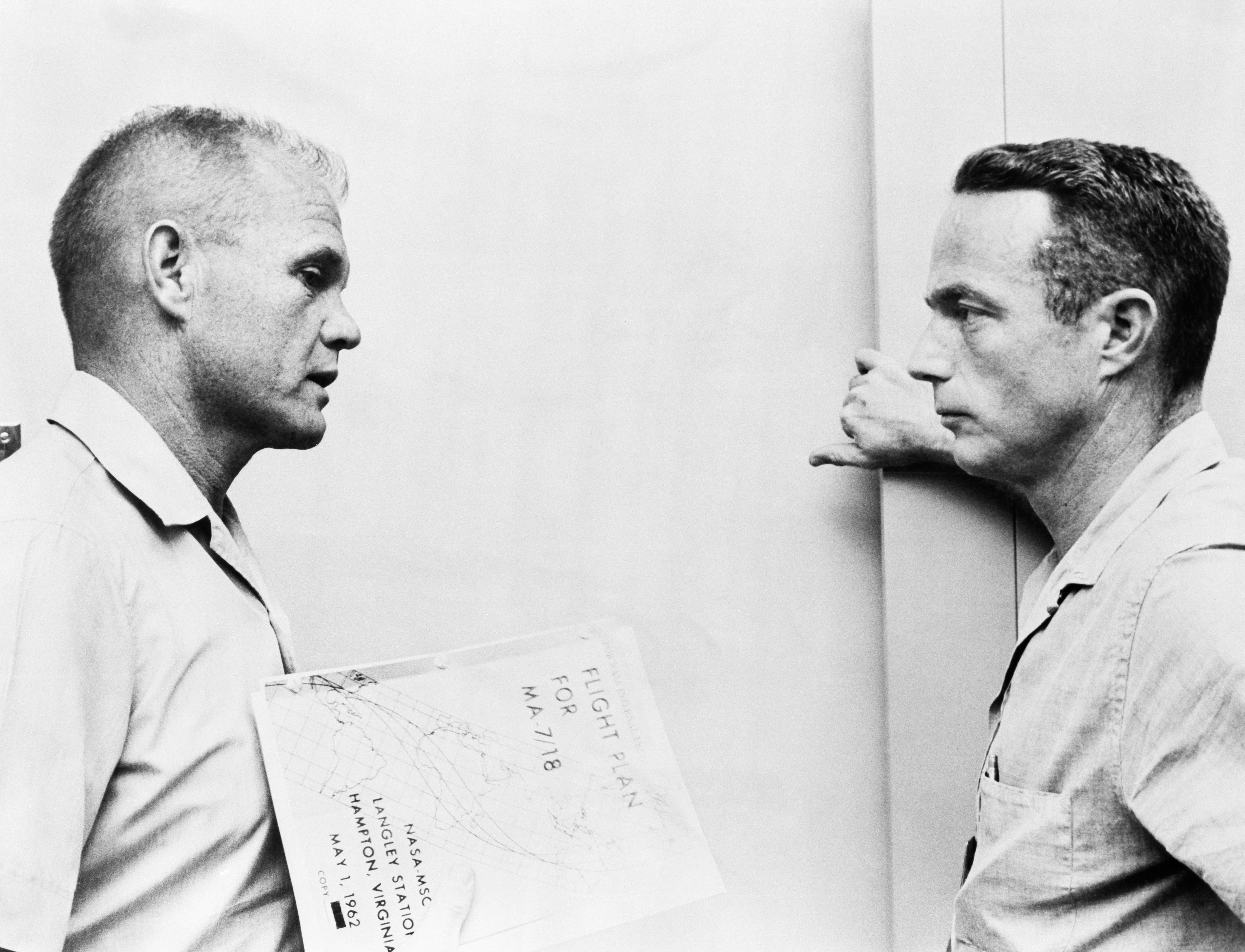
What is not in dispute is the final sequence. When the flight director told him to begin the retrofire countdown and shift to automatic attitude control, Carpenter acknowledged that he had started his landing preparations late, in part because he had been watching the particles. Aligning the spacecraft, he found that the automatic stabilisation system would not hold the required attitude of thirty-four degrees in pitch and zero in yaw; while he looked for the source of the trouble he fell behind on his other checks. Noticing a disagreement between his attitude indicators and what he could see through the window and the periscope, he set the retrofire attitude visually. The spacecraft was in fact aimed twenty-five degrees to the right of the true retrograde vector.
Splashdown far from the target
To the attitude error was added a retrorocket firing three seconds late, which by itself put roughly twenty-four kilometres more onto the trajectory error. After retropack jettison the gauges read twenty per cent propellant in the automatic tank and five per cent in the manual one. Carpenter meant to use that manual remainder to set reentry attitude, but the gauge was inaccurate and the tank was in fact empty. The result was a splashdown some four hundred kilometres beyond the planned point.
The arithmetic of that overshoot has itself been told more than one way. One reconstruction assigns around two hundred and seventy kilometres of it to the twenty-five-degree yaw caused by the failed scanner, some thirty kilometres to the delayed firing — which took two pushes of the override button — and a further hundred-odd kilometres to the disturbance of the retrorockets' fixed ignition sequence when they were fired manually, and argues that without the pilot taking manual control the overshoot would have been greater still. The spacecraft came down north-east of Puerto Rico, about fifty nautical miles north of Anegada in the British Virgin Islands.
Nearly three hours at sea
Locating him took close to an hour. Although Aurora 7's SARAH beacon was broadcasting its precise position and the recovery vessels were already on their way, NASA did not pass that on to the news media; broadcasting from a CBS news van in Florida, Walter Cronkite painted a grim picture and spoke of an almost intolerable silence while thousands watched and prayed. There was genuine public concern over whether Carpenter had survived.
.jpg)
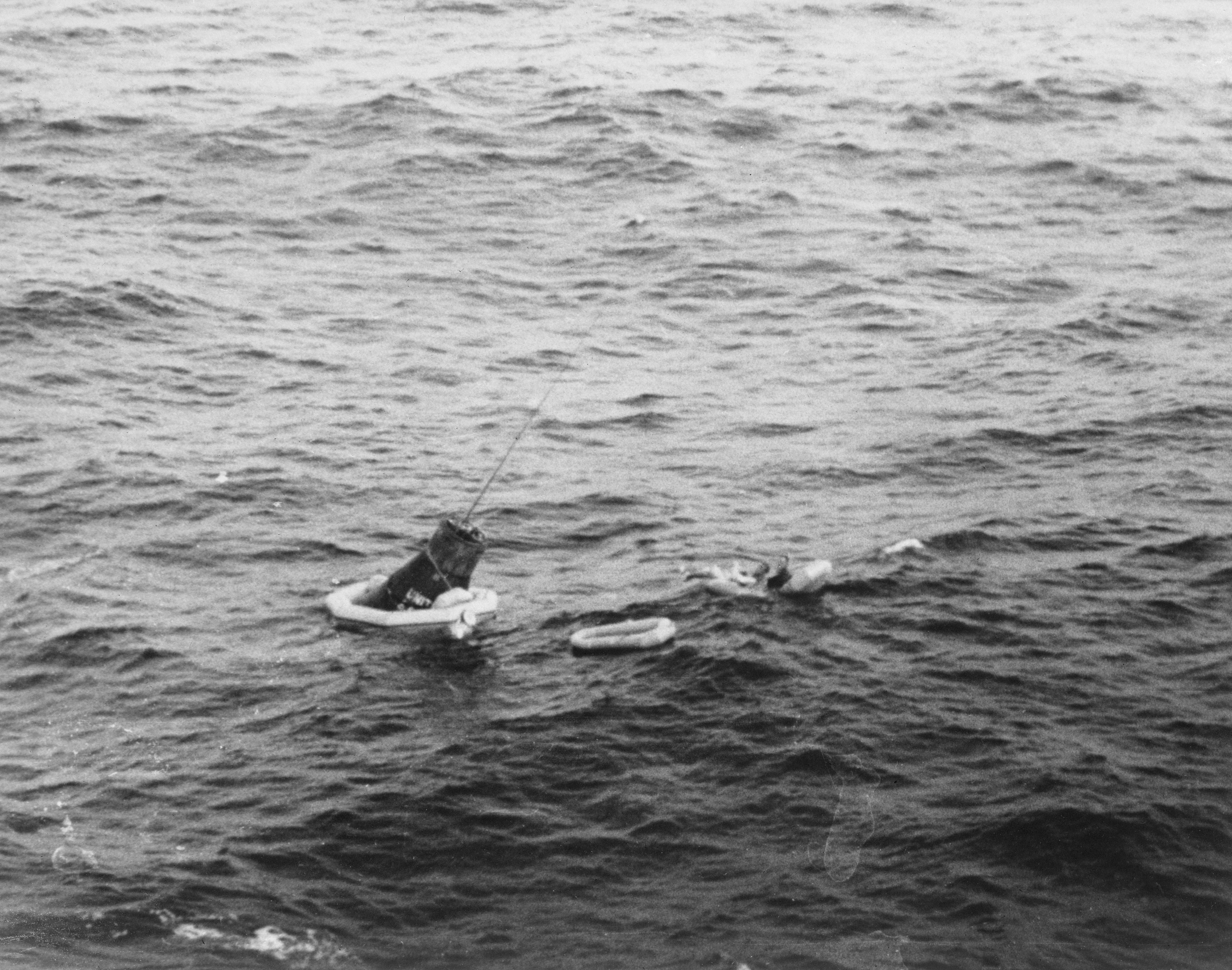
Aware that the ships would take time and that the capsule might founder as Grissom's Liberty Bell 7 had, Carpenter climbed out through the neck of the spacecraft — something the less agile Glenn had been unable to do — inflated his life raft and waited. The sea around him was stained green by the marker dye. The raft carried no radio.
About thirty-six minutes after splashdown he spotted two aircraft. A P2V Neptune of Patrol Squadron 18, flying out of Naval Air Station Jacksonville, was the first to sight and mark his position; a Piper Apache followed, circling and photographing, and then SC-54 Skymaster aircraft, one of which parachuted two frogmen, Airman First Class John F. Heitsch and Sergeant Ray McClure, while another dropped a flotation collar that the frogmen attached to the capsule. A radio battery was dropped, but not the radio. An Air Force SA-16 Albatross arrived ready to collect them, but Mission Control forbade it for fear the seaplane would break up, although its crew did not consider the swell dangerous. Three hours on, an HSS-2 Sea King helicopter picked Carpenter up and flew him to the carrier Intrepid.
At sea, the destroyer Farragut was the first ship to reach the spacecraft, roughly forty minutes after splashdown, and stayed with it until John R. Pierce arrived with the equipment needed to tow Aurora 7 to Roosevelt Roads, Puerto Rico, from where it was flown back to Cape Canaveral. Apart from slight exhaustion Carpenter was in good health and good spirits, and postflight medical examinations found no significant physical changes or anomalies.
What the report said, and what the people said
The mission report was explicit in both directions. It called the pitch horizon scanner malfunction the single mission-critical failure that occurred, and at the same time recorded that the pilot had adequately compensated for it in subsequent in-flight operations, so that the success of the mission was not compromised. All primary objectives were counted as achieved and the performance of spacecraft and launch vehicle was rated excellent in nearly every respect. Cabin and pressure-suit temperatures were high but not intolerable, and there were stretches of uncertainty in the bioinstrumentation data, though always accompanied by other information indicating the astronaut's continued well-being. The reading drawn from all this was that the backup system — the human pilot — could carry a mission through when the automatics failed.
.jpg)
The operational managers read it very differently. NASA's official history of Project Mercury, published in 1989, records that until the third pass over Hawaii Christopher C. Kraft Jr., who directed the flight from Cape Canaveral, considered this the most successful mission to date, everything having gone perfectly except for some overexpenditure of hydrogen peroxide. In his 2001 memoir Kraft wrote that Carpenter was completely ignoring the request to check his instruments, and that he swore an oath that Carpenter would never fly in space again; he titled the chapter on the flight "The Man Malfunctioned".
Other voices from mission control qualified that verdict. Gene Kranz, assistant flight director at the time, acknowledged that in Mercury the monitoring of propellant consumption and other aspects of vehicle operation were as much the responsibility of the ground controllers, and admitted the ground had waited too long to address the fuel status and should have been more forceful in pressing on with the checklists. A crewman distracted and behind on the flight plan, he wrote, is a danger to the mission and to himself.
There is an organisational reading as well: much of the criticism of Carpenter's performance has been explained by tensions between the astronaut office and the flight controller office, and by simmering resentment among the latter at the former's hero status. Tom Wolfe observed that one might argue Carpenter had mishandled the reentry, but that accusing him of panic made no sense given the telemetered data on his heart and respiratory rates. Later memoirs, such as Gene Cernan's, revived the controversy, holding that Carpenter wrecked his own flight by joyriding, not paying enough attention to the job and missing his retrofire cue, and repeating whispers about how he had come into the programme at all. Against all of it, Carpenter replied in 2001 in a letter to The New York Times, written in response to a review of Kraft's memoir, arguing that the system failures he met during the flight would have meant the loss of the capsule and total mission failure had a man not been aboard, and that his debriefings and reports led to important changes in capsule design and in later flight plans. Nor was the problem unique to him: Schirra would later have trouble with the override button on Mercury-Atlas 8.
What it meant for Carpenter's career
Carpenter never flew in space again. The immediate consequence of the flight was to be sidelined from the missions that followed. In 1964 he obtained NASA's permission for a leave of absence to join the Navy's SEALAB project as an aquanaut; during training he suffered injuries that grounded him and closed off any second spaceflight for good. In 1965 he spent twenty-eight days living on the ocean floor off the coast of California as part of SEALAB II. He then returned to NASA as Executive Assistant to the Director of the Manned Spacecraft Center, and in 1967 joined the Navy's Deep Submergence Systems Project as Director of Aquanaut Operations for SEALAB III. He retired from NASA in 1967 and from the Navy in 1969 with the rank of commander. He remains the only person to have been both astronaut and aquanaut.
What the flight gave the programme
Beyond the controversy, Mercury-Atlas 7 gave the programme things no other short flight did. It produced the first data on how a liquid behaves in weightlessness, the identification of the airglow layer Glenn had described, and a set of photographs of terrestrial features and meteorological phenomena. The balloon experiment, meant to measure aerodynamic drag and colour visibility in space, worked only in part. The flight also settled, almost by accident, the riddle of the "fireflies" inherited from Mercury-Atlas 6.
On the engineering side, the modification of the spacecraft control-system thrust units was judged effective, and the thermal sensor installation left temperature data from twenty-eight positions that fed later studies. One of those secondary tests kept yielding results long afterwards: in January 1963 McDonnell reported to the Manned Spacecraft Center on a study of the thermal effects of the white paint patches applied to the MA-7 and MA-8 spacecraft, a six-inch square painted next to an oxidised surface to compare shingle temperatures. Structural differences between the two points kept the test from being conclusive, but the recorded temperatures were different enough to establish that the painted surfaces were cooler directly beneath the patch and at the corresponding point inside the spacecraft. The tethered balloon was also carried forward, in similar form, among the experiments proposed for the one-day orbital mission of Mercury-Atlas 9, and Carpenter's photographs were used in work outside the programme, such as studies at the Massachusetts Institute of Technology on observations during a mission's mid-course phase.
In August 1962 a conference on the technical aspects of the mission was held at the Rice Hotel in Houston. Taken as a whole, the flight further qualified the Mercury spacecraft systems for crewed orbital operations and provided the evidence needed to move on to missions of extended duration with more demanding systems requirements: the road that led to Mercury-Atlas 8 and then to the one-day mission of Mercury-Atlas 9.
The capsule today
Aurora 7 is on display at the Museum of Science and Industry in Chicago, Illinois.
Images
Elsewhere
- Flickr — NASA on The CommonsAurora 7 Launch — Scott Carpenter's Mercury-Atlas 7 capsule lifts off from Pad 14, Cape Canaveral, 24 de mayo de 1962 ↗
- AlamyScott Carpenter's Aurora 7 Mercury Atlas rocket lifts off from Pad 14, Cape Canaveral, Florida, on May 24, 1962 ↗
- AlamyNASA astronaut Scott Carpenter looks into his Mercury-Atlas 7 spacecraft, the Aurora 7, before being inserted to begin the launch, May 24, 1962 ↗
- AlamyAstronaut Scott Carpenter looks inside the Aurora 7 spacecraft prior to insertion, watched by Wally Schirra and John Glenn, Cape Canaveral, May 24, 1962 ↗
- Museum of Science and Industry, ChicagoHenry Crown Space Center — la cápsula Mercury Aurora 7 de Scott Carpenter, en exposición permanente ↗
- Space.comAurora 7: Astronaut Scott Carpenter's Mercury Flight in Pictures ↗
- Space.comBehind the Scenes: Inside Astronaut Scott Carpenter's 1962 Mercury Flight (Photos) ↗
- American HeritageThe Recovery of 'Aurora' — el amerizaje largo y el rescate de Scott Carpenter ↗
- AmericaSpace"Pretty Good Oscillations": Remembering Aurora 7, 60 Years On (Part 2) — reentrada y amerizaje ↗
- AmericaSpaceIn Dire Peril: 55 Years Since the Troubled Mission of Aurora 7 (Part 2) ↗
- AmericaSpaceFlight of the Aurora: Remembering the Mission of Scott Carpenter (Part 2) ↗
- Smithsonian National Air and Space Museum (archivo)Aurora 7 — Scott Carpenter ↗