United States · 2000–
Blue Origin
Blue Origin is a privately held American space technology company headquartered in Kent, Washington. Amazon founder Jeff Bezos started it in 2000 with a stated long-term goal of enabling millions of people to live and work in space. For more than a decade it worked almost in secret, funded by its founder's personal fortune, and followed a deliberately incremental path: first low-altitude test vehicles, then suborbital rockets and only afterwards the leap to orbit. Its first visible product was New Shepard, a reusable suborbital system made up of a vertically landing booster and a capsule for six passengers. It flew and landed uncrewed for the first time in 2015 and first carried people in July 2021, with Bezos himself on board, turning the company into a space tourism operator. At the same time Blue Origin became a rocket engine maker. Its BE-4, burning liquid oxygen and liquefied natural gas, powers not only the company's own heavy-lift New Glenn but also the first stage of United Launch Alliance's Vulcan Centaur. New Glenn reached orbit on its maiden flight in January 2025, and in November that year it sent NASA's ESCAPADE mission on its way to Mars. The company is also developing the Blue Moon lander under contract to NASA for the Artemis programme, the Blue Ring orbital platform and, together with several partners, the Orbital Reef commercial space station. Criticised for years for its slow progress compared with SpaceX, it changed leadership in 2023, when Dave Limp became chief executive.
Blue Origin in the news
.jpg)
The launch infrastructure improvements also include a substantial manufacturing expansion at Rocket Park and the addition of new landing barges.
The infrastructure is designed to support multiple flights per week by the end of the decade.
.jpg)
Four months after Blue Origin’s New Glenn rocket exploded on the launch pad, the company… The post Blue Origin Advances LC-36 Rebuild for Year-End New Glenn Return to Flight appeared first on…
.jpg)
On October 8, 2026, space systems manufacturer Blue Origin announced plans to construct Constellation Park, a $550 million satellite manufacturing complex in central Texas. The 120,000-square-meter…
.jpg)
On October 8, 2026, space systems manufacturer Blue Origin announced plans to construct Constellation Park, a $550 million satellite manufacturing complex in central Texas. The 120,000-square-meter…
-1600.webp)
-1600.webp)
-1600.webp)
-1600.webp)
History
Origins of a quiet venture
The idea behind Blue Origin took shape in the late 1990s. According to the EUROAVIA blog, after watching the 1999 film "October Sky", about a group of young rocket enthusiasts, Jeff Bezos and science fiction novelist Neal Stephenson began exploring the creation of a space company. Bezos formally founded Blue Origin on 8 September 2000 in Kent, outside Seattle, the same town that still hosts its headquarters and research and development centre.
The long-term aim the company repeats is to open space to millions of people living and working away from Earth. In its early years, however, almost nothing was known about its activities: it kept a very low profile and was funded almost entirely by its founder's private investments. Rob Meyerson joined in 2003 and went on to lead the company until he left in 2018.
The first test vehicles
The first craft to fly under the company's name was not a rocket at all. Charon, named after Pluto's moon, was lifted by four vertically mounted Rolls-Royce Viper jet engines and was used to test autonomous guidance and control, as well as the working processes later applied to rockets. It made a single flight, on 5 March 2005 at Moses Lake, Washington, climbing to 96 metres before a controlled landing near its starting point. It is now displayed at the Museum of Flight in Seattle.
In 2006 the company bought land about 30 miles north of Van Horn, Texas, which became its suborbital launch site, known as Launch Site One or Corn Ranch. There, in November 2006, it flew Goddard, also called PM1, its first rocket vehicle, powered by the peroxide-fuelled BE-1 engine. That first hop reached only about 285 feet, but it proved the principle of vertical take-off and landing. It was followed by PM2, which made two tests in west Texas in 2011 with five BE-2 engines burning kerosene and peroxide. The first, in May, was a short hop; the second, in August, ended with the loss of the vehicle when, at Mach 1.2 and about 14 kilometres up, a flight instability caused the range safety system to cut thrust. The company published its failure analysis a few days later.
NASA contracts and the fight over Pad 39A
From 2009 Blue Origin began working for NASA. Under the first phase of the Commercial Crew Development programme it received 3.7 million dollars for ground testing of a reusable "pusher" escape system and a composite crew cabin; in November 2010 it announced that it had met every milestone. In April 2011 it secured a commitment of a further 22 million dollars to mature the escape system, review the design of an orbital vehicle and accelerate testing of the BE-3 engine. In 2012, though, it did not bid for the next phase and carried on with private funds.
In 2013 it bid to lease Launch Complex 39A at the Kennedy Space Center under a shared, multi-user arrangement, against SpaceX's bid for exclusive use. It even filed a protest with the US Government Accountability Office, which rejected it in December 2013; NASA chose SpaceX and signed a twenty-year lease with it in April 2014.
An engine house
The company's move into orbital business came in 2014 through engines. Late that year it signed an agreement with United Launch Alliance to develop the BE-4, a liquid oxygen and liquefied natural gas engine with 2,400 kN of thrust, intended to replace the Russian-built RD-180. Work on the BE-4 had begun in 2011. The first two units were delivered to ULA in October 2022, and on 8 January 2024 Vulcan Centaur made its debut with two BE-4s on its first stage, carrying Astrobotic's Peregrine lunar lander.
The hydrogen-oxygen BE-3 exists in two versions: the BE-3PM, which powers New Shepard and can throttle down deeply for vertical landings, and the open expander cycle BE-3U, two of which drive New Glenn's second stage. The BE-7, another cryogenic engine using a dual expander cycle, is being developed for the Blue Moon lander; its first ignition tests took place in June 2019. Series engine production is concentrated in a plant of about 600,000 square feet in Huntsville, Alabama.
New Shepard and suborbital tourism
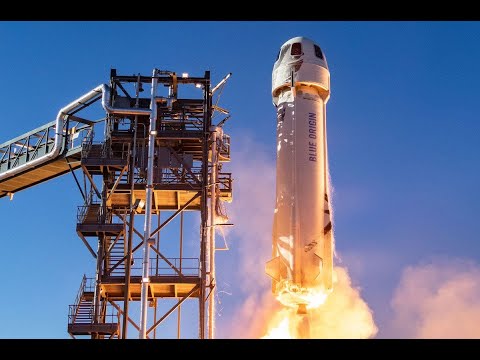
New Shepard, named after Alan Shepard, the first American astronaut in space, is a fully reusable system: a booster with a single BE-3PM engine sends the capsule above the Kármán line, where its occupants experience a few minutes of weightlessness. The capsule returns under three parachutes and the booster lands vertically on the pad it left from. In 2015 it achieved its first uncrewed launch and landing.
On 20 July 2021 the NS-16 mission carried people for the first time: Jeff Bezos, his brother Mark, Wally Funk and Oliver Daemen, on a flight of roughly ten minutes. Further passenger and cargo missions followed. On 12 September 2022, during the uncrewed NS-23 mission, the booster failed around the moment of maximum dynamic pressure; the escape system pulled the capsule away and it landed under parachutes, while the booster was destroyed. The Federal Aviation Administration grounded the vehicle while the mishap was investigated. On 14 April 2025 the company completed its eleventh crewed flight, with an all-female crew of six. In January 2026 it decided to pause tourist flights for at least two years to focus resources on lunar landing work.
New Glenn: the leap to orbit
Design work on the heavy-lift launcher began in 2012. The company publicly announced its orbital plans in September 2015 and revealed the name, New Glenn, honouring astronaut John Glenn, in September 2016. With a diameter of seven metres, a reusable first stage powered by seven BE-4s and a very large payload fairing, the rocket went through years of delays. To fly it the company converted the former Launch Complex 36 at Cape Canaveral, whose facilities were initially completed in 2020.
.jpg)
On 16 January 2025 New Glenn reached orbit on its first flight, placing the Blue Ring Pathfinder test satellite in orbit. On 13 November 2025 it flew its first NASA mission, sending the two ESCAPADE probes towards Mars, and recovered the booster on a landing vessel in the Atlantic. In 2024 the company had won its first National Security Space Launch contract.
Blue Moon and the return to the Moon
Bezos unveiled the Blue Moon lander in May 2019. In 2020 Blue Origin led the so-called "National Team", with Lockheed Martin, Northrop Grumman and Draper, bidding for the Artemis crewed landing system, and won 579 million dollars for the initial phase. In April 2021 NASA picked SpaceX instead, and Blue Origin contested the decision. In a second round, on 19 May 2023, NASA awarded it a contract worth about 3.4 billion dollars to develop Blue Moon for the Artemis V mission, including an uncrewed test flight and a crewed landing planned for 2029.
Other projects
With Sierra Space, Boeing and other partners the company is designing Orbital Reef, a commercial station conceived as a business park in low Earth orbit; NASA raised its funding to 172 million dollars in 2024. Blue Ring, unveiled in October 2023, is a platform for orbital logistics. The company has also taken part in nuclear propulsion studies and in work on producing solar cells from lunar regolith, and in 2026 it announced the TeraWave communications constellation.
Funding, leadership and criticism
By July 2014 Bezos had put more than 500 million dollars into the company, and in 2017 it emerged that he was selling around a billion dollars of Amazon stock each year to fund it. Bob Smith succeeded Meyerson in 2018 and led the company until 2023. Blue Origin was criticised for years for its slow pace compared with SpaceX, and in September 2023 it appointed Dave Limp, a former Amazon executive, as chief executive. In 2023 it had around 11,000 employees.
The 2026 setback
On 28 May 2026, during a static fire test, New Glenn suffered a catastrophic failure that badly damaged Launch Complex 36. The company chose to modify the pad rather than rebuild it as before, agreed with NASA to test the second stage at the Stennis Space Center and, in August 2026, traced the failure to the main oxygen valve on one of the BE-4 engines.
.jpg)
Catalog — Rockets
- 2025
New Glenn
New Glenn is a family of two-stage partially reusable launch vehicles developed and operated by the American company Blue Origin. It is named after NASA astronaut John Glenn, the first American to orbit Earth. All versions use seven-meter diameter stages, and with a payload capacity of 45 tons to low Earth orbit it is the most powerful reusable launch vehicle to reach orbit. The rocket exists in two configurations that should not be conflated. The operational one, New Glenn 7×2, is a heavy-lift vehicle 98 m tall: its 57.5 m GS1 first stage carries seven BE-4 engines burning liquid methane and oxygen, while the 23.4 m GS2 second stage uses two hydrolox BE-3U engines. The configuration under development, New Glenn 9×4, is a super heavy-lift vehicle with nine BE-4 engines on the first stage and four BE-3U on the second. Announced in November 2025, the company says it will be capable of more than 70,000 kg to low Earth orbit, over 14,000 kg on a direct insertion to geosynchronous orbit and more than 20,000 kg to a trans-lunar injection trajectory, together with an enlarged 8.7 m fairing. As with Blue Origin's suborbital New Shepard, New Glenn's first stage is designed for reuse and lands at sea aboard the barge Landing Platform Vessel 1. Blue Origin states that both the 7×2 and 9×4 versions are intended to operate concurrently.
Videos


Show the 6 more



Did you know… about Blue Origin
- Why is blue origin so slow?
Blue Origin was built on deliberate, owner-funded incrementalism: its motto is Gradatim Ferociter, step by step, and it spent its first two decades on…
- Why is blue origin logo a feather?
Blue Origin uses the feather as an emblem of flight itself: the company presents it as a symbol of flight's perfection, grace and freedom rather than of speed…
- What is blue origin company?
Blue Origin is an American space company founded in 2000 by Jeff Bezos and based in Kent, Washington. It builds the reusable suborbital New Shepard, which…
- When was blue origin founded?
Blue Origin was founded in 2000 by Jeff Bezos, two years before SpaceX. It worked almost in silence for its first decade, flew the suborbital New Shepard from…
- How long blue origin in space?
A New Shepard flight lasts about ten to eleven minutes from liftoff to touchdown, of which roughly three minutes are spent in weightlessness above the Kármán…