Fighter · Military · United States
McDonnell Douglas F-4 Phantom II
- May 27, 1958
- First flight
- 1961
- Introduced
- In service
- Status
- 5,195
- Units built


_of_302_Sqn_fly_over_Misawa_Air_Base_during_Cope_North_exercise%2C_-30_Nov._1978_a-1600.webp)
_landing_with_the_Drague_parachute_deployed_at_Gifu_Air_Base_October_30%2C_2016-1600.webp)


-1600.webp)
_of_306_Sqn_takes_off_from_Komatsu_Air_Base%2C_-7_Apr._1986_a-1600.webp)


-1600.webp)


_J79-J-1K%2C_71KN%2C_7460rpm_at_Flugausstellung_Hermeskeil%2C_pic1-1600.webp)
-1600.webp)

-1600.webp)


_in_March_1969-1600.webp)
_off_Vietnam_in_1965-1600.webp)

-1600.webp)
_1975-1600.webp)
The McDonnell Douglas F-4 Phantom II is a large two-seat, twin-engine, all-weather fighter that McDonnell Aircraft designed for the United States Navy as a fleet defence interceptor and which proved equally capable as a fighter-bomber and a reconnaissance platform. It first flew on 27 May 1958, entered Navy service in 1961 — VF-121 had received its first F4H-1Fs on 30 December 1960, which is why some sources date the type's entry into service to that year — and was taken up shortly afterwards by the Marine Corps and the Air Force, becoming the backbone of all three American air arms. With 5195 aircraft built between 1958 and 1981 it is the most-produced American supersonic military aircraft and one of the defining shapes of the Cold War. The design grew out of in-house studies begun in 1953, when McDonnell looked for a way to move beyond its F3H Demon carrier fighter. That family of projects produced the modular «Super Demon» offered to the Navy on 19 September 1953, with interchangeable one- or two-seat noses able to house radar, cameras or cannon. The Navy, already served by the A-4 Skyhawk for attack and the F-8 Crusader for dogfighting, ordered a mock-up but then rewrote the brief: on 26 May 1955 it handed McDonnell an entirely new set of requirements for an all-weather fleet defence interceptor carrying a second crew member to work the radar, on the assumption that a single pilot would be swamped by information in future air combat. The resulting XF4H-1 buried two General Electric J79 engines low in the fuselage, used a thin wing with 45° of leading-edge sweep, and solved the lateral instability found in the wind tunnel without touching the titanium centre section: only the outer wing panels were angled up by 12°, while the all-moving tailplane received 23° of anhedral to stay clear of the exhaust. Robert C. Little took it aloft on 27 May 1958, and on 17 December of the same year the Navy chose it over the Vought XF8U-3 Crusader III. Performance was the Phantom's calling card. It exceeds Mach 2,2 and carries more than 8200 kg of ordnance on nine external hardpoints, from air-to-air and air-to-ground missiles to conventional bombs. Like other interceptors of its generation it was designed without an internal gun, in the belief that missiles had made close combat obsolete; later models restored firepower with the M61 Vulcan rotary cannon. From 1959 the Navy used the aircraft to sweep up world records — fifteen by the most-quoted count — including the absolute altitude mark: on 6 December 1959, during Operation Top Flight, the second XF4H-1 accelerated to Mach 2,5, pitched into a zoom climb and coasted with its engines shut down to 30 040 m. Five of the speed records stood until the F-15 Eagle arrived in 1975. Defense Secretary Robert McNamara's drive for a common fighter brought the naval aircraft to the Air Force: briefly evaluated as the F-110A, it was settled as the F-4C on 18 September 1962, and the first Air Force Phantom flew on 27 May 1963, passing Mach 2 on its maiden flight. Vietnam was its war. It served there first as the principal air superiority fighter of the Navy, Marine Corps and Air Force and later as a ground-attack and reconnaissance aircraft, and every one of the five American servicemen who became aces in that conflict — pilots, weapon systems officers and a radar intercept officer — did so flying a Phantom. Through the 1980s it gave way to the F-15 and F-16 in the Air Force and to the F-14 and F/A-18 in the Navy and Marine Corps, yet the reconnaissance versions and the F-4G Wild Weasel defence-suppression aircraft remained in front-line use through the 1991 Gulf War and left combat service only in 1996. It was also the sole type flown by both American military demonstration teams: the Air Force Thunderbirds with the F-4E and the Navy Blue Angels with the F-4J. As the QF-4 target drone it kept flying until 21 December 2016. Eleven other nations put the Phantom into service. Israeli aircraft saw heavy combat in successive Arab-Israeli wars; Iran flew the large fleet bought before the fall of the Shah throughout the war with Iraq; the United Kingdom ordered bespoke versions re-engined with Rolls-Royce Spey turbofans, the F-4K or Phantom FG.Mk.1 for the Royal Navy and the F-4M or Phantom FGR.Mk.2 for the RAF; and Japan assembled the F-4EJ under licence, so that the very last Phantom built came off the Mitsubishi Heavy Industries line and was delivered on 20 May 1981. Of the total output, 2874 went to the US Air Force and 1264 to the Navy and Marine Corps, with the balance going to export customers. Long after the United States retired it, Greece and Turkey still operate the type, and Turkey's upgraded F-4E Terminator is expected to remain in service until at least 2030.
Three-view drawing
.png)
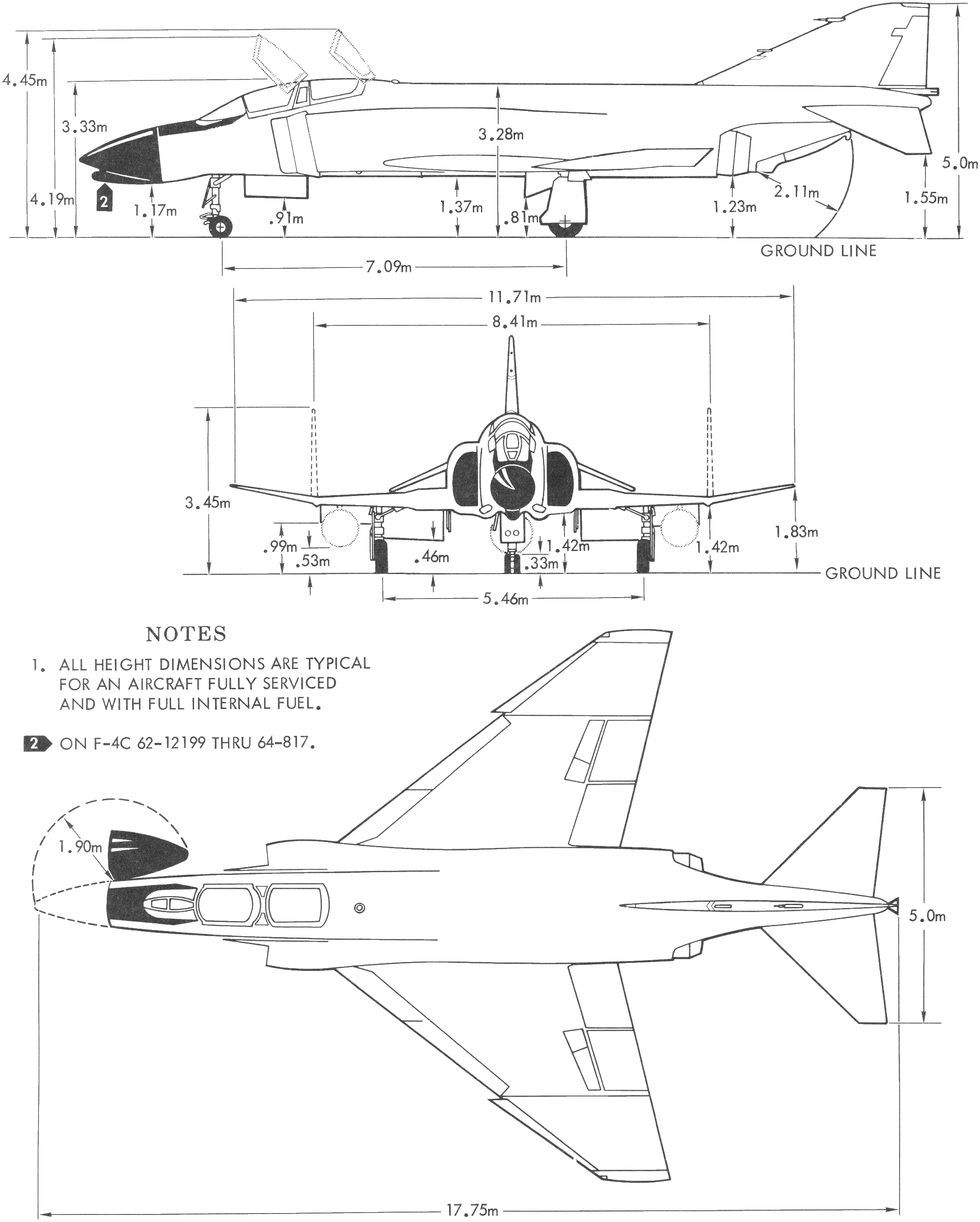
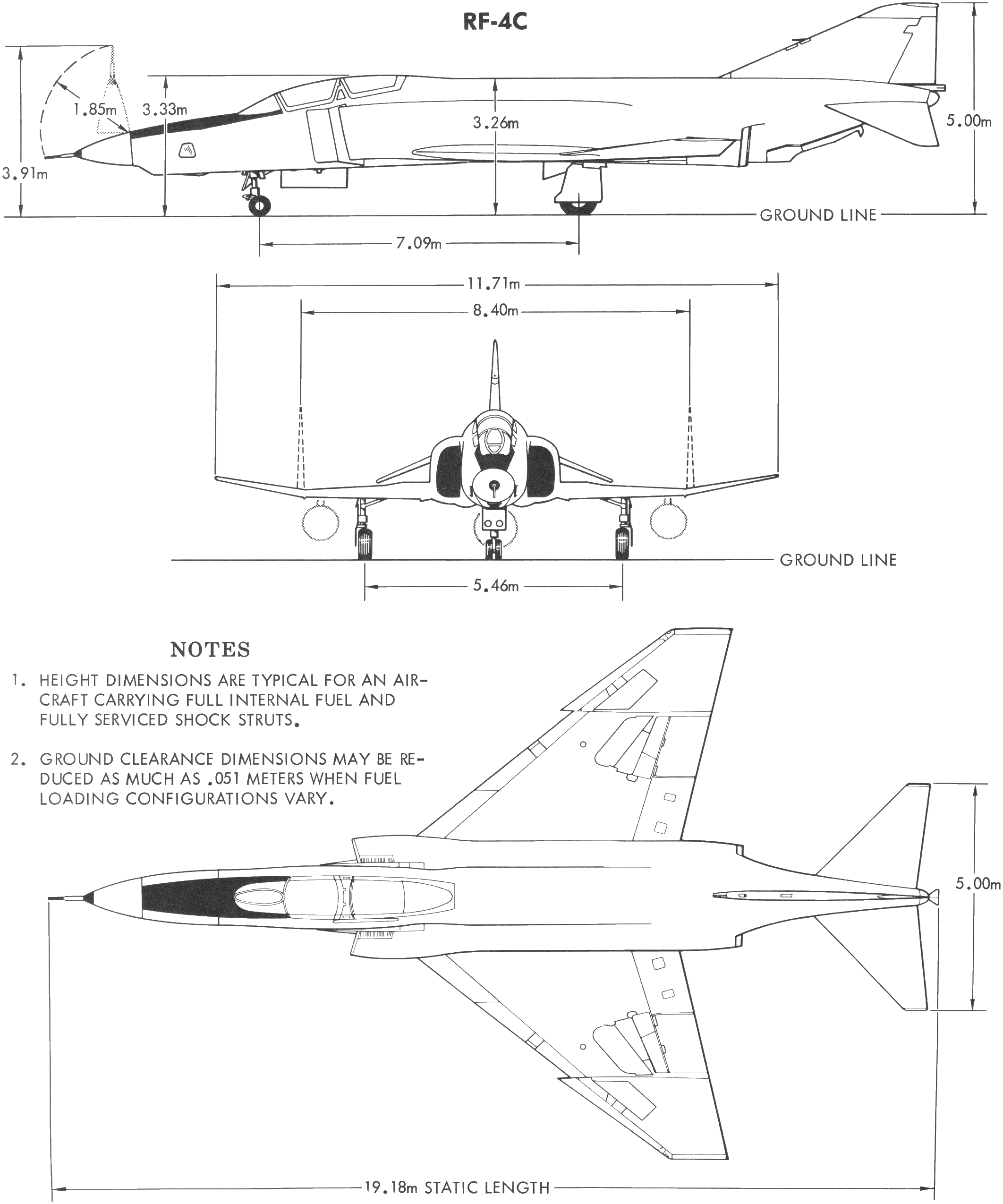
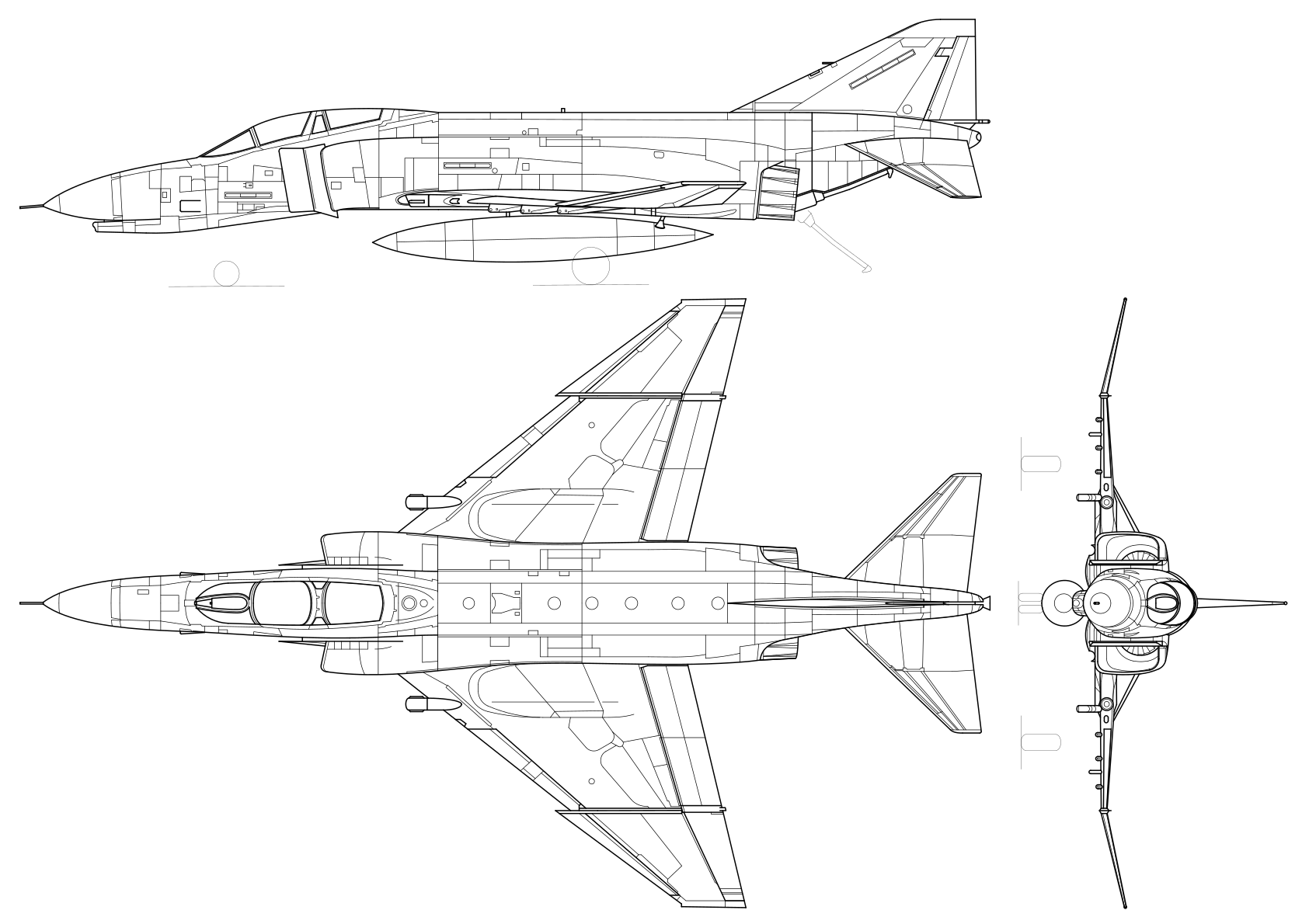
_front_view_at_Komaki_Air_Base_March_13%2C_2016.jpg)
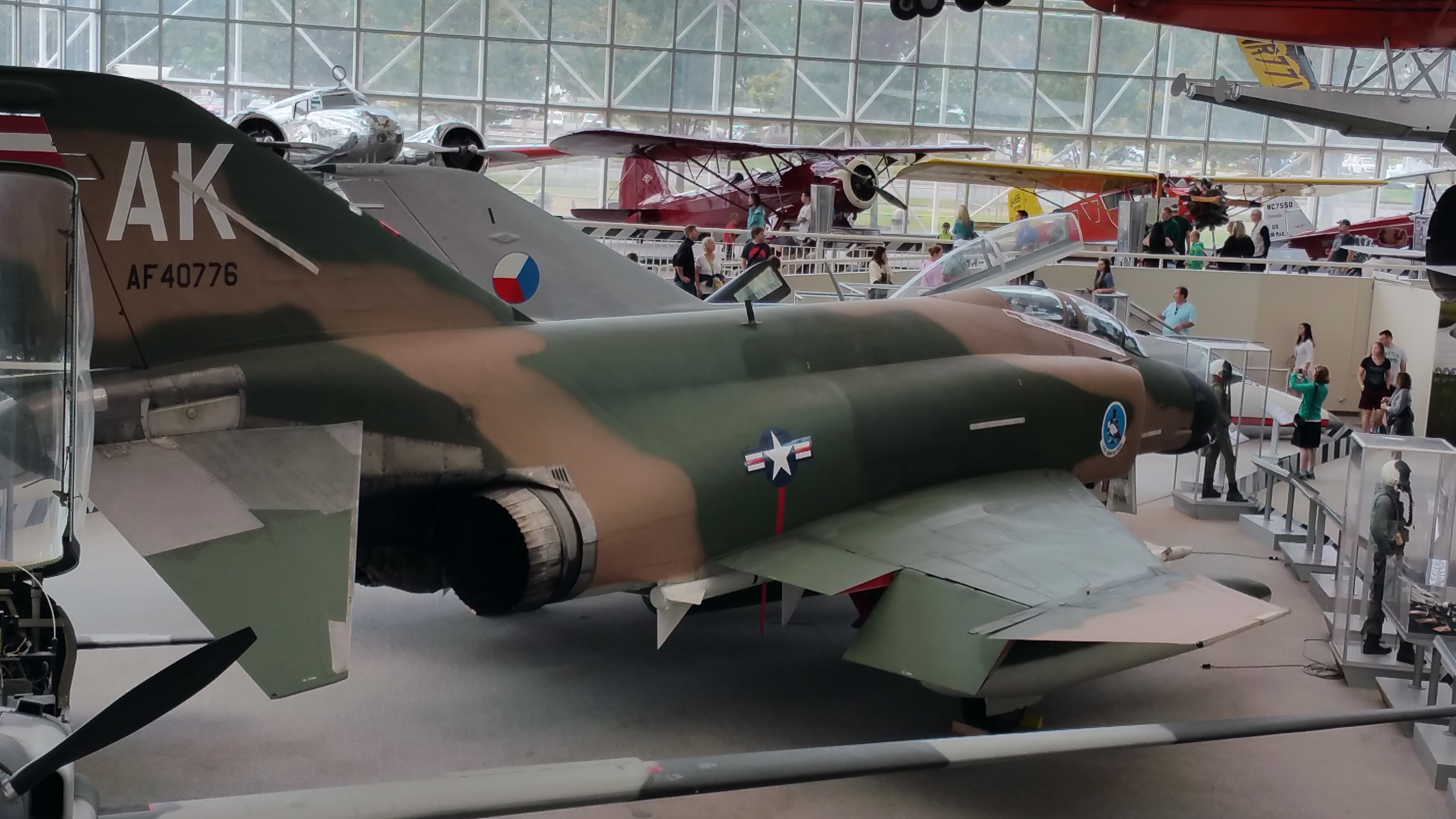
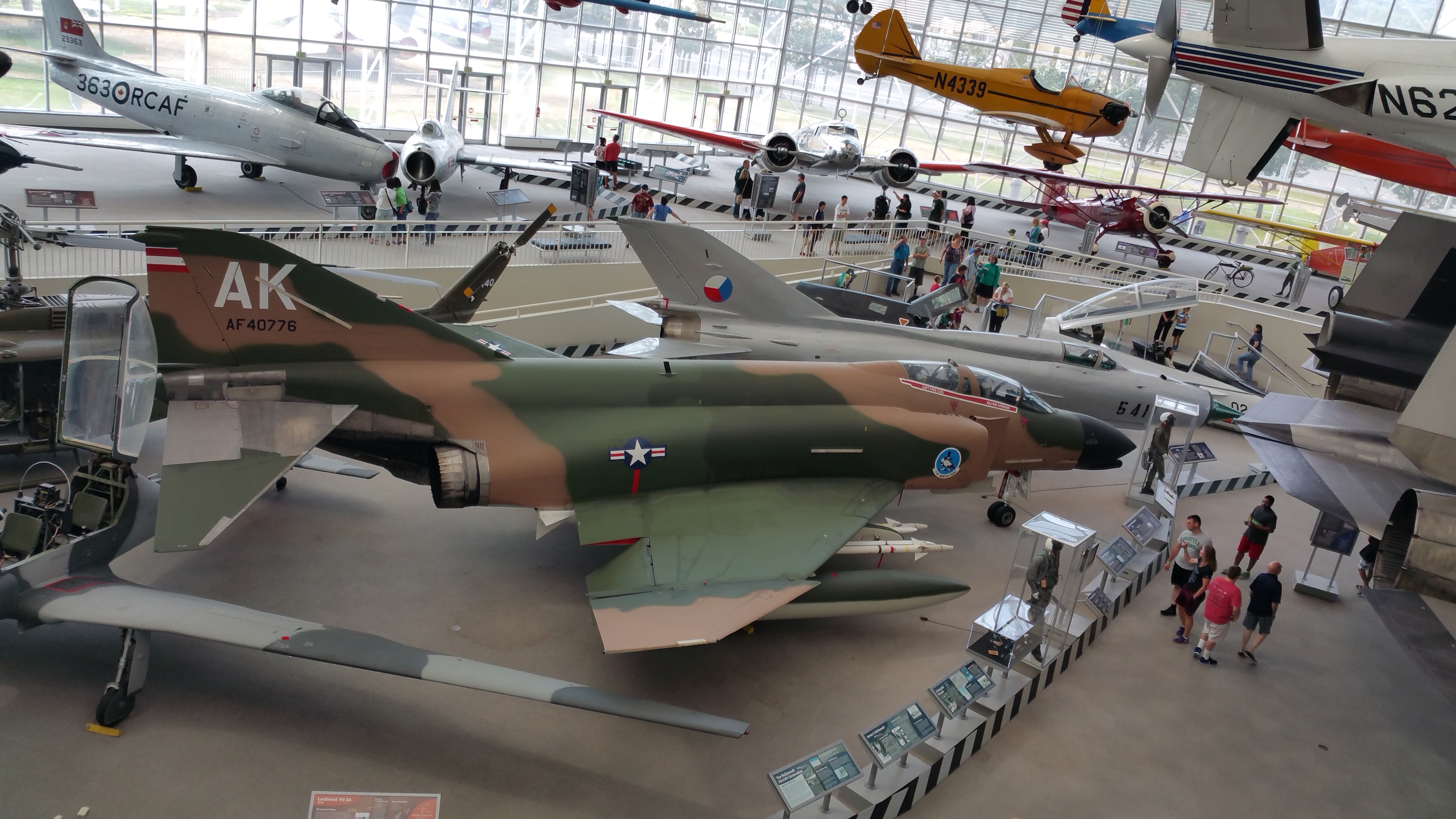
_left_side_view_at_Komaki_Air_Base_February_23%2C_2014.jpg)
History
Origins: from a reworked Demon to a fleet interceptor (1952-1955)
In 1952 McDonnell's chief executive, Jim McDonnell, put Dave Lewis — until then the company's head of aerodynamics — in charge of preliminary design. With no competition in sight, the work began as a commercial question rather than a technical one: what was the customer missing? Internal studies concluded that the clearest gap belonged to the Navy, and that the gap was an attack fighter.
Working from that premise, in 1953 the company set about reworking its F3H Demon carrier fighter for greater capability and better performance. Several branches were explored: one powered by a Wright J67, one by two Wright J65s and one by two General Electric J79s. The last promised the attractive figure of Mach 1.97. On 19 September 1953 McDonnell presented the Navy with the «Super Demon», conceived with unusual modularity: interchangeable one- or two-seat nose sections depending on the mission, and different nose cones housing radar, photographic cameras, four 20 mm cannon or 56 unguided FFAR rockets, all of that on top of nine hardpoints under the wings and fuselage. The Navy was interested enough to order a full-scale mock-up of the F3H-G/H, but concluded that the forthcoming Grumman XF9F-9 and Vought XF8U-1 already covered the need for a supersonic fighter.
The project was then recast as an all-weather fighter-bomber with eleven hardpoints, and on 18 October 1954 the company received a letter of intent for two YAH-1 prototypes. The decisive turn came on 26 May 1955, when four Navy officers arrived at McDonnell's offices and, in less than an hour, laid an entirely new set of requirements on the table. With the Douglas A-4 Skyhawk already assigned to ground attack and the F-8 Crusader to dogfighting, what remained uncovered was an all-weather fleet-defence interceptor. A second crew member was added to work a powerful radar, because the designers assumed that air combat in the next war would overwhelm a single pilot with information. That decision — two crew, a big radar, medium-range missiles — shaped everything that followed.
The XF4H-1 prototype and the duel with the Crusader III
The XF4H-1 was designed to carry four semi-recessed AAM-N-6 Sparrow III radar-guided missiles in its belly and to be powered by two J79-GE-8 engines. As on the McDonnell F-101 Voodoo, the engines sat low in the fuselage to maximise internal fuel capacity and breathed through fixed-geometry intakes. The thin-section wing had 45° of leading-edge sweep and was fitted with blown flaps to improve low-speed handling.
Wind-tunnel testing revealed lateral instability and forced 5° of dihedral into the wing. Rather than rework the titanium centre section, the engineers settled on a compromise that became the aircraft's visual signature: raising only the outer panels by 12°, which averaged out to the required 5° across the span. The wings also received the characteristic dogtooth for better control at high angle of attack. The all-moving tailplane was given 23° of anhedral, likewise to retain authority at high angle of attack by keeping it clear of the engine efflux. The intakes carried one fixed and one variable ramp, scheduled for maximum pressure recovery between Mach 1.4 and Mach 2.2; matching the intake to the engine was handled by bleeding secondary air to the nozzle. All-weather intercept capability rested on the AN/APQ-50 radar. For carrier work the landing gear was stressed for touchdowns at up to 23 feet per second (7 m/s) of sink rate, and the nose leg could extend 20 inches (51 cm) to raise the angle of attack during catapult launch.
On 25 July 1955 the Navy ordered two XF4H-1 test aircraft and five YF4H-1 pre-production machines. The maiden flight took place on 27 May 1958 with Robert C. Little at the controls; a hydraulic problem prevented the gear from retracting, but subsequent flights went better. Early testing forced a redesign of the intakes, including the addition of 12,500 holes to bleed the slow boundary-layer air off the surface of each ramp; production aircraft also received splitter plates to divert it away from the engine. The aircraft competed against the XF8U-3 Crusader III and, on the strength of cockpit workload — the Navy wanted two seats — the F4H was declared the winner on 17 December 1958. Delays to the J79-GE-8 meant the first production aircraft came out with J79-GE-2 and -2A engines rated at 16,100 lbf of afterburning thrust (71.8 kN). Carrier suitability trials began in 1959, and on 15 February 1960 the first full launch-and-recovery cycle was completed aboard USS Independence.
The name, the designation and the move to all three services
There were proposals to call it «Satan» and «Mithras». The less contentious option prevailed: «Phantom II», recalling the company's first Phantom, the FH-1 jet. The Air Force, which came to the programme later, briefly named it «Spectre» under the designation F-110A; the unified tri-service designation system adopted in September 1962 settled the name it is known by: F-4.
The world records (1959-1962)
To show off its new fighter, the Navy ran a string of record flights during development. In total the Phantom set fifteen world records — the figure given both by the reference article's lead and by the Spanish-language article, even though the former's records section counts sixteen — and five of the speed marks stood until the F-15 Eagle arrived in 1975.
- **Operation Top Flight** (6 December 1959): the second XF4H-1 made a ballistic zoom climb to a record 98,557 ft (30,040 m). Commander Lawrence E. Flint Jr. accelerated to Mach 2.5 (2,660 km/h) at 47,000 ft (14,330 m), climbed to 90,000 ft (27,430 m) at a 45° angle, shut down the engines and glided to peak altitude; passing back through 70,000 ft (21,300 m) he restarted them and resumed normal flight. - **5 September 1960**: an F4H-1 averaged 1,958.16 km/h (1,216.78 mph) over a 500 km closed circuit. - **25 September 1960**: an F4H-1F averaged 2,237.37 km/h (1,390.24 mph) over a 100 km closed circuit. - **Operation LANA** (24 May 1961): to mark the fiftieth anniversary of naval aviation — «L» being the Roman numeral for 50 and «ANA» standing for Anniversary of Naval Aviation — several Phantoms crossed the continental United States in under three hours with aerial refuelling. The fastest averaged 1,400.28 km/h (869.74 mph) and completed the run in 2 h 47 min, earning the 1961 Bendix trophy for Lieutenant Richard Gordon — a future NASA astronaut — and his radar intercept officer, Lieutenant Bobbie Young. - **Operation Sageburner** (28 August 1961): an F4H-1F averaged 1,452.777 km/h over a 3-mile (4.82 km) course while staying below 125 ft (38.1 m) throughout. The previous attempt had killed Commander J. L. Felsman on 18 May 1961, when his aircraft disintegrated in the air after a pitch damper failure. - **Operation Skyburner** (22 November 1961): a water-injection-modified Phantom flown by Lieutenant Colonel Robert B. Robinson set the absolute speed record at an average of 2,585.086 km/h (1,606.342 mph) over a 20-mile (32.2 km) out-and-back straight course. - **5 December 1961**: a sustained altitude record of 20,252 m (66,443.8 ft). - **Project High Jump** (early 1962): a series of time-to-climb marks — 34.523 s to 3,000 m, 48.787 s to 6,000 m, 61.629 s to 9,000 m, 77.156 s to 12,000 m and 114.548 s to 15,000 m — all set by F4H-1 production aircraft number 108 (bureau number 148423). Two of them were flown by then-Lieutenant Commander John Young, later a NASA astronaut.
Design: thrust over aerodynamics
The Phantom is a tandem two-seat fighter-bomber that began life as a carrier-based fleet-defence interceptor. Its novelties included extensive structural use of titanium and, on later variants, pulse-Doppler radar. Despite imposing dimensions and a maximum take-off weight of over 60,000 lb (27,000 kg), it reaches Mach 2.23 and an initial climb rate of more than 41,000 ft/min (210 m/s). Its nine hardpoints take up to 18,650 lb (8,480 kg) of ordnance: air-to-air and air-to-surface missiles, unguided and guided bombs, and thermonuclear weapons. Like other interceptors of its era it was designed without an internal gun.
That combination — Mach 2 class, long range and a bomber's worth of ordnance — ended up serving as the template for the next generation of fighters, both heavyweights and the lighter, medium day-fighter designs.
How it flew: «speed is life»
«Speed is life» was its pilots' motto, because the Phantom's edge in combat was acceleration and thrust: they let a skilled pilot enter and leave a fight at will. MiGs generally out-turned it thanks to the Phantom's high drag — a large fighter built to shoot radar-guided missiles beyond visual range, less agile than its Soviet rivals and prone to adverse yaw in hard manoeuvring. Although it could enter unrecoverable spins during aileron rolls, pilots described it as very responsive and easy to fly to the edge of its envelope. In 1972 the F-4E received leading-edge slats that greatly improved high-angle-of-attack manoeuvring at the cost of some top speed.
The J79 had a markedly shorter lag than earlier engines between throttle advance and full thrust, a virtue that saved more than one landing: John Chesire recounted how, when his arrestor hook failed to catch aboard USS Midway after he had mistakenly pulled back to idle, the engine spooled up fast enough on afterburner to get him airborne again. The trade-off was the heavy black smoke at mid power settings, a first-order tactical problem that was only solved two decades after entry into service, with the smokeless combustor of the F-4S.
The lack of an internal gun was, in Chesire's own words, «the biggest flaw of the F-4»: «bullets are cheap and tend to go where you aim them. I needed a gun, and I really wished I had one». Marine Corps General John R. Dailey recalled that «everyone in RF-4s wished they had a gun on the aircraft». For a time doctrine held that dogfighting would be impossible at supersonic speeds and air combat manoeuvring was barely taught; in practice engagements turned subsonic almost at once, because pilots slowed down to get behind their opponents. To that were added the poor reliability of the then-new infrared and radar-guided missiles, which meant firing several to down a single aircraft, and rules of engagement in Vietnam that required visual identification and in practice nullified long-range shots. Many crews found themselves behind an enemy but too close to use their Falcons or Sidewinders. From 1965 Air Force F-4Cs began carrying SUU-16 pods with a 20 mm M61A1 rotary cannon, but the cockpits had no lead-computing gunsight until the SUU-23, which practically guaranteed a miss in manoeuvring combat; the external gun also cost performance in drag and proved inaccurate unless boresighted often, though it remained far cheaper than a missile. The definitive solution came with the M61A1 installed internally in the F-4E.
Production and the family of versions
Very early on the radar was replaced by the Westinghouse AN/APQ-72 — an APQ-50 with a larger antenna — which required the characteristic bulbous nose, and the cockpit was reworked to improve visibility and relieve the cramped rear station.
The Navy operated the F4H-1, redesignated F-4A in 1962, with J79-GE-2 and -2A engines of 16,100 lbf and, on the last examples, the -8. Forty-five F-4As were built; none saw combat and almost all ended as test or training aircraft. The first definitive Phantom was the F-4B for the Navy and Marine Corps, with APQ-72 radar (pulse only), an AN/AAA-4 infrared search-and-track sensor under the nose, an AN/AJB-3 bombing system and J79-GE-8, -8A and -8B engines of 10,900 lbf dry and 16,950 with afterburner. It flew on 25 March 1961 and 649 were built, the first deliveries going that same year to VF-121 «Pacemakers» at NAS Miramar.
The Air Force came to the Phantom through Defense Secretary Robert McNamara's determination to give every service a common fighter. After an F-4B won the «Operation Highspeed» fly-off against the Convair F-106 Delta Dart, the USAF borrowed two Navy F-4Bs — provisionally designated F-110A in January 1962 — and drew up the requirements for its own version. Where the Navy's approach centred on interception for fleet defence, the Air Force wanted an aircraft equally capable air-to-air and air-to-ground. With the unification of designations on 18 September 1962 the Navy version became the F-4B and the USAF one the F-4C; the first Air Force Phantom flew on 27 May 1963 and exceeded Mach 2 on its maiden flight.
The F-4J improved both air combat and ground attack: 522 were delivered between 1966 and 1972, with J79-GE-10 engines of 17,844 lbf, a Westinghouse AN/AWG-10 fire-control system — which made the F-4J the first fighter in the world with an operational look-down/shoot-down capability — a new integrated missile control system and an AN/AJB-7 bombing system.
In 1972 the Navy launched «Project Bee Line» to rebuild F-4Bs with smokeless engines and the F-4J's aerodynamic improvements: 228 aircraft were converted to F-4N by 1978. The F-4S came from rebuilding 265 F-4Js, with smokeless J79-GE-17 engines of 17,900 lbf, AWG-10B radar with digitised circuitry, the Honeywell AN/AVG-8 Visual Target Acquisition Set — the world's first operational helmet-mounted sight — structural reinforcement and leading-edge slats. The Marine Corps also operated the RF-4B photo-reconnaissance version, of which 46 were built: it flew alone and unarmed, required to hold straight and level at 5,000 ft while photographing, relying on the shortcomings of enemy air defences to survive because it could not manoeuvre evasively.
American production ended in 1979 after a total of 5,195 Phantoms had been built (5,057 by McDonnell Douglas and 138 by Mitsubishi in Japan). Of those, 2,874 went to the Air Force, 1,264 to the Navy and Marine Corps and the rest to foreign customers. The last US-built F-4 went to South Korea; the last Phantom of all was an F-4EJ off the Mitsubishi Heavy Industries line, delivered on 20 May 1981.
In the United States Navy
On 30 December 1960 VF-121 «Pacemakers» at NAS Miramar became the first Phantom operator with its F4H-1Fs. VF-74 «Be-devilers» at NAS Oceana was the first deployable squadron to receive it, on 8 July 1961; it completed carrier qualifications that October and made the type's first full deployment between August 1962 and March 1963 aboard USS Forrestal. The second deployable Atlantic Fleet squadron was VF-102 «Diamondbacks», which worked up its aircraft on USS Enterprise's shakedown cruise, and the first in the Pacific Fleet was VF-114 «Aardvarks», embarked in USS Kitty Hawk in September 1962. By the time of the Gulf of Tonkin incident, 13 of the Navy's 31 deployable squadrons were flying the type.
The Phantom's first combat sortie of the Vietnam War was flown by F-4Bs from USS Constellation on 5 August 1964, escorting bombers on Operation Pierce Arrow. Navy fighter pilots were unused to flying with a non-pilot radar intercept officer, but combat soon taught them the advantages of the «guy in back» sharing the workload. The type's first air-to-air victory came on 9 April 1965, when a VF-96 F-4B flown by Lieutenant (junior grade) Terence M. Murphy with Ensign Ronald Fegan as RIO shot down a Chinese MiG-17; the Phantom itself was then downed, probably by an AIM-7 Sparrow from one of its own escorts, and the argument over whether the MiG's cannon or the friendly missile killed it was never fully settled. On 17 June 1965 a VF-21 F-4B crewed by Commander Louis Page and Lieutenant John C. Smith shot down the first North Vietnamese MiG of the war.
On 10 May 1972 Lieutenant Randy «Duke» Cunningham and Lieutenant (junior grade) William P. Driscoll, flying an F-4J with the callsign *Showtime 100*, shot down three MiG-17s and became the war's first American aces. On the way home a surface-to-air missile badly damaged the aircraft and the two kept it flying on rudder and afterburner — the conventional controls were by then almost useless — until they could eject over the sea and avoid capture.
Across the war Navy F-4 squadrons flew 84 combat tours with F-4Bs, F-4Js and F-4Ns. The Navy claimed 40 air-to-air victories in exchange for 73 Phantoms lost in combat (seven to enemy aircraft, 13 to surface-to-air missiles and 53 to anti-aircraft artillery), plus 54 more lost in accidents.
Retirement was staggered: deployable squadrons gave up their F-4Ns in 1984 and the last F-4Ss in 1987. On 25 March 1986 a VF-151 F-4S was the last active-duty Navy Phantom to launch from a carrier, USS Midway; on 18 October that year an F-4S of VF-202, a Naval Reserve squadron, made the last Phantom carrier landing, aboard USS America. In 1987 the last Reserve F-4Ss were replaced by F-14As. The Navy's final Phantoms were QF-4N and QF-4S drones of the Naval Air Warfare Center at NAS Point Mugu, retired in 2004.
In the Marine Corps
The Marines received their first F-4Bs in June 1962, VMFA-314 «Black Knights» at Marine Corps Air Station El Toro, California, being the first operational squadron. Phantoms of VMFA-323 «Death Rattlers», flying from Puerto Rico, provided air cover for Operation Power Pack during the evacuation of American citizens from the Dominican Republic and supported the 508th Infantry Regiment in taking a position east of the Duarte Bridge. On 10 May 1965 the Phantoms of VMFA-531 «Grey Ghosts» settled in at Da Nang Air Base, initially for the Corps' own air defence; they soon began flying close air support, and were joined by VMFA-314, VMFA-232, VMFA-323 and VMFA-542.
Phantoms of VMFA-323 and VMFA-531 embarked in USS Coral Sea took part in Operation Eagle Claw, the attempt to rescue the American hostages in Iran, under orders to shoot down any Iranian aircraft; to avoid confusion with Iranian Phantoms they were painted with an orange stripe flanked by two black ones. The operation was aborted in its early stages.
VMCJ-1 «Golden Hawks» flew the first RF-4B photo-reconnaissance mission on 3 November 1966 from Da Nang and stayed there until 1970 without losing an aircraft and with only one damaged by anti-aircraft fire. In 1975 VMFP-3 was formed at El Toro, concentrating all of the Corps' RF-4Bs and becoming known as «the eyes of the Corps»; it was disbanded in August 1990, once the F/A-18D's advanced tactical airborne reconnaissance system made it unnecessary. The Phantom went on equipping active and reserve fighter-attack squadrons through the 1960s, 1970s, 1980s and early 1990s. Transition to the F/A-18 Hornet began in the early 1980s, fittingly with the same squadron that had introduced the type, VMFA-314. The last Marine Corps Phantom, a Reserve F-4S, was retired on 18 January 1992 by VMFA-112 at NAS Dallas, Texas.
In the Air Force: from F-110A to Wild Weasel
The Air Force, which initially designated the aircraft F-110A, adopted the design quickly and ended up its largest operator. The first Phantoms it flew were Navy-loaned F-4Bs: 27 aircraft delivered to the 4453rd Combat Crew Training Wing at MacDill Air Force Base, Florida, in November 1963. The first operational unit was the 12th Tactical Fighter Wing, which received its first F-4Cs in January 1964 and reached initial operational capability that October. The first USAF Phantoms in the Vietnam War were F-4Cs of the 45th Tactical Fighter Squadron, deployed to Ubon Royal Thai Air Force Base in April 1965.
Unlike the Navy and Marine Corps, who flew with a naval aviator in front and a naval flight officer as RIO behind, the Air Force initially crewed its Phantoms with two rated pilots. Pilots generally disliked the back seat: they could fly and even land the aircraft, but with fewer instruments and a badly restricted forward view. The USAF later assigned qualified navigators to the rear seat as weapon systems officers.
On 10 July 1965 F-4Cs of the 45th TFS scored the Air Force's first victories over North Vietnamese MiG-17s using AIM-9 Sidewinders. On 26 April 1966 an F-4C of the 480th TFS achieved the first American kill of a MiG-21. Losses came just as early: on 24 July 1965 a 45th TFS Phantom was the first American aircraft downed by an enemy surface-to-air missile, and on 5 October 1966 an F-4C of the 8th TFW was the first US jet shot down by an air-to-air missile fired from a MiG-21.
On 2 January 1967 F-4Cs of the 8th Tactical Fighter Wing under Robin Olds flew Operation Bolo in response to heavy losses during Operation Rolling Thunder: they took off from Ubon simulating an F-105 strike package, and when the North Vietnamese air force scrambled its MiG-21s to intercept, the ensuing battle cost it half its MiG-21 fleet without a single American loss.
Early aircraft suffered wing-tank leaks that required resealing after every flight, and cracks were found in outer-wing ribs and stringers on 85 aircraft; there were also problems with the aileron control cylinders, electrical connectors and engine bay fires. The RF-4C reconnaissance version debuted in Vietnam on 30 October 1965 with hazardous post-strike reconnaissance missions. The Thunderbirds display team flew the F-4E from the 1969 season until 1974.
Although the F-4C was essentially identical to the Navy F-4B in performance and carried Sidewinders, the USAF-specific F-4D arrived in June 1967 armed with the AIM-4 Falcon. Designed to bring down heavy bombers in straight and level flight, the Falcon proved as unreliable as its predecessors, and its complex firing sequence and limited seeker cooling time made it practically useless against agile fighters: in 1968 the F-4Ds went back to the Sidewinder under the «Rivet Haste» programme, and by 1972 the AIM-7E-2 «Dogfight Sparrow» was the Air Force pilots' missile of choice. Like every other Phantom in the war, F-4Ds urgently received radar warning receivers to detect Soviet-built S-75 Dvina missiles.
From the F-4C's first deployment to Southeast Asia, USAF Phantoms covered both air superiority and ground attack, supporting troops in South Vietnam and bombing in Laos and North Vietnam. As the F-105 force suffered severe attrition between 1965 and 1968, the F-4's bombing role grew in proportion, until after November 1970 — with the last F-105D withdrawn from combat — it became the Air Force's principal tactical weapons-delivery system. In October 1972 the first EF-4C Wild Weasel squadron deployed on temporary duty to Thailand; the «E» prefix was later dropped and the aircraft became known simply as the F-4C Wild Weasel.
Sixteen Phantom squadrons were permanently based in Indochina between 1965 and 1973, and another seventeen served on temporary combat assignments. The peak came in 1972, with 353 combat F-4s based in Thailand. The Air Force lost 445 Phantom fighter-bombers, 370 of them in combat and 193 over North Vietnam (33 to MiGs, 30 to surface-to-air missiles and 307 to anti-aircraft artillery). The RF-4C was flown by four squadrons and suffered 83 losses, 72 in combat, including 38 over North Vietnam. By the end of the war the Air Force had lost 528 F-4s and RF-4Cs; added to the 233 Navy and Marine losses, the type's total in Vietnam came to 761 aircraft.
On 28 August 1972 Captain Steve Ritchie became the first Air Force ace of the war; on 9 September weapon systems officer Charles B. DeBellevue reached six victories and with them the status of the conflict's highest-scoring American ace, and on 13 October Jeffrey Feinstein became the last USAF ace of the war. Air Force F-4C/D/E crews claimed 107.5 MiG kills in Southeast Asia (50 with Sparrows, 31 with Sidewinders, five with Falcons, 15.5 with the gun and six by other means). Set against those claims, 42 Phantoms were lost in air-to-air combat. North Vietnamese accounts differed sharply: they claimed 103 F-4s downed by MiG-21s against 54 MiG-21s shot down by Phantoms, and acknowledged 131 MiGs lost in air combat over the whole war, half of them to F-4s.
On 31 January 1972 the 170th Tactical Fighter Squadron of the Illinois Air National Guard's 183rd Tactical Fighter Group became the first Guard unit to convert to the Phantom from the Republic F-84F Thunderstreak; in time the type would equip numerous tactical fighter and reconnaissance units in the active Air Force, the Air National Guard and the Reserve. On 2 June 1972 Major Phil Handley shot down a MiG-19 with gunfire over Thud Ridge while flying at Mach 1.2: the only recorded gun kill at supersonic speed.
In early December 1989, Air Force F-4s based at Clark took part in Operation Classic Resolve, President George H. W. Bush's response to the attempted coup in the Philippines: they were ordered to buzz the rebel aircraft at low level, fire on them if they attempted to take off and shoot them down if they succeeded. The passes alone were enough for the coup to collapse.
On 15 August 1990, 24 F-4G Wild Weasel Vs and six RF-4Cs deployed to Shaikh Isa Air Base, Bahrain, for Operation Desert Storm. The F-4G was the only aircraft in the USAF inventory equipped for the suppression of enemy air defences and proved indispensable in protecting the coalition from Iraq's extensive defence network; the RF-4C, for its part, was the only aircraft carrying the KS-127 LOROP camera for very long-range oblique photography. Despite flying almost daily, only one RF-4C was lost, in a fatal accident before hostilities began, and one F-4G that ran out of fuel near a friendly base after taking hits in its tanks. The Air Force's last Phantoms, F-4G Wild Weasel Vs of the 561st Fighter Squadron, were retired on 26 March 1996; the F-4G's last operational flight was made by the Idaho Air National Guard's 190th Fighter Squadron in April that year.
The United Kingdom: the Spey-powered Phantom
The United Kingdom bought versions derived from the naval F-4J for the Royal Air Force and for the Royal Navy's Fleet Air Arm, and was the only country outside the United States to operate the Phantom from aircraft carriers, specifically HMS Ark Royal. The main differences were British Rolls-Royce Spey engines and domestically built avionics. The naval and RAF versions received the designations F-4K and F-4M, and entered service as the Phantom FG.1 (fighter/ground attack) and Phantom FGR.2 (fighter/ground attack/reconnaissance).
The first British order was placed in September 1964: two YF-4K prototypes and two pre-production FG.1 airframes. Larger orders followed in July 1965 — 60 airframes, including two YF-4M prototypes, 20 FG.1s and 38 FGR.2s — and in October 1966 — 159 airframes, 35 FG.1s and 124 FGR.2s — of which seven FG.1s and 46 FGR.2s were later cancelled. The test aircraft came off the line between 1966 and early 1967, the first production model flew on 18 September 1967 and the first three FG.1s were delivered to RNAS Yeovilton on 29 April 1968. The first FGR.2 arrived on 18 July that year and the last Spey-powered Phantom at the end of October 1969.
Initially the FGR.2 was used for ground attack and reconnaissance, chiefly with the RAF in Germany, while 43 Squadron formed in the air defence role on FG.1s originally intended for the Fleet Air Arm aboard HMS Eagle. The Phantom's superiority over the English Electric Lightning in range and weapon system, together with the SEPECAT Jaguar's smooth entry into service, meant that by the mid-1970s most of the strike Phantoms deployed in Germany returned to the United Kingdom to replace the Lightning air-defence squadrons. In 1979 a second RAF squadron formed on FG.1s, 111 Squadron, following the disbandment of 892 NAS.
During the Falklands War in 1982, three Phantom FGR.2s of 29 Squadron stood alert on Ascension Island to protect the base from air attack. After the war fifteen second-hand F-4Js from the US Navy, known as F-4J(UK), entered RAF service to compensate for the interceptor squadron redeployed to the Falklands; the first three arrived at RAF Wattisham on 30 August 1984 and the last in January 1985.
Around fifteen RAF squadrons received Phantom variants, many of them based in West Germany. The first unit to equip was 228 Operational Conversion Unit at RAF Coningsby, in August 1968. 43 Squadron is a singular case: it kept its Phantom FG.1s for twenty years, from September 1969 to July 1989, based at Leuchars. The interceptor Phantoms were replaced by the Panavia Tornado F3 from the late 1980s. Expected to serve until 2003, the restructuring of the British armed forces brought the end forward to 1992: the last British combat Phantoms were withdrawn in October that year with the disbandment of 74(F) Squadron. The very last was FG.1 XT597, retired on 28 January 1994 after a whole career as a test aircraft.
Germany: from the RF-4E to the F-4F ICE
The West German air force found itself needing new aircraft after NATO published its doctrine of flexible response in December 1967. The return to a conventional-war hypothesis in Europe demanded photo-reconnaissance and fighter capabilities well beyond those of the RF-104G and F-104G fleets, which could not operate at night or in bad weather and — in the fighter's case — were inadequate against the MiG-21 the Warsaw Pact was fielding in numbers. They also had to arrive soon, because ageing and fatigue would leave the Luftwaffe below its required strength by around 1976, and the ongoing development of the Panavia Tornado left no capital for designing new aircraft: they had to be bought abroad.
In reconnaissance the competition narrowed to the Lockheed RTF-104G and the McDonnell Douglas RF-4E. The former could reuse the existing RF-104G infrastructure, cost far less — 8 million marks against the RF-4E's 23 million — and could be licence-built on Messerschmitt-Bölkow-Blohm's F-104G line, keeping the money in Germany. Weighing against it were safety and power: the US Air Force recorded nine F-4 losses against twenty-five F-104 losses per hundred thousand flight hours, and the German experience with the Starfighter had been marked by accidents. The Phantom was also helped by industrial offsets, with 3,000 million marks set aside to buy American defence equipment outside the ordinary budget. In 1969 the Defence Ministry decided to acquire 88 RF-4Es for 2,052 million marks. Although they were not built in Germany, they were not entirely American either: firms such as MBB produced tailplanes, landing-gear doors, outer wing panels and ailerons that were shipped to McDonnell Douglas's St. Louis plant for final assembly.
The RF-4E first flew on 15 September 1970 and the first four aircraft were received at Bremgarten on 20 January 1971. In 1978 it was decided to adapt them to a secondary ground-attack role with the same equipment as the F-4F and to improve their self-defence with new flare and chaff dispensers and a more capable radar warning receiver. In the mid-1980s 71 aircraft received a second modernisation, given that no replacement was foreseeable before 2005: the airframe flight-hour limit was raised from 4,500 to 8,000, laser and GPS navigation were fitted along with an AN/APQ-172 terrain-following radar, and the AIM-9L was integrated. After reunification and the end of the Cold War, cuts in military spending led to 27 RF-4Es being sold to Greece — seven of them for spares — and another 46 to Turkey. The Luftwaffe retired the type in 1994.
In the fighter competition, designed expressly not to repeat the F-104's loss rates, two requirements proved decisive: an all-weather navigation system and two engines. The SEPECAT Jaguar, Saab Viggen, Dassault Mirage F1, Northrop F-5, Northrop P-530 and McDonnell Douglas F-4F competed; the earlier adoption of the RF-4E, together with the F-4F's advantages in range and weapons load, decided the outcome, and on 24 June 1971 an order for 175 aircraft was signed under the «Peace Rhine» programme. The F-4F was a simplified version of the E, some 1,500 kilograms lighter for dispensing with the ram-air turbine, the rear fuselage fuel tank, the slotted stabilators and AIM-7 Sparrow capability; that weight reduction, combined with leading-edge slats the RF-4E lacked, made it markedly more manoeuvrable, especially at low speed. All the F-4Fs were delivered between 1973 and 1976, and those purchases made Germany the Phantom's largest export customer.
The F-4F flew on 18 March 1973 and was presented publicly on 24 May. The first twelve aircraft went to George Air Force Base, in cooperation with the 35th Tactical Fighter Wing, to set up an operational conversion unit, which the pilots of Jagdgeschwader 71 joined on 1 January 1974. With the front line pressing, those F-4Fs were replaced in 1975 by ten new F-4Es that stayed in the United States for training until their retirement in 1997.
The decisive upgrade was the Improved Combat Efficiency programme (ICE, or *Kampfwertsteigerung*), begun in 1983 to give the aircraft substantially better air-to-air and air-to-ground weapons, including beyond-visual-range missiles. The 153 front-line F-4Fs first received the KWS-LA ground-attack update, with laser navigation and structural reinforcement that raised the airframe hour limit from 4,000 to 6,500; of those, 110 then went through the KWS-LV air-defence update, with AN/APG-65GY radar, a new mission computer and AIM-120 AMRAAM compatibility. The F-4F KWS-LV entered service in 1992 and was expected to serve until 2012. The last German Phantoms were based at Wittmund with Jagdgeschwader 71 and at Manching with WTD 61; 24 F-4Fs were operated by the American 49th Tactical Fighter Wing at Holloman to train German crews until December 2004. Germany deployed Phantoms on Baltic Air Policing in 2005, 2008, 2009, 2011 and 2012, and retired the last F-4Fs on 29 June 2013, after 279,000 flight hours since entering service on 31 August 1973.
Spain: the Phantom in the Ejército del Aire
In 1953 the Spanish government signed the military agreements with the United States, and the renewal in August 1970 of the Mutual Defence Assistance Agreement opened the way to aircraft transfers. The outcome was the delivery of thirty-six Phantoms to the Ejército del Aire in 1971 under the «Peace Alfa» programme. The deal came to 7,200,000,000 pesetas and included three KC-97L tankers — designated TK.1 in Spain — and two C-97s destined to be a source of spares.
The Spanish selection commission preferred the F-4E, but financial constraints forced it to accept the older, more limited F-4C. The aircraft chosen had been built in 1964 for the US Air Force and were serving with the 81st FW in Britain. They began arriving in February 1971 and by 1972 all thirty-six were in place, designated C.12.
The first fatal accident came on 28 November 1973, with the loss of C.12-5 and its two captains; others followed on 14 February 1975 and 14 October 1977, and in July 1978 a fire wrote off another aircraft. To make up the losses and keep Ala 12 operational, four additional F-4Cs were bought from the American 58th FW, in an order that also included four RF-4C reconnaissance aircraft, designated CR.12. Between them, the Spanish fleet reached some 55,000 flight hours in around 36,200 sorties, with four more aircraft lost: C.12-13 in May 1979, with both crew killed; C.12-35 in April 1983, with an unhurt ejection; C.12-24 in May 1984, with two captains killed; and C.12-06 in February 1985, from which an American and a Spanish captain ejected unhurt.
By the late 1980s keeping an acceptable number of F-4Cs flying had become difficult and expensive because of breakdowns and the shortage of spares. In late 1988 eight RF-4Cs were bought from the Kentucky Air National Guard, reviving 123 Escuadrón. The arrival of EF-18s at Zaragoza from 1986 and later at Torrejón gradually relegated the F-4C to a secondary role, though not the RF-4C, which remained the only effective aerial reconnaissance asset Spain had; to reinforce it a further batch of six RF-4Cs was acquired, fitted with an in-flight refuelling probe compatible with the Spanish KC-707s. During 1989 all the F-4Cs were struck off charge, with a total of 69,772 flight hours over eighteen years of service and seven aircraft lost; Spain was the last country to retire this Phantom variant. The RF-4Cs were withdrawn between 1999 and 2001, and in February 2002 those still in service were grounded.
The other foreign operators
**Israel** acquired between 212 and 222 aircraft, new and second-hand from the US Air Force, and modified several as unique reconnaissance versions. The first F-4Es, nicknamed *Kurnass* («sledgehammer»), and RF-4Es, nicknamed *Orev* («crow»), were delivered in 1969 under the «Peace Echo I» programme; more followed through the 1970s with «Peace Echo II» to «V» and «Nickel Grass». Israeli Phantoms saw heavy combat in the Arab-Israeli conflicts, beginning with the War of Attrition. In the 1980s Israel launched the «Kurnass 2000» modernisation programme, thoroughly renewing the avionics. The last were retired in 2004.
**Iran** received 225 F-4Ds, F-4Es and RF-4Es while Tehran and Washington were allies, making it the type's second-largest export customer. The Imperial Iranian Air Force suffered at least one engagement with a loss, when a Soviet MiG-21 rammed an RF-4C during the Dark Gene electronic intelligence project. After the revolution, the Islamic Republic's Phantoms fought hard in the Iran-Iraq War, kept flying by the country's aviation industry. Among their actions were Operation Scorch Sword — the attack by two F-4s on the Iraqi Osirak nuclear reactor near Baghdad on 30 September 1980 — and the H3 strike of 4 April 1981, when eight Iranian F-4s hit the H-3 airbase complex in Iraq's far west, destroying or damaging numerous Iraqi aircraft without loss. On 5 June 1984 two Saudi F-15s shot down two Iranian F-4s over the Persian Gulf. Iranian Phantoms were still in use in late 2014, when they were credited with strikes on Islamic State targets in Iraq's Diyala province, and three F-4Es of the 91st Tactical Fighter Squadron took part in the 2024 Kish air show.
**Japan** bought a total of 140 F-4EJs from 1968, without an in-flight refuelling probe, without AGM-12 Bullpup missile provision, without nuclear control and without ground-attack capability. Mitsubishi built 138 under licence and fourteen unarmed RF-4E reconnaissance aircraft were imported. Of these, 96 F-4EJs were upgraded to F-4EJ Kai standard and fifteen F-4EJs and F-4EJ Kais were converted into RF-4EJ reconnaissance aircraft. In 2007 Japan still had ninety Phantoms in service. With the F-35A chosen as the replacement in 2011, the 302nd Tactical Fighter Squadron was the first to convert, in March 2019; the 501st Tactical Reconnaissance Squadron retired its RF-4Es and RF-4EJs on 9 March 2020 and disbanded that same month. The 301st Squadron, the last F-4EJ user in Air Defense Command, announced on 20 November 2020 that its retirement had been brought forward: it flew until 10 December and its aircraft were struck off on the 14th. Two F-4EJs and one F-4EJ Kai kept flying with the development and test wing in Gifu Prefecture until 17 March 2021, ending the Phantom's career in Japan.
**Greece** signed a contract in 1972 for 36 new F-4Es, delivered from 1974, and in the early 1990s took on surplus RF-4Es and F-4Es from the Luftwaffe and the US Air National Guard. Following the success of the German ICE programme, on 11 August 1997 DASA and Hellenic Aerospace Industry signed an agreement to modernise 39 aircraft to the very similar «Peace Icarus 2000» standard. The Greek RF-4E was officially retired on 5 May 2017.
**Turkey** received 40 F-4Es in 1974, another 32 F-4Es and eight RF-4Es in 1977-1978 under «Peace Diamond III», 40 surplus American aircraft under «Peace Diamond IV» in 1987 and another 40 from the Air National Guard in 1991, plus 32 RF-4Es transferred by the Luftwaffe between 1992 and 1994. In 1995 Israel Aerospace Industries applied a Kurnass 2000-like modernisation to 54 Turkish F-4Es, producing the F-4E 2020 Terminator. Turkish Phantoms have been used, alongside F-16s, against PKK bases in northern Iraq. On 22 June 2012 Syrian air defences shot down a Turkish RF-4E near the shared border, in an incident where the two countries disagreed over whether the aircraft was in international or Syrian airspace. Two crashes in 2015 — two RF-4Es on 24 February and an F-4E-2020 on 5 March — led to the RF-4E being withdrawn from active service. Turkey expects to keep its F-4E 2020s flying until at least 2030.
**South Korea** received its first batch of used F-4Ds from the US Air Force in 1969 under the «Peace Spectator» programme, with deliveries continuing until 1988; the «Peace Pheasant II» programme added new and second-hand F-4Es. In 1975 the country funded the purchase of five new Phantoms through a public subscription. In all the ROKAF operated 92 F-4Ds, 27 RF-4Cs and 103 F-4Es; the last F-4Es were retired on 7 June 2024.
**Australia** leased 24 F-4Es from the US Air Force between 1970 and 1973 while waiting for delivery of its General Dynamics F-111Cs. They were liked well enough that the Royal Australian Air Force considered keeping them; they operated from RAAF Base Amberley with No. 1 and No. 6 Squadrons.
**Egypt** bought thirty-five surplus American F-4Es in 1979 together with Sparrow, Sidewinder and Maverick missiles for 594 million dollars, under the «Peace Pharaoh» programme; it acquired seven more in 1988 and received three further aircraft as attrition replacements up to the late 1990s. The Egyptian F-4Es were retired in 2020 and their Cairo West base was reconfigured to operate F-16C/Ds.
Drones, civil use and test work
Like the Navy, the Air Force converted Phantoms into QF-4 target drones, operated by the 82nd Aerial Targets Squadron at Tyndall Air Force Base, Florida, and Holloman Air Force Base, New Mexico. The programme reached initial operational capability in 1997, replacing the QF-106 — the last of which was shot down on 20 February 1997. BAE Systems delivered its 314th and final QF-4 on 19 November 2013: an RF-4C that had spent more than twenty years in storage. Over sixteen years the company had converted 314 F-4s and RF-4s into QF-4s and QRF-4s, at a rate of six months per aircraft. By late 2013 those aircraft had flown more than 16,000 manned and 600 unmanned sorties, with 250 shot down in live-fire exercises. The replacement was the QF-16, of which 126 were planned; the first was delivered to Tyndall in September 2014. The last QF-4 flight from Tyndall took place on 27 May 2015, leaving the 53rd Weapons Evaluation Group at Holloman as the sole operator of the remaining 22 QF-4s. The final unmanned flight came on 17 August 2016, when an F-35 Lightning II fired on QF-4E 72-0166, which nonetheless returned to base. The type was officially retired from US military service with a four-ship formation at Holloman on 21 December 2016; the last thirteen QF-4s were demilitarised from 1 January 2017 and went to the White Sands range as static targets. Throughout their drone career, several QF-4s retained the ability to fly manned and were kept in historic paint schemes to take part in Air Combat Command Heritage Flight displays.
Outside the military sphere, in 1988 Sandia National Laboratories mounted an F-4 on a rocket sled and crashed it into a reinforced concrete block to study aircraft impacts against structures such as those of a nuclear power plant. An F-4D registered NX749CF flies as a Collings Foundation «living history» display, sustained by donations and sponsorship. NASA, for its part, used the Phantom in the 1960s to photograph and film Titan II missiles after launch from Cape Canaveral, once the F-104 Starfighter had proved inadequate: retired Colonel Jack Petry described diving at Mach 1.2 in sync with the countdown and «riding the contrail» for ninety seconds, up to 68,000 ft. NASA's Flight Research Center received an F-4A on 3 December 1965 and flew 55 chase missions with it on X-15 and lifting-body flights; the type also took part in a biomedical monitoring programme spanning 1,000 flights, in a 1967 test of the possibility of steering a sonic boom, and in a spanwise blowing study carried out with an F-4C between 1983 and 1985.
Legacy, nicknames and «the Spook»
The F-4 Phantom II is regarded as an iconic aircraft of post-Second World War military aviation, celebrated for its versatility, its performance and an unmistakable silhouette. With 5,195 built over more than twenty years and in numerous versions, it was the best-selling supersonic fighter in American history, and it remains the last aircraft on which a US serviceman of any branch has become an ace.
The nicknames piled up: «Snoopy», «Rhino», «Double Ugly», «Old Smokey», the «flying anvil», the «flying footlocker», the «flying brick», «Lead Sled», the «big iron sled» and the «St. Louis Slugger», after the city where it was built. Its record against Soviet-built aircraft earned it the title of «world's leading distributor of MiG parts», and its performance despite its bulk brought the verdict that it was «the triumph of thrust over aerodynamics». German crews called it *Eisenschwein* («iron pig»), *Fliegender Ziegelstein* («flying brick») and *Luftverteidigungsdiesel* («air defence diesel»); in the RAF it was «The Toom» and in the Turkish Air Force *Baba* («father»). McDonnell fed the phenomenon with a series of patches playing on the spelling of the name: pilots were Phantom Phlyers, back-seaters Phantom Pherrets, enthusiasts Phantom Phanatics and ground crew Phantom Phixers. Retired Colonel Chuck DeBellevue summed it up: «the F-4 Phantom was the last aircraft that looked like it was made to kill somebody. It was a beast».
The aircraft's emblem is a cartoon ghost called «The Spook», created by McDonnell Douglas technical illustrator Anthony «Tony» Wong for shoulder patches; the name was coined by crews of the 12th Tactical Fighter Wing or the 4453rd Combat Crew Training Wing at MacDill. The figure appears on all manner of Phantom-related items and has picked up local styling in each country: the British adaptation of the American «Phantom Man» is a Spook that sometimes sports a bowler hat and smokes a pipe.
An accident that marked the Navy
On 5 August 1967, with USS Forrestal off the coast of Indochina to strike North Vietnam, an electrical fault fired a Zuni rocket from an F-4. The projectile hit the fuel tank of an A-4 Skyhawk and started a fire that spread to other aircraft and detonated several bombs. The fire and explosions killed 134 men and seriously injured another 161 in what is known as the 1967 USS Forrestal fire.
Current status
The figures in this section are a dated count, not a permanent state: they change with every retirement, sale or loss. In 2008 there were 631 Phantoms still in service worldwide. By June 2025 the figure had fallen to 98, split between Greece (17), Turkey (19) and Iran (62); the Iranian number has since fallen further through the Israeli strikes of the war with Iran, which destroyed at least one F-4 at Tabriz air base and several more at the 3rd Tactical Air Base in Hamadan province. The Phantom thus remains in active service with the Greek and Turkish air forces, and the Turkish F-4E 2020 Terminator is expected to fly until at least 2030.
Variants
| YF4H-1 / F4H-1F / F-4A | F-110A Spectre / F-4C | F-4D | F-4E | F-4EJ | F-4F | F-4G Wild Weasel | F4H-1 / F-4B | F-4J | F-4K | F-4M | F-4N | F-4S | QF-4 | RF-4B | RF-4C | RF-4E | |
|---|---|---|---|---|---|---|---|---|---|---|---|---|---|---|---|---|---|
| First flight | May 27, 1958 | — | — | — | — | — | — | — | — | — | — | — | — | — | — | — | — |
| Aircraft type | — | — | — | multirole fighter-bomber | — | — | SEAD / Wild Weasel fighter | carrier-based interceptor and air-superiority fighter | — | — | — | — | — | — | — | tactical photo-reconnaissance aircraft | — |
| Powerplant | — | — | — | Two afterburning General Electric J79-GE-17 turbojets, 52.8 kN dry and 79.6 kN with afterburner each. | — | — | — | — | — | — | — | — | — | — | — | — | — |
| Powerplant | 2 × turbojet | 2 × turbojet | 2 × turbojet | 2 × General Electric J79-GE-17 | 2 × turbojet | 2 × turbojet | 2 × turbojet | 2 × General Electric J79-GE-8 | 2 × turbojet | 2 × Rolls-Royce Spey 201 | 2 × Rolls-Royce RB.168-25R Spey Mk.202/203 | 2 × turbojet | 2 × turbojet | 2 × turbojet | 2 × turbojet | 2 × General Electric J79-GE-15 | 2 × turbojet |
| Thrust per engine | — | — | — | 79.6 kN | — | — | — | 75.6 kN | — | — | 91.2 kN Best value in this row | — | — | — | — | 75.6 kN | — |
| Length | — | — | — | 19.2 m Best value in this row | — | — | — | 17.8 m | — | — | 17.6 m | — | — | — | — | 19.2 m | — |
| Wingspan | — | — | — | 11.7 m Best value in this row | — | — | — | 11.7 m Best value in this row | — | — | 11.7 m Best value in this row | — | — | — | — | 11.7 m Best value in this row | — |
| Height | — | — | — | 5 m Best value in this row | — | — | — | 5 m | — | — | 4.9 m | — | — | — | — | 5 m Best value in this row | — |
| Wing area | — | — | — | 49.2 m² Best value in this row | — | — | — | 49.2 m² Best value in this row | — | — | 49.2 m² Best value in this row | — | — | — | — | 49.2 m² Best value in this row | — |
| Empty weight | — | — | — | 13,396 kg | — | — | — | 12,701 kg Best value in this row | — | — | 14,061 kg | — | — | — | — | 12,825 kg | — |
| MTOW | — | — | — | 27,964 kg Best value in this row | — | — | — | 24,766 kg | — | — | 25,401 kg | — | — | — | — | 26,308 kg | — |
| Top speed | — | — | — | 2,301 km/h | — | — | — | 2,390 km/h Best value in this row | — | — | 2,231 km/h | — | — | — | — | 2,348 km/h | — |
| Max speed altitude | — | — | — | 10,973 m | — | — | — | 14,630 m | — | — | 12,192 m | — | — | — | — | 14,630 m | — |
| Cruise speed | — | — | — | 941 km/h | — | — | — | — | — | — | — | — | — | — | — | 945 km/h Best value in this row | — |
| Service ceiling | — | — | — | 18,974 m Best value in this row | — | — | — | 18,898 m | — | — | 18,288 m | — | — | — | — | 18,105 m | — |
| Initial climb rate | — | — | — | 312 m/s Best value in this row | — | — | — | 142 m/s | — | — | 163 m/s | — | — | — | — | 245 m/s | — |
| Ferry range | — | — | — | 3,034 km | — | — | — | 3,702 km Best value in this row | — | — | 2,816 km | — | — | — | — | 2,816 km | — |
| Combat radius | — | — | — | — | — | — | — | 644 km | — | — | 1,609 km Best value in this row | — | — | — | — | 1,352 km | — |
| Range conditions | — | — | — | Combat range of 958 km; maximum ferry range of 3,034 km with external fuel tanks. | — | — | — | — | — | — | — | — | — | — | — | — | — |
| Armament | — | — | — | 20 mm M61A1 Vulcan cannon with 639 rounds in an undernose fairing; up to 4 semi-recessed AIM-7 Sparrow missiles and 2 to 4 AIM-9 Sidewinders on inner underwing pylons; maximum offensive load of 7,257 kg on the centerline and four underwing hardpoints. | — | — | No internal cannon (replaced by the AN/APR-38 system fairing); AGM-45 Shrike and AGM-78 Standard anti-radiation missiles. | Four semi-active radar-homing AIM-7 Sparrow missiles in fuselage recesses; inner underwing pylons could carry additional Sparrows or AIM-9 Sidewinder pairs; in the ground-attack role, up to 7,257 kg of ordnance on the centerline and four underwing hardpoints. | — | — | Four semi-recessed AIM-7 Sparrow missiles in the fuselage belly and two to four AIM-9 Sidewinders on the inner underwing pylons; total offensive load of up to 7,257 kg on the centerline and four underwing hardpoints. | — | — | None: an unmanned aircraft used as an aerial target, carrying no armament. | None: a photo-reconnaissance aircraft carrying no armament. | None: the nose houses reconnaissance cameras instead of weapons; no cannon or air-to-air missile pylons. | — |
| Max weapons load | — | — | — | 7,257 kg Best value in this row | — | — | — | 7,257 kg Best value in this row | — | — | 7,257 kg Best value in this row | — | — | 0 kg | 0 kg | 0 kg | — |
| Payload | — | — | — | 0 kg Best value in this row | — | — | — | — | — | — | — | — | — | 0 kg Best value in this row | — | 0 kg Best value in this row | — |
| Cargo capacity | — | — | — | No civilian payload capacity: a pure fighter-bomber with no transport variant. | — | — | — | — | — | — | — | — | — | — | — | No civilian or transport-type payload capacity: internal and podded photographic sensors only. | — |
| Crew | — | — | — | 2 Best value in this row | — | — | 2 Best value in this row | 2 Best value in this row | — | — | 2 Best value in this row | — | — | — | — | 2 Best value in this row | — |
| Passengers | — | — | — | 0 | — | — | — | — | — | — | — | — | — | — | — | — | — |
| Units built | 45 | — | 825 Best value in this row | — | — | — | 116 | — | — | — | — | — | — | — | — | — | — |
Images
Elsewhere
- FlightGlobal ImagesDespiece (cutaway) del McDonnell Douglas F-4K Phantom — Flight International ↗
- National Air and Space MuseumF-4S Phantom II BuNo 157307 del NASM — ficha de colección con fotografías del aparato ↗
- National Air and Space MuseumF-4A «Sageburner», récord de velocidad a baja cota — ficha de colección ilustrada ↗
- National Air and Space MuseumMaqueta estática del F-4E Phantom II en la colección del NASM ↗
- National Air and Space MuseumTurborreactor General Electric J79 del Phantom — ficha de colección con fotografías ↗
- National Air and Space MuseumEl F-4S Phantom II expuesto en el centro Udvar-Hazy ↗
- National Air and Space MuseumF-4B Phantom II en ascenso vertical, hacia 1973 ↗
- National Air and Space MuseumF-4S Phantom II — vista del aparato conservado en el NASM ↗
- National Air and Space MuseumF-4S Phantom II — segunda vista del aparato del NASM ↗
- National Air and Space MuseumEl Phantom de Flynn y John en vuelo, el día que derribaron un MiG-21 ↗
- National Air and Space MuseumEl mismo Phantom, ya convertido en F-4S, expuesto en el museo ↗
- National Air and Space MuseumCabina de un F-4 Phantom en Vietnam: Kovaleski y Plautz, último derribo sobre Vietnam del Norte ↗
Show the 14 more
- National Air and Space MuseumPhantom del VF-161 conservado a bordo del USS Midway Museum ↗
- National Air and Space MuseumPintando la silueta del MiG derribado en la toma de aire del Phantom ↗
- National Air and Space MuseumCasey Tissue y el F-4 Phantom II ↗
- RAF MuseumPhantom FGR.2 (F-4M) de la RAF — ficha ilustrada del ejemplar conservado ↗
- National Naval Aviation MuseumF-4N Phantom II del VF-154 «Black Knights» — ficha fotográfica ↗
- National Naval Aviation MuseumF-4N Phantom II en las galerías del museo naval de Pensacola ↗
- The Museum of FlightF-4C (F-110A) Phantom II del 389th TFS, con tres derribos de MiG-21 ↗
- Pima Air & Space MuseumF-4N Phantom II conservado en Pima Air & Space Museum ↗
- Pima Air & Space MuseumF-4C Phantom II conservado en Pima Air & Space Museum ↗
- Pima Air & Space MuseumF-4J Phantom II conservado en Pima Air & Space Museum ↗
- March Field Air MuseumF-4C Phantom II 63-7693 del March Field Air Museum ↗
- FlickrPhantom XT596 del Fleet Air Arm Museum, Yeovilton ↗
- FlickrSección de cabina del Phantom FGR.2 XV426, City of Norwich Aviation Museum ↗
- FlickrPhantom FGR.2 XV435 y XV488 del 92 Sqn, julio de 1987 ↗