McDonnell Douglas F-4 Phantom II variant
McDonnell Douglas F-4 Phantom II F-4F
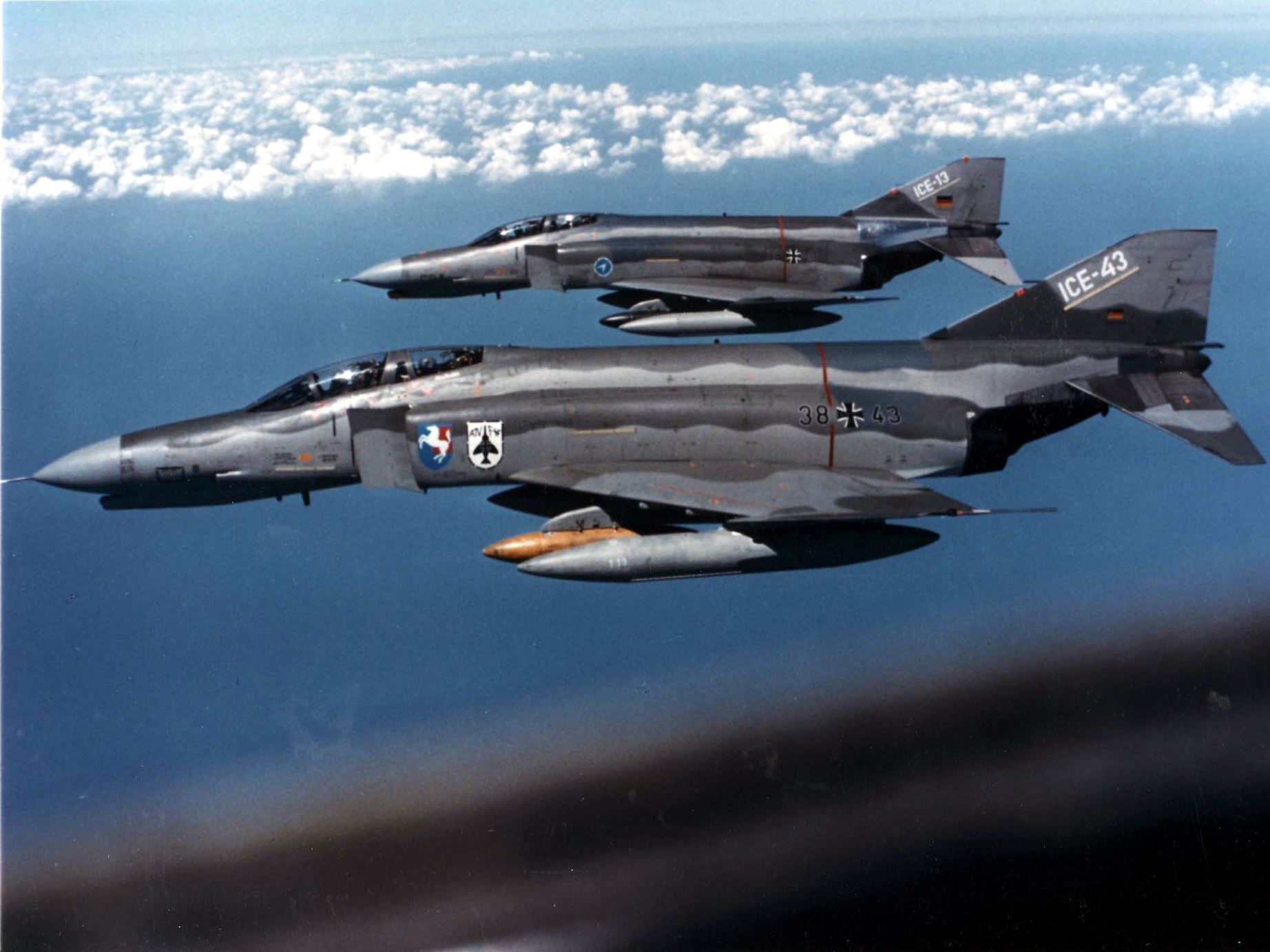
The F-4F was the simplified, lightened version of the F-4E built for the West German Luftwaffe under the "Peace Rhine" programme: 175 aircraft ordered on 24 June 1971, without Sparrow capability or the rear fuselage tank but with manoeuvring slats. It first flew on 18 March 1973 and, after the ICE upgrade with APG-65 radar and AMRAAM, served until 29 June 2013.
McDonnell Douglas F-4 Phantom II sheet

History
Origin and development
The West German Luftwaffe needed new aircraft after NATO adopted its flexible response doctrine in December 1967. The return to planning for a conventional war in Europe called for far more capable fighters and reconnaissance aircraft than the F-104G and RF-104G, which could not operate at night or in bad weather and, in the fighter's case, were judged inadequate against the MiG-21 fielded en masse by the Warsaw Pact. Airframe fatigue was also set to push Luftwaffe strength below the required level by 1976, and with the Panavia Tornado under development there was no money to design anything new: the aircraft would have to be bought abroad.
The purchase of 88 RF-4E reconnaissance aircraft in 1968-1969 paved the way. For the fighter, Germany first considered a simplified single-seat F-4E already proposed for the 1962 TFX programme, but its cost ruled it out. The competition, framed to avoid a repeat of the F-104's loss rates, demanded all-weather navigation and two engines, and pitted the SEPECAT Jaguar, Saab Viggen, Dassault Mirage F1, Northrop F-5 and P-530 against the McDonnell Douglas F-4F. With the RF-4E already adopted and the Phantom's advantages in range and weapons load, the F-4F was declared the winner and an order for 175 aircraft was placed on 24 June 1971 under the "Peace Rhine" programme, at a unit price of roughly 12 million Deutsche Marks.
Differences from the F-4E
The F-4F was a simplified F-4E designed for maximum commonality with the German RF-4E. It was about 1,500 kilograms lighter, dispensing with the ram-air turbine, the rear fuselage tank (one of the F-4E's seven), the slotted stabilator and the ability to fire the AIM-7 Sparrow. In exchange it carried manoeuvring leading-edge slats, absent on the RF-4E, and the weight saving gave a thrust-to-weight ratio approaching 1:1 with low fuel, making it markedly more agile, especially at low speed. All but the first incorporated West German-built subassemblies, as the RF-4Es did, through the industrial offsets that had Messerschmitt-Bölkow-Blohm producing components for the St. Louis line. Initial armament comprised the cannon, AIM-9 Sidewinders, Mk 82 bombs and BL755 cluster weapons.
Production and deliveries
The first F-4F, serial 3701, flew on 18 March 1973 and was unveiled on 24 May. The first 12 aircraft went to George AFB, California, where the 35th Tactical Fighter Wing stood up the conversion unit; Jagdgeschwader 71 pilots began training there on 1 January 1974. Because the F-4Fs were urgently needed at home, in 1975-1976 Germany replaced them in the United States with 10 new F-4Es, which stayed there as trainers until 1997. One F-4F (72-118) remained at Eglin on loan to Air Force Systems Command until 1982 as a testbed under the designation NTF-4F. Deliveries were completed between 1973 and 1976, and with them Germany became the Phantom's largest export customer: 175 F-4Fs, 10 F-4Es and 88 RF-4Es, the third-largest foreign operator after Iran and Israel.
Operational service
The F-4F equipped Jagdgeschwader 71 at Wittmund and 74 at Neuburg an der Donau in the air-to-air role and, from April 1975, Jagdbombergeschwader 36 and 35 (Pferdsfeld), which flew it in both attack and air defence. Twelve aircraft were initially fitted with dual controls and later returned to standard. Between 1980 and 1983 the fleet received refuelling probes to deploy to Canada and Spain with USAF tankers, and the AIM-9B and F Sidewinders gave way to the AIM-9L. A first mid-1980s upgrade brought a digital weapons computer, a radar adapted for bombing through cloud, a HUD, integration of the AIM-9L and AGM-65B Maverick (two per launcher), a lower-drag drop tank borrowed from the F-15C, and new radar warning receivers, jamming pods and chaff/flare dispensers.
The ICE programme
The ICE programme (Improved Combat Efficiency, Kampfwertsteigerung in German) began in 1983 to strengthen air-to-air capability with the AN/APG-65 radar and the AIM-120 AMRAAM. Planned for 75 aircraft, it grew to 110 in the late 1980s: initially only the interceptor wings were to be upgraded, but Eurofighter delays forced its extension. Phase 1, begun in 1989-1990, added the ALR-68 radar warning receiver, the Honeywell H-423 laser-gyro inertial platform, the GEC CPU-143/A air data computer and the MIL-STD-1553R digital bus. The first Phase 2 aircraft was completed in July 1989, the first AMRAAM firing took place on 22 November 1991, and in 1992 JG 71 received the first batch of six upgraded aircraft, though without missiles. By the end of 1994 some 70 F-4F ICEs were finished, 40 awaited their APG-65 and another 40 remained in service unmodified; Defence Minister Volker Rühe's review of the EFA programme considered "gap-filler" fighters such as the MiG-29, F-15 or F-16 but ended by confirming the full conversion. ICE gave Germany a capable, inexpensive interceptor with real limits: lacking an IFF interrogator and MIDS, it relied on AWACS by voice radio for target identification beyond visual range, and only 96 AIM-120Bs were bought because the Meteor was expected, and that did not arrive until 2013. The F-4F ICEs flew with JG 71, 72, 74 and 73; the last, at Preschen, was a mixed wing with one squadron of Phantoms and one of MiG-29s inherited from East Germany.
Retirement and legacy
The F-4F plugged gaps twice: first through the Tornado's delays and then, as ICE, through those of the Eurofighter Typhoon. JG 73 retired its last F-4F in 2002, JG 74 said farewell in March 2008 and the remaining wings were disbanded without replacement. JG 71 "Richthofen" was the last: the Luftwaffe retired its operational F-4Fs on 29 June 2013 at an open house at Wittmundhafen attended by 130,000 people. Since entering service on 31 August 1973, German F-4Fs had logged roughly 279,000 flying hours.
Multimedia


-1600.webp)
-1600.webp)
-1600.webp)
-1600.webp)


_2010-06-11_Andre_Gerwing_Collection_ID_011424-1600.webp)
_2024-08-31_Andre_Gerwing_Collection_ID_022028-1600.webp)
_2024-08-31_Andre_Gerwing_Collection_ID_022027-1600.webp)

-800.webp)

_2009-04-16_Andre_Gerwing_Collection_ID_011420-1600.webp)
_2009-04-16_Andre_Gerwing_Collection_ID_011419-1600.webp)
_2009-04-16_Andre_Gerwing_Collection_ID_011418-1600.webp)

-1600.webp)
-1600.webp)
-1600.webp)
-1600.webp)

-1600.webp)
-1600.webp)
-1600.webp)
-1600.webp)
-1600.webp)
-1600.webp)
-1600.webp)
-1600.webp)
-1600.webp)
-800.webp)
-800.webp)
-800.webp)
-800.webp)


_(8738567849)-1600.webp)
-1600.webp)

_(9049076620)-1600.webp)
_(9049075120)-1600.webp)
_(9046847797)-1600.webp)
_(8855574526)-1600.webp)
_(8855550832)-1600.webp)
_(8855535620)-1600.webp)
_(8855491630)-1600.webp)
_(8854957331)-1600.webp)
_(8854948763)-1600.webp)
_(8854907983)-1600.webp)
_(8854892495)-1600.webp)
_(8739599398)-1600.webp)
_(8737464004)-1600.webp)
_(8737450838)-1600.webp)
_(8737433572)-1600.webp)
_(8737417502)-1600.webp)
_(8737404784)-1600.webp)
_(8736337981)-1600.webp)
-1600.webp)
_(8736322157)-1600.webp)
_(8736300593)-1600.webp)
_(8736292405)-1600.webp)
_(8736282089)-1600.webp)
_(8736264293)-1600.webp)
-1600.webp)
-1600.webp)
-1600.webp)
-1600.webp)
-1600.webp)
-1600.webp)
-1600.webp)
-1600.webp)
-1600.webp)
-1600.webp)
-800.webp)
-800.webp)
-800.webp)
-800.webp)
-800.webp)
-800.webp)

-1600.webp)
-1600.webp)
-1600.webp)
-1600.webp)
-1600.webp)
-1600.webp)
-1600.webp)
-1600.webp)
-1600.webp)
-1600.webp)
_Luftwaffe._(6938827824)-800.webp)
_Luftwaffe%2C_RIAT_1993._(7162632158)-800.webp)
-1600.webp)
-1600.webp)


-800.webp)
-800.webp)
-1600.webp)
-1600.webp)
-1600.webp)
-1600.webp)
-1600.webp)
-1600.webp)
-1600.webp)
-1600.webp)
-1600.webp)