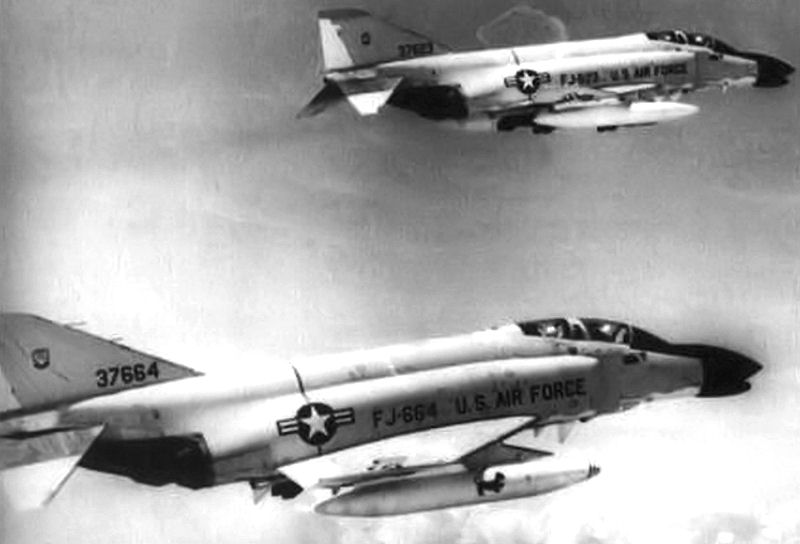
McDonnell Douglas F-4 Phantom II variant
McDonnell Douglas F-4 Phantom II F-110A Spectre / F-4C
The F-4C was the first Phantom II version for the United States Air Force, born as the F-110A "Spectre" from borrowed Navy F-4Bs and renamed in September 1962. Externally almost identical to the F-4B, it added full dual controls, boom refuelling, low-pressure tyres, the AN/APQ-100 radar and J79-GE-15 engines. It flew in May 1963, reached the 12th Tactical Fighter Wing in 1964 and was the first USAF Phantom in Vietnam, where it scored the service's first MiG-17 kills and flew Operation Bolo.
McDonnell Douglas F-4 Phantom II sheet

History
Origin and development
The Phantom II had been conceived as a US Navy carrier interceptor, and it became the first fighter designed solely for carrier use ever ordered by the United States Air Force. The road to the F-4C started on the naval line: F4H-1F BuNo 145310 was tested with multiple bomb racks that let it carry up to 22 500-pound bombs under the fuselage and inner wings; the Navy, which saw the Phantom as an interceptor with only a secondary attack role, did not adopt the fit, but the demonstration led to the tactical fighter for the USAF. The Air Force evaluated the aircraft for close air support, interdiction and counter-air work and, after an F-4B won the Operation Highspeed fly-off against the Convair F-106 Delta Dart, borrowed two Navy F-4Bs in January 1962, designated them F-110A for the time being and drew up requirements for its own version, which it approved that same year. In all, 29 F-4Bs were loaned to the Air Force with the temporary serials 62-12168 to 62-12196; they wore F-110 markings but kept their naval designation. The USAF's chosen name, "Spectre", did not last: with Secretary McNamara's unification of designations on 18 September 1962 the Phantom became the F-4, the naval version the F-4B and the Air Force version the F-4C. The F-4C made its first flight on 27 May 1963 and production deliveries began in November 1963.
Differences from the F-4B
The F-4C was developed specifically for the Air Force but was externally almost identical to the F-4B, right down to the tailhook. The differences were the things the USAF needed: full dual flight controls in the rear cockpit; low-pressure tyres for runways rather than decks, with wider main wheels that required deeper wheel wells and left the distinctive bulges on the upper wing; anti-skid brakes; a dorsal receptacle for boom refuelling in place of the Navy probe and drogue; the AN/APQ-100 radar instead of the APQ-72; and J79-GE-15 engines with provision for cartridge starting. It kept the four semi-recessed AIM-7 Sparrows and added a wide spectrum of air-to-ground weapons, including the AIM-4 Falcon, the AGM-12 Bullpup, guided and unguided bombs and nuclear stores, with up to three external tanks for extra range. From 1965 USAF F-4Cs began carrying SUU-16 external gun pods housing a 20 mm M61A1 Vulcan rotary cannon, but their cockpits had no lead-computing gunsight until the SUU-23 arrived, which virtually guaranteed a miss in a manoeuvring fight. In flight performance the F-4C was essentially identical to the Navy and Marine F-4B, and it carried AIM-9 Sidewinders too.
Operational service
The first operational unit was the 12th Tactical Fighter Wing, which received the Air Force's first F-4Cs in January 1964 and reached initial operational capability in October 1964. The first USAF Phantoms in the Vietnam War were the F-4Cs of the 45th Tactical Fighter Squadron, deployed to Ubon Royal Thai Air Force Base in April 1965. On 10 July 1965 F-4Cs of the 45th TFS, 15th TFW, scored the Air Force's first victories over North Vietnamese MiG-17s using AIM-9 Sidewinders. The bad news came quickly: on 24 July 1965 another 45th TFS Phantom became the first American aircraft downed by an enemy surface-to-air missile, and on 5 October 1966 an 8th Tactical Fighter Wing F-4C was the first lost to a MiG-21. On 26 April 1966 an F-4C of the 480th Tactical Fighter Squadron scored the first American kill of a MiG-21. On 2 January 1967 the F-4Cs of the 8th TFW, under Robin Olds, executed Operation Bolo, the response to the heavy losses of Rolling Thunder. From that first deployment to Southeast Asia, USAF Phantoms flew both air superiority and ground attack, supporting troops in South Vietnam and bombing in Laos and North Vietnam. In October 1972 the first squadron of EF-4C Wild Weasel aircraft deployed to Thailand on temporary duty; the "E" prefix was later dropped and the aircraft became simply the F-4C Wild Weasel, and many survivors were later returned to standard configuration. By the end of the war the Air Force had lost 528 F-4s and RF-4Cs, and its F-4C, F-4D and F-4E crews claimed 107.5 MiGs in Southeast Asia: 50 with the Sparrow, 31 with the Sidewinder, five with the Falcon, 15.5 with the gun and six by other means.

After active duty the F-4Cs passed to the Air National Guard for air defence work; on 21 March 1987 Captain Dean Paul Martin of the California Guard's 163d Tactical Fighter Group, son of the entertainer Dean Martin, crashed his F-4C into San Gorgonio Mountain shortly after leaving March Air Force Base. Spain bought its first batch of ex-USAF F-4Cs in 1971 under the Peace Alfa programme, together with a number of RF-4Cs. NASA flew an F-4C in a spanwise blowing study from 1983 to 1985, and the last airframes ended up as QF-4C target drones.
Survivors
F-4C 64-0776 at Seattle's Museum of Flight, built in 1965, sums up the type's career. It is displayed as it looked in May 1967 with the 389th Tactical Fighter Squadron of the 366th Tactical Fighter Wing, when it shot down three North Vietnamese MiG-21s with two crews, Major Robert D. Anderson with Captain Fred D. Kjer and Lt Col Robert F. Titus with 1st Lt Milan Zimer. It then spent nine years with the Oregon Air National Guard's 123rd Fighter Interceptor Squadron flying air defence missions from Portland, and came to the museum after its retirement in 1994 on loan from the National Museum of the United States Air Force.
Multimedia


-1600.webp)
-800.webp)


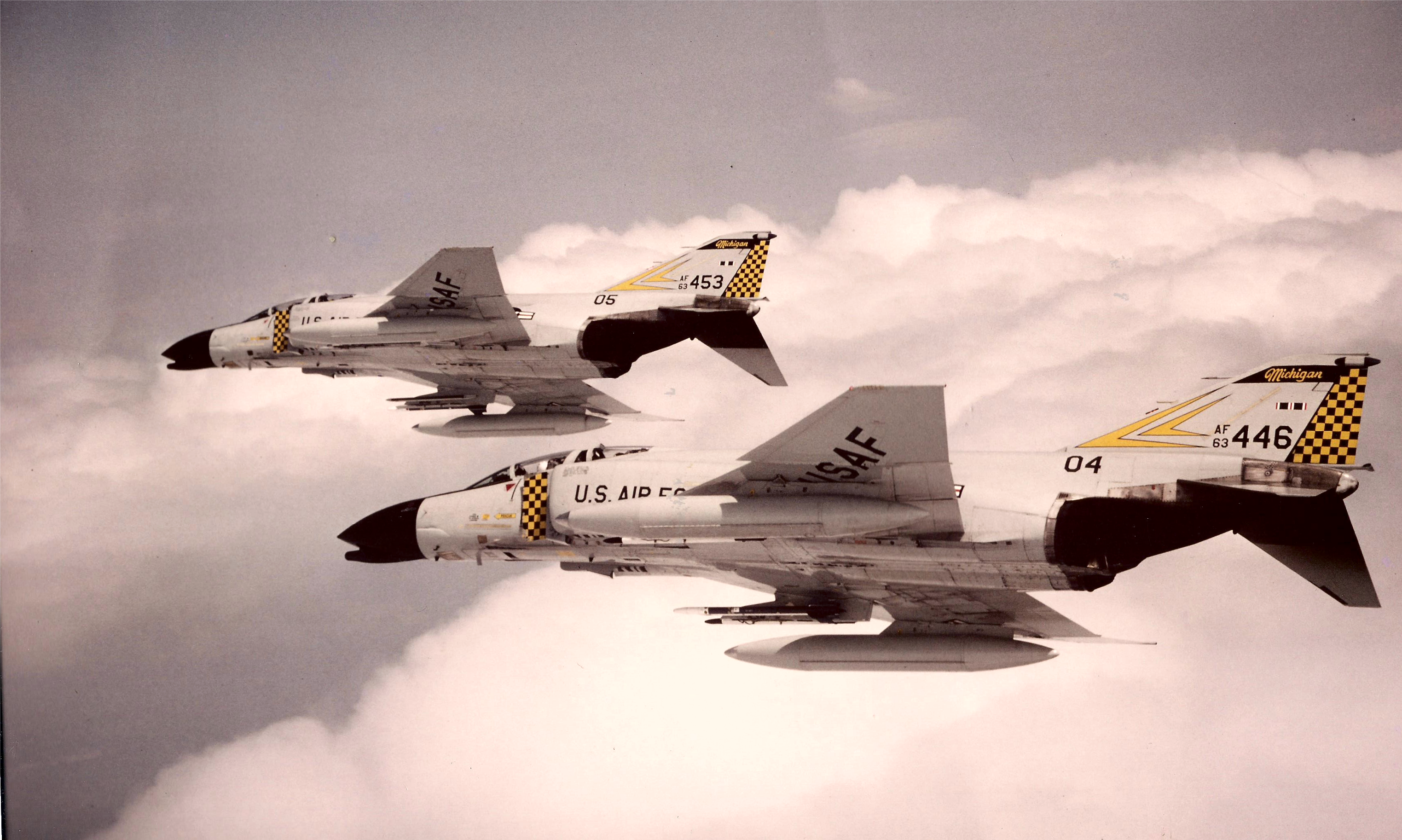


-1600.webp)