McDonnell Douglas F-4 Phantom II variant
McDonnell Douglas F-4 Phantom II F-4M
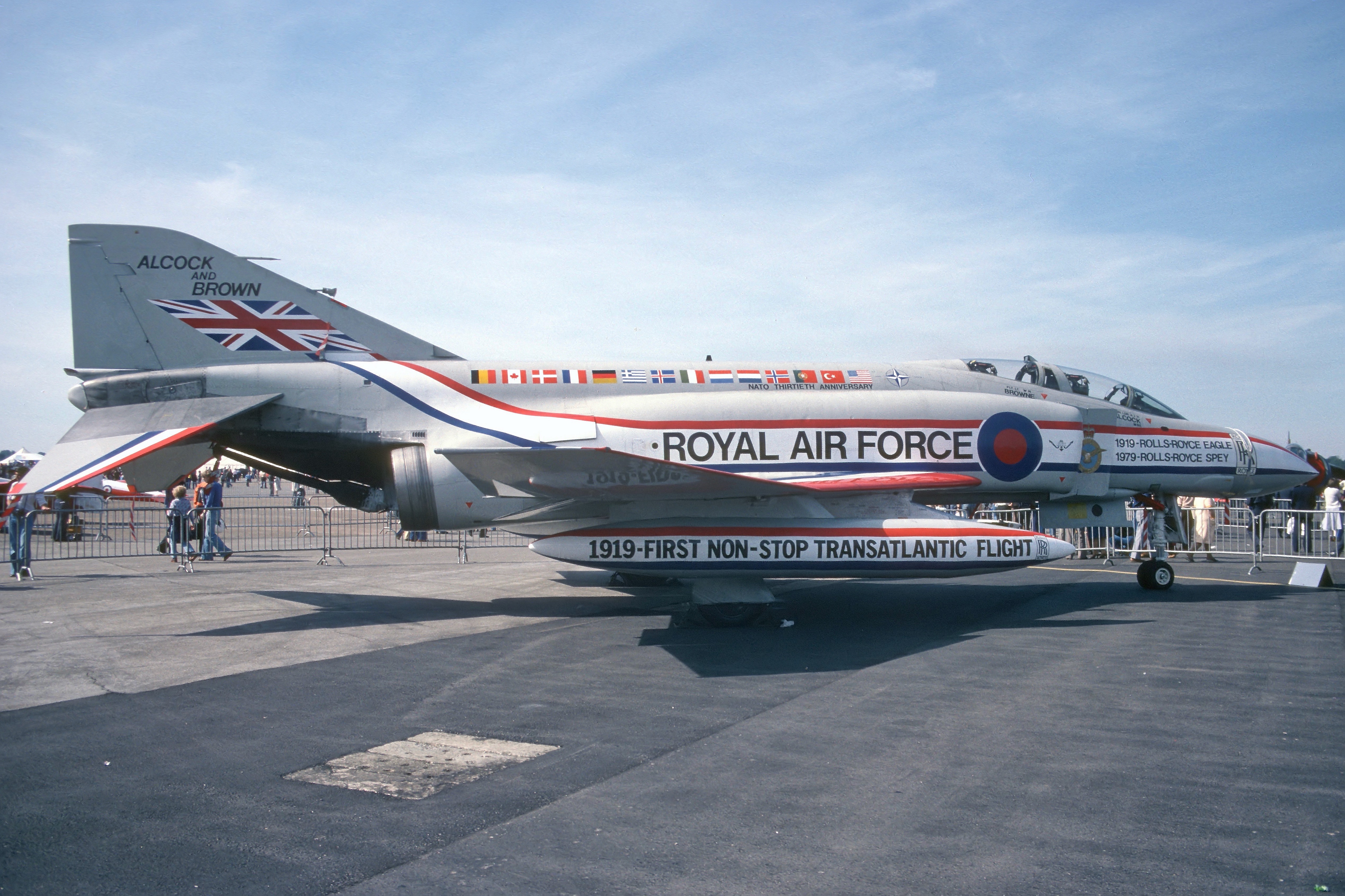
Land-based version for the Royal Air Force, the Phantom FGR.Mk 2: Spey engines, AN/AWG-12 fire control with a Ferranti inertial navigation system and gun-pod compatibility, without the carrier features of the F-4K. It replaced the Hunter in attack and reconnaissance from 1969, moved to air defence in the mid-1970s and was retired in 1992.
McDonnell Douglas F-4 Phantom II sheet
-1600.webp)
History
Origin and development
The F-4M was the version of the Phantom intended for the Royal Air Force, designated Phantom FGR.Mk 2 in service, "FGR" standing for the fighter, ground-attack and reconnaissance roles it was to fill as a replacement for the Hawker Hunter. The intended Hunter successor had been the Hawker Siddeley P.1154, a Mach 2 V/STOL fighter planned in both shipboard and land-based forms; the Royal Navy backed out of the project in February 1964, leaving the RAF alone, and after Harold Wilson's Labour government took office in October 1964 the programme's cost was called into question. On 2 February 1965 it was cancelled outright.
The RAF had expressed interest in the Phantom as early as January 1964, at the same time as the Royal Navy was considering the version that eventually emerged as the F-4K. Anticipating an order, McDonnell's design team began developing a variant specifically for the RAF under the US designation F-4M. On 9 February 1965 the RAF announced that it had chosen the Phantom as the Hunter's successor, and on 1 July 1965 agreement was announced on the initial batch of two YF-4Ms and 38 F-4Ms, with the RAF expected ultimately to acquire 200. The order was soon cut to 150, and the final 32 aircraft were cancelled before delivery.
Differences from the F-4K and F-4J
Like the naval version, the F-4M was powered by two Rolls-Royce Spey 202/203 turbofans; the RAF would have preferred the cheaper and proven J79, but political considerations dictated a British-designed engine. It differed from the F-4K in having a Ferranti-built AN/AWG-12 fire-control system, a licence-built version of the Westinghouse AN/AWG-10 fitted to the US Navy F-4J, interfaced with a Ferranti inertial navigation and attack system originally developed for the abortive TSR.2. Not being intended for carrier launches, it lacked the slotted stabilators, the double-extending nose leg and the aileron droop of the naval variant, as well as the prominent stabilator incidence indicator on the F-4K's rear fuselage; it did, however, have anti-skid brakes for safer operation on wet or short runways. Otherwise it was externally almost identical to the F-4K.

It also had no internal cannon, but unlike the F-4K it was compatible with the SUU-16/A and SUU-23/A gun pods. Basic armament comprised four Sparrows in the fuselage recesses and two to four Sidewinders under the inboard pylons. Numerous subsystems were made in Britain: BAC built the aft fuselages, fins, rudders, tailcones, stabilators and inboard wing leading edges; Delaney Gallay the heat exchangers and titanium insulation blankets; Goodyear's UK branch the brakes, with the anti-skid system subcontracted to Dunlop; Ferranti the fire-control and inertial navigation systems; and Marconi the fuel flow meters, fuel gauge, autopilot and the ASN-46 navigation computer under Bendix licence.
Production
The first of the two YF-4Ms (XT852 and XT853) flew at St Louis on 17 February 1967; XT852 then went to Holloman AFB in New Mexico and XT853 to NAS Patuxent River in Maryland for trials. Production aircraft differed only in detail from the prototypes. A total of 116 production Phantom FGR.Mk 2s were delivered to the RAF. The first to reach Britain was XT891, which arrived at Yeovilton on 18 July 1968 and was transferred two days later to No. 23 Maintenance Unit at Aldergrove in Northern Ireland, where the remaining 115 were also received. The last, XV501, was delivered on 29 October 1969, although repairs to XV434, damaged in an earlier accident, delayed its delivery until 16 June 1970.
Operational service
The initial plan was for the FGR.Mk 2 to serve in the strike/attack role until the Anglo-French SEPECAT Jaguar became available, after which it would switch to air defence and replace the BAC Lightning. The first aircraft were handed to No. 228 Operational Conversion Unit at RAF Coningsby in August 1968, and the first operational squadron was No. 6, formed at Coningsby in May 1969 to replace its ageing Canberra B.Mk 16s. The type subsequently equipped Nos. 6 and 54 Squadrons of Air Support Command, Nos. 23, 29, 56 and 111 Squadrons of Strike Command and Nos. 14, 17, 19, 31 and 92 Squadrons in Germany, in the ground-attack and air-defence roles; in tactical reconnaissance it was flown by No. 2 Squadron in Germany and No. 41 Squadron of Air Support Command. It could carry SNEB rocket pods, 1000-pound bombs, the BL755 cluster bomb and nuclear weapons, and for reconnaissance an EMI pod housing cameras, infrared linescan and side-looking radar with mapping and moving-target indication capability.
In the mid-1970s, as the Jaguar arrived, the ground-attack squadrons gave up their Phantoms, which moved to air defence in place of the retiring Lightning. From 1975 the change of role was accompanied by the fitting of Marconi ARI.18228 radar warning receiver antennas in a fin-top pod. In the air-defence role the typical armament was four AIM-7E2 Sparrows, two AIM-9G Sidewinders and an optional SUU-23/A gun pod; the Sparrow gave way to the BAe Sky Flash in 1979 and the AIM-9G to the AIM-9L in the early 1980s.
RAF Phantoms took no part in the Falklands conflict, but from 1982, after the islands were retaken, they operated from Port Stanley Airport. To compensate NATO for the diversion of these aircraft, Britain bought 15 ex-US Navy F-4Js, which kept their J79 engines and American avionics and were designated F-4J(UK) (serials ZE350 to ZE364) so as not to be confused with the Tornado F.Mk 3. From 1987 onward, 75 FGR.Mk 2s received new BAe-built outer wing panels to extend their fatigue lives.
Retirement and survivors
In the late 1980s the interceptor squadrons began re-equipping with the Tornado F.Mk 3; the last two disbanded in the second half of 1991, the Falklands-based No. 1435 Flight exchanged its Phantoms for Tornados in mid-1992, and Nos. 56 and 74 Squadrons at Wattisham disbanded in the autumn of 1992, bringing Phantom service with the RAF to an end. A total of 32 FGR.Mk 2s were lost in accidents. Preserved examples include XT891 at Coningsby, XV408 at Cranwell, XV409 at Mount Pleasant in the Falklands and XT899, the last Phantom at Wildenrath, displayed at the Czech Air Force Museum at Kbely.
Multimedia


-1600.webp)


-1600.webp)

_2013-04-30_Andre_Gerwing_Collection_ID_011366-1600.webp)

-1600.webp)
-1600.webp)
_at_the_Tangmere_Aviation_Museum_-_geograph.org.uk_-_2383900.jpg)
-1600.webp)
_F-4M_Phantom_FGR.2_aircraft_formerly_of_No._1435_Flight_RAF_as_the_gate_guardian_at_the_entrance_to_the_air_terminal_at_Mount_Pleasant_Complex-1600.webp)