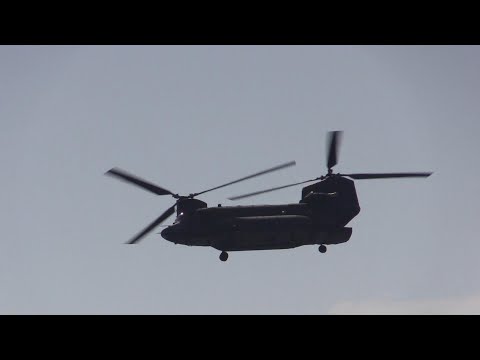
Helicopter · Military · United States
Boeing CH-47 Chinook
- September 21, 1961
- First flight
- In service
- Status


The Boeing CH-47 Chinook is a heavy-lift transport helicopter with tandem rotors, conceived by Vertol in the late 1950s and built today by Boeing. It takes its name from the Chinook people of the American Pacific Northwest. Among Western heavy-lift helicopters only the Sikorsky CH-53 lifts more, and very few designs from the early 1960s can claim, as the Chinook can, more than sixty years in both production and frontline service. The formula is simple and effective. Two turboshafts beside the rear pylon drive two three-bladed rotors turning in opposite directions, so no power is wasted on an anti-torque rotor. A wide rear ramp, several doors and three ventral hooks let it carry troops, vehicles, artillery or underslung loads. The YHC-1B prototype first hovered on 21 September 1961, and in 1962 the type became the CH-47A. Vietnam made it indispensable: it placed artillery batteries on otherwise unreachable ridges, kept them supplied with ammunition and recovered downed aircraft. The B and C models brought more power, and the CH-47D, in service from 1982, renewed the engines, blades, cockpit and avionics. Special operations MH-47 versions followed and, in this century, the digital CH-47F and its Block II development. Exported to some twenty operators and licence-built in Italy and Japan, the Chinook has fought in the Falklands, the Iran-Iraq War, the Gulf, Afghanistan and Iraq, and has been a first-rate tool after natural disasters, from a hurricane in Florida to the Fukushima nuclear plant. Its civil sibling, the Model 234, works in logging, construction and firefighting.
Related events
- First flight of the Boeing CH-47 Chinook
- The HC-1B becomes the CH-47A Chinook
- The 147th medium helicopter company arrives in Vietnam
- ACH-47A gunship Chinooks arrive in Vietnam
- CH-47A crash at Phu Cat Air Base
- CH-47 carrying 83 people crashes near Phuoc Vinh
- Iran buys its first Agusta-built CH-47Cs
- 101st Airborne CH-47C flies into high ground
- Libya buys 24 Italian-built CH-47Cs
- Soviet MiG-23 shoots down an Iranian Chinook
- Chinook HC1 enters RAF service
- CH-47D enters US Army service
- Iranian Chinooks in Operation Fath ol-Mobin
- Atlantic Conveyor lost with three Chinooks; Bravo November survives
- Chinook crash at the Mannheim air show
- Iraqi Mirage F1 destroys three Iranian Chinooks
- Iraqi MiG-21s shoot down two Iranian Chinooks
- RAAF CH-47C crashes into Perseverance Dam
- First flight of the CH-47J for Japan
- Sumburgh civil Chinook crash
- Some 163 CH-47Ds in the Gulf War
- Mull of Kintyre Chinook crash
- Hundreds of Chinooks grounded over landing-gear cracks
- Chinooks evacuate civilians from Freetown
- First flight of the CH-47F
- Greek CH-47SD crashes off Mount Athos
- Chinook shot down in Kunar Province
- Six RAF Chinooks flown to Kandahar by C-17
- First production CH-47F flies
- Canada orders 15 CH-47Fs as the CH-147F
- Chinook HC2 lands after RPG strike near Sangin
- UK announces purchase of 24 new Chinooks
- 100th CH-47F delivered
- First flight of the Chinook HC4
- Japanese Chinooks cool the Fukushima reactors
- Extortion 17 Chinook shootdown
- First CH-47Fs enter Australian service
- RAF receives its last Chinook HC6
- Singapore selects the CH-47F
- Contract to upgrade 17 Spanish CH-47Ds to F standard
- Chinooks in the Kabul airlift
- Bravo November goes on display at RAF Museum Cosford
- Firefighting CH-47D crashes into the Salmon River over an iPad
- Chinooks evacuate the US Embassy in Khartoum
- RCAF CH-147F crashes into the Ottawa River
Related sheets
Category
Boeing CH-47 Chinook in the news

The Boeing Co., Ridley Park, Pennsylvania, is being awarded a $55,387,192 firm-fixed-price order (W91215-16-G-0001) for basic ordering agreement H9224126FE046 for the procurement of the Active…
The Boeing Co., Ridley Park, Pennsylvania, was awarded a $33,881,195 modification (P00005) to contract W58RGZ-23-F-0395 to add country-specific requirements (Korea) to the CH-47F Block I Chinook…
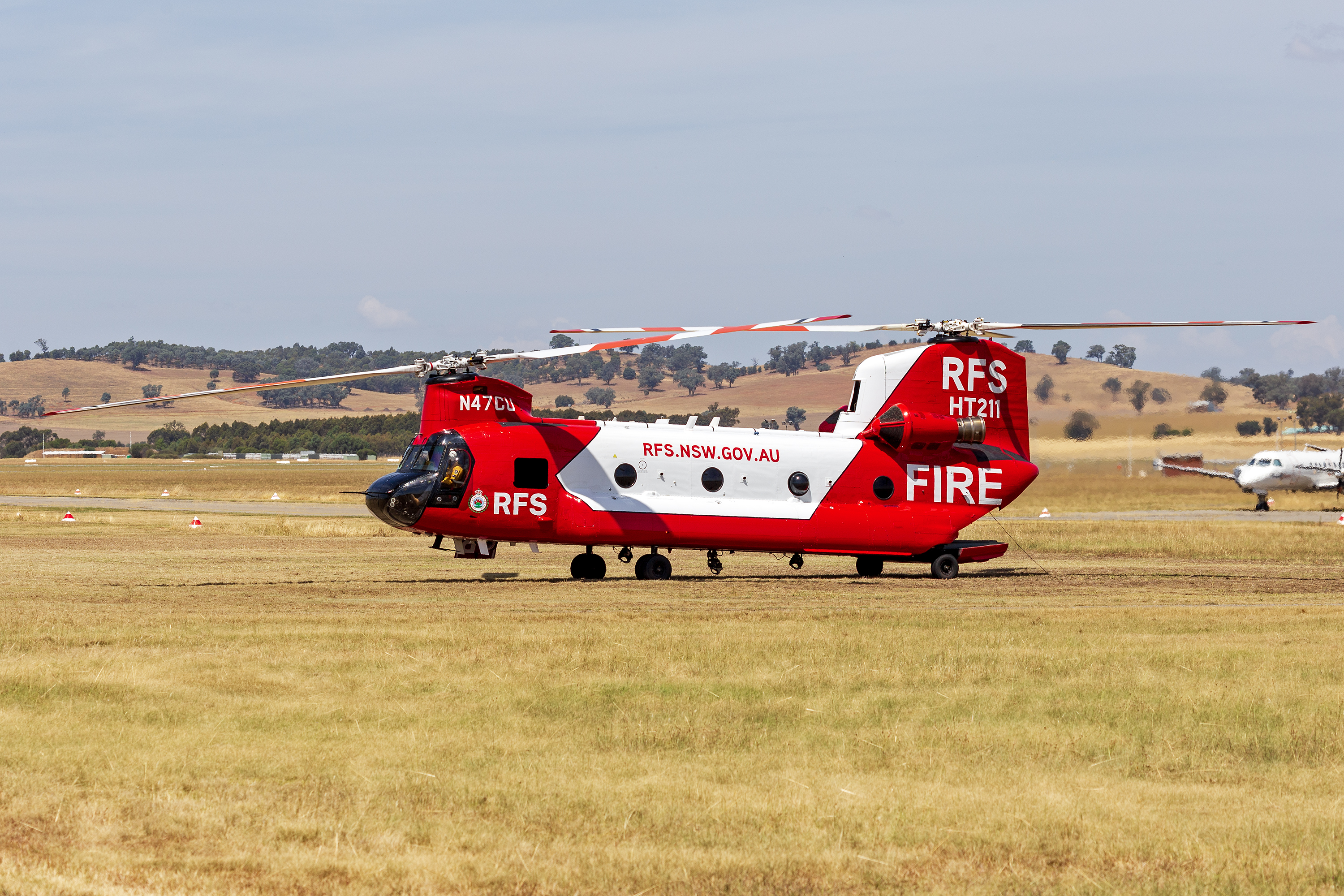
A US Army flight simulator located at a barracks in Germany is proving key to training for
The Boeing Co., Ridley Park, Pennsylvania, was awarded a $26,056,041 firm-fixed-price, indefinite-delivery/indefinite-quantity contract for maintenance and overhaul of CH-47 Chinook cargo hook. One…
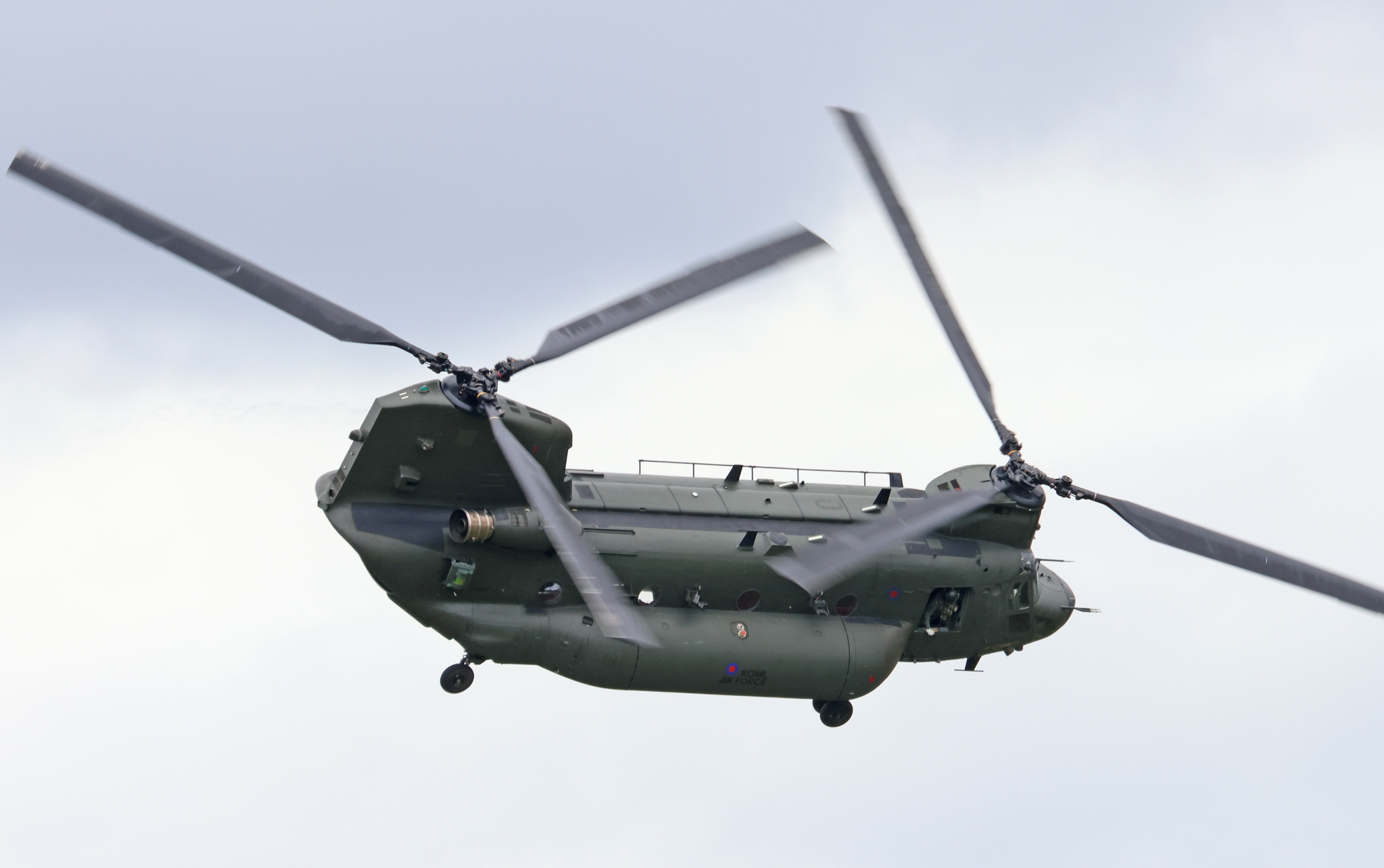
The Luftwaffe's Helicopter Wing 64 (HSG64), so far the only unit with the CH-53 transport helicopter and in future with the new heavy-lift CH-47F Chinook, is…


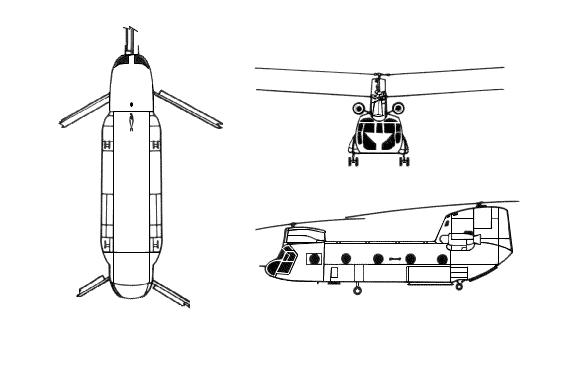
Three-view drawing
History
An order the Army could not define
In late 1956 the U.S. Army announced it wanted to replace the piston-engined Sikorsky CH-37 Mojave with a gas-turbine helicopter, the same technology that powered the small UH-1 Huey. The trouble was size. One faction in Army Aviation wanted a light tactical transport for around fifteen men, a squad, taking over from the ageing Piasecki H-21 and Sikorsky H-34. Another wanted something far larger, able to move heavy artillery and carry the new MGM-31 Pershing missile inside.
Vertol had begun work in 1957 on a tandem-rotor design, the Model 107 or V-107. In June 1958 the Army ordered a handful as the YHC-1A, able to seat up to 20 troops, and in September of that year a joint Army and Air Force board recommended buying the Vertol medium transport. Testing of three machines produced an awkward verdict: too heavy for assault, too light for general transport. The answer was to split the job. The Huey would be upgraded to carry infantry, while Vertol was asked for an enlarged V-107, the Model 114, designated HC-1B. The YHC-1A itself went on to the Marines as the CH-46 Sea Knight.
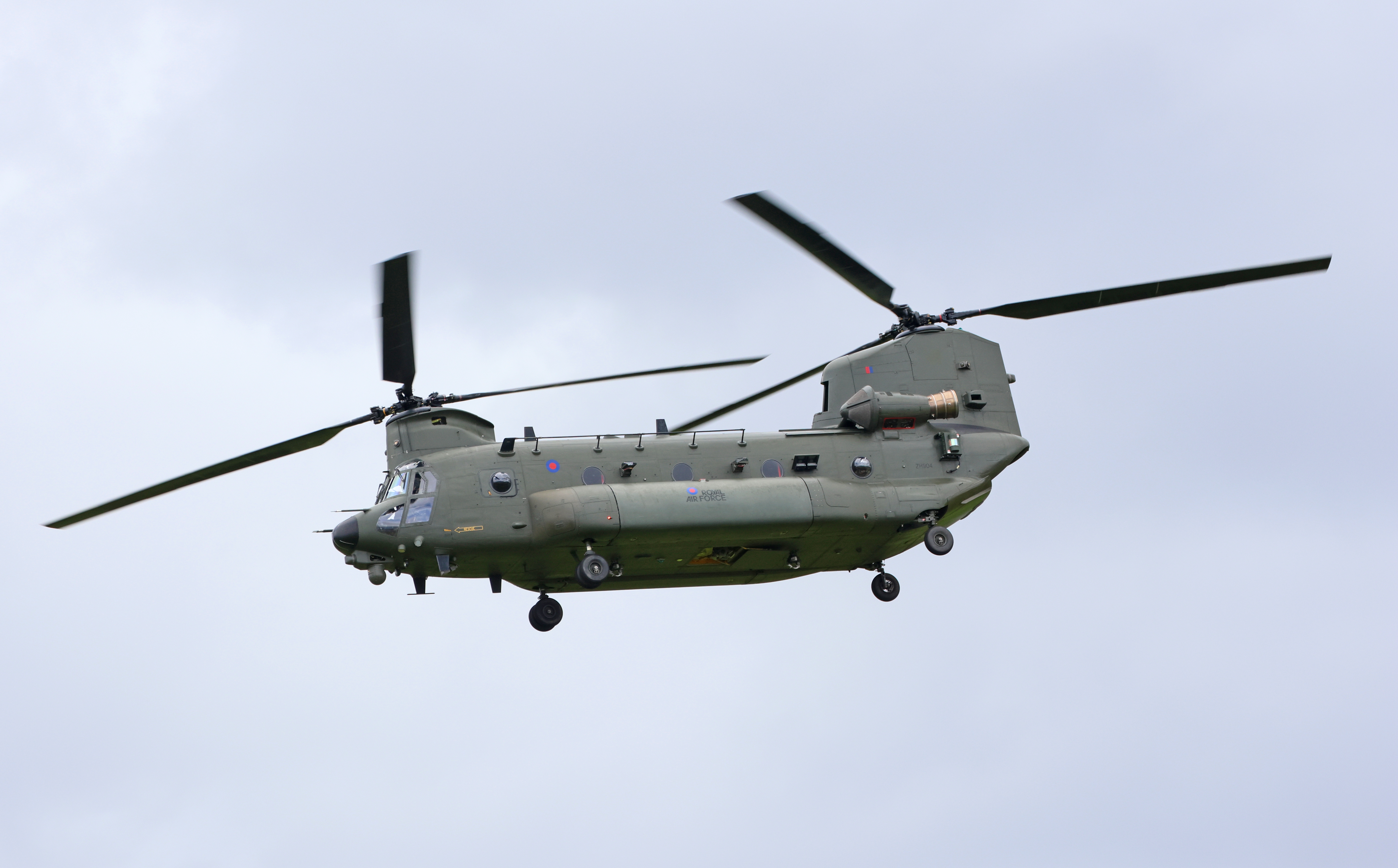
Boeing had meanwhile bought Vertol in 1960 and turned it into its rotorcraft division, which is why early production machines bore the Boeing Vertol name. On 21 September 1961 the preproduction YHC-1B made its first hovering flight. Under the 1962 tri-service designation system it became the CH-47A and received the Chinook name, and deliveries to the Army began in August 1962.
The logic of the tandem layout
The Chinook relies on two turboshafts, one on each side of the rear pylon, linked by drive shafts to two three-bladed rotors. Early aircraft used Lycoming T55 engines rated at 2,200 hp each. Because the rotors turn in opposite directions they cancel each other's torque, so there is no tail rotor and all the power goes into lift and thrust. Lift on each rotor can be adjusted separately, which makes the helicopter tolerant of centre-of-gravity shifts when loads are picked up or dropped, or when soldiers slide down or climb ropes in the hover. If one engine fails, the other can turn both rotors.
Cargo goes in through several doors and a wide rear ramp, and three hooks under the fuselage take sling loads. With a top speed of 170 knots it was much faster than the utility and attack helicopters of its day, and it remains one of the fastest in the U.S. inventory. Its size followed Army doctrine directly: the Huey grew to carry the squad, while the Chinook took the guns and heavy logistics. That pairing accelerated the Army's whole air mobility effort.
Vietnam: the flying truck
The Army finally made the Chinook its standard medium transport, and 161 had been delivered by February 1966. The 1st Cavalry Division arrived in 1965 with its own Chinook battalion, and on 29 November that year the 147th medium helicopter company landed, initially supporting the 1st Infantry Division. The Delta illustrated encyclopedia calls it a huge twin-rotor transport with 44 seats for fully equipped troops, or room for medium vehicles and artillery, and notes that its hooks could carry every air-portable weapon, round and supply used in the war.
Its most striking task was placing artillery batteries on mountain sites reachable by no other means and then keeping them fed with ammunition. In the mountains the 1st Cavalry found the payload limited to about 7,000 pounds, with roughly 1,000 more possible near the coast. The cabin was so inviting that commanders had to stop eager soldiers overloading it, and sling loads took time to master. The Chinook soon proved so valuable for guns and logistics that it was seldom used as an assault carrier; it also evacuated casualties, usually beyond its rated load, and its most cost-effective job may have been recovering other downed aircraft.
At the height of the war the Army had 21 Chinook companies in Vietnam. Pilots found that the CH-47A transmission could not take both turbines at full power, and heat and humidity cut maximum lift by more than 20% in the lowlands and 30% in the mountains. Crews mounted M60 machine guns in the forward doors, with stops to keep the gunners off the blades, and dust filters were added to the engines. Of nearly 750 Chinooks in the U.S. and South Vietnamese fleets, about 200 were lost in combat or wartime accidents. Some carried radar and night vision equipment, and the boldest experiment was the ACH-47A gunship: four armoured conversions with 20 mm cannon, a grenade launcher and heavy machine guns that reached Vietnam in 1966. They performed well, but upkeep was costly and the demand for transports stronger; three were lost.
From B to D: more power in the same airframe
Stronger transmissions and fuselages arrived in 1968 with the CH-47B, followed a few months later by the CH-47C, which Delta says began reinforcing the earlier models in Vietnam from September 1968. Delta credits the C model with a payload of 10,430 kg internally or 12,700 kg on the hook. Upgrades were often applied to existing airframes, so a single aircraft could pass through several standards during its life.
The big leap was the CH-47D, in Army service from 1982: more powerful engines, composite blades, a cockpit redesigned to ease workload, redundant electrical systems, an advanced flight control system and better avionics. Its triple-hook system could carry heavy external loads such as 40-foot containers. A redesigned hydraulic system also allowed civil certification as the Boeing Model 234, used around the world for logging, construction, fire suppression and oil work; in December 2006 Columbia Helicopters bought its type certificate from Boeing.
Exports and licence production
The Chinook was licence-built abroad, in Italy by Agusta and Elicotteri Meridionali and in Japan by Kawasaki. Australia became the first export customer in 1973, the same year Meridionali began building CH-47Cs for the Italian Army. Iran became a major user: its imperial air force took 20 Agusta-built CH-47Cs in 1971 and its army aviation 70 more between 1972 and 1976. Libya bought 24 in 1976 and used them in the 1980s to supply its forces in Chad. Japan ordered 54 CH-47Js for its ground and air self-defence forces, with Boeing supplying flyable aircraft and kits and Kawasaki finishing them. In Spain the Chinook is the armed forces' heavy transport helicopter, flown by the army's Transport Helicopter Battalion V.
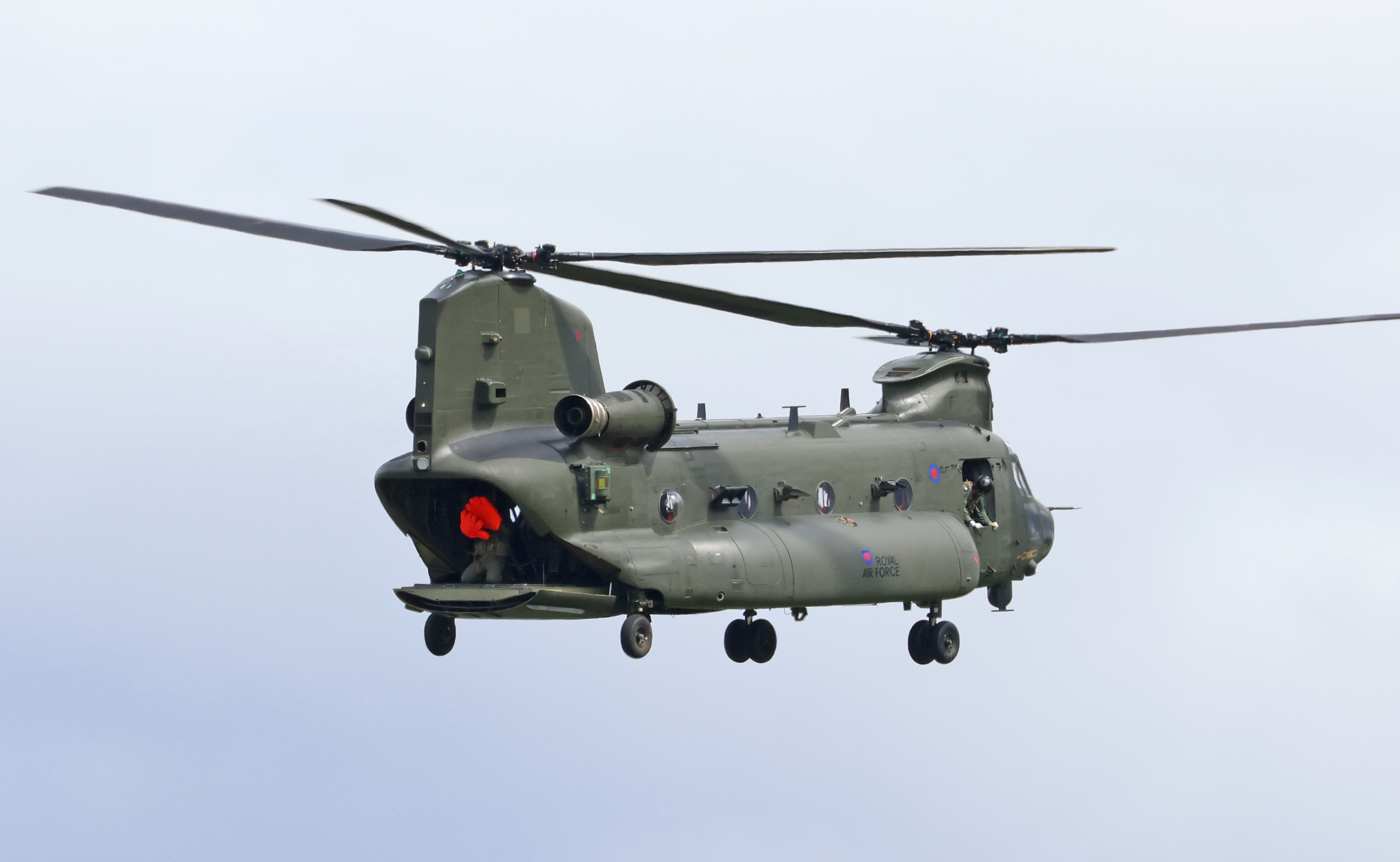
Britain ordered fifteen CH-47Bs in March 1967, but defence cuts cancelled the order later that year. The need returned in 1978 and the Royal Air Force ordered thirty-three aircraft comparable to the CH-47C, the Chinook HC1, which entered service in December 1980. Over time the British fleet, through the HC2, HC4, HC5 and HC6 versions, became the largest outside the United States.
Combat in the Falklands and the Gulf region
Both sides used the Chinook in the 1982 Falklands War. Argentina deployed four CH-47Cs between its air force and army; one was destroyed on the ground by a Harrier and another captured by the British. Three British Chinooks went down with Atlantic Conveyor, hit by an Exocet on 25 May 1982. The lone survivor, Bravo November, did outstanding work and once lifted 81 troops; since April 2022 it has been displayed at the RAF Museum Cosford. The record noted by Delta goes further still: a Chinook once took off with 147 people on board.
Iran worked its Chinooks hard against Iraq, losing at least eight between 1980 and 1988, yet on 22 March 1982, in Operation Fath ol-Mobin, they landed troops behind Iraqi lines who silenced enemy artillery and seized a headquarters. Despite the embargo, 20 to 45 were still operational in 2015. Earlier, in 1978, a Soviet MiG-23 had shot down one of four Iranian CH-47Cs that strayed into Soviet airspace.
The Gulf, Afghanistan and Iraq
Some 163 CH-47Ds deployed to Saudi Arabia, Kuwait and Iraq for Desert Shield and Desert Storm in 1990 and 1991. In Afghanistan and Iraq the D model flew air assaults, inserted troops into fire bases and supplied them with food, water and ammunition, and it was the British forces' preferred casualty evacuation aircraft. Afghan mountains, where altitude and heat restrict helicopters such as the UH-60, made its lift especially prized; one Chinook was reportedly worth up to five Black Hawks in the assault transport role. British, Italian, Dutch, Spanish, Canadian and Australian Chinooks served there. The cost was high: on 6 August 2011 a Chinook shot down near Kabul killed all 38 on board, the deadliest single loss of Operation Enduring Freedom. In 2021 Chinooks took part in the final Kabul airlift.
Special operations: the MH-47 line
Army special forces found the Chinook an ideal platform. The first aircraft of what became the 160th Special Operations Aviation Regiment came from the 101st Airborne Division in 1980 and entered service in 1981. The MH-47D added in-flight refuelling and fast-rope gear; the MH-47E, whose prototype dates from 1991, increased fuel; and the MH-47G unified the fleet with a common digital cockpit and the new CH-47F sections. With night vision devices and mission equipment, these crews fly low, at night and in poor visibility over any terrain. The MH-47G also spawned the HH-47, selected on 9 November 2006 for the Air Force combat search and rescue programme, although the award was protested and the competition had to be rerun.
CH-47F and Block II: the digital Chinook
The CH-47F, a thoroughly upgraded CH-47D, flew in 2001; the first production aircraft rolled out at Ridley Park, Pennsylvania, and flew on 23 October 2006. It brought more powerful Honeywell engines, digital flight controls and a milled structure that cuts vibration and maintenance. The low-rate initial production contract was signed in January 2003. The Netherlands became the first international customer in February 2007; Canada signed on 10 August 2009 for 15 heavily modified CH-147Fs; Britain announced new purchases in December 2009, which became fourteen HC6s, the last delivered in December 2015; India approved 15 in 2015; and in June 2022 Germany chose the CH-47F Block 2 to replace its CH-53Gs with some sixty aircraft. Spain, with 17 Chinooks, had converted 13 CH-47Ds to F standard by 2023 and added four new ones.
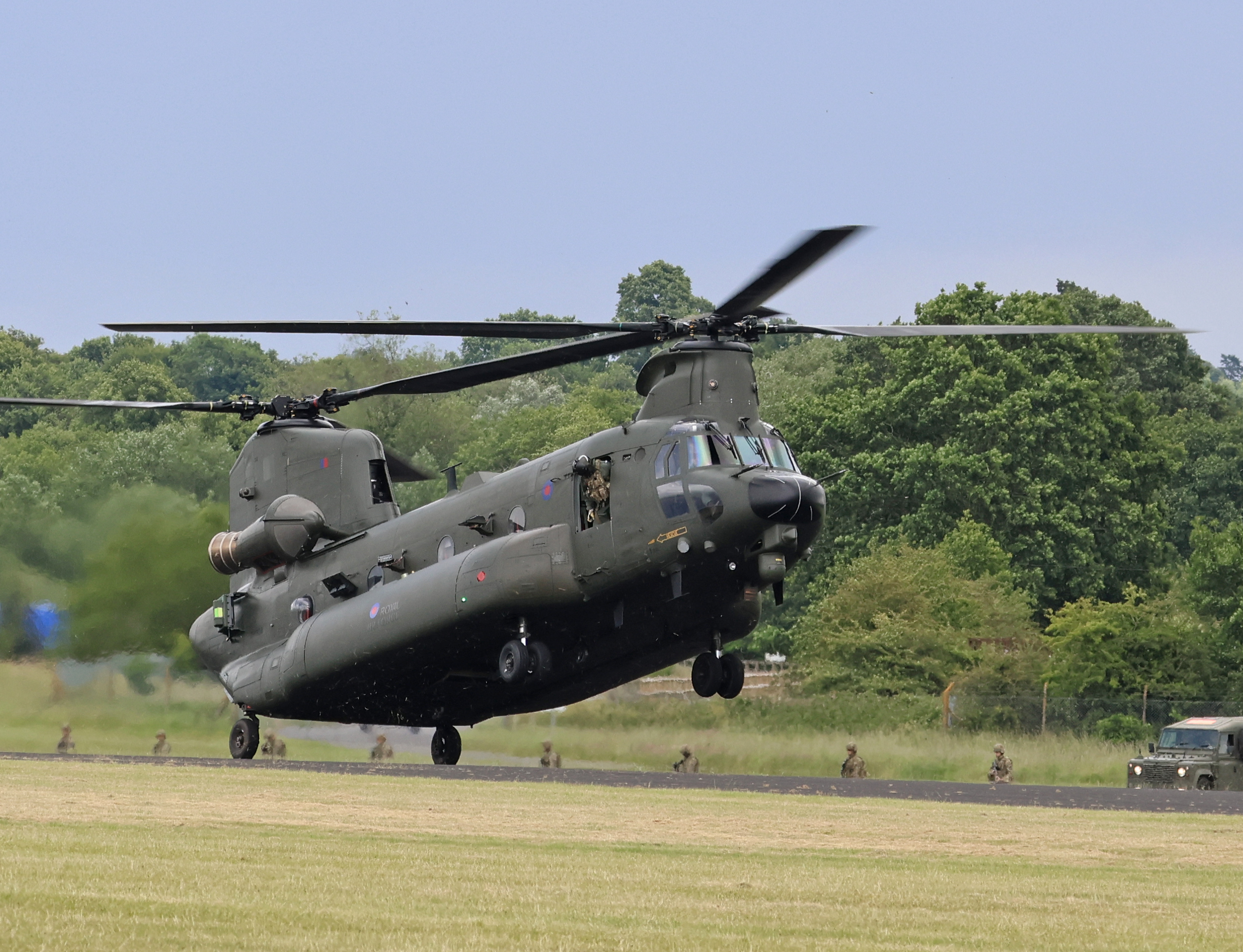
In July 2017 Boeing won the contract to modernise about 500 Army Chinooks to Block II: a strengthened structure, redesigned fuel tanks, an improved drivetrain and open avionics architecture to lift more, fly farther and accept future upgrades. The Army is also considering a Block 3 beyond 2025.
Serving civilians
Its ability to carry huge underslung loads has made it vital after disasters. Singapore sent its Chinooks to Indonesia after the 2004 tsunami, and the RAF sent them to Pakistan after the 2005 Kashmir earthquake. In August 1992 six CH-47Ds flew from Fort Bragg to Florida after Hurricane Andrew, in one of the first major helicopter relief operations on U.S. soil; they supplied 64 distribution sites and moved 1.2 million pounds of supplies. In 2011 three Japanese CH-47s dropped seawater on reactors 3 and 4 at Fukushima, with lead plates on the floor and sorties capped at 45 minutes to protect the crews. Even India's space agency has used air force Chinooks to drop its Pushpak reusable demonstrator in tests in 2023 and 2024.
Legacy
Few aircraft have kept their role so long with such a recognisable outline. Boeing now presents it in service with the U.S. Army and 20 international operators, and the RAF, with fifty-four aircraft in 2025, expects to keep it into the 2040s. Like the C-130 Hercules among fixed-wing types, the Chinook shows that a good early-1960s design, renewed again and again from within, is still the answer when heavy loads must reach places no truck can.
Variants
| YHC-1B | BV-347 | CH-47D | Chinook HC4 | ICH-47F | CH-47F Block II | ACH-47A | Boeing Vertol 234 | CH-147C | CH-147F | CH-47A | CH-47B | CH-47C | CH-47C Plus | CH-47DG | CH-47F | CH-47J | CH-47JA | CH-47SD | Chinook H-47(ER) | Chinook HC1 | Chinook HC1B | Chinook HC2 | Chinook HC2A | Chinook HC3 | Chinook HC5 | Chinook HC6 | Chinook HC6A | CU-47 | HH-47 | HH-47D | MH-47D | MH-47E | MH-47G | MH-47G Block II | Model 234ER | Model 234LR | Model 234MLR | Model 234UT | Model 414 | |
|---|---|---|---|---|---|---|---|---|---|---|---|---|---|---|---|---|---|---|---|---|---|---|---|---|---|---|---|---|---|---|---|---|---|---|---|---|---|---|---|---|
| First flight | September 21, 1961 | May 27, 1970 | May 11, 1979 | December 9, 2010 | June 24, 2013 | April 8, 2024 | — | — | — | — | — | — | — | — | — | — | — | — | — | — | — | — | — | — | — | — | — | — | — | — | — | — | — | — | — | — | — | — | — | — |
| Aircraft type | Pre-production transport helicopter | — | — | — | — | — | Gunship helicopter (conversion) | — | — | — | — | — | — | — | — | Tandem-rotor heavy-lift transport helicopter | — | — | — | — | — | — | — | — | — | — | — | — | — | — | Search and rescue helicopter | Special operations helicopter | Special operations helicopter | Special operations helicopter | Special operations helicopter | — | — | — | — | — |
| Powerplant | — | — | 2 × Lycoming T55-L-712 turboshafts (later T55-GA-714A) | — | — | — | — | — | — | — | 2 × Lycoming T55-L-5 turboshafts (later replaced by T55-L-7 or T55-L-7C) | — | — | — | — | 2 × Honeywell T55-GA-714A turboshafts with FADEC | — | — | — | — | — | — | — | — | — | — | — | — | — | — | — | — | 2 × Textron Lycoming T55-L-714 turboshafts rated at over 4,000 shp | — | — | — | — | — | — | — |
| Powerplant | — | — | 2 × Lycoming T55-L-712 | 2 × Honeywell T55-714 | — | 2 × Honeywell T55-GA-714A | — | — | — | — | 2 × Lycoming T55-L-5 | 2 × Lycoming T55-L-7C | 2 × Lycoming T55-L-7C | — | — | 2 × Honeywell T55-GA-714A | — | — | — | 2 × Honeywell T55-GA-714A | 2 × Lycoming T55-L-11E | — | — | — | — | 2 × Honeywell T55-714 | — | 2 × Honeywell T55-GA-714A | — | — | — | — | — | 2 × Honeywell T55-714 | — | — | — | — | — | — |
| Power per engine | — | — | 2,796 kW | — | — | 3,562 kW Best value in this row | — | — | — | — | 1,640 kW | 2,130 kW | 2,130 kW | — | — | 4,732 hp | — | — | — | 3,562 kW Best value in this row | — | — | — | — | — | — | — | — | — | — | — | — | — | — | — | — | — | — | — | — |
| Length | — | — | 30.1 m | — | — | 30.1 m | — | — | — | — | — | — | — | — | — | 30.1 m Best value in this row | — | — | — | — | — | — | — | — | — | — | — | 30.1 m | — | — | — | — | — | — | — | — | — | — | — | — |
| Height | — | — | 5.7 m Best value in this row | — | — | 5.7 m Best value in this row | — | — | — | — | — | — | — | — | — | 5.7 m | — | — | — | — | — | — | — | — | — | — | — | 5.7 m | — | — | — | — | — | — | — | — | — | — | — | — |
| Empty weight | — | — | 10,185 kg | — | — | — | — | — | — | — | — | — | — | — | — | 11,148 kg | — | — | — | — | — | — | — | — | — | — | — | 10,183 kg Best value in this row | — | — | — | — | — | — | — | — | — | — | — | — |
| MTOW | — | — | 22,680 kg | — | — | 24,494 kg Best value in this row | — | — | — | — | 15,000 kg | — | — | — | — | 24,494 kg Best value in this row | — | — | — | — | — | — | — | — | — | — | — | 22,680 kg | — | — | — | — | — | — | — | — | — | — | — | — |
| Top speed | — | — | 315 km/h Best value in this row | — | — | 302 km/h | — | — | — | — | — | — | — | — | — | 310 km/h | — | — | — | — | — | — | — | — | — | — | — | 300 km/h | — | — | — | — | — | — | — | — | — | — | — | — |
| Cruise speed | — | — | 220 km/h | — | — | 291 km/h Best value in this row | — | — | — | — | — | — | — | — | — | 291 km/h Best value in this row | — | — | — | — | — | — | — | — | — | — | — | — | — | — | — | — | — | — | — | — | — | — | — | — |
| Service ceiling | — | — | 5,639 m | — | — | 6,096 m | — | — | — | — | — | — | — | — | — | 6,100 m Best value in this row | — | — | — | — | — | — | — | — | — | — | — | 4,600 m | — | — | — | — | — | — | — | — | — | — | — | — |
| Initial climb rate | — | — | 7.7 m/s | — | — | — | — | — | — | — | — | — | — | — | — | 7.7 m/s | — | — | — | — | — | — | — | — | — | — | — | 10.1 m/s Best value in this row | — | — | — | — | — | — | — | — | — | — | — | — |
| Range | — | — | 741 km Best value in this row | — | — | — | — | — | — | — | — | — | — | — | — | 740 km | — | — | — | — | — | — | — | — | — | — | — | — | — | — | — | — | — | — | — | — | — | — | — | — |
| Ferry range | — | — | 2,252 km Best value in this row | — | — | — | — | — | — | — | — | — | — | — | — | 2,252 km Best value in this row | — | — | — | — | — | — | — | — | — | — | — | 2,200 km | — | — | — | — | — | — | — | — | — | — | — | — |
| Combat radius | — | — | — | — | — | 306 km Best value in this row | — | — | — | — | — | — | — | — | — | 306 km Best value in this row | — | — | — | — | — | — | — | — | — | — | — | — | — | — | — | — | — | — | — | — | — | — | — | — |
| Range conditions | — | — | — | — | — | — | — | — | — | — | — | — | — | — | — | 740 km range; 306 km combat radius and 2,252 km ferry range | — | — | — | — | — | — | — | — | — | — | — | Ferry range with auxiliary fuel tanks | — | — | — | — | — | — | — | — | — | — | — | — |
| Armament | — | — | — | — | — | — | Up to five 7.62 mm M60D or 12.7 mm M2HB machine guns (XM32 window, XM33 ramp); two fixed 20 mm M24A1 cannon (XM34); two XM159B/XM159C 19-tube 70 mm rocket launchers or two M18/M18A1 7.62 mm gun pods; M75 40 mm grenade launcher in an M5 (XM5) chin turret. | — | — | — | — | 2 × door-mounted 7.62 mm M60D (M24) and 1 × ramp-mounted M60D (M41) | — | — | — | Up to 3 pintle-mounted 7.62 mm M240 machine guns (or M134 Minigun) | — | — | — | — | — | — | — | — | — | — | — | 2 × M134 Miniguns and 1 × M60 machine gun | — | — | — | — | M134 miniguns (from 1995) | 2 × 7.62 mm M134 Miniguns and 2 × 7.62 mm M240 machine guns | — | — | — | — | — | — |
| Payload | — | — | 12,700 kg Best value in this row | — | — | 12,565 kg | — | — | — | — | 4,500 kg | — | 12,700 kg Best value in this row | — | — | 10,886 kg | — | — | — | — | — | — | — | — | — | — | — | — | — | — | — | — | — | — | — | — | — | — | — | — |
| Cargo capacity | — | — | Triple hook; up to 12,700 kg of cargo. 33 to 55 troops or 24 stretchers | — | — | Useful load 12,565 kg | — | — | — | — | Maximum payload about 4,500 kg | — | Payload record (September 1968): 10,430 kg internal and 12,700 kg on the hook | — | — | 33 to 55 troops, 24 stretchers or 10,886 kg payload | — | — | — | — | — | — | — | — | — | — | — | — | — | — | — | — | — | — | — | — | — | — | — | — |
| Crew | — | — | 3 Best value in this row | — | — | — | — | — | — | — | — | — | — | — | — | 3 Best value in this row | — | — | — | — | — | — | — | — | — | — | — | 4 | — | — | — | — | — | — | — | — | — | — | — | — |
| Passengers | — | — | 55 Best value in this row | — | — | — | — | — | — | — | — | — | — | — | — | 55 Best value in this row | — | — | — | — | — | — | — | — | — | — | — | 55 Best value in this row | — | — | — | — | — | — | — | — | — | — | — | — |
| Units built | — | — | — | — | — | — | 4 | — | 8 | 15 | 354 Best value in this row | 108 | 233 | — | — | — | — | — | — | — | 41 | — | — | 6 | 8 | — | 14 | — | — | 0 | — | 12 | 26 | — | — | — | — | — | — | — |
Images
Elsewhere
- DVIDSCH-47 Chinook of the 25th Combat Aviation Brigade during helocast training with Navy divers, Hawaii ↗
- DVIDSSoldiers fit a rotor blade to a CH-47 Chinook at Kandahar Airfield (Lifting the big blade) ↗
- DVIDSCH-47 Chinook during an 82nd Airborne air assault in Kandahar Province, Afghanistan ↗
- DVIDSCH-47 Chinook landing at Bellows, Hawaii, during a Special Forces helocast exercise ↗
- DVIDSU.S. Army CH-47 Chinook lifting off from an airfield in the Middle East (2026) ↗
- Vertical Flight Photo GalleryBoeing CH-47F Chinook nose ↗
- Vertical Flight Photo GalleryBoeing Chinook rear fuselage and cabin ↗
- Vertical Flight Photo GalleryIndian Air Force Chinook at Boeing Ridley Park ↗
- Vertical Flight Photo GalleryMH-47G Chinook at Oshkosh 2018 ↗
- Australian War MemorialU.S. Army CH-47F Chinook takes off after transporting Australian soldiers, Uruzgan, 2011 ↗
- flugzeuginfo.netBoeing Vertol CH-47D D-661, Royal Netherlands Air Force, Leeuwarden 2006 ↗
- Irish Air PicsBoeing CH-47D Chinook D-103, Royal Netherlands Air Force ↗
Show the 12 more
- Irish Air PicsBoeing CH-47 Chinook D401, Royal Netherlands Air Force ↗
- Photo12American Boeing Vertol CH-47 Chinook helicopter (Bernard Crochet collection) ↗
- AirHistory.netBoeing CH-47SD Chinook 7302, Taiwan Army, Guiren 2019 ↗
- AirHistory.netBoeing CH-47SD Chinook 7305, Taiwan Army, Kueijen 2014 ↗
- AirHistory.netBoeing Vertol CH-47C Chinook H-92, Argentine Air Force, Homestead 1980 ↗
- AirHistory.netBoeing CH-47 Chinook D-663, Royal Netherlands Air Force ↗
- JetPhotosBillings Flying Service Boeing CH-47D Chinook N404AJ at Medford, Oregon, 2016 ↗
- JetPhotosAustralian Army CH-47F Chinook A15-303 escorting retiring CH-47D A15-202 over the Australian War Memorial, 2016 ↗
- U.S. Air ForceAustralian Army CH-47F Chinook loaded onto a C-5M Galaxy at Dover AFB, 2021 ↗
- U.S. Air ForceTwo 160th SOAR MH-47G Chinooks hover over the Banana River, Florida, 2023 ↗
- AirTeamImagesBoeing Chinook HC6 ZK558, Royal Air Force, Swansea 2017 ↗
- Royal International Air TattooBoeing Chinook HC6 ZA681, Royal Air Force, at RIAT ↗