Boeing CH-47 Chinook variant
Boeing CH-47 Chinook CH-47D
The CH-47D was the US Army's large-scale rebuild of the Chinook, launched in the mid-1970s. Rather than buying new helicopters, Boeing Vertol stripped existing CH-47A, B and C airframes back to their basic structure and rebuilt them with more powerful turboshafts, uprated transmissions, composite rotor blades, redundant electrics, new avionics and a triple-hook external cargo system. The first prototype flew in May 1979 and deliveries began in 1982. For more than two decades the D model was the Army's standard heavy-lift helicopter, playing a central part in the Gulf War, the Balkans, Afghanistan and Iraq. It also served, new-built or converted, with the Netherlands, South Korea, Spain, Greece, Singapore, Canada and Australia. It was succeeded by the CH-47F, and many retired airframes found a second career with civil firefighting operators.

- May 11, 1979
- First flight
- 741 km
- Range
- 55
- Passengers
History
A rebuild rather than a purchase
By the mid-1970s the US Army owned a large fleet of early-series Chinooks, many of them worn hard by the Vietnam War. Drawing on that combat experience, Boeing and the Army began a deep modernisation in 1975 that became the CH-47D. The central choice was practical and financial: instead of ordering new-build machines, the Army would rebuild the helicopters it already had to a far better standard.
To prove the concept, one airframe from each earlier series, a CH-47A, a CH-47B and a CH-47C, was taken apart down to the basic structure and fitted with the new systems, producing three prototypes. The first, converted from a CH-47A, flew on 11 May 1979. Once Army flight testing was complete, Boeing Vertol started series conversions and handed over the first aircraft in 1982.
What changed from the CH-47C
The airframe was essentially that of earlier models, but nearly everything inside it was new. Early CH-47Ds had two Lycoming T55-L-712 turboshafts, rated at 4,500 shp each according to one source, and most of the fleet later moved to the T55-GA-714A. Transmissions were strengthened to absorb the extra power and the rotor blades were made from composite materials. The cockpit was redesigned to cut pilot workload and the controls were made compatible with night-vision goggles. The electrical system gained redundancy, the hydraulics were modularised, and an advanced flight control system, an auxiliary power unit and new navigation and communication avionics were added, eventually including GPS.
The most visible addition was the triple hook under the fuselage, which lets the helicopter sling bulky loads such as 12-metre containers or construction machinery. English-language Wikipedia puts the external load at up to 12,000 kg; the Spanish edition gives 11 800 kg. In air assault operations the CH-47D became the usual means of moving an M198 155 mm howitzer together with 30 rounds of ammunition and its 11-man crew. Its useful load was close to twice that of the original Chinook.
How many were produced
Sources disagree on the total. English Wikipedia counts 472 conversions for the US Army; the Spanish edition says almost 500 A, B and C models went through the process; and Army Technology states that Boeing delivered over 480 CH-47Ds to the Army and the National Guard. Deliveries under the main programme ran from 1982 to 1994. Only two were built from scratch, to replace losses in the Gulf War, and the last US Army CH-47D was delivered in 2002 to the Army Reserve at Fort Hood, Texas.
Gulf War and the Balkans
The type's first large-scale combat came in 1990 and 1991, when about 163 CH-47Ds took part in Operations Desert Shield and Desert Storm, serving in the heavy-lift battalions of each corps' aviation brigades. On 24 February 1991, the first day of the ground offensive, the 101st Airborne Division mounted its air assault into Iraq and set up Forward Operating Base Cobra, halfway between the border and the Euphrates; 60 CH-47Ds carried and then resupplied around 5000 soldiers and their equipment there.
For the peacekeeping mission in Bosnia the Army deployed 16 CH-47Ds from A Company, 5th Battalion, 159th Aviation. Their best-remembered task was supporting the bridging of the Sava river, and a platoon of six helicopters stayed in the area until 1997.
Special operations
In 1983 the Army fitted 16 CH-47Ds with improved navigation, communications and self-protection equipment for special forces work, under the name CH-47D Special Operations Aircraft. When the MH-47E arrived, these machines were returned to the standard configuration. The South Korean Air Force later took a search-and-rescue derivative of the D, the HH-47D.
Afghanistan and Iraq
In Afghanistan and Iraq the CH-47D inserted troops in air assaults and then flew food, water and ammunition to forward bases. In the Afghan mountains, where altitude and heat restrict lighter helicopters such as the UH-60, its lift proved especially valuable; one Chinook was reportedly able to do the work of up to five Black Hawks. On 6 April 2005 the CH-47D known as Big Windy 25 crashed in a sandstorm near Ghazni, killing all 18 aboard. Canada, which had sold its earlier Chinooks to the Netherlands, found itself short of heavy-lift helicopters in Afghanistan and in 2008 bought six CH-47Ds from the US Army for $252 million; one was lost in an accident and the other five were sold in 2011, to be replaced by seven CH-147Fs. Australia lost a CH-47D in Zabul Province in May 2011 and replaced it with two former US Army aircraft.
Foreign operators
In 1993 the Netherlands agreed with Canada to take over seven retired CH-147s, which Boeing remanufactured to CH-47D standard and delivered between August 1995 and February 1996; six new-build aircraft followed in 1998. The Dutch machines featured a long nose housing a Bendix weather radar, a glass cockpit and T55-L-714 engines, and flew with 298 Squadron. Two were lost in Afghanistan in 2005, and between 2015 and 2023 the remaining 11 were replaced by CH-47Fs. South Korea bought 18 CH-47Ds for its army in 1988 and later added 14 second-hand examples. Spain bought nine CH-47Ds and brought its older CH-47Cs up to the same standard, giving a fleet of 17 armed with three M60 machine guns each; all have since become F models. Greece upgraded its CH-47Cs and added ten ex-US CH-47Ds, and Singapore bought six in 1996. The export version carried the company designation Model 414.
Succession and second life
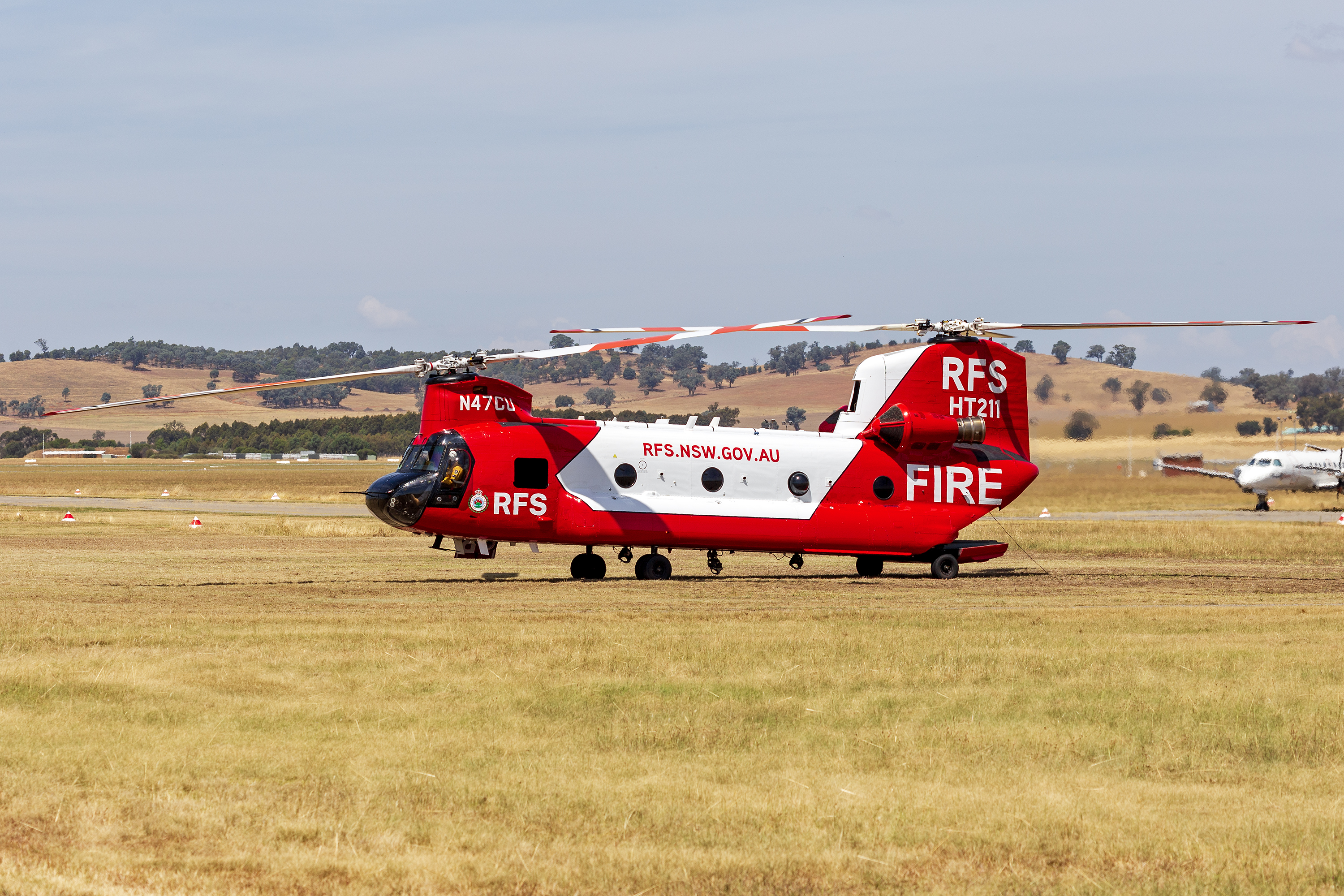
In the mid-1990s Boeing and the Army agreed on the next step, the CH-47F, which eventually replaced the D. Retired aircraft formed a surplus of about 80 airframes that the United States repeatedly offered to allies; in 2014, for example, a batch of 24 was proposed to Brazil, Chile and Colombia. Others moved to the civil register in the FAA restricted category and now fight wildfires. One of them, registered N388RA, crashed into the Salmon River in Idaho on 21 July 2022 while working on the Moose Fire, killing both pilots. In Australia, CH-47D A15-104 is preserved at the Australian Army Flying Museum in Oakey.
Multimedia

Elsewhere
- flugzeuginfo.netBoeing Vertol CH-47D D-661, Royal Netherlands Air Force, Leeuwarden 2006 ↗
- Irish Air PicsBoeing CH-47D Chinook D-103, Royal Netherlands Air Force ↗
- JetPhotosBillings Flying Service Boeing CH-47D Chinook N404AJ at Medford, Oregon, 2016 ↗
- JetPhotosAustralian Army CH-47F Chinook A15-303 escorting retiring CH-47D A15-202 over the Australian War Memorial, 2016 ↗