Eurofighter Typhoon: Europe’s $130M Supersonic Jet That Dominates the Skies
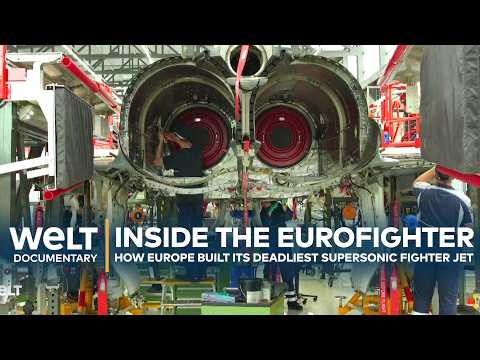
Video from the channel WELT Documentary about Eurofighter Typhoon, linked on its Above Ten Thousand entry. Duration: 51:08. Language: English. Video type: Documentary.
What it's about
WELT documentary on the Eurofighter Typhoon focused on Airbus's plant in Manching (Bavaria), where the Luftwaffe's Eurofighters are assembled and maintained. It covers the fitting-out of the fuselage center section, its joining with the front section, warehouse logistics, scheduled maintenance, EJ200 engine repair at MTU, engine testing in the hangar and the flight simulator, interspersing bombing and air-to-air combat exercises.
Historical context
The program brings together Germany, the United Kingdom, Italy and Spain. Germany had already built the Tornado's center section and carried that experience over to the new aircraft. In 1983 Chancellor Helmut Kohl called for support for a pure fighter; on 2 August 1985 Germany, the United Kingdom and Italy signed the program agreement, and Spain joined a month later. The first prototype flew on 27 March 1994 and, after seven more prototypes, the first series-production units left Manching, Warton, Turin and the Spanish plant in 2003. 148 Tranche 1 aircraft were produced; the Luftwaffe put them into service in April 2004 with Fighter Wing 73 in Laage, and Tranche 2 deliveries began in October 2008 with nearly 400 modifications. Today it has more than 680 orders from nine customers.
Key facts
According to the documentary, it reaches Mach 2.35 (about 2,900 km/h), is nearly 16 m long with an 11 m wingspan, weighs 11,000 kg empty, carries more than 6,200 l of fuel and reaches a combat radius of 1,300 km with additional tanks; it costs around 130 million euros. It is inherently unstable by design and relies on a quadruplex flight control system that continuously corrects the canards. Each EJ200 delivers the equivalent of about 50,000 hp, burns about 75 kg of fuel per minute dry and 250 kg with afterburner, and allows supersonic flight without it. Up to 10 aircraft a year are built at Manching: the center section spends 45 working days in its jig, with 2,500 work steps, around 30,000 hand-crimped connections and 15,000 cables traceable by operator and tool. Every German aircraft returns after 600 flight hours for a months-long overhaul, with clearance checks on the canards and engines, whose damaged parts — often from bird strikes — undergo fluorescent-dye crack testing. In the exercises, two GPS-guided bombs hit within 12 km and missiles with a range of up to 80 km are fired against drones over northern Scotland.