Airliner · Civil · United Kingdom
Vickers VC10
- June 29, 1962
- First flight
- 1964
- Introduced
- 2013
- Retired
- 54
- Units built


-1600.webp)


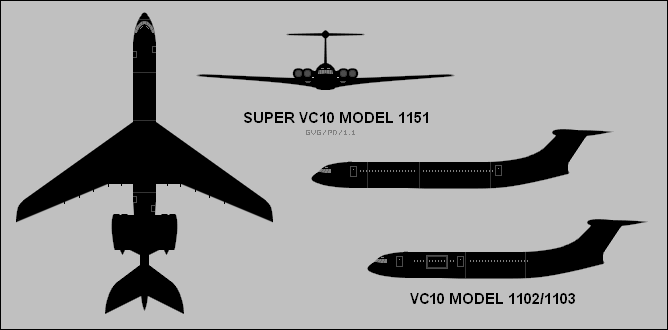
The Vickers VC10 was a British long-range jet airliner designed to operate from the short, hot and high runways of BOAC's route network. It first flew in 1962 and, after its airline career, soldiered on with the Royal Air Force until 2013.
Related events
Related sheets
Category
History
The VC10 answered a very specific BOAC requirement: a long-range jet able to lift a full load out of the short, hot and high runways of its African and Asian network, where contemporary American jets paid heavy performance penalties. Vickers chose an unusual layout, clustering four Rolls-Royce Conway engines at the tail to leave a clean, high-lift wing. The prototype flew from Brooklands on 29 June 1962 and the type entered BOAC service in 1964.
The stretched Super VC10 added capacity for Atlantic routes, where the aircraft earned a reputation for speed and a quiet cabin that passengers remembered fondly; a VC10 set the fastest Atlantic crossing recorded by a subsonic airliner. Its operating economics, however, could not match the American competition, and production ended after just 54 aircraft.
Its second career was military. The Royal Air Force used the VC10 as a transport and, above all, as an air-to-air refuelling tanker, a role it kept flying until final retirement in 2013, nearly half a century after its first flight.
Variants
| Vickers VC10 Type 1100 | BAC Super VC10 Type 1151 | BAC Standard VC10 Type 1102 | BAC Standard VC10 Type 1103 | BAC Standard VC10 Type 1104 | BAC Standard VC10 Type 1106 | BAC Standard VC10 Type 1109 | BAC Super VC10 Type 1150 | BAC Super VC10 Type 1152 | BAC Super VC10 Type 1154 | BAC Super VC10 Type 1180 | BAC Super VC10 Type 1181 | BAC Type 1125 | BAC VC10A Type 1110 | BAC VC10A Type 1111 | BAC VC10 Type 1101 | BAC VC11 Type 1400 | VC10 C.1 | VC10 C.1K | VC10 K.2 | VC10 K.3 | VC10 K.3A | VC10 K.4 | |
|---|---|---|---|---|---|---|---|---|---|---|---|---|---|---|---|---|---|---|---|---|---|---|---|
| First flight | June 29, 1962 | May 7, 1964 | — | — | — | — | — | — | — | — | — | — | — | — | — | — | — | — | — | — | — | — | — |
| Aircraft type | Long-haul airliner prototype | Long-haul airliner | Long-haul airliner | Long-haul airliner | Long-haul airliner (not built) | Strategic military transport | Long-haul airliner | Long-haul airliner | Long-haul airliner (not built) | Long-haul airliner | Long-haul airliner (not built) | Long-haul airliner (not built) | Long-haul airliner (not built) | Long-haul airliner (not built) | Long-haul airliner (not built) | Long-haul airliner | Medium-haul airliner (not built) | Strategic military transport | Military transport and aerial tanker | Aerial refuelling tanker | Aerial refuelling tanker | Aerial refuelling tanker (not built) | Aerial refuelling tanker |
| Powerplant | Four Rolls-Royce Conway RCo.42 turbofans paired on either side of the rear fuselage, with thrust reversers on all four engines, an arrangement the production series dropped. | Four Rolls-Royce Conway RCo.43D Mk.550 turbofans of 96.97 kN each (21,800 lbf), in nacelles angled three degrees nose-up and with reversers on all four engines. | Four Rolls-Royce Conway RCo.42 Mk.540 turbofans of 93.4 kN each, with the 4% chord leading-edge extension and an extra wing fence near the root. | Four Rolls-Royce Conway RCo.42 Mk.540 turbofans of 93.4 kN each, with the same extended leading-edge wing as the Ghana Airways series. | Four Rolls-Royce Conway turbofans in rear pairs, like the rest of the Standard series; the order was cancelled before the available sources pinned down the exact engine mark. | Four Rolls-Royce Conway RCo.43 Mk.301 turbofans of 96.97 kN each (21,800 lbf dry), the same uprated engines as the Super VC10, fed as well by the fin fuel tank. | Four Rolls-Royce Conway turbofans in rear pairs; the sources consulted do not state the exact mark carried after the conversion. | Four Rolls-Royce Conway RCo.43D Mk.550 turbofans of 96.97 kN each (21,800 lbf), with thrust reversers on all four engines and an extra fin fuel tank. | Four Rolls-Royce Conway turbofans of the Super VC10 family; the order was cancelled before the sources pinned down the exact mark. | Four Rolls-Royce Conway RCo.43D Mk.550 turbofans of 96.97 kN each (21,800 lbf), identical to those of BOAC's Super VC10. | Four Rolls-Royce Conway turbofans in rear pairs, following the Super VC10 layout the project derived from. | Four Rolls-Royce Conway turbofans in rear pairs, following the Super VC10 layout. | Four Rolls-Royce Conway turbofans in rear pairs; the study never reached a documented engine designation. | Four Rolls-Royce Conway turbofans in the VC10's characteristic rear arrangement; the project never settled on a documented engine designation. | Four Rolls-Royce Conway turbofans in rear pairs, following the VC10A project layout. | Four Rolls-Royce Conway RCo.42 Mk.540 turbofans of 93.4 kN each (21,000 lbf), paired on either side of the rear fuselage; thrust reversers were retained only on the inboard engines. | Four Rolls-Royce Spey turbofans in the rear arrangement inherited from the VC10; sources do not state the engine mark. | Four Rolls-Royce Conway RCo.43 Mk.301 turbofans of 96.97 kN each (21,800 lbf dry), with a tail APU for self-sufficiency at bases without ground support equipment. | Four Rolls-Royce Conway RCo.43 Mk.301 turbofans of 96.97 kN each (21,800 lbf dry), unchanged from the C Mk.1 the conversion came from. | Four Rolls-Royce Conway RCo.43 Mk.550B turbofans of 96.97 kN each (21,800 lbf): the conversion brought the Standard airframes up to the C Mk.1 engine standard to unify the fleet. | Four Rolls-Royce Conway RCo.43 Mk.550B turbofans of 96.97 kN each (21,800 lbf); the conversion sealed the cargo door and removed the inboard thrust reversers. | Four Rolls-Royce Conway turbofans of the Super VC10 family; the conversion was never carried out and no engine designation is documented. | Four Rolls-Royce Conway RCo.43 Mk.550B turbofans of 96.97 kN each (21,800 lbf), the same as the K Mk.3 the conversion follows. |
| Powerplant | 4 × Rolls-Royce Conway RCo.42 | 4 × Rolls-Royce Conway RCo.43D Mk.550 | 4 × Rolls-Royce Conway RCo.42 Mk.540 | 4 × Rolls-Royce Conway RCo.42 Mk.540 | 4 × turbofan | 4 × Rolls-Royce Conway RCo.43 Mk.301 | 4 × turbofan | 4 × Rolls-Royce Conway RCo.43D Mk.550 | 4 × turbofan | 4 × Rolls-Royce Conway RCo.43D Mk.550 | 4 × turbofan | 4 × turbofan | 4 × turbofan | 4 × turbofan | 4 × turbofan | 4 × Rolls-Royce Conway RCo.42 Mk.540 | 4 × Rolls-Royce Spey | 4 × Rolls-Royce Conway RCo.43 Mk.301 | 4 × Rolls-Royce Conway RCo.43 Mk.301 | 4 × Rolls-Royce Conway RCo.43 Mk.550B | 4 × Rolls-Royce Conway RCo.43 Mk.550B | 4 × turbofan | 4 × Rolls-Royce Conway RCo.43 Mk.550B |
| Thrust per engine | 93.4 kN | 97 kN Best value in this row | 93.4 kN | 93.4 kN | — | 97 kN Best value in this row | — | 97 kN Best value in this row | — | 97 kN Best value in this row | — | — | — | — | — | 93.4 kN | — | 97 kN Best value in this row | 97 kN Best value in this row | 97 kN Best value in this row | 97 kN Best value in this row | — | 97 kN Best value in this row |
| Length | 48.4 m | 52.3 m Best value in this row | 48.4 m | 48.4 m | 48.4 m | 48.4 m | 48.4 m | 52.3 m Best value in this row | 52.3 m Best value in this row | 52.3 m Best value in this row | — | — | — | — | — | 48.4 m | — | 48.4 m | 48.4 m | 48.4 m | 52.3 m Best value in this row | 52.3 m Best value in this row | 52.3 m Best value in this row |
| Wingspan | 42.7 m | 44.6 m Best value in this row | 44.6 m Best value in this row | 44.6 m Best value in this row | 44.6 m Best value in this row | 44.6 m Best value in this row | 44.6 m Best value in this row | 44.6 m Best value in this row | 44.6 m Best value in this row | 44.6 m Best value in this row | — | — | — | — | — | 44.6 m Best value in this row | — | 44.6 m Best value in this row | 44.6 m Best value in this row | 44.6 m Best value in this row | 44.6 m Best value in this row | 44.6 m Best value in this row | 44.6 m Best value in this row |
| Height | 12 m Best value in this row | 12 m Best value in this row | 12 m Best value in this row | 12 m Best value in this row | — | 12 m Best value in this row | 12 m Best value in this row | 12 m Best value in this row | 12 m Best value in this row | 12 m Best value in this row | — | — | — | — | — | 12 m Best value in this row | — | 12 m Best value in this row | 12 m Best value in this row | 12 m Best value in this row | 12 m Best value in this row | — | 12 m Best value in this row |
| Wing area | — | 272 m² | 273 m² Best value in this row | 273 m² Best value in this row | — | 272 m² | 272 m² | 272 m² | 272 m² | 272 m² | — | — | — | — | — | 265 m² | — | 272 m² | 272 m² | 265 m² | 272 m² | — | 272 m² |
| Empty weight | — | 71,937 kg | 66,670 kg | 66,670 kg | — | 66,224 kg | — | — | — | 70,160 kg | — | — | — | — | — | 67,980 kg | — | 66,224 kg | — | 60,875 kg Best value in this row | — | — | — |
| MTOW | — | 151,953 kg Best value in this row | 141,520 kg | 141,520 kg | — | 146,510 kg | — | — | — | 151,953 kg Best value in this row | — | — | — | — | — | 142,430 kg | — | 146,510 kg | 146,510 kg | 135,622 kg | 146,513 kg | — | 146,513 kg |
| Top speed | — | 935 km/h Best value in this row | 914 km/h | 914 km/h | — | 935 km/h Best value in this row | — | — | — | 935 km/h Best value in this row | — | — | — | — | — | 914 km/h | — | 935 km/h Best value in this row | 935 km/h Best value in this row | 914 km/h | 935 km/h Best value in this row | — | 935 km/h Best value in this row |
| Max speed altitude | — | 9,450 m | 9,450 m | 9,450 m | — | 9,450 m | — | — | — | 9,450 m | — | — | — | — | — | 9,450 m | — | 9,450 m | 9,450 m | 9,450 m | 9,450 m | — | 9,450 m |
| Cruise speed | — | 886 km/h Best value in this row | 886 km/h Best value in this row | 886 km/h Best value in this row | — | 684 km/h | — | — | — | 886 km/h Best value in this row | — | — | — | — | — | 886 km/h Best value in this row | — | 684 km/h | 684 km/h | 886 km/h Best value in this row | 886 km/h Best value in this row | — | 886 km/h Best value in this row |
| Cruise altitude | — | 11,600 m | 11,600 m | 11,600 m | — | 9,145 m | — | — | — | 11,600 m | — | — | — | — | — | 11,600 m | — | 9,145 m | 9,145 m | 11,600 m | 11,600 m | — | 11,600 m |
| Service ceiling | — | 12,800 m Best value in this row | 12,800 m Best value in this row | 12,800 m Best value in this row | — | 12,800 m Best value in this row | — | — | — | 12,800 m Best value in this row | — | — | — | — | — | 12,800 m Best value in this row | — | 12,800 m Best value in this row | 12,800 m Best value in this row | 12,800 m Best value in this row | 12,800 m Best value in this row | — | 12,800 m Best value in this row |
| Initial climb rate | — | 11.7 m/s | 9.8 m/s | 9.8 m/s | — | 15.5 m/s Best value in this row | — | — | — | 11.7 m/s | — | — | — | — | — | 9.8 m/s | — | 15.5 m/s Best value in this row | — | — | — | — | — |
| Range | — | 7,596 km | 8,115 km Best value in this row | 8,115 km Best value in this row | — | 6,273 km | — | — | — | 7,596 km | — | — | — | — | — | 8,115 km Best value in this row | — | 6,273 km | — | — | — | — | — |
| Ferry range | — | 11,470 km Best value in this row | 9,765 km | 9,765 km | — | — | — | — | — | 11,470 km Best value in this row | — | — | — | — | — | 9,765 km | — | — | — | — | — | — | — |
| Combat radius | 0 km Best value in this row | 0 km Best value in this row | 0 km Best value in this row | 0 km Best value in this row | 0 km Best value in this row | 0 km Best value in this row | 0 km Best value in this row | 0 km Best value in this row | 0 km Best value in this row | 0 km Best value in this row | 0 km Best value in this row | 0 km Best value in this row | 0 km Best value in this row | 0 km Best value in this row | 0 km Best value in this row | 0 km Best value in this row | 0 km Best value in this row | 0 km Best value in this row | 0 km Best value in this row | 0 km Best value in this row | 0 km Best value in this row | 0 km Best value in this row | 0 km Best value in this row |
| Range conditions | Development airframe devoted to certification testing, with no published range figures of its own; the programme ended with type certification in April 1964. | Range of 7,596 km with maximum payload and up to 11,470 km with maximum fuel, without reserves; the fin tank is the key to the jump over the Standard series. | Range of 8,115 km with maximum payload and 9,765 km with maximum fuel, without reserves. | Range of 8,115 km with maximum payload and 9,765 km with maximum fuel, without reserves. | No range figures of its own: the variant was never built. | Range of 6,273 km with maximum payload; the extra fin tank and the more powerful engines offset the heavier military airframe. | No published range figures of its own; with the Type 1106 wing its behaviour was close to that of the production Standard series. | A family tuned for payload rather than take-off performance; the actual range figures belong to the 1151 and 1154 series. | No range figures of its own: the variant was never built. | Range of 7,596 km with maximum payload and up to 11,470 km with maximum fuel, without reserves. | No range figures: the project never got past the study stage. | No range figures: the project never got past the study stage. | No range figures: the project got no further than a commercial proposal. | No range figures: the project never left the drawing board. | No range figures: the variant was never built. | Range of 8,115 km with maximum payload and up to 9,765 km with maximum fuel, both figures without reserves; the high-lift wing let it work from the short, hot runways of Africa and the Middle East. | No range figures: the project was dropped before any aircraft was built. | Range of 6,273 km with maximum payload, enough for Transport Command's strategic routes to Cyprus, Gan, Singapore and Hong Kong. | Carrying no extra fuel, its radius of action remains that of the transport: whatever it passes to the receiver comes off its own range. | Maximum take-off weight drops to 135,622 kg because the mission is to deliver fuel rather than cover distance: useful endurance depends on how much it gives away. | The long fuselage and maindeck tanks give it the fleet's greatest offload capacity; maximum take-off weight is 146,513 kg. | No range figures: the conversion was never carried out. | Without maindeck tanks it offloads less fuel than the K Mk.3 in exchange for a lighter airframe; maximum take-off weight stays at 146,513 kg. |
| Armament | None | None | None | None | None | None | None | None | None | None | None | None | None | None | None | None | None | None | None | None | None | None | None |
| Max weapons load | 0 kg Best value in this row | 0 kg Best value in this row | 0 kg Best value in this row | 0 kg Best value in this row | 0 kg Best value in this row | 0 kg Best value in this row | 0 kg Best value in this row | 0 kg Best value in this row | 0 kg Best value in this row | 0 kg Best value in this row | 0 kg Best value in this row | 0 kg Best value in this row | 0 kg Best value in this row | 0 kg Best value in this row | 0 kg Best value in this row | 0 kg Best value in this row | 0 kg Best value in this row | 0 kg Best value in this row | 0 kg Best value in this row | 0 kg Best value in this row | 0 kg Best value in this row | 0 kg Best value in this row | 0 kg Best value in this row |
| Payload | — | 22,860 kg | 18,039 kg | 18,039 kg | — | 26,037 kg | — | — | — | 27,360 kg Best value in this row | — | — | — | — | — | 17,840 kg | — | 26,037 kg | — | — | — | — | — |
| Cargo capacity | Test airframe without a definitive commercial cabin: prototype G-ARTA flew with the short 42.72 m span wing and squared tips before the series aerodynamic refinements were fitted. | Fuselage stretched 3.96 m over the Standard: BOAC's typical layout of 16 first-class and 123 economy seats, up to 174 in a high-density cabin, with a maximum payload of 22,860 kg. | Combi version for Ghana Airways: up to 151 economy seats and, on the second airframe, a large side cargo door for mixed passenger and freight work, with a maximum payload of 18,039 kg. | Combi version for British United Airways, very close to the Type 1102 and also fitted with a cargo door; up to 151 seats and 18,039 kg maximum payload. One airframe came from a cancelled Ghana Airways order. | Standard series ordered by Nigeria Airways with the usual VC10 cabin; the two-aircraft order was cancelled and none was ever built. | Manufacturer designation of the RAF's VC10 C Mk.1: shortened Super VC10 fuselage with a large port-side cargo door and a tail APU, for 150 passengers or 76 stretchers with six medical attendants and up to 26,037 kg of freight. | Type 1100 prototype rebuilt with the Type 1106 wing and leased to Laker Airways, with a cabin of up to 151 economy seats. | Generic designation of the Super VC10, with a fuselage stretched 3.96 m over the Standard and seating for 163 to 174 economy passengers. | Combi Super VC10 for BOAC, with a large cargo door and a freight handling system for mixed operations; the thirteen-aircraft order was cancelled. | Combi Super VC10 for East African Airways, with a large freight door on the port side ahead of the wing: up to 174 economy seats or mixed passenger and cargo loads with a maximum payload of 27,360 kg, the highest in the family. | Double-deck Super VC10 project for high passenger capacity; sources disagree on the exact seat count and none was built. | A second double-deck Super VC10 project, of even greater capacity than the Type 1180; it was not built either. | Hybrid project between the Standard series and the Super VC10 offered to Aerolíneas Argentinas; none was built. | Generic designation of the VC10A project, a development of the Standard series that was never built. | VC10A version intended for BOAC; the airline chose the Super VC10 instead and none was built. | Production series for BOAC in a typical layout of 16 first-class and 93 economy seats, stretchable to 151 in a high-density cabin; maximum payload is 17,840 kg. | Scaled-down VC10 with a six-abreast cabin for 80 to 138 passengers; cancelled in favour of the BAC One-Eleven. | RAF transport with the short Super VC10 fuselage and a large cargo door: 150 passengers or 76 stretchers with six medical attendants, and up to 26,037 kg of payload. | Thirteen C Mk.1s converted to transport/tanker standard: they keep the transport's passenger and freight cabin and add two underwing hose units, with no extra fuselage tanks. | Five Type 1101s converted to tankers, without a cargo door: five extra fuselage tanks, three hose drum units and only 18 seats for support personnel. | Four East African Airways Super VC10 Type 1154s converted into three-point tankers, with maindeck tanks and 17 seats for support crew. | RAF designation for four proposed Type 1166 tanker conversions; none was converted. | Five British Airways Super VC10 Type 1151s converted into three-point tankers like the K Mk.3, but without maindeck tanks, so the volume they can offload is smaller. |
| Crew | — | 4 Best value in this row | — | — | — | 4 Best value in this row | — | — | — | — | — | — | — | — | — | 4 Best value in this row | — | 4 Best value in this row | 4 Best value in this row | 4 Best value in this row | 4 Best value in this row | — | 4 Best value in this row |
| Passengers | — | 174 | 151 | 151 | — | 150 | 151 | 174 | 174 | 174 | 239 Best value in this row | 239 Best value in this row | — | — | — | 151 | 138 | 150 | 150 | 18 | 17 | — | 17 |
| Units built | 1 | 17 Best value in this row | 3 | 2 | 0 | 14 | 1 | — | 0 | 5 | 0 | 0 | 0 | 0 | 0 | 12 | 0 | 14 | 13 | 5 | 4 | 0 | 5 |
Images
Elsewhere
- FlightGlobalDespiece numerado (cutaway) del Vickers VC10, lámina del archivo de Flight International ↗
- FlightGlobalDespiece numerado (cutaway) del Vickers Super VC10, lámina del archivo de Flight International ↗
- FlightGlobalDespiece numerado (cutaway) del Vickers VC10 de la RAF, lámina del archivo de Flight International ↗