Airliner · Civil · Russia
Tupolev Tu-104
- June 17, 1955
- First flight
- 1956
- Introduced
- 1981
- Retired
- 201
- Units built


-1600.webp)
)-1600.webp)
-800.webp)


)-1600.webp)
%2C_1956%E2%80%9357.jpg)


-800.webp)


)-1600.webp)


-1600.webp)


-1600.webp)
_en_Arlanda-800.webp)
.png)
%2C_Kyiv-Zhulyany%2C_2008-800.webp)


_en_Arlanda%2C_1966-800.webp)

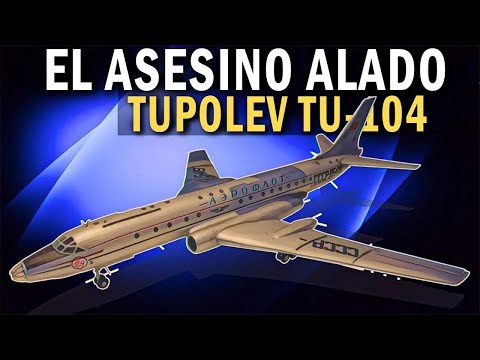
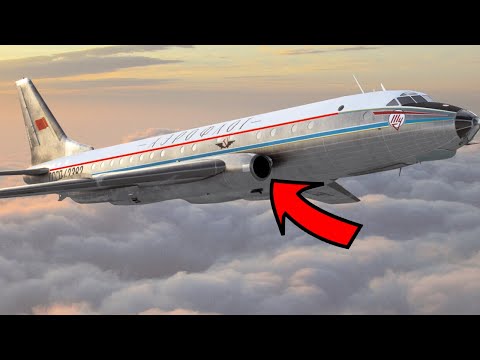
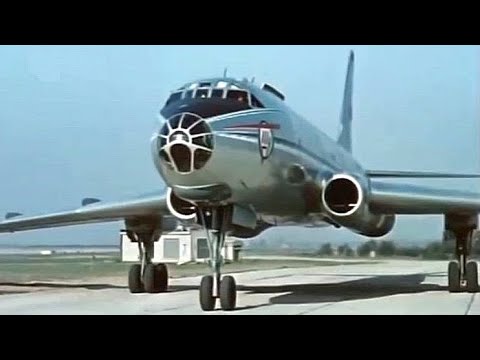
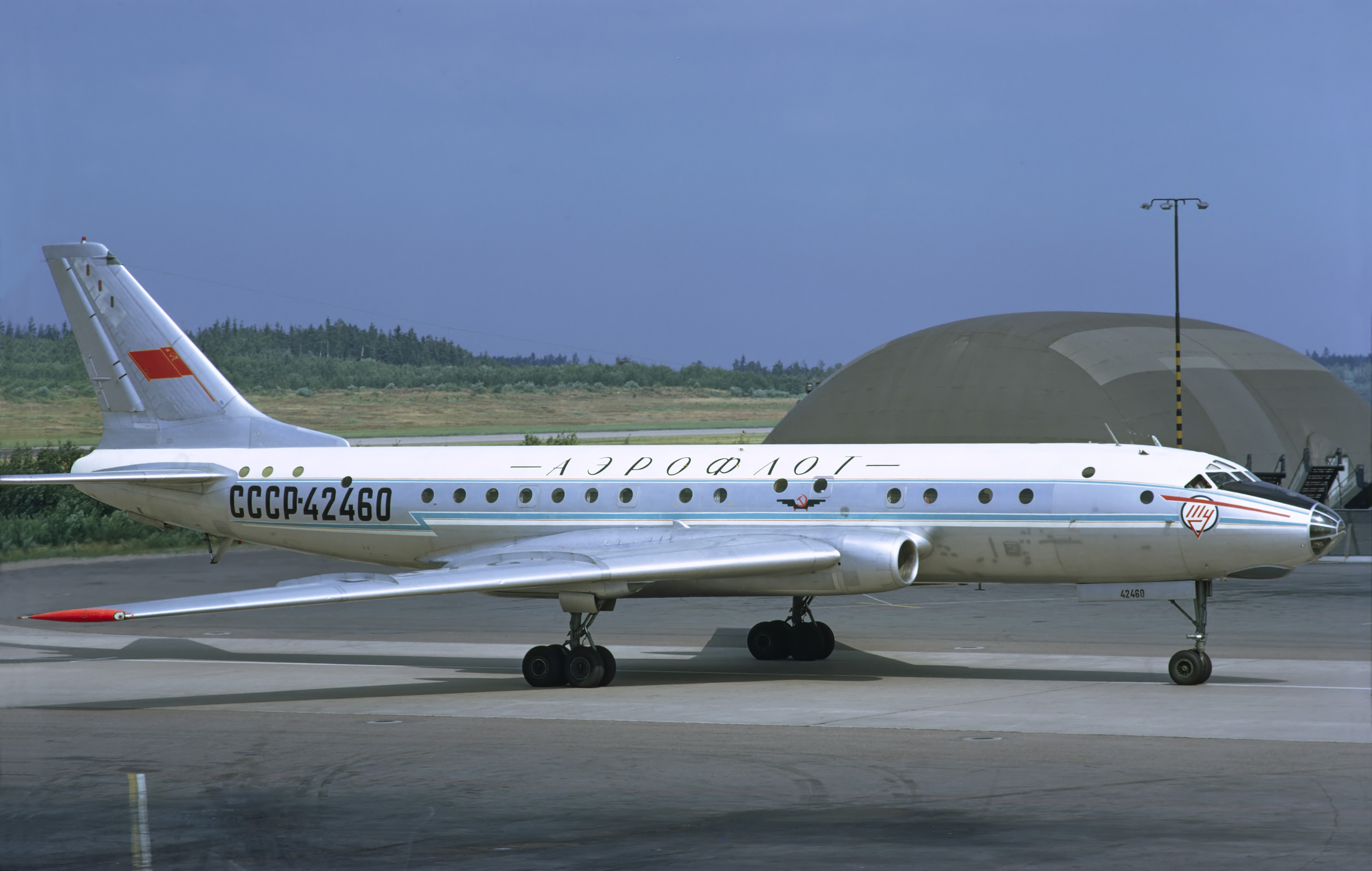
The Tupolev Tu-104 is a Soviet medium-range, narrow-body airliner powered by two turbojets. Its historical significance is twofold: it was the second jetliner to enter regular service, after the British de Havilland Comet, and from 1956 to 1958 it was the only one operating anywhere in the world, after the British jets were grounded following several crashes. Its NATO reporting name was Camel. The aircraft answered a very specific need: in the early 1950s Aeroflot required a modern airliner with better capacity and performance than the piston-engined types then in use. The Tupolev OKB met the requirement by deriving it from the Tu-16 strategic bomber, retaining its wings, engines and tail surfaces and mating them to a wider pressurised fuselage designed for fifty passengers. Two Mikulin AM-3 turbojets sat in the wing roots, as on the bomber. The prototype flew on 17 June 1955 with Yu. L. Alasheyev at the controls and carried a drag parachute to shorten the landing run by up to 400 m, since few airports then had long enough runways. In civil service the Tu-104 carried over 90 million passengers with Aeroflot, at the time the world's largest airline, and a smaller number with Czechoslovak carrier ČSA; it was also operated by the Soviet Air Force. Its safety record was poor compared with Western jetliners, and the aircraft was heavy on the controls and unstable, with a tendency to stall with little or no warning. Its successors were the Tu-124, the Tu-134 and the Tu-154.
Related events
Related sheets
Category
Three-view drawing

History
A bomber turned jetliner
In the early 1950s Aeroflot needed to replace its piston fleet with something far faster and more capable. The Tupolev bureau took the most effective shortcut available: starting from the Tu-16 Badger strategic bomber. Wings, engines and tail surfaces carried over almost unchanged to the new aircraft, which received a wider pressurised fuselage designed for fifty passengers. The prototype, built at the MMZ 'Opit' plant, first flew on 17 June 1955; the first production Tu-104 took off on 5 November of the same year. The crew consisted of two pilots, a navigator seated in the glazed bomber nose, a flight engineer and a radio operator, the last later eliminated. The cabin drew attention from Western observers, who called it 'Victorian' because of the mahogany, copper and lace used in it.
Scheduled service and international reach
On 15 September 1956 the Tu-104 opened revenue service on Aeroflot's Moscow–Omsk–Irkutsk route, replacing the Ilyushin Il-14 and cutting the flight time from thirteen hours and fifty minutes to seven hours and forty minutes. By 1957 the type was flying from Moscow's Vnukovo Airport to London, Budapest, Copenhagen, Beijing, Brussels, Ottawa, Delhi and Prague. That same year Czechoslovak carrier ČSA became the only export customer and, flying the Tu-104A between Prague and Moscow, the first airline in the world to operate a route exclusively with jet airliners. ČSA bought six Tu-104As configured for 81 passengers, four new and two used. In 1959 one aircraft was leased to Britain's Sir Henry Lunn Ltd. to carry holidaymakers to Russia on four-and-a-half-hour flights.
A demanding aircraft
Handling was always the Tu-104's weak point. Pilots trained on the Il-28 bomber and then flew mail sorties in an unarmed Tu-16 painted in Aeroflot colours; those with Tu-16 experience converted with relative ease. The aircraft was heavy on the controls, quite fast on final approach and prone to stalling at low speed. Poor wing aerodynamics produced a violent pitch-up before the stall that could develop into an unrecoverable dive; at least two accidents were attributed to the phenomenon and, despite changes to the design and to operating procedures, it was never fully cured. Fearing inadvertent stalls, crews landed at 270–300 km/h, nearly 50 km/h faster than recommended. Sixteen of ninety-six aircraft were lost in accidents.
Withdrawal
Aeroflot retired the Tu-104 from civilian service in March 1979 after a fatal accident at Moscow, though several aircraft passed to the military as staff transports and for training cosmonauts in zero gravity. A military crash in February 1981 that killed 50 people, 17 of them senior army and naval staff, led to the type's permanent removal from service. The last flight was a ferry to the Ulyanovsk Aircraft Museum on 11 November 1986. A total of 201 aircraft were built between 1956 and 1960, and the experience gained led Tupolev to develop the Tu-124, the world's first series-built turbofan airliner, and subsequently the Tu-134.
Variants
| Tu-104 | Tu-104 2NK-8 | Tu-104A | Tu-104AK | Tu-104A-TS | Tu-104B | Tu-104B-115 | Tu-104B-TS | Tu-104 ČSA | Tu-104D | Tu-104D 3NK-8 | Tu-104D-85 | Tu-104E | Tu-104G | Tu-104LL | Tu-104Sh | Tu-104V | |
|---|---|---|---|---|---|---|---|---|---|---|---|---|---|---|---|---|---|
| First flight | June 17, 1955 | — | — | — | — | — | — | — | — | — | — | — | — | — | — | — | — |
| Aircraft type | Short/medium-haul airliner | Airliner (project) | Short/medium-haul airliner | Zero-gravity trainer | Troop transport and casualty evacuation | Short/medium-haul airliner | High-density airliner | Troop transport and casualty evacuation | Short/medium-haul airliner | VIP short/medium-haul version | Airliner (project) | Short/medium-haul airliner | Experimental airliner | Short/medium-haul airliner | Flying testbed | Navigator trainer | High-density airliner (project) |
| Powerplant | 2 × Mikulin AM-3 (RD-3) turbojets, 66.0 kN (6,735 kgf) each | 2 × Kuznetsov NK-8 turbofans | 2 × Mikulin AM-3M (RD-3M) turbojets, 85.3 kN (8,700 kgf) each | 2 × Mikulin AM-3M (RD-3M) turbojets, 85.3 kN (8,700 kgf) each | 2 × Mikulin AM-3M (RD-3M) turbojets, 85.3 kN (8,700 kgf) each | 2 × Mikulin AM-3M-500 (RD-3M-500) turbojets, 95.1 kN (9,700 kgf) each | 2 × Mikulin AM-3M-500 (RD-3M-500) turbojets, 95.1 kN (9,700 kgf) each | 2 × Mikulin AM-3M-500 (RD-3M-500) turbojets, 95.1 kN (9,700 kgf) each | 2 × Mikulin AM-3M (RD-3M) turbojets, 85.3 kN (8,700 kgf) each | 2 × Mikulin AM-3M (RD-3M) turbojets, 85.3 kN (8,700 kgf) each | 3 × Kuznetsov NK-8 turbofans | 2 × Mikulin AM-3M (RD-3M) turbojets, 85.3 kN (8,700 kgf) each | 2 × Zubets RD-16-15 turbojets, with greater thrust and better fuel economy than the AM-3M-500 | 2 × Mikulin AM-3 family turbojets, depending on the donor airframe | 2 × Mikulin AM-3M-500 (RD-3M-500) turbojets, 95.1 kN (9,700 kgf) each | 2 × Mikulin AM-3 family turbojets, depending on the donor airframe | 2 × Mikulin AM-3M-500 (RD-3M-500) turbojets, 95.1 kN (9,700 kgf) each |
| Powerplant | 2 × Mikulin AM-3 (RD-3) | 2 × Kuznetsov NK-8 | 2 × Mikulin AM-3M (RD-3M) | 2 × Mikulin AM-3M (RD-3M) | 2 × Mikulin AM-3M (RD-3M) | 2 × Mikulin AM-3M-500 (RD-3M-500) | 2 × Mikulin AM-3M-500 (RD-3M-500) | 2 × Mikulin AM-3M-500 (RD-3M-500) | 2 × Mikulin AM-3M (RD-3M) | 2 × Mikulin AM-3M (RD-3M) | 3 × Kuznetsov NK-8 | 2 × Mikulin AM-3M (RD-3M) | 2 × Zubets RD-16-15 | 2 × turbojet | 2 × Mikulin AM-3M-500 (RD-3M-500) | 2 × turbojet | 2 × Mikulin AM-3M-500 (RD-3M-500) |
| Thrust per engine | 66 kN | — | 85.3 kN | 85.3 kN | 85.3 kN | 95.1 kN Best value in this row | 95.1 kN Best value in this row | 95.1 kN Best value in this row | 85.3 kN | 85.3 kN | — | 85.3 kN | — | — | 95.1 kN Best value in this row | — | 95.1 kN Best value in this row |
| Length | 38.9 m | — | 38.9 m | — | — | 40.1 m Best value in this row | — | — | — | — | — | — | — | — | — | — | — |
| Wingspan | 34.5 m Best value in this row | — | 34.5 m Best value in this row | — | — | 34.5 m Best value in this row | — | — | — | — | — | — | — | — | — | — | — |
| Height | 11.9 m Best value in this row | — | 11.9 m Best value in this row | — | — | 11.9 m Best value in this row | — | — | — | — | — | — | — | — | — | — | — |
| Wing area | — | — | — | — | — | 184 m² | — | — | — | — | — | — | — | — | — | — | — |
| Empty weight | — | — | 43,320 kg Best value in this row | — | — | 43,800 kg | — | — | — | — | — | — | — | — | — | — | — |
| MTOW | 75,500 kg | — | 75,500 kg | — | — | 78,100 kg Best value in this row | — | — | — | — | — | — | — | — | — | — | — |
| Top speed | 950 km/h | — | 980 km/h Best value in this row | — | — | 950 km/h | — | — | — | — | — | — | — | — | — | — | — |
| Cruise speed | 850 km/h Best value in this row | — | 775 km/h | — | — | 800 km/h | — | — | — | — | — | — | — | — | — | — | — |
| Cruise altitude | — | — | — | — | — | 10,000 m | — | — | — | — | — | — | — | — | — | — | — |
| Service ceiling | 11,500 m | — | 12,300 m Best value in this row | — | — | 12,000 m | — | — | — | — | — | — | — | — | — | — | — |
| Initial climb rate | — | — | — | — | — | 10 m/s | — | — | — | — | — | — | — | — | — | — | — |
| Range | 2,750 km | — | 2,790 km Best value in this row | — | — | 2,750 km | — | — | — | — | — | — | — | — | — | — | — |
| Combat radius | — | — | — | — | — | 0 km | — | — | — | — | — | — | — | — | — | — | — |
| Range conditions | 2,750 km practical range, 11,500 m ceiling | — | 2,790 km practical range, 12,300 m ceiling | — | — | 2,750 km with an 8,150 kg payload and 2,120 km with 12,000 kg; 12,000 m ceiling | — | — | — | — | — | — | — | — | — | — | — |
| Armament | None | None | None | None | None | None | None | None | None | None | None | None | None | None | No standard armament; some airframes carried air-to-air missile launchers for trials, live firing included | None | None |
| Max weapons load | 0 kg Best value in this row | 0 kg Best value in this row | 0 kg Best value in this row | 0 kg Best value in this row | 0 kg Best value in this row | 0 kg Best value in this row | 0 kg Best value in this row | 0 kg Best value in this row | 0 kg Best value in this row | 0 kg Best value in this row | 0 kg Best value in this row | 0 kg Best value in this row | 0 kg Best value in this row | 0 kg Best value in this row | — | 0 kg Best value in this row | 0 kg Best value in this row |
| Payload | 5,200 kg | — | 9,000 kg | — | — | 12,000 kg Best value in this row | — | — | — | — | — | — | — | — | — | — | — |
| Cargo capacity | Initial batch with a 50-seat cabin; up to 5,200 kg of freight when used as a transport | Projected version with NK-8 turbofans that was never built | 70-seat cabin; up to 9,000 kg of freight. The definitive production variant | Tu-104A conversion with a cleared cabin for zero-gravity cosmonaut training | Tu-104A airframes converted for troop transport and casualty evacuation | Fuselage stretched by 1.2 m for 100 seats; up to 12,000 kg of freight in transport configuration | Tu-104B airframes rebuilt to seat 115 passengers, with new radio and navigation equipment | Six Tu-104B airframes converted for troop transport and casualty evacuation | Six Tu-104A-series aircraft delivered to the Czechoslovak carrier ČSA | VIP interior with two forward sleeper cabins and a 39-seat rear cabin | Project with new wings and a T-tail, direct precursor of the Tu-154; never built | Tu-104A airframes rebuilt to seat 85 passengers | Two prototypes converted from Tu-104Bs; the programme was cancelled in the mid-1960s in favour of the Tu-154 | Version with a revised passenger cabin layout. Not to be confused with the so-called "Tu-104G", the de-militarised mailplane version of the Tu-16 | Tu-104B airframes converted to test Tu-129 and Tu-22M electronics and air-to-air missile systems | Navigator trainer in two versions, fitted with the mission equipment of the aircraft its crews were being trained for | Tu-104B rebuild for 117 passengers that was never carried out |
| Crew | 5 Best value in this row | — | 5 Best value in this row | — | — | 5 Best value in this row | — | — | 5 Best value in this row | — | — | — | — | — | — | — | — |
| Passengers | 50 | — | 70 | — | — | 100 | 115 | — | 70 | — | — | 85 | — | — | — | — | 117 Best value in this row |
| Units built | 29 | — | 80 | — | 5 | 95 Best value in this row | — | 6 | 6 | — | — | — | 2 | — | — | — | — |
Images