Airliner · Civil · United States
Lockheed Constellation
- January 9, 1943
- First flight
- In service
- Status


The Lockheed Constellation, nicknamed "Connie", is the family of four-engined propeller airliners that Lockheed built at its Burbank, California, plant from 1943 into the late 1950s. It was the first civil airliner family with a pressurized cabin to enter widespread service, which let it cruise above most bad weather and made air travel both safer and more comfortable. A dolphin-shaped fuselage and a triple tail gave it one of the most recognisable outlines of the piston era. The design grew out of a 1939 requirement from Transcontinental and Western Air (TWA), pushed by its major stockholder Howard Hughes, for a transcontinental airliner far more capable than Lockheed's earlier L-044 Excalibur study. Engineers including Kelly Johnson and Hall Hibbard produced the L-049, with hydraulically boosted controls and wing and tail de-icing. The Second World War turned it into the C-69 military transport, whose first prototype flew on January 9, 1943. After the war the Connie came into its own as the long-haul airliner of its day. TWA opened New York-Paris service in February 1946, and in 1947 Pan Am launched the first scheduled round-the-world service with an L-749. The line was stretched into the L-1049 Super Constellation, first flown in 1950 as Lockheed's answer to the Douglas DC-6, and ended with the new-winged L-1649 Starliner, able to fly nonstop from California to Europe. In military service it carried troops and cargo as the C-121 and R7V, flew President Dwight D. Eisenhower, and above all became an airborne early warning platform: the WV-1, WV-2 and EC-121 Warning Star, with huge radomes above and below the fuselage, flew Cold War radar barriers and controlled the air war over Vietnam until 1978, one electronic warfare example lasting until 1982. Constellations also flew in the Berlin and Biafra airlifts. In all, 856 were built. Jets pushed the type first off ocean routes and then off domestic ones, but it soldiered on as a freighter for decades, and today it is a museum favourite with a few examples still airworthy.
Related events
Related sheets
Category
Three-view drawing
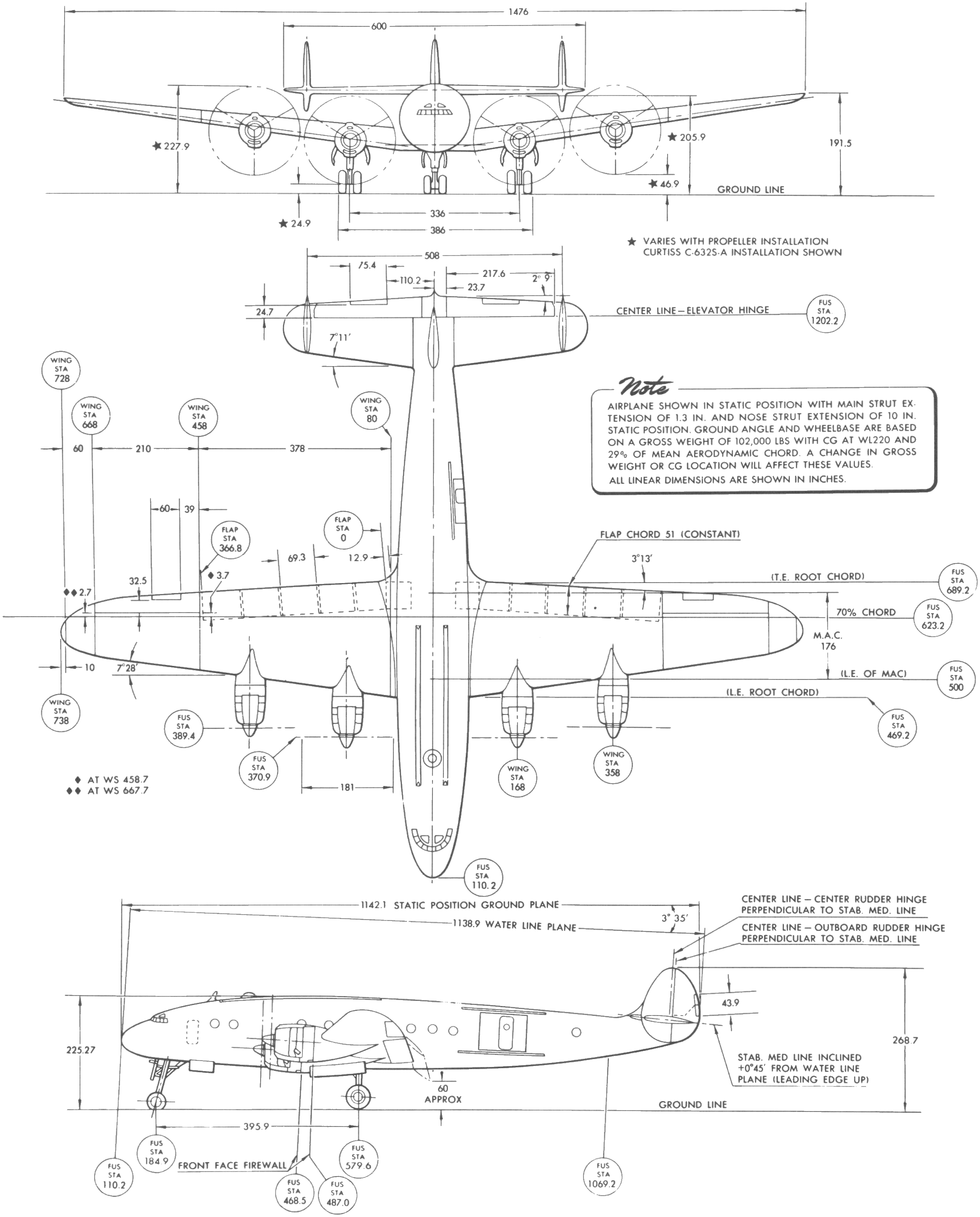
History
Origins: from Excalibur to the Hughes order
Lockheed had been working since 1937 on the L-044 Excalibur, a four-engined pressurized airliner. In 1939 TWA, prompted by Howard Hughes, who had just taken control of the airline, asked for a 40-passenger transcontinental airliner with a range of some 3,500 miles (5,600 km), well beyond anything the Excalibur could offer. The answer was the L-049 Constellation. Lockheed Martin's own history recalls the key meeting with Hughes, attended by company president Robert Gross, chief engineer Hall Hibbard and chief research engineer Kelly Johnson, and notes that the Burbank team arrived with bigger ambitions than their customer: a large transport that would carry more people farther and faster, economically enough to rival train, ship and car.
Hughes treated the programme as a secret weapon against rival airlines. He demanded total secrecy and stipulated that Lockheed could not sell the type to any other transcontinental carrier until TWA had received 35 aircraft. He set the initial performance targets, but the design itself was Lockheed's. Hibbard later said that the company had been small-time until then and that the Constellation forced it to become big-time. Engineer Willis Hawkins went as far as claiming that the Excalibur had been nothing more than cover for the Constellation. Anthony Sampson repeated rumours that Hughes had effectively dictated the shape and character of the aircraft; Johnson dismissed them, and Hughes and TWA president Jack Frye denied them in a letter in November 1941.
Design: a fighter's wing and a dolphin's body
The Constellation's wing was close to that of the twin-engined P-38 Lightning fighter, differing mainly in size. The triple tail had a practical purpose: keeping the fin height low enough for the aircraft to fit existing hangars. New features included hydraulically boosted flight controls, the aviation equivalent of power steering and a first for an airliner, and de-icing on the wing and tail leading edges. The pressurized cabin let it fly above most weather. Its quoted performance belonged to a fighter: a top speed above 600 km/h, faster than a Japanese Zero, a cruise of about 550 km/h and a service ceiling of around 7,300 m. Most models used four 18-cylinder Wright R-3350 Duplex-Cyclone radials.
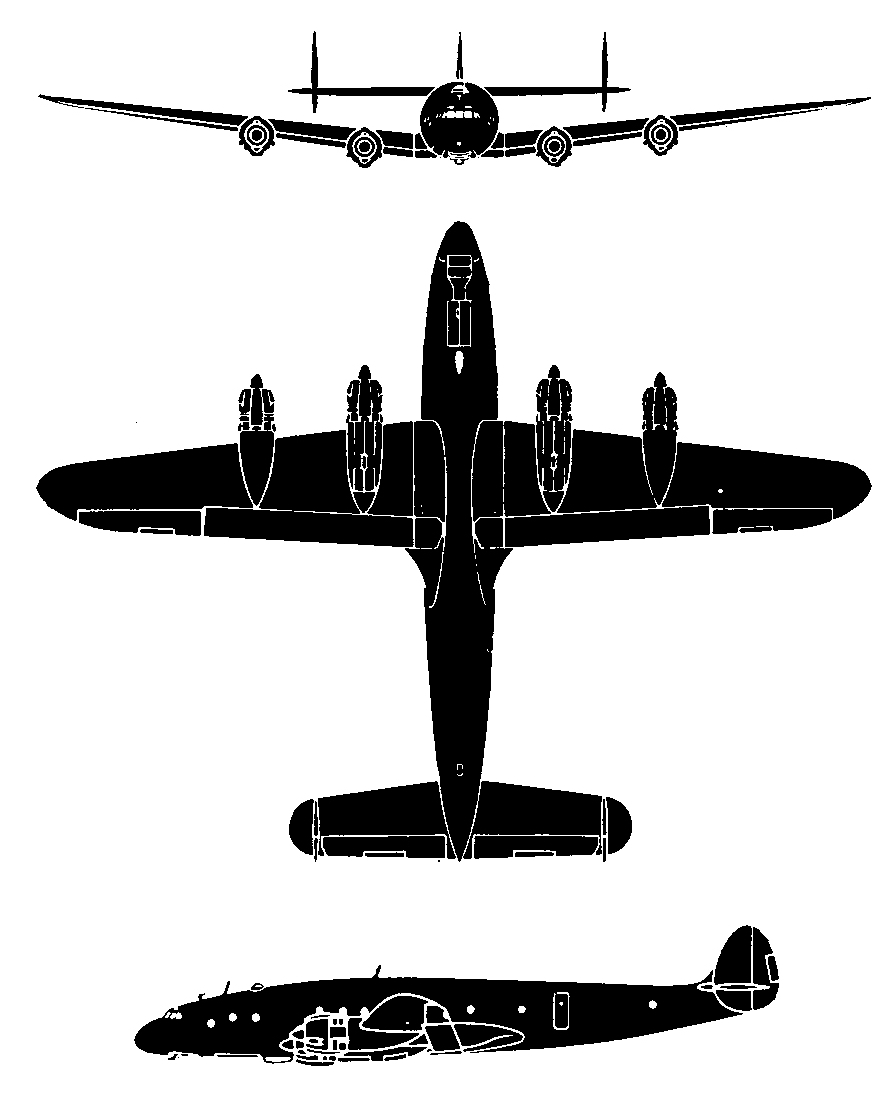
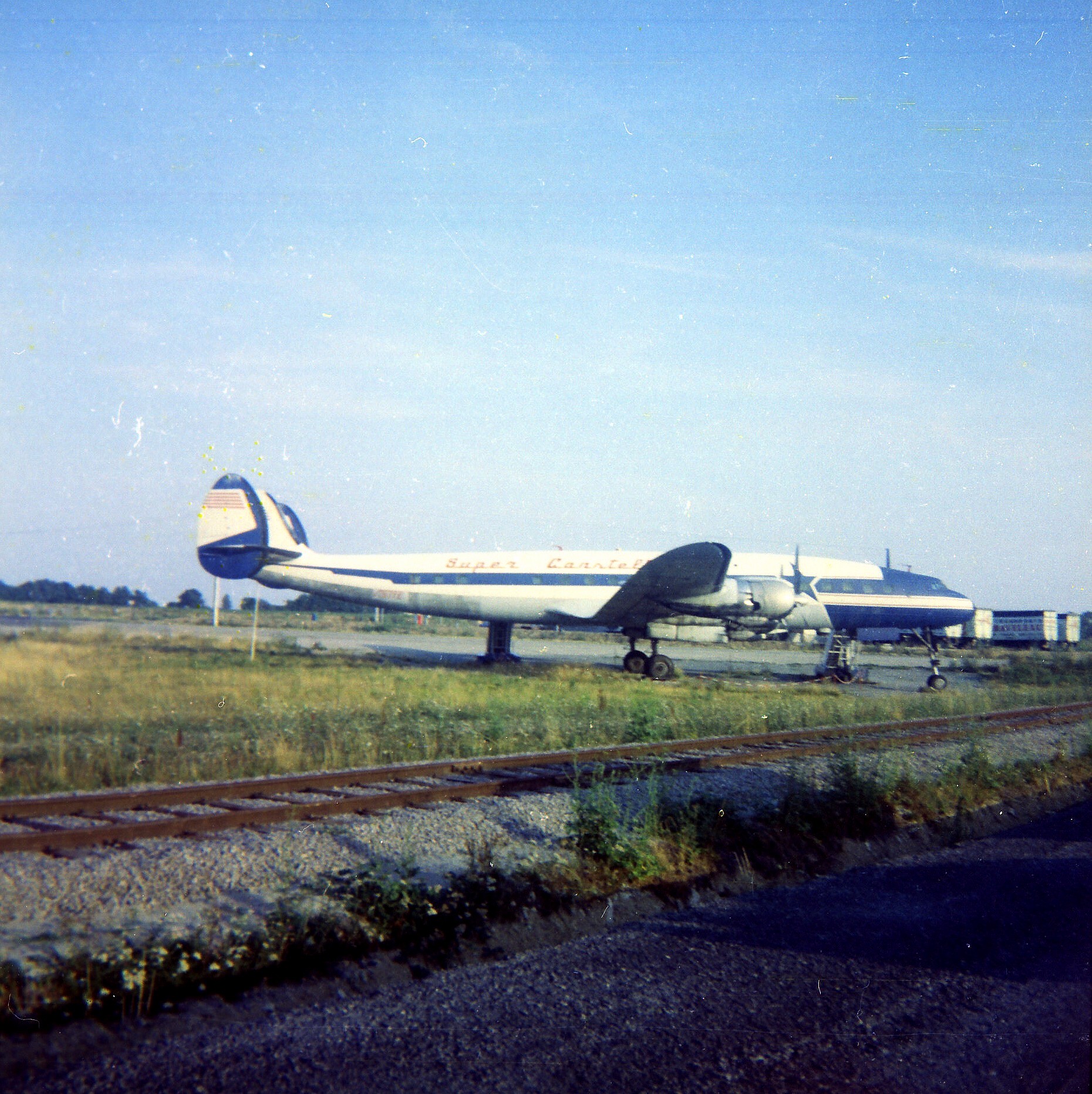
Much of its elegance came from the dolphin-shaped fuselage, a continuously changing profile in which no two bulkheads were alike and the skin was formed in compound curves. It was expensive to build, and later airliners settled on cylindrical fuselages, which are cheaper and cope better with repeated pressurization.
War service: the C-69
When the United States entered the Second World War, the TWA aircraft on the line became an order for 202 C-69 transports for the US Army Air Forces; Lockheed Martin dates the military takeover of production to 1942. The olive-drab first prototype took off on January 9, 1943 for a short hop from Burbank to Muroc, flown by Boeing test pilot Eddie Allen with Lockheed's Milo Burcham in the right seat and Kelly Johnson and Rudy Thoren aboard. The day went so well that five more flights followed.
The C-69 served mostly as a fast long-range troop carrier. Lockheed also offered a long-range bomber, the L-249 or XB-30, which was not pursued; a very-long-range troop transport, the C-69B, was cancelled, and a single 43-seat VIP C-69C was built in 1945. Wartime production figures vary: Lockheed Martin says only 13 Constellations were built during the war, while other compilations count 22 C-69s completed before hostilities ended, seven of which were finished on the line as civil L-049s. The USAAF cancelled the rest of the order in 1945, and Lockheed was told to concentrate on the P-38.
Records with Hughes at the controls
Hughes publicised the aircraft in his own way. On April 17, 1944 he and Jack Frye flew the second production C-69 from Burbank to Washington, around 2,300 miles (3,700 km), in 6 hours 57 minutes, an average of 331 mph (533 km/h). On the way back the aircraft called at Wright Field in Ohio, where Orville Wright made his last flight, more than four decades after his first; he remarked that the Constellation's wingspan was longer than that pioneering hop.
Postwar: the Atlantic airliner
When the war ended, TWA bought back every C-69 it could, and aircraft still on the line were completed as airliners; TWA took the first on October 1, 1945. Its transatlantic proving flight left Washington on December 3, 1945 and reached Paris the next day via Gander and Shannon, and scheduled New York-Paris service began on February 6, 1946. On June 17, 1947 Pan Am inaugurated the first scheduled round-the-world service with the L-749 Clipper America; the famous "Pan Am 1" ran until 1982.
The family was organised by model number. The original L-049, and its extra-fuel L-149 derivative, were followed by the first Constellations designed from the outset as airliners: the more powerful L-649 and the L-749, with additional fuel in the outer wings. The turbo-compound L-849 and the L-949 passenger-cargo combi stayed on paper. Lockheed Martin admits that the early years had their troubles: the Connie pushed piston-engine technology to its limits, and its complex engines needed maintenance and parts replacement at rates that would look unacceptable once jets arrived.
Even so, as the first pressurized airliner in widespread use the Constellation helped make flying affordable and comfortable, and it was adopted by TWA, Eastern, Pan Am, Air France, BOAC, KLM, Qantas, Lufthansa, Iberia, Panair do Brasil, TAP, Trans-Canada Air Lines, Aer Lingus, VARIG, Cubana, Avianca and many others. It also retired some of the stopgaps of the immediate postwar years: the Spanish-language Enciclopedia ilustrada de la aviación notes that the Canadian transatlantic service flown with converted Lancasters, extended to London in September 1946, was uneconomic and was replaced the following year by the Constellation.
The Super Constellation: longer and stronger
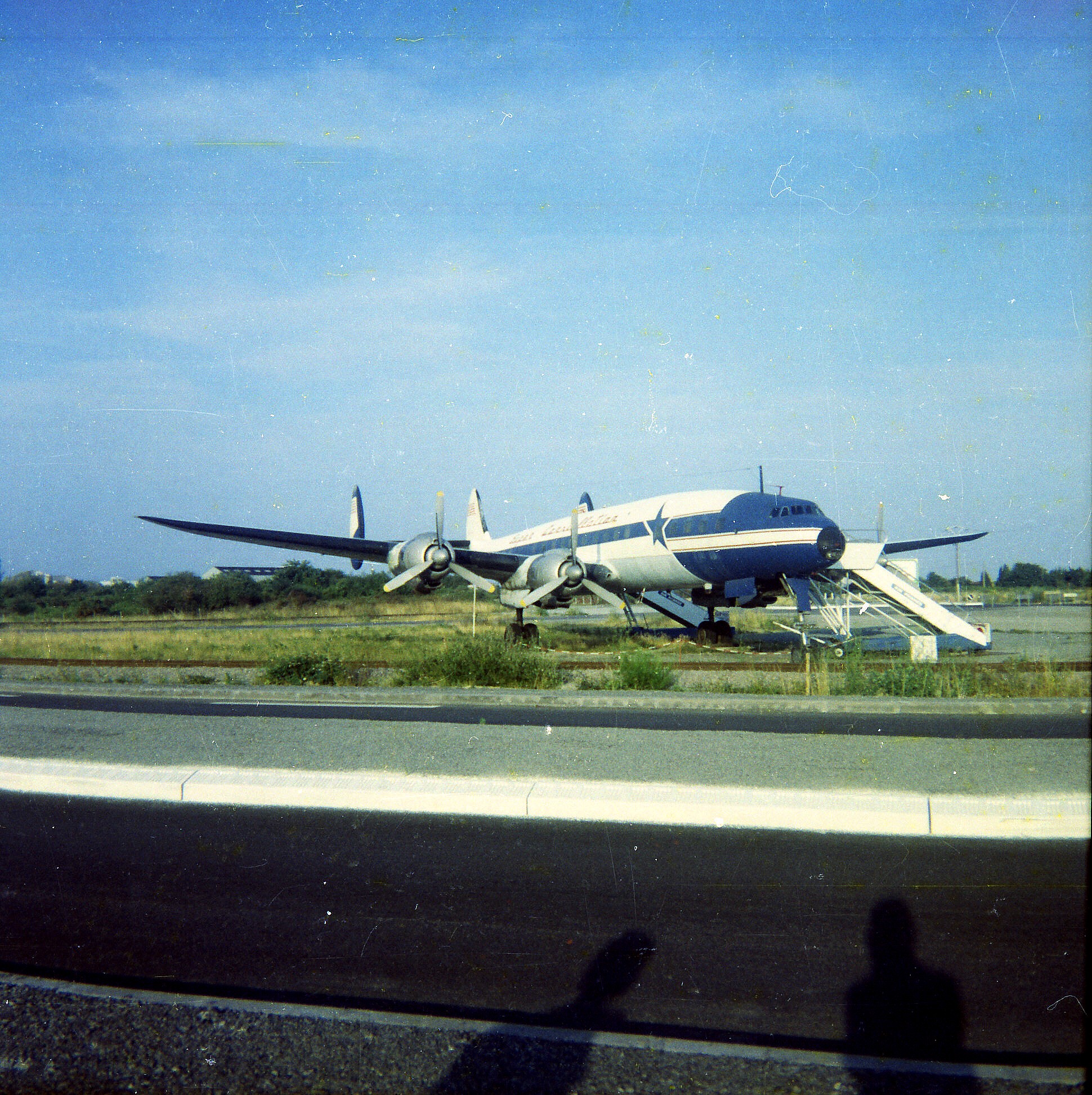
Douglas had launched the DC-6A freighter and was preparing the DC-6B airliner, which seated 23 more passengers than the L-749. Lockheed's reply began with the old XC-69 prototype, bought back from the Hughes Tool Company in 1950, stretched by 18 ft (5.5 m) and used as the testbed for the L-1049 Super Constellation; it flew that year still on Pratt & Whitney R-2800 engines before receiving R-3350s. Compared with the L-749 the new model incorporated some 550 changes, including more fuel, rectangular windows, larger windshields and better heating and pressurization. Eastern ordered 10 and TWA 14. The first production L-1049 flew on July 14, 1951, was certified that November and entered service with Eastern in December 1951 between Miami and New York. Lockheed Martin highlights then-novel comforts such as air conditioning, reclining seats and extra lavatories.
The real leap came in 1953, when the R-3350 Turbo-Compound became available for civil use. The L-1049C flew on February 17 that year. Each engine carried three power recovery turbines that harvested the velocity of the exhaust and fed the energy back to the crankshaft, adding about 550 hp without burning more fuel; the most visible side effect was the exhaust flame, especially striking at night. Forty-eight L-1049Cs were built, with cabin layouts ranging from the 47-seat "Siesta" to the 105-seat "Inter-urban", and KLM put them on Amsterdam-New York that same year.
Next came the L-1049D freighter of August 1954, with two cargo doors and a strengthened floor, four of which went to Seaboard & Western; the L-1049E, with 28 delivered; and the L-1049G "Super G", first flown on December 17, 1954 and introduced by TWA and Northwest in 1955. The G addressed its predecessors' inability to fly nonstop from Europe to New York against the prevailing winds, with more powerful engines, wingtip tanks adding about 1,110 miles (1,790 km) of range and an optional nose weather radar. Sixteen airlines ordered more than 100. Cubana was the first Latin American airline with Super Constellations, flying Havana to Madrid, New York and Mexico City, and Iberia kept a weekly Madrid-Santa Maria-Havana service going until 1966. The convertible L-1049H, the "Super H" or "Husky", reached Qantas in 1956; 53 were built, and a Flying Tiger Line L-1049H was the last Constellation of all, completed in 1959. AvWeb, quoting the National Air and Space Museum, puts Super Constellation production at some 579 aircraft.
The period had its tragedy too: in 1956 a TWA L-1049 collided with a United DC-7 over the Grand Canyon, killing everyone on both aircraft.
The Starliner: last and longest-legged
To counter the Douglas DC-7C, Lockheed studied the L-1449, with Pratt & Whitney PT2 turboprops and a new 150 ft (46 m) wing, and a further stretched L-1549. When Pratt & Whitney dropped the engine in March 1955, Lockheed and TWA settled on something less ambitious: the L-1649A Starliner, mating the L-1049G fuselage with the new wing and Wright R-3350 turbo-compound engines. Lockheed promoted it as able to carry 58 passengers over 6,500 miles (10,500 km). Although never built, the L-1449 left a mark: every Constellation from 1954 onwards was strengthened to take turboprop thrust, and turboprops were indeed fitted to several Navy R7V-2s.
The prototype flew on October 11, 1956 and airline service began on June 1, 1957 with TWA from New York to London and Frankfurt. TWA called it the "Jetstream"; Air France bought ten and was the only airline to market it by name, as the "Super Starliner", opening a Paris-Anchorage-Tokyo route in April 1958; Lufthansa, the last customer for new aircraft, had its four "Super Stars" delivered nonstop from Burbank to Hamburg. Forty-four were built. On September 29, 1957 a TWA L-1649A flew Los Angeles-London in 18 hours 32 minutes, about 5,420 miles (8,720 km), and on TWA's first London-San Francisco service on October 1-2 the aircraft stayed aloft for 23 hours 19 minutes, the endurance record for a nonstop passenger flight by a piston airliner. Its prime was brief: Boeing 707s replaced TWA's last transatlantic L-1649 in October 1961.
In uniform: from transport to "Willie Victor"
The US services quickly saw how versatile the aircraft was; Lockheed Martin reckons they bought nearly 40 percent of all Constellations built. There were C-121 transports for the Air Force and R7Vs for the Navy, rescue, liaison and magnetic-field mapping aircraft, and presidential and VIP transports: Dwight D. Eisenhower flew in the VC-121s Columbine, Columbine II and Columbine III, and General Douglas MacArthur used Bataan during the Korean War.
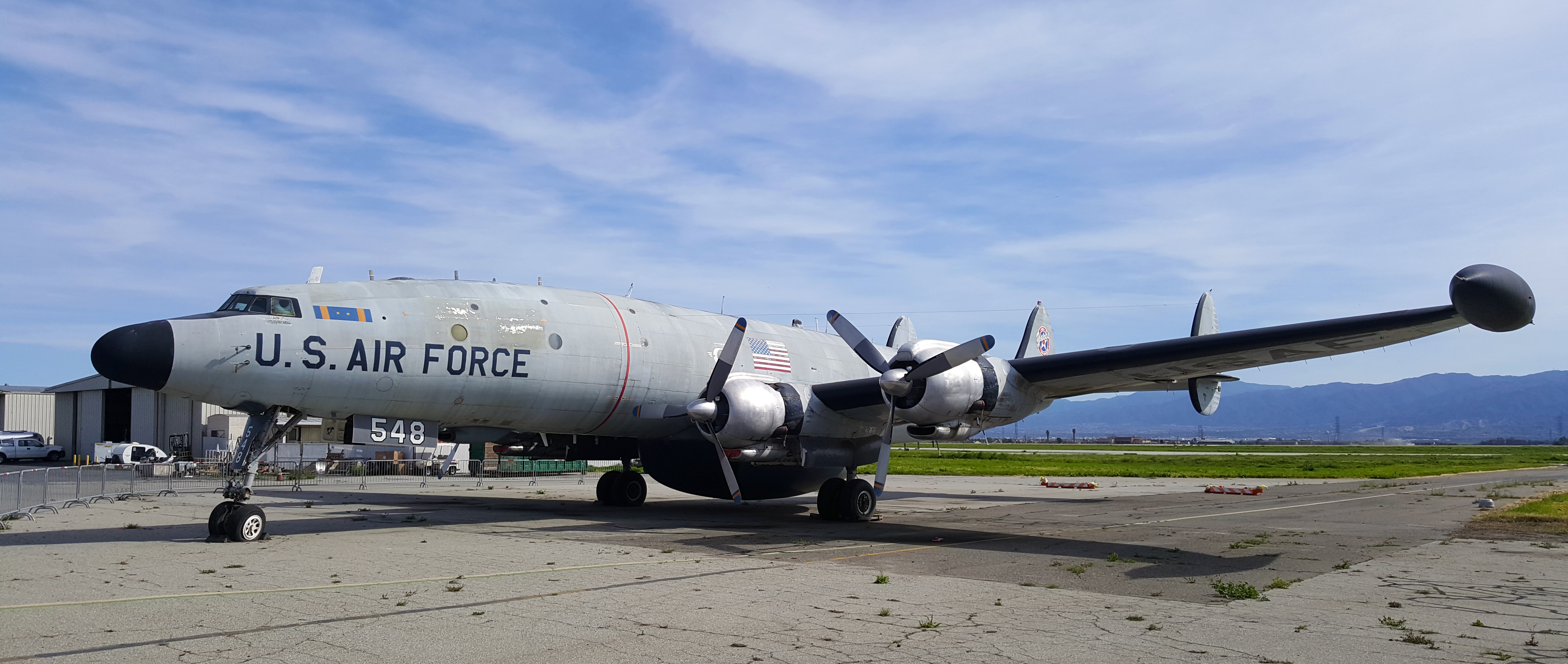
Its signature role, though, was as a sentry. The Enciclopedia ilustrada de la aviación places in 1948-49 the birth of the first long-endurance airborne early warning aircraft, the PO-1W Constellation, later WV-1, which started one of the largest families of radar aircraft. The Navy acquired two L-749s in 1949, and the PO-1W flew on June 9 that year with large radars in radomes above and below the fuselage, which required enlarged fins. Once it had shown that big radars could be carried aloft, the Navy ordered 142 PO-2Ws based on the Super Constellation, delivered from 1953, redesignated WV-2 in 1954 and EC-121K in 1962. They carried a ventral AN/APS-20 search radar and a dorsal AN/APS-45 height finder, with a usual crew of 18. Navy crews called them "Willie Victor"; the Air Force, which received 10 RC-121Cs and 74 EC-121Ds from October 1953, called them Warning Star. Lockheed Martin credits the Constellation as the first aircraft to carry rotating radomes, a lineage that runs to today's airborne control aircraft.

From 1954 to 1965 WV-2s flew two barrier forces, one off each coast of North America, extending the DEW radar line against a surprise Soviet attack. The Atlantic barrier provided continuous coverage from July 1, 1956 until early 1965 with missions of 6 to 20 hours, while the Pacific barrier tied together radar picket ships between the Aleutians and Midway. In 1969 North Korean fighters shot down a Navy EC-121 with 31 crew aboard.
Vietnam and the end of military service
When the air campaign over North Vietnam began, the Air Force sent five EC-121Ds to Southeast Asia as the Big Eye task force, renamed College Eye in March 1967 and eventually based at Korat in Thailand. The Warning Stars flew elliptical orbits off enemy territory, warned of MiGs, directed escorts and relayed communications. From late 1971, under the callsign Disco, they returned to cover B-52 missions over Laos and were one of the two main control radars when Operation Linebacker began on May 10, 1972. Some 40 more, converted as EC-121R "Batcats", picked up signals from sensors seeded along the Ho Chi Minh Trail for Operation Igloo White; two were lost in accidents with 22 crew killed. The final operational variant, the EC-121T, served as an AWACS prototype in 1972, a forerunner of the Boeing E-3 Sentry. The Warning Stars were retired in 1978, while a Navy NC-121K electronic warfare aircraft kept flying until June 25, 1982. India, which had converted former Air India Super Constellations for search and rescue, was the last military operator and retired them between 1981 and 1983.
Civil twilight
Jets from the Comet to the Boeing 707, DC-8, Convair 880 and Caravelle made the Connie obsolete. It lost the ocean routes first and the domestic ones later: the last scheduled passenger Constellation flight in the contiguous United States was a TWA L-749 from Philadelphia to Kansas City on May 11, 1967, and the last in North America a Western Airlines aircraft in Alaska on November 26, 1968. Eastern kept them on backup sections of its New York-Washington-Boston shuttle until 1968, and others lingered as night freighters, crop sprayers and charter aircraft. Dominican airlines were the last commercial operators, until US aviation authorities barred their Constellations from the United States in 1993. As in Berlin, the Connie also flew relief supplies during the Biafran airlift.
Legacy and survivors
Lockheed Martin calls the Constellation an enduring symbol of grace in propeller-driven flight, and the number of museum examples bears that out. A C-121C restored with Breitling sponsorship flies from Basel, another in Qantas-style colours flies in Australia, and MacArthur's VC-121A Bataan returned to the air on June 20, 2023 after restoration. Eisenhower's Columbine III has been at the National Museum of the US Air Force near Dayton since its retirement in 1966, C-121C 54-0177 is at the Udvar-Hazy Center by Dulles airport, and an L-1649A has become a cocktail lounge at the TWA Hotel at New York's Kennedy airport. Nearly 40 years after work on the L-049 began, the last operational EC-121 was still flying patrols from Iceland.
Variants
| XC-69 | L-649 | L-749 | L-1049 | L-1049G | L-1649A Starliner | C-121A | C-121C | C-121G | C-121J | C-69 | C-69A | C-69B | C-69C-1 | C-69D | EC-121D | EC-121H | EC-121J | EC-121K | EC-121L | EC-121M | EC-121P | EC-121Q | EC-121R «BatCat» | EC-121S | EC-121T | JC-121C | JC-121K | JEC-121P | L-049 | L-051 | L-084 | L-1049A | L-1049B | L-1049C | L-1049D | L-1049E | L-1049F | L-1049H | L-1049J | L-1149 | L-1249A | L-1249B | L-1449 | L-149 | L-1549 | L-1649B | L-249 | L-349 | L-449 | L-549 | L-649A | L-749A | L-749B | L-849 | L-949 | NC-121C | NC-121D | NC-121J | NC-121K | NC-121S | PO-1W | PO-2W Warning Star | R7O-1 | R7V-1 | R7V-1P | R7V-2 | RC-121C | RC-121D | TC-121C | TC-121G | VC-121A | VC-121B | VC-121C | VC-121E | VC-121G | VC-121J | WC-121N | WV-1 | WV-2E | WV-2Q | WV-2 Warning Star | WV-3 | XB-30 | XC-69E | XW2V-1 | YC-121F | YEC-121K | |
|---|---|---|---|---|---|---|---|---|---|---|---|---|---|---|---|---|---|---|---|---|---|---|---|---|---|---|---|---|---|---|---|---|---|---|---|---|---|---|---|---|---|---|---|---|---|---|---|---|---|---|---|---|---|---|---|---|---|---|---|---|---|---|---|---|---|---|---|---|---|---|---|---|---|---|---|---|---|---|---|---|---|---|---|---|---|---|---|---|
| First flight | January 9, 1943 | October 19, 1946 | March 14, 1947 | July 14, 1951 | December 17, 1954 | October 10, 1956 | — | — | — | — | — | — | — | — | — | — | — | — | — | — | — | — | — | — | — | — | — | — | — | — | — | — | — | — | — | — | — | — | — | — | — | — | — | — | — | — | — | — | — | — | — | — | — | — | — | — | — | — | — | — | — | — | — | — | — | — | — | — | — | — | — | — | — | — | — | — | — | — | — | — | — | — | — | — | — | — | — | — |
| Aircraft type | — | — | — | — | Four-engine long-range airliner | — | — | — | — | — | — | — | — | — | — | — | — | — | — | — | — | — | — | — | — | — | — | — | — | — | — | — | — | — | — | — | — | — | — | — | — | — | — | — | — | — | — | — | — | — | — | — | — | — | — | — | — | — | — | — | — | — | — | — | — | — | — | — | — | — | — | — | — | — | — | — | — | — | — | — | — | — | — | — | — | — | — | — |
| Powerplant | — | — | — | — | Four Wright R-3350 972TC-18DA-3 Turbo Compound radial engines | — | — | — | — | — | — | — | — | — | — | — | — | — | — | — | — | — | — | — | — | — | — | — | — | — | — | — | — | — | — | — | — | — | — | — | — | — | — | — | — | — | — | — | — | — | — | — | — | — | — | — | — | — | — | — | — | — | — | — | — | — | — | — | — | — | — | — | — | — | — | — | — | — | — | — | — | — | — | — | — | — | — | — |
| Powerplant | 4 × piston | 4 × Wright R-3350-749C18BD | 4 × piston | 4 × piston | 4 × Wright R-3350 972TC-18DA-3 Turbo Compound | 4 × Wright R-3350 988 TC18-EA-2 Duplex-Cyclone | 4 × Wright R-3350-75 Duplex-Cyclone | 4 × Wright R-3350-34 | 4 × piston | 4 × piston | 4 × Wright R-3350-35 Duplex-Cyclone | 4 × piston | 4 × piston | 4 × piston | 4 × piston | 4 × Wright R-3350-34 turbo compound | 4 × piston | 4 × piston | 4 × piston | 4 × piston | 4 × piston | 4 × piston | 4 × piston | 4 × piston | — | 4 × piston | 4 × piston | 4 × piston | — | 4 × piston | 4 × piston | 4 × Allison T56-A8 | 4 × piston | 4 × piston | 4 × Wright R-3350 972-TC-18DA-1 Duplex-Cyclone | 4 × piston | 4 × piston | 4 × piston | 4 × piston | 4 × piston | 4 × turboprop | 4 × turboprop | 4 × turboprop | 4 × turboprop | 4 × piston | 4 × turboprop | 4 × turboprop | 4 × piston | 4 × piston | 4 × piston | 4 × piston | 4 × piston | 4 × piston | 4 × piston | 4 × piston | 4 × piston | 4 × piston | 4 × piston | 4 × piston | 4 × piston | 4 × piston | 4 × piston | 4 × Wright R-3350-34 | 4 × Wright R-3350-91 | 4 × piston | 4 × piston | 4 × Pratt & Whitney YT34-P-12A | 4 × piston | 4 × piston | 4 × piston | 4 × piston | 4 × piston | 4 × piston | 4 × piston | 4 × piston | 4 × piston | 4 × piston | 4 × piston | 4 × piston | 4 × piston | 4 × piston | 4 × Wright R-3350-34 turbo compound | 4 × piston | 4 × piston | 4 × Pratt & Whitney R-2800 Double Wasp | 4 × Allison T56-A8 | 4 × Pratt & Whitney T34-P-6 | — |
| Power per engine | — | 2,501 hp | — | — | 3,245 hp | 3,353 hp | 2,548 hp | 3,401 hp | — | — | 2,146 hp | — | — | — | — | 3,401 hp | — | — | — | — | — | — | — | — | — | — | — | — | — | — | — | — | — | — | 3,245 hp | — | — | — | — | — | — | — | — | — | — | — | — | — | — | — | — | — | — | — | — | — | — | — | — | — | — | — | 3,401 hp | 3,252 hp | — | — | 4,141 hp | — | — | — | — | — | — | — | — | — | — | — | — | — | — | 3,401 hp | — | — | — | — | 6,002 hp Best value in this row | — |
| Length | — | — | — | — | 35.4 m Best value in this row | 35.4 m Best value in this row | 29 m | — | — | — | 29 m | — | — | — | — | 35.4 m | — | — | — | — | — | — | — | — | — | — | — | — | — | — | — | — | — | — | 34.6 m | — | — | — | — | — | — | — | — | — | — | — | — | — | — | — | — | — | — | — | — | — | — | — | — | — | — | — | — | — | — | — | — | — | — | — | — | — | — | — | — | — | — | — | — | — | — | 35.4 m | — | — | — | — | — | — |
| Wingspan | — | — | — | — | 38.5 m | 46 m Best value in this row | 37 m | — | — | — | 37 m | — | — | — | — | 38.5 m | — | — | — | — | — | — | — | — | — | — | — | — | — | — | — | — | — | — | 37 m | — | — | — | — | — | — | — | — | — | — | — | — | — | — | — | — | — | — | — | — | — | — | — | — | — | — | — | — | — | — | — | — | — | — | — | — | — | — | — | — | — | — | — | — | — | — | 38.5 m | — | — | — | — | — | — |
| Height | — | — | — | — | 7.5 m Best value in this row | 7.5 m Best value in this row | 6.8 m | — | — | — | 6.8 m | — | — | — | — | 7.5 m Best value in this row | — | — | — | — | — | — | — | — | — | — | — | — | — | — | — | — | — | — | 7.5 m Best value in this row | — | — | — | — | — | — | — | — | — | — | — | — | — | — | — | — | — | — | — | — | — | — | — | — | — | — | — | — | — | — | — | — | — | — | — | — | — | — | — | — | — | — | — | — | — | — | 7.5 m Best value in this row | — | — | — | — | — | — |
| Wing area | — | — | — | — | 154 m² | 172 m² Best value in this row | 153 m² | — | — | — | 153 m² | — | — | — | — | 153 m² | — | — | — | — | — | — | — | — | — | — | — | — | — | — | — | — | — | — | 153 m² | — | — | — | — | — | — | — | — | — | — | — | — | — | — | — | — | — | — | — | — | — | — | — | — | — | — | — | — | — | — | — | — | — | — | — | — | — | — | — | — | — | — | — | — | — | — | 153 m² | — | — | — | — | — | — |
| Empty weight | — | — | — | — | 36,151 kg | 41,569 kg | 27,776 kg | — | — | — | 22,680 kg Best value in this row | — | — | — | — | 31,387 kg | — | — | — | — | — | — | — | — | — | — | — | — | — | — | — | — | — | — | 31,298 kg | — | — | — | — | — | — | — | — | — | — | — | — | — | — | — | — | — | — | — | — | — | — | — | — | — | — | — | — | — | — | — | — | — | — | — | — | — | — | — | — | — | — | — | — | — | — | 31,387 kg | — | — | — | — | — | — |
| MTOW | — | — | — | — | 62,369 kg | 70,808 kg Best value in this row | 48,534 kg | — | — | — | 32,659 kg | — | — | — | — | 65,000 kg | — | — | — | — | — | — | — | — | — | — | — | — | — | — | — | — | — | — | 54,431 kg | — | — | — | — | — | — | — | — | — | — | — | — | — | — | — | — | — | — | — | — | — | — | — | — | — | — | — | — | — | — | — | — | — | — | — | — | — | — | — | — | — | — | — | — | — | — | 65,000 kg | — | — | — | — | — | — |
| Top speed | — | — | — | — | 607 km/h Best value in this row | 607 km/h Best value in this row | 538 km/h | — | — | — | 530 km/h | — | — | — | — | 481 km/h | — | — | — | — | — | — | — | — | — | — | — | — | — | — | — | — | — | — | 530 km/h | — | — | — | — | — | — | — | — | — | — | — | — | — | — | — | — | — | — | — | — | — | — | — | — | — | — | — | — | — | — | — | — | — | — | — | — | — | — | — | — | — | — | — | — | — | — | 481 km/h | — | — | — | — | — | — |
| Max speed altitude | — | — | — | — | — | 5,669 m | — | — | — | — | 3,048 m | — | — | — | — | — | — | — | — | — | — | — | — | — | — | — | — | — | — | — | — | — | — | — | — | — | — | — | — | — | — | — | — | — | — | — | — | — | — | — | — | — | — | — | — | — | — | — | — | — | — | — | — | — | — | — | — | — | — | — | — | — | — | — | — | — | — | — | — | — | — | — | — | — | — | — | — | — |
| Cruise speed | — | — | — | — | 550 km/h Best value in this row | 470 km/h | 521 km/h | — | — | — | 365 km/h | — | — | — | — | 410 km/h | — | — | — | — | — | — | — | — | — | — | — | — | — | — | — | — | — | — | 489 km/h | — | — | — | — | — | — | — | — | — | — | — | — | — | — | — | — | — | — | — | — | — | — | — | — | — | — | — | — | — | — | — | — | — | — | — | — | — | — | — | — | — | — | — | — | — | — | 410 km/h | — | — | — | — | — | — |
| Cruise altitude | — | — | — | — | 6,888 m | — | — | — | — | — | — | — | — | — | — | — | — | — | — | — | — | — | — | — | — | — | — | — | — | — | — | — | — | — | — | — | — | — | — | — | — | — | — | — | — | — | — | — | — | — | — | — | — | — | — | — | — | — | — | — | — | — | — | — | — | — | — | — | — | — | — | — | — | — | — | — | — | — | — | — | — | — | — | — | — | — | — | — |
| Service ceiling | — | — | — | — | 7,300 m | 7,200 m | 7,450 m | — | — | — | 7,630 m | — | — | — | — | 7,620 m | — | — | — | — | — | — | — | — | — | — | — | — | — | — | — | — | — | — | 7,800 m Best value in this row | — | — | — | — | — | — | — | — | — | — | — | — | — | — | — | — | — | — | — | — | — | — | — | — | — | — | — | — | — | — | — | — | — | — | — | — | — | — | — | — | — | — | — | — | — | — | 7,620 m | — | — | — | — | — | — |
| Initial climb rate | — | — | — | — | 8.2 m/s Best value in this row | 5.5 m/s | — | — | — | — | — | — | — | — | — | 4.9 m/s | — | — | — | — | — | — | — | — | — | — | — | — | — | — | — | — | — | — | — | — | — | — | — | — | — | — | — | — | — | — | — | — | — | — | — | — | — | — | — | — | — | — | — | — | — | — | — | — | — | — | — | — | — | — | — | — | — | — | — | — | — | — | — | — | — | 4.9 m/s | — | — | — | — | — | — |
| Range | — | — | — | — | 8,700 km Best value in this row | 7,950 km | — | — | — | — | 3,900 km | — | — | — | — | 6,843 km | — | — | — | — | — | — | — | — | — | — | — | — | — | — | — | — | — | — | 8,290 km | — | — | — | — | — | — | — | — | — | — | — | — | — | — | — | — | — | — | — | — | — | — | — | — | — | — | — | — | — | — | — | — | — | — | — | — | — | — | — | — | — | — | — | — | — | — | 6,843 km | — | — | — | — | — | — |
| Ferry range | — | — | — | — | — | 11,080 km | — | — | — | — | — | — | — | — | — | — | — | — | — | — | — | — | — | — | — | — | — | — | — | — | — | — | — | — | — | — | — | — | — | — | — | — | — | — | — | — | — | — | — | — | — | — | — | — | — | — | — | — | — | — | — | — | — | — | — | — | — | — | — | — | — | — | — | — | — | — | — | — | — | — | — | — | — | — | — | — | — | — |
| Range conditions | — | — | — | — | Maximum range of 8,700 km per the sources, which do not state payload or reserves. Optional wingtip tanks (3,930 litres in total) added about 1,790 km, allowing nonstop Europe–New York crossings against the prevailing winds. | Range with 8845 kg payload | — | — | — | — | — | — | — | — | — | — | — | — | — | — | — | — | — | — | — | — | — | — | — | — | — | — | — | — | — | — | — | — | — | — | — | — | — | — | — | — | — | — | — | — | — | — | — | — | — | — | — | — | — | — | — | — | — | — | — | — | — | — | — | — | — | — | — | — | — | — | — | — | — | — | — | — | — | — | — | — | — | — |
| Armament | — | — | — | — | None | None | — | — | — | — | — | — | — | — | — | — | — | — | — | — | — | — | — | — | — | — | — | — | — | — | — | — | — | — | — | — | — | — | — | — | — | — | — | — | — | — | — | — | — | — | — | — | — | — | — | — | — | — | — | — | — | — | — | — | — | — | — | — | — | — | — | — | — | — | — | — | — | — | — | — | — | — | — | — | — | — | — | — |
| Max weapons load | — | — | — | — | 0 kg Best value in this row | 0 kg Best value in this row | — | — | — | — | — | — | — | — | — | — | — | — | — | — | — | — | — | — | — | — | — | — | — | — | — | — | — | — | — | — | — | — | — | — | — | — | — | — | — | — | — | — | — | — | — | — | — | — | — | — | — | — | — | — | — | — | — | — | — | — | — | — | — | — | — | — | — | — | — | — | — | — | — | — | — | — | — | — | — | — | — | — |
| Payload | — | — | — | — | 8,301 kg | 8,845 kg Best value in this row | — | — | — | — | — | — | — | — | — | — | — | — | — | — | — | — | — | — | — | — | — | — | — | — | — | — | — | — | — | — | — | — | — | — | — | — | — | — | — | — | — | — | — | — | — | — | — | — | — | — | — | — | — | — | — | — | — | — | — | — | — | — | — | — | — | — | — | — | — | — | — | — | — | — | — | — | — | — | — | — | — | — |
| Cargo capacity | — | — | — | — | Typically 62 to 95 passengers, up to 109 in high-density configuration; 8,301 kg (18,300 lb) payload. | — | — | — | — | — | — | — | — | — | — | — | — | — | — | — | — | — | — | — | — | — | — | — | — | — | — | — | — | — | — | — | — | — | — | — | — | — | — | — | — | — | — | — | — | — | — | — | — | — | — | — | — | — | — | — | — | — | — | — | — | — | — | — | — | — | — | — | — | — | — | — | — | — | — | — | — | — | — | — | — | — | — | — |
| Crew | — | — | — | — | 5 | 5 | 5 | — | — | — | 4 Best value in this row | — | — | — | — | — | — | — | — | — | — | — | — | — | — | — | — | — | — | — | — | — | — | — | 5 | — | — | — | — | — | — | — | — | — | — | — | — | — | — | — | — | — | — | — | — | — | — | — | — | — | — | — | — | — | — | — | — | — | — | — | — | — | — | — | — | — | — | — | — | — | — | — | — | — | — | — | — | — |
| Passengers | — | 81 | — | 109 Best value in this row | 109 Best value in this row | 99 | 44 | — | — | — | — | — | — | — | — | — | — | — | — | — | — | — | — | — | — | — | — | — | — | — | — | — | — | — | 106 | — | — | — | — | — | — | — | — | — | — | — | — | — | — | — | — | — | — | — | — | — | — | — | — | — | — | — | — | — | — | — | — | — | — | — | — | — | — | — | — | — | — | — | — | — | — | — | — | — | — | — | — | — |
| Units built | 1 | 14 | 131 | 24 | 102 | 44 | 9 | 33 | 32 | 18 | — | 0 | 0 | 1 | 0 | 73 | 42 | 2 | 142 Best value in this row | 1 | 13 | — | 4 | 30 | 5 | 22 | — | 1 | 3 | 88 | 0 | 0 | — | — | 48 | 4 | 28 | — | 53 | 0 | 0 | — | 0 | 0 | 0 | 0 | 0 | 0 | 0 | — | 1 | — | — | 0 | 0 | 0 | — | — | — | — | — | 2 | — | — | 50 | 1 | — | 10 | — | 9 | — | 6 | 1 | 4 | — | 1 | 4 | 8 | 2 | 1 | 13 | 142 Best value in this row | 8 | 0 | — | 0 | 2 | 1 |
Images
Elsewhere
- SFO MuseumPhotograph: Lockheed L-1049 Super Constellation (SFO Museum Aviation Archive) ↗
- SFO MuseumPhotograph: TWA Lockheed L-1049 Super Constellation (SFO Museum Aviation Archive) ↗
- SFO MuseumPhotograph: Pan American World Airways Lockheed Constellation (SFO Museum Aviation Archive) ↗
- The Museum of FlightLockheed Model 1049 Super Constellation in flight (Museum of Flight Digital Collections) ↗
- The Museum of FlightLockheed Model 749 Constellation (Museum of Flight Digital Collections) ↗
- IngeniumLockheed Constellation (Ingenium, Canada Aviation and Space Museum) ↗
- IBCC Digital ArchiveLockheed Constellation parked in front of a hangar (IBCC Digital Archive) ↗
- Digital Library of GeorgiaLockheed Constellation on the tarmac, Atlanta, 1945 (Digital Library of Georgia) ↗
- Wright State University LibrariesLockheed Constellation airplanes on flight line, circa 1940s (Wright State University Special Collections) ↗
- Sharlot Hall MuseumLockheed Super Constellation, US Navy C-121G (Sharlot Hall Museum) ↗
- Aviation Safety NetworkLockheed L-049 Constellation NC88831, Pan Am, Shannon 1946 (Aviation Safety Network) ↗
- Science Museum GroupLockheed 749 Constellation tail and wing, 1983 (Science Museum Group) ↗


