El avión que revolucionó los vuelos comerciales - Lockheed Constellation
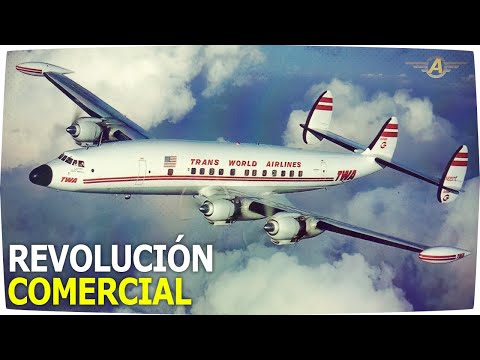 Watch the video on YouTube: El avión que revolucionó los vuelos comerciales - Lockheed Constellation
Video from the channel Mundo de Aviación about Lockheed Constellation, linked on its Above Ten Thousand entry. Duration: 11:17. Language: Spanish. Video type: Documentary.
What it's about
Spanish-language documentary on the Lockheed Constellation, the first widely used series of pressurised-cabin civil airliners, recognisable by its dolphin-shaped fuselage and triple tail fin. Three examples served as presidential aircraft for Eisenhower.
Historical context
In 1939, TWA, with Howard Hughes as majority shareholder, asked Lockheed for a transcontinental airliner. The L-049, whose design involved Kelly Johnson and Hal Hibbard, first flew on 9 January 1943 with Wright R-3350 Duplex Cyclone engines. The war turned the aircraft into C-69 military transports, of which 22 were completed. From 1945 it returned to civilian use: TWA received its first on 1 October 1945. The early months brought three accidents from engine fires, addressed with stainless-steel shrouds and direct fuel injection. It was followed by the L-649, the L-749 with wingtip tanks, the 1049 Super Constellation and the 1649 Starliner; the EC-121 Warning Star version served in the United States until 1978. Jet aircraft relegated it to domestic routes and cargo work.
Key facts
On 17 April 1944, a C-69 flown by Hughes and Jack Frye flew from Burbank to Washington in 6 h 57 min; on the return leg, Orville Wright made his last flight aboard it. In 1957 a TWA Starliner flew nonstop from London to San Francisco in 23 h 19 min. A top speed of 607 km/h and a range of 8,700 km are cited.