Airliner · Civil · Russia
Ilyushin Il-18
- July 4, 1957
- First flight
- 1959
- Introduced
- In service
- Status
- 678
- Units built
-1600.webp)


-1600.webp)


-1600.webp)


-1600.webp)


-800.webp)


-1600.webp)


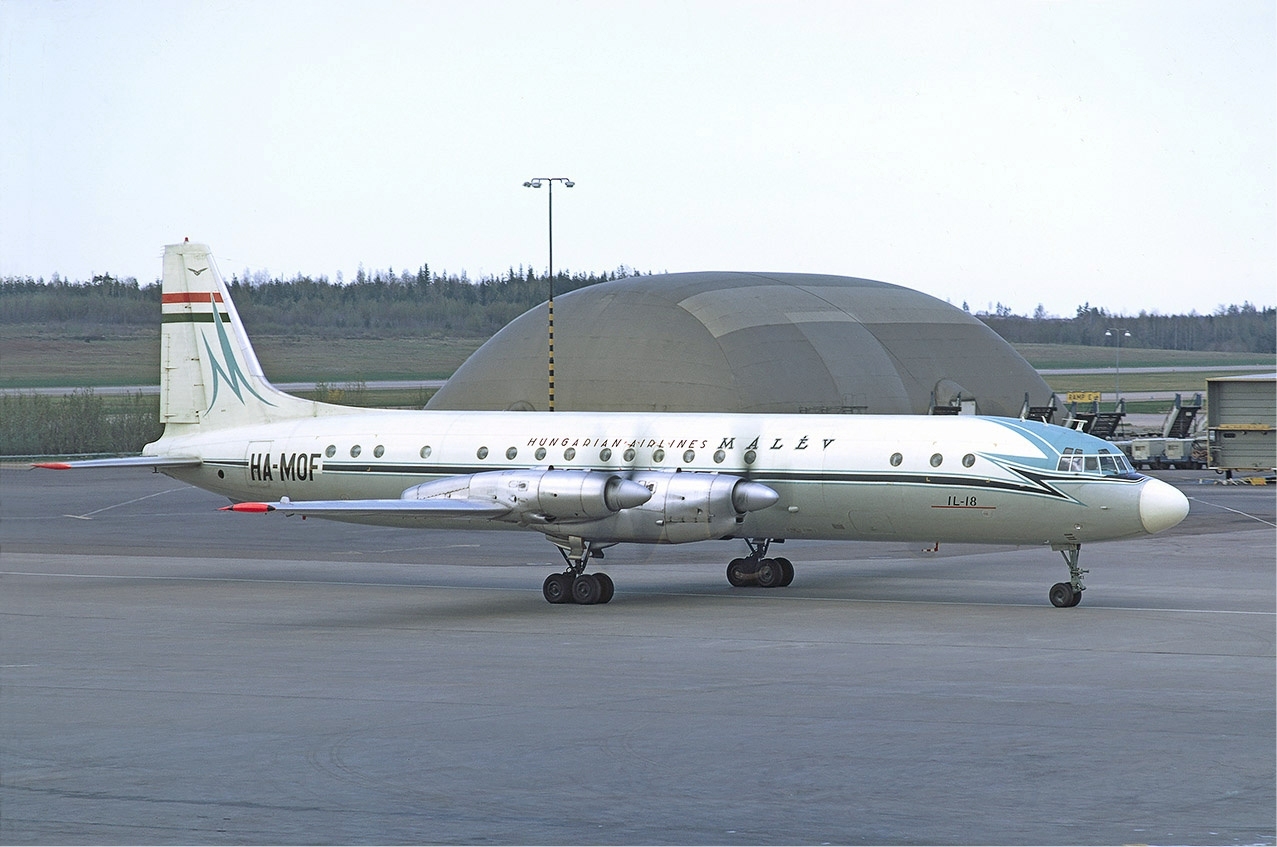
The Ilyushin Il-18 (NATO reporting name «Coot») is a four-engined low-wing turboprop airliner developed by the Soviet Ilyushin design bureau in the mid-1950s to meet an Aeroflot requirement for a medium-range aircraft seating between 75 and 100 passengers. The prototype, registered SSSR-L5811, took off from Khodynka on 4 July 1957 and on 10 July was flown to Vnukovo to be shown to a Soviet government commission alongside the Antonov An-10 and the Tupolev Tu-114. Aeroflot began passenger operations on 20 April 1959 on the Moscow-Sochi and Moscow-Alma Ata routes. Seventeen foreign carriers took delivery of some 125 aircraft with cabins seating 100 to 120, and the type became one of the signatures of air transport across the socialist bloc. Between 1958 and 1960 the Il-18 set twenty-five world records, including range and altitude marks with various payloads, and in 1958 it was awarded the Grand Prix of the Brussels World Fair. Durability became its trademark: many airframes passed 45,000 flight hours. The basic design spawned military derivatives such as the Il-20M electronic intelligence platform, the Il-22 airborne command post and the Il-38 anti-submarine patroller, which have kept the airframe flying long after its commercial career wound down. On long-haul routes its successor was the Ilyushin Il-62.
Related sheets
Category
Ilyushin Il-18 in the news

Spanish EF-18M fighters intercepted and escorted a Russian Il-20M COOT-A “spy” plane over the Baltic
After a Quick Reaction Alert (QRA) mission was activated, two Spanish EF-18M fighters identified and escorted over the Baltic Sea a signals intelligence and surveillance aircraft…

A Russian Il-20M electronic intelligence aircraft violated Finnish airspace and penetrated about 8.7 kilometres into Finnish territory. The incident took place in…
.jpg)
Polish fighter jets intercepted a Russian Ilyushin Il-20M reconnaissance aircraft over the Baltic Sea on Tuesday in the second such incident this week, as Warsaw accused Moscow of testing NATO’s…

-1600.webp)
History
A turboprop to renew Aeroflot
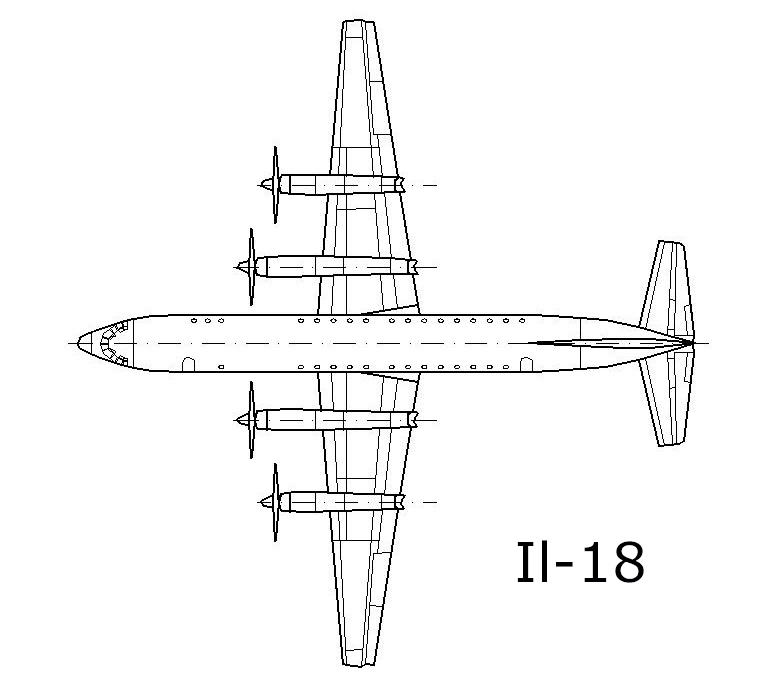
Design work began in 1954, before the Soviet Council of Ministers issued the directive of 30 December 1955 instructing Kuznetsov and Ivchenko to develop new turboprop engines and Ilyushin and Antonov to design the aircraft that would use them. Two machines came out of that assignment, the Il-18 and the Antonov An-10. Ilyushin reused a designation already applied to a piston-engined four-motor transport of 1946 that never went beyond a prototype, but the new aircraft was an entirely fresh design: a low-wing monoplane with a circular pressurised fuselage, conventional tail and a tricycle undercarriage whose four-wheel main bogies rotated 90 degrees as they retracted. Two features stood out for the period: weather radar in the nose and the first automatic approach system fitted to a Soviet airliner.
From prototype to production line
The prototype was rolled out in June 1957, began high-speed runs on 1 July and flew on 4 July from Khodynka. The type was formally named Moskva and the name was painted on the fuselage, although it was dropped once series production started. Manufacture was assigned to Moscow Machinery Plant No. 30, which wound down Il-14 output to make room for the newcomer. Early aircraft used Kuznetsov NK-4 engines, which proved troublesome; in July 1958 the Council of Ministers decreed that all production from November that year would use the Ivchenko AI-20 and that earlier machines would be re-engined. On 17 September 1958 the first Il-18 flew with the new powerplant, with Vladimir Kokkinaki as test pilot. Only about twenty Il-18As were built before the improved Il-18B took over; the Il-18V appeared in December 1959 and 334 were built up to 1965, while the later Il-18I, Il-18D and Il-18E, powered by 3,169 kW AI-20M engines, pushed capacity to 122 seats.
Half a century in service
Production totals vary with the source: the English article records at least 678 aircraft built between 1957 and 1985, while the Spanish one puts the figure above 850 machines produced between 1959 and 1978. What is not in dispute is the type's longevity. A commemorative monument was unveiled at Moscow's Sheremetyevo airport in April 1979; as of July 2018 seven Il-18s were still flying in airline service with six operators, and examples built in the mid-1960s remained in civilian use in Africa and south Asia as of 2014. The military derivatives have lasted even longer: the Il-22PP electronic warfare aircraft entered service in October 2016 and a modernised Il-20M followed in July 2020. One Interflug Il-18 used to carry East German leaders ended its days converted into a static hotel suite at Teuge Airfield in the Netherlands.
Variants
| Il-18 (prototipo) | Il-18B | Il-18V | Il-18T | Il-38 | Il-20M | Il-18Gr | Il-118 | Il-18A | Il-18 Combi | Il-18D | Il-18DORR | Il-18D Pomor | Il-18E | Il-18GrM | Il-18I | Il-18LL | Il-18RT | Il-18S | Il-18TD | Il-18USh | Il-20RT | Il-22 (Coot-B) | Il-22M | Il-22PP | Il-24N | |
|---|---|---|---|---|---|---|---|---|---|---|---|---|---|---|---|---|---|---|---|---|---|---|---|---|---|---|
| First flight | July 4, 1957 | September 30, 1958 | October 10, 1959 | February 29, 1960 | September 28, 1961 | March 21, 1968 | March 4, 1978 | — | — | — | — | — | — | — | — | — | — | — | — | — | — | — | — | — | — | — |
| Aircraft type | Medium-haul airliner prototype | Medium-haul airliner | Medium-haul airliner | Military transport and medevac aircraft | Maritime patrol and anti-submarine warfare aircraft | COMINT/ELINT reconnaissance aircraft | Converted freighter | Proposed propfan re-engining | Medium-haul airliner | Mixed passenger/cargo airliner | Medium-haul airliner | Long-range fishery resources survey aircraft | Fishery reconnaissance aircraft | Medium-haul airliner | Modified freighter | Medium-haul airliner | Flying testbed | Airborne telemetry relay aircraft | Government and VIP transport | Military transport and paratroop aircraft | Navigator trainer | Space programme telemetry relay aircraft | Airborne command post | Airborne command post | Electronic warfare and reconnaissance aircraft | Ice reconnaissance aircraft |
| Powerplant | 4 × Kuznetsov NK-4 turboprops of 2,985 kW (4,000 shp) each | 4 × Ivchenko AI-20A turboprops of 2,985 kW (4,000 shp) each | 4 × Ivchenko AI-20K turboprops of 2,985 kW (4,000 shp) each | 4 × Ivchenko AI-20 turboprops, in whichever series the donor airframe carried (Il-18A, Il-18B or Il-18V) | 4 × Ivchenko AI-20M turboprops of 3,169 kW (4,250 ehp) each | 4 × Ivchenko AI-20M turboprops of 3,169 kW (4,250 ehp) each | 4 × Ivchenko AI-20 turboprops, in whichever series the donor airframe carried (AI-20K or AI-20M) | 2 × Lotarev D-236-T propfans replacing the four AI-20 turboprops; a proposal that was never built | 4 × Kuznetsov NK-4 turboprops of 2,985 kW (4,000 shp) each; poor reliability grounded the batch in January 1959 and the aircraft were re-engined with the Ivchenko AI-20 | 4 × Ivchenko AI-20 turboprops, in whichever series the donor airframe carried (AI-20K or AI-20M) | 4 × Ivchenko AI-20M turboprops of 3,169 kW (4,250 ehp) each, driving 4.5 m four-blade constant-speed AV-68I propellers | 4 × Ivchenko AI-20M turboprops of 3,169 kW (4,250 ehp) each | 4 × Ivchenko AI-20M turboprops of 3,169 kW (4,250 ehp) each | 4 × Ivchenko AI-20M turboprops of 3,169 kW (4,250 ehp) each | 4 × Ivchenko AI-20M turboprops of 3,169 kW (4,250 ehp) each | 4 × Ivchenko AI-20M turboprops of 3,169 kW (4,250 ehp) each | 4 × Ivchenko AI-20 turboprops on the donor airframe; one of the aircraft served precisely as an engine testbed | 4 × Ivchenko AI-20K turboprops of 2,985 kW (4,000 shp) each, as fitted to the donor Il-18V | 4 × Ivchenko AI-20A turboprops of 2,985 kW (4,000 shp) each, as fitted to the donor Il-18B | 4 × Ivchenko AI-20 turboprops inherited from the donor Il-18T | 4 × Ivchenko AI-20K turboprops of 2,985 kW (4,000 shp) each, as fitted to the donor Il-18V | 4 × Ivchenko AI-20M turboprops of 3,169 kW (4,250 ehp) each | 4 × Ivchenko AI-20M turboprops of 3,169 kW (4,250 ehp) each | 4 × Ivchenko AI-20M turboprops of 3,169 kW (4,250 ehp) each | 4 × Ivchenko AI-20M turboprops of 3,169 kW (4,250 ehp) each | 4 × Ivchenko AI-20M turboprops of 3,169 kW (4,250 ehp) each |
| Powerplant | 4 × Kuznetsov NK-4 | 4 × Ivchenko AI-20A | 4 × Ivchenko AI-20K | 4 × Ivchenko AI-20 | 4 × Ivchenko AI-20M | 4 × Ivchenko AI-20M | 4 × Ivchenko AI-20 | 2 × Lotarev D-236-T | 4 × Kuznetsov NK-4 | 4 × Ivchenko AI-20 | 4 × Ivchenko AI-20M | 4 × Ivchenko AI-20M | 4 × Ivchenko AI-20M | 4 × Ivchenko AI-20M | 4 × Ivchenko AI-20M | 4 × Ivchenko AI-20M | 4 × Ivchenko AI-20 | 4 × Ivchenko AI-20K | 4 × Ivchenko AI-20A | 4 × Ivchenko AI-20 | 4 × Ivchenko AI-20K | 4 × Ivchenko AI-20M | 4 × Ivchenko AI-20M | 4 × Ivchenko AI-20M | 4 × Ivchenko AI-20M | 4 × Ivchenko AI-20M |
| Power per engine | 4,003 hp | 4,003 hp | 4,003 hp | — | 4,250 hp Best value in this row | 4,250 hp Best value in this row | — | — | 4,003 hp | — | 4,250 hp Best value in this row | 4,250 hp Best value in this row | 4,250 hp Best value in this row | 4,250 hp Best value in this row | 4,250 hp Best value in this row | 4,250 hp Best value in this row | — | 4,003 hp | 4,003 hp | — | 4,003 hp | 4,250 hp Best value in this row | 4,250 hp Best value in this row | 4,250 hp Best value in this row | 4,250 hp Best value in this row | 4,250 hp Best value in this row |
| Length | — | — | — | — | 40.2 m Best value in this row | 35.9 m | — | — | — | — | 35.9 m | — | — | — | — | — | — | — | — | — | — | — | 35.9 m | — | — | — |
| Wingspan | — | — | — | — | 37.4 m | 37.4 m Best value in this row | — | — | — | — | 37.4 m | — | — | — | — | — | — | — | — | — | — | — | 37.4 m | — | — | — |
| Height | — | — | — | — | 10.2 m Best value in this row | 10.2 m Best value in this row | — | — | — | — | 10.2 m Best value in this row | — | — | — | — | — | — | — | — | — | — | — | 10.2 m Best value in this row | — | — | — |
| Wing area | — | — | — | — | 140 m² | 141 m² Best value in this row | — | — | — | — | 140 m² | — | — | — | — | — | — | — | — | — | — | — | 140 m² | — | — | — |
| Empty weight | — | — | — | — | 35,500 kg | 33,760 kg Best value in this row | — | — | — | — | 35,000 kg | — | — | — | — | — | — | — | — | — | — | — | 35,000 kg | — | — | — |
| MTOW | — | 61,200 kg | 61,200 kg | — | 66,000 kg Best value in this row | 64,000 kg | — | — | 58,000 kg | — | 64,000 kg | — | — | 61,400 kg | — | — | — | — | — | — | — | — | 65,000 kg | — | — | — |
| Top speed | — | — | — | — | 645 km/h | 675 km/h Best value in this row | — | — | — | — | 675 km/h Best value in this row | — | — | — | — | — | — | — | — | — | — | — | 675 km/h Best value in this row | — | — | — |
| Max speed altitude | — | — | — | — | — | 8,000 m | — | — | — | — | — | — | — | — | — | — | — | — | — | — | — | — | — | — | — | — |
| Cruise speed | — | — | — | — | — | 620 km/h | — | — | — | — | 625 km/h Best value in this row | — | — | — | — | — | — | — | — | — | — | — | 625 km/h Best value in this row | — | — | — |
| Cruise altitude | — | — | — | — | — | — | — | — | — | — | 8,000 m | — | — | — | — | — | — | — | — | — | — | — | — | — | — | — |
| Service ceiling | — | — | — | — | 11,000 m | 10,000 m | — | — | — | — | 11,800 m | — | — | — | — | — | — | — | — | — | — | — | 12,000 m Best value in this row | — | — | — |
| Initial climb rate | — | — | — | — | 5.3 m/s | — | — | — | — | — | 7 m/s Best value in this row | — | — | — | — | — | — | — | — | — | — | — | — | — | — | — |
| Range | — | — | — | — | 7,500 km Best value in this row | 6,200 km | — | — | — | — | 6,500 km | — | — | — | — | — | — | — | — | — | — | — | 6,500 km | — | — | — |
| Ferry range | — | — | — | — | 7,500 km | — | — | — | — | — | — | — | — | — | — | — | — | — | — | — | — | — | — | — | — | — |
| Combat radius | 0 km Best value in this row | 0 km Best value in this row | 0 km Best value in this row | 0 km Best value in this row | — | 0 km Best value in this row | 0 km Best value in this row | 0 km Best value in this row | 0 km Best value in this row | 0 km Best value in this row | 0 km Best value in this row | 0 km Best value in this row | 0 km Best value in this row | 0 km Best value in this row | 0 km Best value in this row | 0 km Best value in this row | 0 km Best value in this row | 0 km Best value in this row | 0 km Best value in this row | 0 km Best value in this row | 0 km Best value in this row | 0 km Best value in this row | 0 km Best value in this row | 0 km Best value in this row | 0 km Best value in this row | 0 km Best value in this row |
| Endurance | — | — | — | — | 780 min | — | — | — | — | — | — | — | — | — | — | — | — | — | — | — | — | — | — | — | — | — |
| Range conditions | — | — | — | — | 7,500 km ferry range and thirteen hours of endurance. | 6,200 km range, 10,000 m ceiling. | — | — | — | — | 6,500 km with maximum fuel, a 6,500 kg payload and one hour of reserves; 3,700 km with the maximum 13,500 kg payload. | — | — | — | — | — | — | — | — | — | — | — | Up to 6,500 km without refuelling. | — | — | — |
| Armament | None | None | None | None | Up to 9,000 kg of disposable stores — depth charges, mines, torpedoes and bombs — plus Kh-35E anti-ship missiles. | None: an unarmed signals-intelligence platform | None | None | None | None | None | None | None | None | None | None | None | None | None | None | None | None | None | None | None: its payload consists of electronic jamming systems | None |
| Max weapons load | 0 kg | 0 kg | 0 kg | 0 kg | 9,000 kg Best value in this row | 0 kg | 0 kg | 0 kg | 0 kg | 0 kg | 0 kg | 0 kg | 0 kg | 0 kg | 0 kg | 0 kg | 0 kg | 0 kg | 0 kg | 0 kg | 0 kg | 0 kg | 0 kg | 0 kg | 0 kg | 0 kg |
| Payload | — | 14,000 kg Best value in this row | — | — | — | — | — | — | 12,000 kg | — | 13,500 kg | — | — | — | — | — | — | — | — | — | — | — | — | — | — | — |
| Cargo capacity | Sole prototype, named Moskva; the initial production layout was settled at 75 seats. | 84 seats: the first production version with the Ivchenko engine, in Aeroflot service from early 1959. | Between 90 and 100 seats across three cabins; the standard Aeroflot version from 1961. | No seats, lavatories or wardrobes: a clear cabin for freight or casualty evacuation. | No commercial seating: weapons bays and systems-operator consoles; a crew of seven or eight. | No commercial seating: six operator stations for the electronic systems, cameras in the nose and the radar antenna in the underfuselage pod. | No passenger fittings: reinforced floor and an overhead hoist rail along the cabin ceiling. Converted from airliners with life remaining, from 1978. | A proposed upgrade of the Il-18 cabin that never left the drawing board. | 75 seats in the initial Aeroflot layout. | Cabin split between a passenger section and a cargo section; a conversion of airliners already in service. | Between 65 and 122 seats depending on layout and a maximum commercial payload of 13,500 kg; flight crew of five. | Two Il-18Ds fitted with mission equipment for the Polar Institute of Oceanic Fishery and Oceanography; they flew in 1985 and were later returned to Il-18D standard. | A single converted Il-18D for fishing-ground surveillance; Pomor is the name of the people of the Russian Arctic coast. | Between 100 and 110 seats with a reworked air-conditioning system; without the Il-18D extra centre tank. | Large pressurised cargo door on the left side plus floor handling gear; several Il-18Ds converted between 1990 and 1996. | Up to 122 seats thanks to the aft pressure bulkhead moved 1.64 m rearwards to enlarge the cabin; without the Il-18D extra centre tank. | No commercial layout: an Il-18A adapted for anti-icing trials and an Il-18V used as an engine testbed by the Czechoslovak flight test centre. | Two Il-18Vs converted in 1964, with telemetry reception and recording equipment and fifteen operator stations in the cabin. | Salon layout on an Il-18B airframe, with lounges and an office in place of the standard passenger cabin. | Up to 69 stretchers or 118 paratroopers; a single 1968 example that, rejected by the military, was converted to Il-18D standard. | Twenty navigator stations in the cabin and two dorsal astro-sextant windows; a single converted Il-18V, developed in 1972. | Four aircraft on Il-18D airframes with telemetry reception stations; they shadowed launchers out of Baikonur over routes without ground coverage and were replaced by Il-76 versions. | No commercial seating: command and relay consoles for the mission crew, on an Il-18D airframe with a long underfuselage pod and a bullet-shaped fin cap. | No commercial seating: identical to the Il-22 apart from the renewed mission equipment, with a shorter underfuselage pod. | No commercial seating: four bulbous countermeasures fairings on the sides and tail. Development started in the autumn of 2009. | Two Il-18Ds with civilian survey equipment similar to the Il-20M fit; both were later restored to standard configuration and sold. |
| Crew | — | 5 Best value in this row | 5 Best value in this row | — | 8 | 13 | — | — | 5 Best value in this row | — | 5 Best value in this row | — | — | 5 Best value in this row | — | 5 Best value in this row | — | — | — | — | — | — | 14 | — | — | — |
| Passengers | 75 | 84 | 100 | — | 0 | 0 | 0 | — | 89 | — | 122 Best value in this row | 0 | 0 | 110 | 0 | 122 Best value in this row | 0 | 0 | 84 | 118 | 0 | 0 | 0 | 0 | 0 | 0 |
| Units built | — | 64 | 334 Best value in this row | — | — | — | — | — | 20 | — | 122 | 2 | 1 | 23 | — | — | — | 2 | — | 1 | 1 | 4 | — | — | 1 | 2 |
Images
Elsewhere
- Airliners.netIl-18 de Aeroflot ↗
- Airliners.netIl-18V de Aeroflot ↗
- Airliners.netIl-18 de la CAAC china ↗
- Airliners.netIl-18V de ČSA Československé Aerolinie ↗
- Airliners.netIl-18V de Air Koryo ↗
- Airliners.netIl-18D de Interflug ↗
- Airliners.netIl-18V de Interflug conservado en Erfurt-Weimar ↗
- Airliners.netIl-18V de Interflug en Leipzig-Halle ↗
- Airliners.netIl-18V de Interflug ↗
- Airliners.netIl-18V de Interflug conservado en Flugausstellung Hermeskeil ↗
- Airliners.netIl-18E de LOT Polish Airlines ↗
- Airliners.netIl-18V de Balkan Bulgarian Airlines ↗
Show the 17 more
- Airliners.netIl-18V de TABSO Bulgarian Air Transport ↗
- Airliners.netIl-18V HA-MOE de Malév en Budapest ↗
- Airliners.netIl-18V de Malév Air Cargo ↗
- Airliners.netIl-18 de la Fuerza Aérea Rusa ↗
- Airliners.netIl-18 de la Fuerza Aérea Rusa ↗
- Airliners.netIl-38 de la Aviación Naval rusa ↗
- Airliners.netIl-38 «22 rojo» de la Aviación Naval rusa ↗
- Airliners.netIl-38N Novella de la Aviación Naval rusa ↗
- Airliners.netIl-20RT de telemetría de la Aviación Naval rusa ↗
- JetPhotosIl-18Gr UN-75004 de Irbis Airlines ↗
- JetPhotosIl-18D P-835 de Air Koryo en Samjiyon ↗
- JetPhotosIl-18D P-835 de Air Koryo en Wonsan Kalma ↗
- JetPhotosIl-18D P-835 de Air Koryo en Pyongyang-Sunan ↗
- JetPhotosIl-18 P-835 de Air Koryo ↗
- JetPhotosIl-18 P-835 de Air Koryo ↗
- JetPhotosIl-18D 3X-GGU de Sky Guinee Airlines ↗
- FlightGlobalDespiece numerado (cutaway) del Ilyushin Il-18, lámina del archivo de Flight International ↗