Ilyushin Il-18 variant
Ilyushin Il-18E
1965-1966 version of the Il-18 with Ivchenko AI-20M engines and a high-density cabin (up to 120-122 seats), equivalent to the Il-18D but without the extra centre-section fuel tanks; 23 built according to the Russian source.

- 23
- Units built
- 110
- Passengers
History
The Il-18E was the penultimate passenger version of the Il-18 family. It emerged in 1965 from the Ilyushin design bureau to meet a specific Aeroflot need: more seats and a more comfortable cabin without the weight of the supplementary fuel tanks that the long-range Il-18D was receiving at the same time. To understand its place in the line it helps to recall the succession of variants. The first-series Il-18A had Kuznetsov NK-4 engines so troublesome that in July 1958 the Council of Ministers decreed that all production from November of that year would use the Ivchenko AI-20 and that aircraft already built would be re-engined; only about twenty Il-18As were completed before production switched to the Il-18B, with a higher gross weight and a nose lengthened by 20 cm to house a larger radome. The first Il-18B flew on 30 September 1958 and Aeroflot opened commercial service on 20 April 1959 on the Moscow-Adler and Moscow-Alma-Ata routes. In 1960 came the Il-18V, the standard Aeroflot version from 1961, with AI-20K engines, 90 to 100 seats arranged in three cabins of 20, 55 and 14 places separated by vestibules, and improved navigation equipment fitted in 1963-1964.
On that basis the bureau drew up the Il-18I in 1965: an aircraft with the more powerful AI-20M engines of 3,169 kW (4,250 shp), more fuel and a longer cabin obtained by moving the rear pressure bulkhead 1.64 m aft, allowing up to 122 passengers. Two production variants built in parallel derived from that project. The Il-18D kept the extra fuel in tanks beneath the wing centre section and raised the maximum take-off weight from 61.2 to 64 tonnes to reach 6,500 km. The Il-18E, as the English, French, Spanish and Italian Wikipedias and airwar.ru all define it, was "the same as the Il-18I but without the increased fuel capacity". The German Wikipedia puts it the other way round: identical to the Il-18D except for the additional tanks, and produced at the same time. The cost of that simplification, as Military Factory notes, was a shorter range than the Il-18D; in return the aircraft was lighter and suited the medium-haul domestic routes where the extra fuel served no purpose.
Compared with the Il-18V, the changes in the Il-18E were mostly in the cabin. According to airwar.ru the seat count rose to 120 in the densest layout, the toilets, wardrobes and buffet were modernised, the cabin finish was improved and more comfortable seats were installed. The French Wikipedia adds reinforced acoustic insulation, better-appointed toilets and buffet and a larger wardrobe. The Russian Wikipedia also mentions a revised air-conditioning system, and the technical documentation compiled by Nemeth Designs from the type's manuals explains that the Il-18D and Il-18E shared a pressurisation, heating and ventilation system that was new relative to earlier series, with a redesigned cabin pressure regulator, autonomous temperature regulation for the rear cabin and flow limiters on each engine's hot-air line. The certified maximum take-off weight was 61,400 kg, against 61,200 kg for the Il-18B and Il-18V and 64,000 kg for the Il-18D, with a 500 kg allowance consumed during engine warm-up and taxiing; maximum fuel remained the 18,600 kg common to every version except the D, which reached 23,550 kg thanks to its twelfth tank.
The sources do not agree on capacity. The variants table of the Russian Wikipedia gives "up to 100-110 seats", its own main text and airwar.ru say 120, and airliners.net credits the Il-18D and Il-18E with "110 or a maximum of 122". The manual material gathered by Nemeth Designs resolves the apparent contradiction: 122 seats was the variant's initial figure, later capped at 100 when the cabin was rearranged. That range, rather than a single number, is what should be understood as the Il-18E's capacity. Nor is production unanimous: the Russian Wikipedia counts 23 aircraft built in 1965-1966, a figure none of the other sources consulted breaks down; airwar.ru and the French Wikipedia agree only on the 1965-1966 period, and total production of the family ranges from the "over 600" of airliners.net to the 719 of flugzeuginfo. There was also an Il-18E "Salon", a VIP transport version cited by the English and French Wikipedias and by Military Factory, with no further detail in the material consulted.
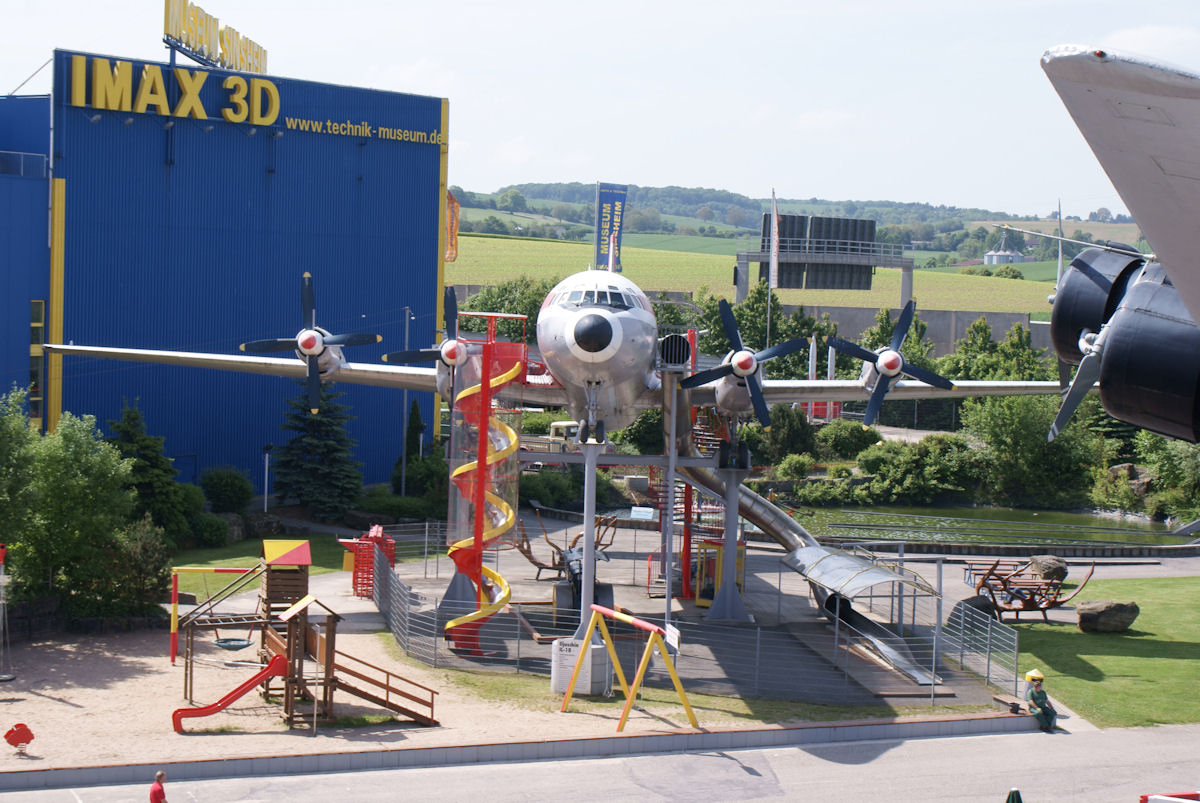
The Il-18E flew with Aeroflot and with several Eastern Bloc airlines. Poland's LOT operated the Il-18E until the end of the turboprop era, as a Wikipedia photograph taken in Warsaw in 1990 documents, and Czechoslovakia's ČSA kept one that is now displayed at the Auto & Technik Museum in Sinsheim, Germany, with registration OK-PAI and construction number 181003105. The gravest episode associated with the version was the accident of 3 September 1968: an Il-18E of the Bulgarian carrier Bulair, registered LZ-BEG and returning from Dresden, flew into terrain near Karnobat, 45 km short of Burgas airport, while trying to skirt showers and a thunderstorm at about 200 m. Of the 89 people on board, 47 died. It was a controlled flight into terrain according to the German Wikipedia's account, which the French one completes by noting that the crew was descending below the cloud base in search of visibility.
When passenger production ended in 1969 the Il-18E remained the final expression of the medium-range Il-18, an intermediate step between the V and the D that is remembered today above all through the aircraft preserved at Sinsheim.
Multimedia


