Ilyushin Il-18 variant
Ilyushin Il-18 Il-20M
Electronic and communications intelligence (ELINT/COMINT) aircraft derived from the Il-18D and known to NATO as "Coot-A". It first flew on 21 March 1968, was built at Moscow's Znamya Truda plant and remains in service with the Russian Aerospace Forces, with frequent Baltic interceptions and the accidental loss of one aircraft over Syria in 2018.

- March 21, 1968
- First flight
- 6,200 km
- Range
History
Origins: a Soviet answer to the RC-135
The Il-20M is the electronic reconnaissance version of the four-turboprop Il-18 airliner, of which Moscow plant No. 30 (later Znamya Truda) built 564 examples between 1957 and 1969. The impulse for a military derivative came from across the Iron Curtain. After Francis Powers' U-2 was shot down over Sverdlovsk on 1 May 1960, the United States gave up overflying Soviet territory and developed the RC-135 on the Boeing 707 airframe; adopted by the USAF in 1964, it could loiter for hours along the borders without crossing them. Soviet air defences could do nothing against an aircraft that stayed over neutral waters, and by the mid-1960s advances in Soviet electronics made an equivalent complex feasible.
On 27 March 1965 the Central Committee of the CPSU and the Council of Ministers issued a resolution ordering an "aircraft for comprehensive reconnaissance of the border strip without crossing the state border"; the corresponding order of the Ministry of Aviation Industry followed on 12 April. The task went to Sergei Ilyushin's design bureau (plant No. 240, from 1966 the Moscow Machine-Building Plant Strela). The chosen basis was the Il-18D, the last and most refined production version of the airliner: compared with the Il-18V it had the more powerful and economical series VI AI-20M engines and additional fuel tanks that raised maximum-fuel range to almost 6,400 km (against 4,850 km for the Il-18V). The Il-18D flew on 26 July 1965 and 122 were built up to 1969; its long endurance and roomy fuselage made it ideal for housing the special equipment and the tactical crew that would operate it. All later military versions of the family descend from this Il-18D.
The Igla complex
The reconnaissance aircraft was designated Il-20, or "article 20". Its main sensor was the non-coherent Igla-1 side-looking radar, developed at SKB-1 of the Leningrad institute NII-131 (later VNIIRES, subsequently part of the Leninets association) under chief designer V. M. Glushkov with S. E. Kontorov as deputy; the aircraft was consequently also known as the Il-18D Igla. The complex tied the radar to radio-technical and photographic reconnaissance equipment linked to the aircraft's navigation system, and delivered a radar image of near-photographic quality usable in any weather.
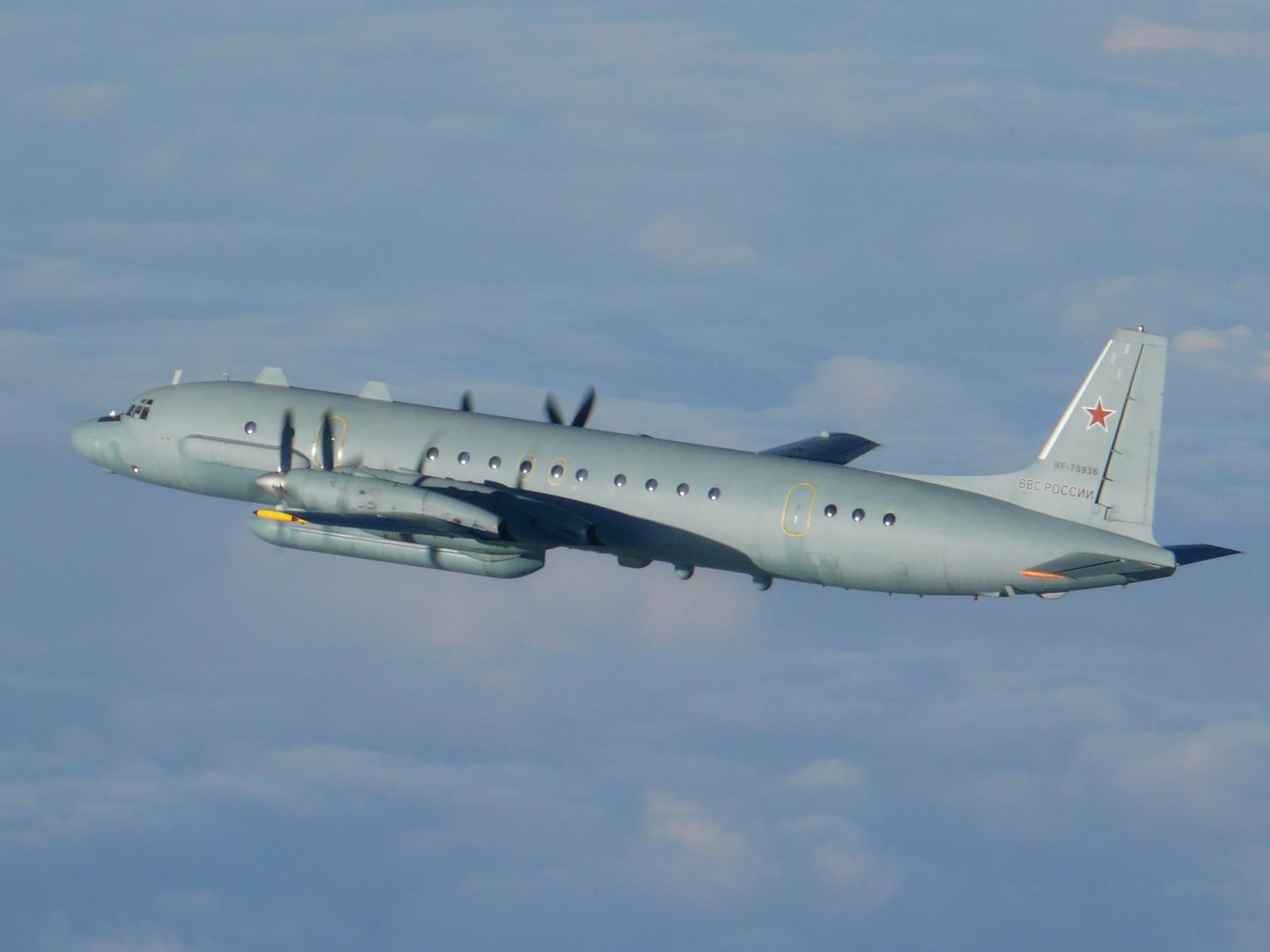
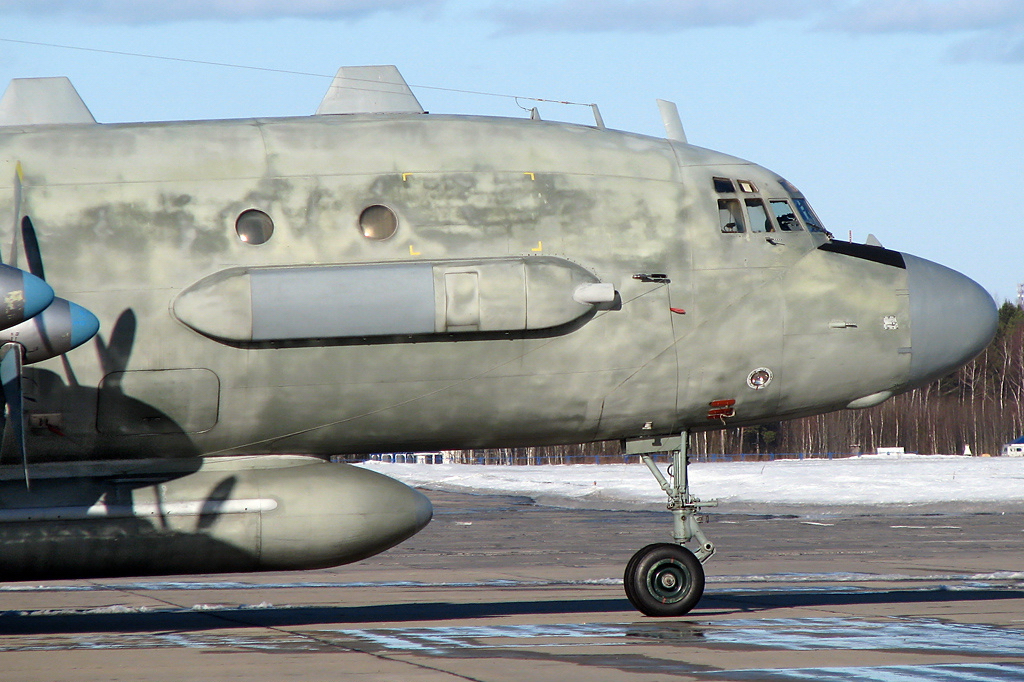
The Igla antenna was housed in a cigar-shaped ventral gondola some 8 m long, fitted between frames 8 and 27 and radio-transparent on its underside; the radar units occupied the forward baggage hold. On both sides of the nose, at the first pair of windows, A-87P aerial cameras were mounted behind sliding shutters under two lateral fairings that form the type's second external hallmark. The rear of those fairings holds the antennas of the Romb general radio-technical reconnaissance system (Romb-4 on the Il-20M), which detects radars and measures bearing and frequency; under the fuselage aft of the wing are the antennas of the Kvadrat detailed reconnaissance station (Kvadrat-2 on the Il-20M), which adds parameters such as pulse repetition frequency, duty cycle and radiated power; above the nose sit the antennas of the Vishnya voice-intercept station, served by an operator fluent in the adversary's language and military radio slang. Information is gathered on several channels at once, so photography confirms the radar picture and the radar picture confirms what Kvadrat detects. With so much equipment the fuselage was partly reinforced, most cabin furnishings were removed, crew seats were adapted for parachutes, and an emergency exit connected to the main cabin by a chute was opened on the starboard side in place of the rear baggage door.
In the original Il-20 the special equipment was worked by six operators in the forward and centre cabins in addition to the standard Il-18 crew of two pilots, navigator, flight engineer and radio operator; the rear cabin kept a rest area with seats, wardrobe, buffet and toilet. The modernised Il-20M carries thirteen people: eight equipment operators plus pilots, navigator, flight engineer and radio operator. According to the English Wikipedia the Il-20 differs from the airliner in its lower flying weight and an increased range of up to 5,400 km, and the two large dorsal satellite-communication antennas allow it to pass information to ground command in near real time.
Testing and production
The first prototype was obtained by converting production Il-18D No. 9403; the conversion at Znamya Truda began on 6 May 1967 and was completed early the following year. On 21 March 1968 test pilot Stanislav Bliznyuk, who had joined the firm after graduating from the LII test pilot school in 1965 and would later become the Ilyushin bureau's chief pilot, made the first flight; V. Volodko was lead test engineer. The first phase of trials, still without the Igla, ended in 1968 and showed the aircraft handled much like an Il-18D, although the gondola's large side area reduced directional stability margins, chiefly with an outboard engine feathered. The second phase, with the radar fitted, ran until the summer of 1969 and was credited as stage "A" of the joint state trials; stage "B" was completed in 1970-1971, after which the type began reaching units. Production drawings were prepared from 1968 and the first series aircraft left the shops at the turn of the decade. The Il-20 was followed by the Il-20M and Il-20M1 with improved equipment.
.jpg)
Production figures differ between sources: airwar.ru states that Znamya Truda built around two dozen Il-20 and Il-20M up to 1976, whereas the English Wikipedia places the end of Il-20 manufacture, modifications included, in 1974. Derivatives of the same root include the Il-20RT, four telemetry and communications relay aircraft used to support the Soviet space programme (with a prototype converted from Il-18A c/n 188000401) and later replaced by an Il-76 variant, and the two Il-18DORR ice-reconnaissance aircraft, similar to the Il-20M but with civilian equipment and later returned to passenger configuration. The Il-22 (Coot-B) airborne command post is a separate development on the same airframe.
Service: the Cold War and after
The Il-20 and Il-20M were never assigned to reconnaissance regiments or squadrons of the Soviet Air Force; they answered directly to the headquarters of each military district or fleet, which held several aircraft. They took part in exercises from the outset: between 4 and 10 February 1970 an Il-20 flown by Bliznyuk's crew joined the Dvina manoeuvres, and in May 1971 it led the Kristall display of aviation equipment for the national leadership at Akhtubinsk. Its patrols over international waters did not go unnoticed, but Western intelligence only identified the type in 1978, when NATO assigned the reporting name Coot-A. In spring 1985 a Sea Harrier of the Royal Navy's 801 Naval Air Squadron met one over the North Atlantic near Norway; on 31 August 1993 an Il-20M commanded by Major I. Antipov was intercepted over the Sea of Japan first by South Korean fighters and then by Japanese aircraft; on 7 December 1995 another took off from Sakhalin to search the Tatar Strait for the wreckage of Khabarovsk-based Tu-154B No. 85164. The type was also used during the war in Afghanistan.
In the 1990s the ageing of the on-board electronics led to the Il-20M being withdrawn from alert duty without an equivalent replacement: the Tu-22RDM reconnaissance aircraft were also retired and the Tu-22MR arrived in minimal numbers, so the bulk of comprehensive aerial reconnaissance passed to the Su-24MR and MiG-25RB. Some Il-20Ms were relegated to transport duties and a few with remaining airframe life were converted back into ordinary Il-18s. Yet the type kept flying: in October 2013 an Il-20M patrolled the Turkish Black Sea coast and was chased by two F-16s until it turned towards Bulgaria; on 13 April 2014 it repeated the profile 15-20 nautical miles off the coast and was intercepted by four Turkish F-16s; on 22 October 2014 Estonia reported a brief incursion into its airspace, escorted by Portuguese, Belgian and Swedish fighters, which Moscow denied. From 2015 the Il-20M was part of the Russian deployment in Syria, where it was later supplemented by the Tu-214R.
The 2018 shoot-down and recent activity
On 17 September 2018, at around 11 p.m., the Russian command in Syria lost contact with Il-20M RF-93610 over the eastern Mediterranean near Latakia: Syrian air defences had shot it down by mistake with an S-200 system while Israeli F-16s were striking targets in the country. All 15 people on board were killed. Russia initially accused Israel of using the aircraft as cover; Israel replied that its jets had already returned to Israeli airspace, and Vladimir Putin spoke of a chain of unfortunate circumstances. In July 2020 a modernised Il-20M with improved radar, radio and electro-optical equipment entered service to provide targeting for the Kh-47M2 Kinzhal missile.
Interceptions over the Baltic have become routine: on 28 November 2022 two German Eurofighters deployed at Ämari identified an Il-20M flying without a transponder between Kaliningrad and mainland Russia; on 27 January 2023 another pair from Tactical Air Wing 73 "Steinhoff" at Rostock-Laage escorted RF-93611; on 9 December 2024 two Dutch F-35s accompanied a Coot-A to the edge of NATO's area of responsibility; on 27 March 2025 two Rostock-Laage Eurofighters escorted one east of Rügen; on 20 August 2025 NORAD tracked an Il-20 for two hours and four minutes inside the Alaskan air defence identification zone with an E-3, a KC-135 and two F-16s; on 21 September 2025 German Eurofighters and Swedish Gripens scrambled over the southern Baltic; and on 28, 30 and 31 October 2025 several Il-20s flew without transponder or flight plan, one of them intercepted by Polish MiG-29s. Almost six decades after its first flight, the Il-20 went down in history as the first Soviet aircraft designed to combine reconnaissance sensors based on different physical principles, and it remains a familiar presence in European skies.
Multimedia

-800.webp)


