Airliner · Civil · Russia
Tupolev Tu-114
- November 15, 1957
- First flight
- 1961
- Introduced
- In service
- Status
- 32
- Units built

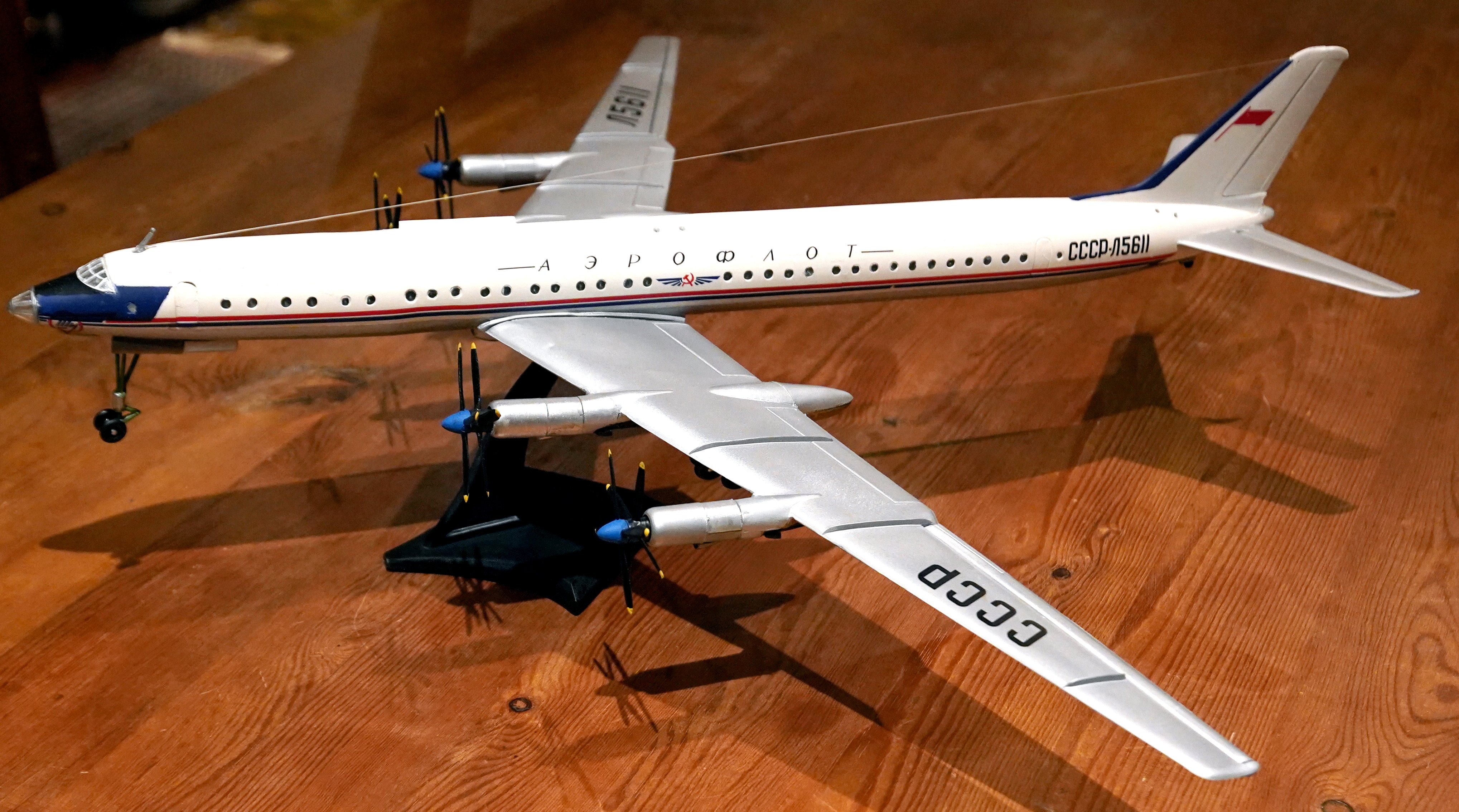
The Tupolev Tu-114 Rossiya is a large Soviet turboprop-powered long-range airliner designed by the Tupolev design bureau. In its day it was the largest and fastest passenger aircraft in the world, and also the longest-legged, at 10,900 km. Since 1960 it has held the official title of fastest propeller-driven aircraft. Its NATO reporting name was Cleat. Its most singular feature is that, thanks to its swept wing and powerplant layout, it reached speeds typical of contemporary jetliners, 880 km/h, despite turning four Kuznetsov NK-12 turboprops with contra-rotating propellers. It could accommodate up to 224 passengers, though Aeroflot more commonly configured it for 170 seats with sleeping berths and a dining lounge. Among its oddities were the lower-deck galleys and crew rest area, linked to the upper deck by a dumbwaiter, and landing gear so tall — the nose leg stood three metres high — that many destination airports had no steps able to reach the cabin door. The Tu-114 carried over six million passengers before being replaced by the jet-powered Ilyushin Il-62. Thirty-two aircraft were built at the Kuibyshev aviation plant. Its commercial life was short — scheduled flights from 1961 to 1976 — but it earned an excellent reputation for reliability, speed and fuel economy, with a safety record that was rarely matched.
Related sheets
Category
Three-view drawing
History
From the Tu-95 bomber to a flying ocean liner
A Council of Ministers directive and a Ministry of Aircraft Production order issued in August 1955 tasked the Tupolev bureau with creating an airliner with a range of 8,000 km, based on the Tu-95 strategic bomber and powered by four Kuznetsov NK-12 engines driving contra-rotating propellers. The Tu-114 kept the bomber's wing, empennage, landing gear and powerplants, mated to an entirely new pressurised fuselage of much larger diameter. The extra weight required greater landing flap area and an increased flap chord compared with the bomber's. The wing was mounted low on the fuselage, leaving the Tu-114 standing much higher on its gear than the Tu-95 and requiring a new nose leg, though the main gear was unchanged. The first flight took place on 15 November 1957.
An instrument of diplomacy
The first Tu-114, registration CCCP-L5611, was shown to the West in 1958 at the Brussels World Exhibition. The following year it carried Nikita Khrushchev on his first trip to the United States, in September 1959, the first such visit by a Soviet leader. The aircraft was still in testing and had completed its first long-range flight only four months earlier; post-flight analysis had found hairline cracks in the engines. The Central Committee, Defence Minister Malinovsky and Khrushchev's own personal pilot all thought the flight too risky, but the premier insisted, and Andrei Tupolev showed his confidence by putting his son Alexei aboard the same aircraft. A team of engineers rode along, operating diagnostic equipment to monitor the engines. On arrival at Andrews Air Force Base the ground crew found they had no steps tall enough, and the delegation had to use the aircraft's own emergency escape ladder. The same happened at London and Paris.
Scheduled service and the Havana run
Regular Aeroflot service began on 24 April 1961 between Moscow's Vnukovo Airport and Khabarovsk, later extending to Copenhagen, Havana, Montreal, New Delhi, Paris, Belgrade and Tokyo. Havana flights via Conakry started on 10 July 1962, but American pressure closed one stopover after another: Guinea after four flights, then Dakar after three, then Algiers after three more. The answer was the very-long-range Tu-114D variant, with seating cut from 170 to 60 and fifteen extra fuel tanks, refuelling at Olenya near Murmansk and routing over the Barents Sea. For the Moscow–Tokyo service, Japan Air Lines agreed with Aeroflot to use the Tu-114 with a mixed crew and a two-class, 105-seat layout; the first flight was on 17 April 1967.
Records and retirement
In a series of flights beginning on 24 March 1960 the Tu-114 set closed-circuit speed records with payload, including 871.38 km/h over 1,000 km with pilot Ivan Sukhomlin. As the Il-62 took over, the Tu-114s were moved to long domestic routes out of Domodedovo. The airframe fatigue life was set at 14,000 flying hours and most aircraft reached it in 1976; by the summer of 1977 Aeroflot decided to scrap twenty-one at once. A few carried on with the Soviet Air Forces until 1991.
Variants
| Tu-114 | Tu-114-200 | Tu-114 6NK-8 | Tu-114A | Tu-114B | Tu-114C | Tu-114 (configuración JAL) | Tu-114D | Tu-114E | Tu-114F | Tu-114PLO | Tu-114T | Tu-115 | Tu-116 | Tu-126 | |
|---|---|---|---|---|---|---|---|---|---|---|---|---|---|---|---|
| First flight | November 15, 1957 | — | — | — | — | — | — | — | — | — | — | — | — | — | — |
| Aircraft type | Long-haul airliner | Long-haul airliner | Turbofan-powered long-haul airliner (project) | Long-haul airliner (project) | Cruise-missile carrier (project) | Tu-114A military derivative (project) | Long-haul airliner | Ultra-long-range airliner | Reconnaissance aircraft (project) | Reconnaissance aircraft (project) | Maritime strike aircraft (project) | Freighter (project) | Military transport (project) | Long-range government transport | Airborne early warning aircraft |
| Powerplant | 4 × Kuznetsov NK-12MV turboprops of 11,033 kW (14,795 shp) each, every engine driving eight-blade AV-60N contra-rotating propellers of 5.6 m diameter. | 4 × Kuznetsov NK-12MV turboprops of 11,033 kW each with AV-60N contra-rotating propellers. | 6 × Kuznetsov NK-8 turbofans replacing the four original turboprops. | 4 × Kuznetsov NK-12MV turboprops of 11,033 kW each with AV-60N contra-rotating propellers. | 4 × Kuznetsov NK-12MV turboprops of 11,033 kW each with AV-60N contra-rotating propellers. | 4 × Kuznetsov NK-12MV turboprops of 11,033 kW each with AV-60N contra-rotating propellers. | 4 × Kuznetsov NK-12MV turboprops of 11,033 kW each with AV-60N contra-rotating propellers. | 4 × Kuznetsov NK-12MV turboprops of 11,033 kW each with AV-60N contra-rotating propellers. | 4 × Kuznetsov NK-12MV turboprops of 11,033 kW each with AV-60N contra-rotating propellers. | 4 × Kuznetsov NK-12MV turboprops of 11,033 kW each with AV-60N contra-rotating propellers. | Nuclear-powered proposal with four powerplants; no specific engine designation is documented. | 4 × Kuznetsov NK-12MV turboprops of 11,033 kW each with AV-60N contra-rotating propellers. | 4 × Kuznetsov NK-12MV turboprops of 11,033 kW each with AV-60N contra-rotating propellers. | 4 × Kuznetsov NK-12MV turboprops of 11,033 kW each with eight-blade contra-rotating propellers. | 4 × Kuznetsov NK-12MV axial-flow turboprops of 11,033 kW (14,795 shp) each with eight-blade contra-rotating propellers. |
| Powerplant | 4 × Kuznetsov NK-12MV | 4 × Kuznetsov NK-12MV | 6 × Kuznetsov NK-8 | 4 × Kuznetsov NK-12MV | 4 × Kuznetsov NK-12MV | 4 × Kuznetsov NK-12MV | 4 × Kuznetsov NK-12MV | 4 × Kuznetsov NK-12MV | 4 × Kuznetsov NK-12MV | 4 × Kuznetsov NK-12MV | 4 × other | 4 × Kuznetsov NK-12MV | 4 × Kuznetsov NK-12MV | 4 × Kuznetsov NK-12MV | 4 × Kuznetsov NK-12MV |
| Power per engine | 14,795 hp Best value in this row | 14,795 hp Best value in this row | — | 14,795 hp Best value in this row | 14,795 hp Best value in this row | 14,795 hp Best value in this row | 14,795 hp Best value in this row | 14,795 hp Best value in this row | 14,795 hp Best value in this row | 14,795 hp Best value in this row | — | 14,795 hp Best value in this row | 14,795 hp Best value in this row | 14,795 hp Best value in this row | 14,795 hp Best value in this row |
| Length | 54.1 m | — | — | — | — | — | — | — | — | — | — | — | — | 46.2 m | 56.5 m Best value in this row |
| Wingspan | 51.1 m | — | — | — | — | — | — | — | — | — | — | — | — | — | 51.4 m Best value in this row |
| Height | 15.4 m | — | — | — | — | — | — | — | — | — | — | — | — | 15.5 m | 16.1 m Best value in this row |
| Wing area | 311 m² Best value in this row | — | — | — | — | — | — | — | — | — | — | — | — | 311 m² Best value in this row | 311 m² Best value in this row |
| Empty weight | 91,000 kg Best value in this row | — | — | — | — | — | — | — | — | — | — | — | — | 93,500 kg | 103,000 kg |
| MTOW | 171,000 kg | — | — | — | — | — | — | 182,000 kg Best value in this row | — | — | — | — | — | 182,000 kg Best value in this row | 171,000 kg |
| Top speed | 870 km/h | — | — | — | — | — | — | — | — | — | — | — | — | 900 km/h Best value in this row | 790 km/h |
| Max speed altitude | 8,000 m | — | — | — | — | — | — | — | — | — | — | — | — | — | — |
| Cruise speed | 770 km/h | — | — | — | — | — | — | — | — | — | — | — | — | 800 km/h Best value in this row | 520 km/h |
| Cruise altitude | 9,000 m | — | — | — | — | — | — | — | — | — | — | — | — | — | 9,000 m |
| Service ceiling | 12,000 m Best value in this row | — | — | — | — | — | — | — | — | — | — | — | — | 12,000 m Best value in this row | 10,700 m |
| Initial climb rate | 10.2 m/s | — | — | — | — | — | — | — | — | — | — | — | — | — | — |
| Range | 8,950 km | — | — | — | — | — | — | — | — | — | — | — | 5,000 km | 10,750 km Best value in this row | 7,000 km |
| Ferry range | 10,900 km | — | — | — | — | — | — | — | — | — | — | — | — | — | — |
| Combat radius | 0 km | — | — | — | — | — | — | — | — | — | — | — | — | — | — |
| Endurance | — | — | — | — | — | — | — | — | — | — | — | — | — | — | 600 min |
| Range conditions | 8,950 km with maximum fuel and a 15,000 kg payload; 6,200 km with maximum payload and 60 minutes of reserves. The maximum range credited to the type is 10,900 km. | — | — | — | — | — | — | Conceived to link Moscow with Havana without an intermediate stop on foreign soil. | — | — | — | — | Design radius of action: 5,000 km with the intended maximum load. | 10,750 km of range, intended for non-stop state flights. | 7,000 km on internal fuel; 10 hours of endurance without refuelling and up to 20 with one in-flight top-up. |
| Armament | None | None | None | None | Intended to carry one large cruise missile; never built. | Not documented; it carried the Tu-114B radome plus lateral sensor blisters. | None | None | Not documented; reconnaissance version derived from the Tu-114A. | Not documented; development of the Tu-114E with extra sensors. | Anti-ship missiles and naval search radar (project). | None | Tail gun turret (project). | None | None |
| Max weapons load | 0 kg Best value in this row | 0 kg Best value in this row | 0 kg Best value in this row | 0 kg Best value in this row | — | — | 0 kg Best value in this row | 0 kg Best value in this row | — | — | — | 0 kg Best value in this row | — | 0 kg Best value in this row | 0 kg Best value in this row |
| Payload | 30,000 kg | — | — | — | — | — | — | — | — | — | — | — | — | 32,000 kg Best value in this row | — |
| Cargo capacity | Double-deck cabin for 120-220 passengers depending on layout: 170 seats in Aeroflot's usual arrangement with sleeping berths and a dining lounge, and 200 once the sleeping compartments were removed in the early 1970s. Maximum payload 30,000 kg. | Interior rework of the Tu-114 seating 200, with the berths and dining lounge deleted. Almost the whole fleet was brought to this standard. | Long-range proposal kept as an alternative should the Ilyushin Il-62M fail. It never reached production. | A 1962-1963 project seating 98-102 for long-distance routes. It never entered production but became the basis of several military derivatives. | No civil cargo capacity | No civil cargo capacity | Two-class layout with 105 seats for the Moscow-Tokyo route flown with Japan Air Lines from 17 April 1967. Mixed crews and a JAL logo on the forward fuselage; the four aircraft involved returned to the 200-seat domestic interior in 1969. | "Dalniy" (long-range) version for the Cuba route: fewer passengers in exchange for fuel, with take-off weight raised to 182,000 kg. Three were built; two reverted to Tu-114-200 standard in 1969-1970. | No civil cargo capacity | No civil cargo capacity | No civil cargo capacity | Projected freighter with a swing tail for oversize loads. It was never built. | Rear loading ramp and a compartment for 38 soldiers behind the flight deck. It was to carry 300 paratroopers or 40 tonnes of freight. Cancelled in favour of the Antonov An-22. | A Tu-95 bomber with two pressurised cabins fitted in the bomb-bay space, connected neither to each other nor to the flight deck: 24 passengers normally and up to 60. Maximum load 32,000 kg. Two were built. | No civil cargo capacity: the Tu-114 airframe houses the rotating Liana radar and its mission equipment, with a crew of 12 plus a full relief crew. |
| Crew | 6 Best value in this row | — | — | — | — | — | — | — | — | — | — | — | — | 7 | 12 |
| Passengers | 220 | 200 | — | 102 | — | — | 105 | 60 | — | — | — | — | 300 Best value in this row | 60 | — |
| Units built | 32 Best value in this row | — | 0 | 0 | 0 | 0 | — | 3 | 0 | 0 | 0 | 0 | 0 | 2 | 9 |
Images