Fighter · Military · United States
Lockheed Martin F-35 Lightning II
- December 15, 2006
- First flight
- 2015
- Introduced
- In service
- Status
- 1,345
- Units built


-1600.webp)
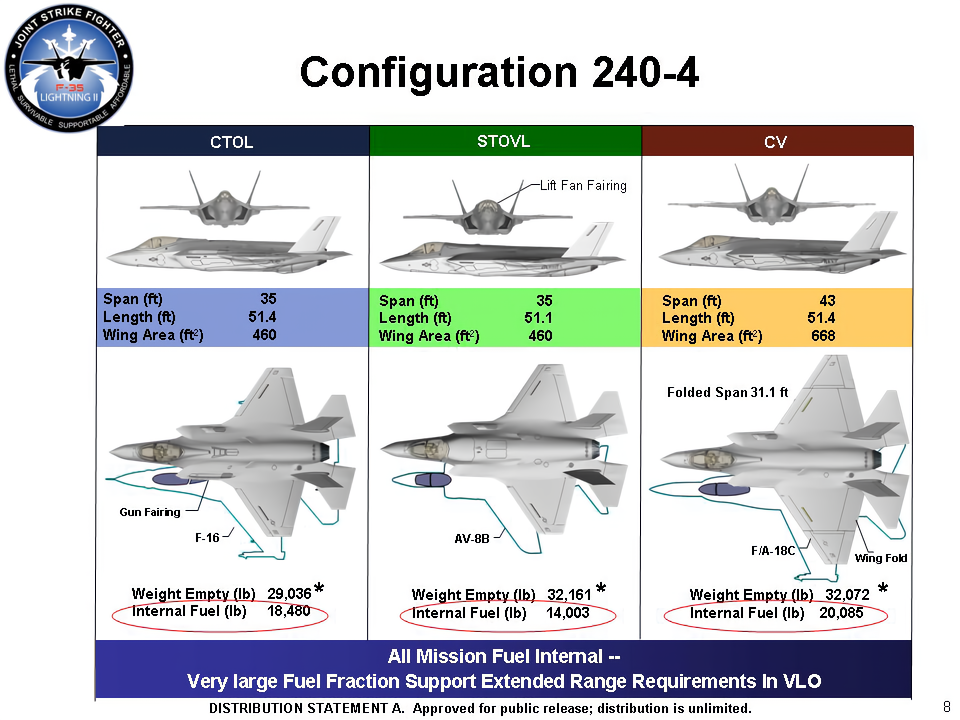
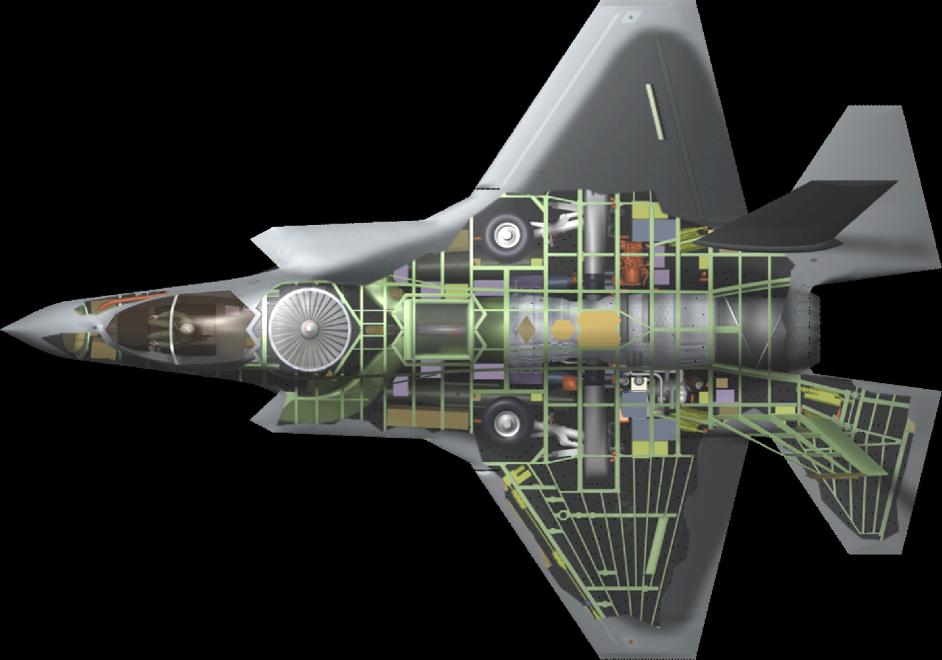
The Lockheed Martin F-35 Lightning II is a family of single-seat, single-engine fifth-generation stealth fighters conceived not as one aircraft but as a common design rendered in three versions that share airframe, powerplant, sensors and mission system, and differ in how they take off and land. The F-35A operates conventionally from a runway; the F-35B takes off in a short roll and lands vertically by means of a shaft-driven lift fan and a swivelling exhaust nozzle; the F-35C carries a larger folding wing, strengthened landing gear and an arresting hook for catapult operations from aircraft carriers. That premise — a single programme replacing the F-16, the A-10, the AV-8B Harrier II and the F/A-18 Hornet at once, across three American services and the air arms of a dozen partner nations — accounts for both its industrial reach and its troubles. The aircraft grew out of the Joint Strike Fighter programme, which in 1996 pitted the Boeing X-32 against the Lockheed Martin X-35. On 26 October 2001 the Pentagon picked the X-35, and the first production-standard F-35, AA-1, flew on 15 December 2006 at Fort Worth. Between selection and service entry came a weight crisis that forced a redesign of the STOVL version, a cost breach that triggered a full restructuring of the programme, and a schedule that slipped by years. The Marine Corps declared initial operational capability in July 2015, the Air Force in August 2016 and the Navy in February 2019. Its defining quality is not speed — capped at Mach 1.6, roughly 1,960 km/h — but the pairing of low observability with a sensor fusion that blends the AN/APG-81 AESA radar, the six-camera AN/AAQ-37 distributed aperture system, the AN/AAQ-40 electro-optical targeting sensor and an integrated electronic warfare suite, all presented to the pilot on a single touchscreen and on the visor of a helmet that replaces the conventional head-up display. In stealth configuration weapons ride in two internal bays; when the threat permits, six external stations raise the load to about 8,160 kg on the A and C models. With more than a thousand aircraft delivered and customers on three continents, the F-35 has become the backbone of Western combat aviation and, at the same time, the most expensive weapons programme in history. Its development continues: the Block 4 capability package and the Technology Refresh 3 avionics upgrade — whose delays halted deliveries for a year between 2023 and 2024 — define the aircraft that will fly for decades to come.
Related events
- JAST program office chartered, the administrative origin of the F-35
- Boeing and Lockheed Martin selected for the Joint Strike Fighter concept demonstration phase
- First flight of the X-35A demonstrator
- The X-35A completes its conventional test programme
- First flight of the X-35C, the carrier-variant demonstrator
- The United Kingdom signs the memorandum making it a tier-one JSF partner
- The X-35B makes the first vertical take-off and landing with a shaft-driven lift fan
- "Mission X": short take-off, supersonic dash and vertical landing in a single X-35B sortie
- Lockheed Martin wins the Joint Strike Fighter competition
- The first F-35A, AA-1, rolls off the Fort Worth assembly line
- The F-35 is officially named "Lightning II"
- First flight of the Lockheed Martin F-35 Lightning II
- First flight of the F-35B, the short take-off and vertical landing variant
- Norway recommends the F-35 over Sweden's Gripen
- First vertical landing of an F-35B at Patuxent River
- First flight of the F-35C, the U.S. Navy carrier variant
- Canada announces its intention to buy 65 F-35A
- Israel signs the letter of offer and acceptance for its first 20 F-35
- First production F-35 delivered to the U.S. Air Force at Eglin
- The F-35B lands aboard a ship for the first time: sea trials on USS Wasp
- Japan selects the F-35A in the F-X competition
- The United Kingdom reverts to the F-35B after trying to switch to the F-35C
- The Netherlands select the F-35A with a plan for 37 aircraft
- South Korea selects the F-35A for its F-X III programme
- Australia confirms 58 more F-35A, raising its order to 72
- First major damage to an F-35: engine fire at Eglin
- First arrested landing of an F-35C aboard a carrier, USS Nimitz
- Service entry of the Lockheed Martin F-35 Lightning II
- The first F-35A assembled outside the United States rolls out at Cameri
- The U.S. Marine Corps declares the F-35B operational
- First flight of an F-35 outside the United States
- The first Dutch F-35s touch Netherlands soil
- Danish Folketing agreement to buy 27 F-35A
- The U.S. Air Force declares the F-35A operational
- A pilot ejects from a burning F-35A at Mountain Home
- Italy's first two operational F-35A arrive at Amendola
- The first two Israeli F-35I "Adir" arrive at Nevatim
- The F-35B gains its first permanent overseas base: Iwakuni
- Rollout of the first Japanese-assembled F-35A
- Norway's first three F-35A land at Ørland
- Israel declares the F-35I "Adir" operational
- First operational shipboard deployment of the F-35B, aboard USS Wasp
- Israel reveals the F-35's first use in combat
- The first British F-35B arrive at RAF Marham
- First F-35B landings aboard the carrier HMS Queen Elizabeth
- First combat strike by a U.S. F-35, in Afghanistan
- First hull loss of an F-35: an F-35B crashes near Beaufort
- Belgium selects the F-35A over the Typhoon
- Australia's first two F-35A arrive at Williamtown
- The U.S. Navy declares the F-35C operational
- South Korea's first two F-35A arrive at Cheongju
- The programme's first fatal accident: a Japanese F-35A is lost over the Pacific
- Combat debut of the U.S. Air Force F-35A over Iraq
- The United States formally removes Turkey from the F-35 programme
- First operational F-35A permanently stationed in the Netherlands
- The United States approves the sale of F-35B to Singapore
- Poland signs the Harpia programme contract for 32 F-35A
- An F-35A crashes on landing at Eglin
- Mid-air collision between an F-35B and a KC-130J tanker
- First F-35B landing aboard the Italian carrier Cavour
- First combat missions launched from HMS Queen Elizabeth
- The Swiss Federal Council selects the F-35A under Air2030
- An Italian Navy F-35B lands aboard the Cavour for the first time
- First British loss: an F-35B falls into the Mediterranean from HMS Queen Elizabeth
- Finland selects the F-35A at the end of the HX competition
- A South Korean F-35A makes a belly landing at Seosan
- An F-35C crashes into the deck of USS Carl Vinson
- Germany decides to buy 35 F-35A for the NATO nuclear mission
- Wake turbulence downs an F-35A at Hill
- A factory-fresh F-35B crashes at Fort Worth
- Canada finally closes the contract for 88 F-35A
- The first Danish F-35A arrive at Skrydstrup
- The South Carolina "ghost jet": an F-35B flies on after its pilot ejects
- The Czech Republic signs the letter of acceptance for 24 F-35A
- An F-35B crashes at Kirtland during a ferry flight
- Greece joins the F-35 programme with an order for 20 aircraft
- The Italian Navy declares its embarked F-35B component operational
- Romania becomes the twentieth member of the F-35 global alliance
- An F-35A crashes at Eielson and the pilot ejects in full view of the base
- An F-35C is lost near Naval Air Station Lemoore
- Belgium's first F-35A arrives at Florennes
- Rollout of Finland's first F-35A
- A U.S. F-35 makes an emergency landing after a combat mission against Iran
- Poland's first F-35A "Husarz" arrive at Łask
- An F-35 crashes at Marine Corps Air Station Miramar
Related sheets
Category
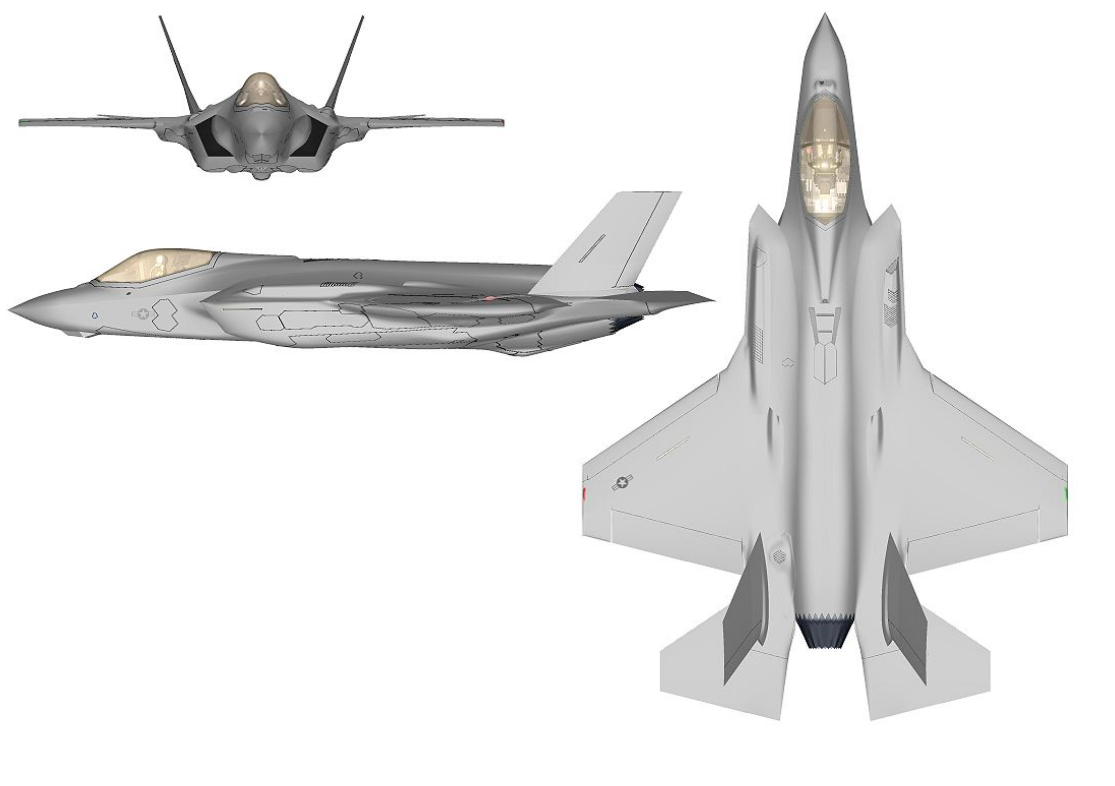
Three-view drawing
History
One fighter for everyone: the origin of the Joint Strike Fighter
The F-35 did not begin as a fighter but as an administrative answer to a budget problem. In the early 1990s the Pentagon had half a dozen overlapping combat aircraft programmes on the table: the Air Force wanted an affordable F-16 replacement to fly alongside the F-22; the Marine Corps needed to replace the AV-8B Harrier II and the F/A-18 Hornet with something that could still operate from short decks and jungle clearings; the Navy was looking for a carrier-capable stealth aircraft after the cancellation of the A-12 Avenger II; and Britain's Royal Navy faced the retirement of its Sea Harriers. Taken one at a time, each requirement justified a programme. Taken together, they were unaffordable.
The 1993 strategic review known as the Bottom-Up Review ordered them merged. The result was the Joint Advanced Strike Technology programme, later renamed Joint Strike Fighter, which absorbed earlier DARPA work on vertical flight — ASTOVL and its successor CALF, the Common Affordable Lightweight Fighter — and adopted a premise never attempted at that scale: a single basic design, with the greatest possible commonality of parts and systems, yielding a conventional version, a short take-off and vertical landing version and a carrier version. The promise was that sharing an assembly line and a logistics chain across three services and several allied air forces would drive unit cost down.
That promise shaped everything that followed. Commonality demanded very early commitment to structural decisions that would be hard to reverse — a common internal weapons bay, a single engine, one wing family — and it meant that the three principal customers had to negotiate requirements with one another before anything could change. The F-35 inherited both the economies of scale and the rigidity of that bargain.
X-32 against X-35
In November 1996 the Department of Defense awarded concept demonstration contracts to Boeing and Lockheed Martin and eliminated the McDonnell Douglas bid, whose gas-driven lift fan was judged too risky. Boeing built the stubby X-32, with a large chin inlet and a direct-lift system that vectored the engine exhaust in the manner of the Harrier. Lockheed Martin offered the X-35, more conventional in outline and radically different in its approach to vertical flight.
The X-35 used a lift fan behind the cockpit, driven mechanically by a shaft taken off the engine through a clutch, together with an exhaust nozzle mounted on three bearings that swivelled until it pointed at the ground. Cold fan air forward and hot exhaust aft balanced the aircraft, and the fan contributed substantial thrust without burning fuel of its own. It was mechanically more complex than the Boeing solution, but the outcome — less hot-gas recirculation, less surface erosion, more vertical thrust available — proved decisive.
The demonstration that settled the contest took place on 20 July 2001. In a single sortie the X-35B made a short take-off, accelerated to supersonic speed in level flight and landed vertically, something no aircraft had done in one flight before. On 26 October 2001 the Pentagon announced that Lockheed Martin had won, with Northrop Grumman and BAE Systems as principal partners, and awarded the System Development and Demonstration contract. The F-35 designation and the name Lightning II — a nod both to the Lockheed P-38 Lightning and to Britain's English Electric Lightning — were announced in 2006.
The weight crisis
The first serious stumble came in 2004, before anything had flown. Detailed calculations showed that the STOVL version was more than a tonne over the maximum weight compatible with vertical landing: as designed, it could not meet its own recovery requirement. Lockheed Martin formed the STOVL Weight Attack Team and put the design through a slimming exercise that lasted eighteen months and touched all three variants, because commonality worked in both directions.
The centre fuselage structure was redesigned, metal parts gave way to composites, the weapons bays of the B model were reduced, the vertical tails were made smaller, internal fuel capacity was cut and the lift system's thrust was increased. The redesign saved the programme at the price of two things that marked it: nearly two years of delay, and the loss of part of the very commonality that had been its rationale, since the three airframes ended up sharing fewer parts than planned.
From AA-1 to three variants in the air
The first F-35, serial AA-1, flew on 15 December 2006 from the Lockheed Martin plant at Fort Worth with Jon Beesley at the controls. It predated the weight redesign and was useful for basic flight testing but not representative of production configuration. The STOVL F-35B flew on 11 June 2008 and made its first vertical landing in March 2010. The carrier-based F-35C flew on 6 June 2010.
Testing exposed a long list of development problems. The F-35C's arresting hook, mounted too close to the main landing gear, repeatedly failed early cable-capture trials and had to be redesigned outright before the aircraft could attempt a real carrier landing, which it achieved on 3 November 2014 aboard USS Nimitz. The F-35B suffered trouble with its lift-fan doors and with deck temperatures. The programme also accumulated difficulties with software, with the pilot's helmet and with the logistics management system.
Cost, schedule and restructuring
In 2010 unit cost growth crossed the legal threshold that in the United States obliges the Pentagon to certify to Congress that a programme remains essential — the Nunn-McCurdy breach — and the F-35 was restructured: development was extended, full-rate production pushed back and the programme director replaced. In January 2011 Defense Secretary Robert Gates placed the STOVL variant on a two-year probation with an explicit threat of cancellation if its technical problems were not solved; good test results allowed the condition to be lifted a year later, in January 2012.
Cost has followed the F-35 like a second shadow. Acquisition of the full programme was estimated at more than 412 billion dollars, and the whole-life figure — including sustainment of the fleet into mid-century — sits well above a trillion and a half, making it the most expensive weapons programme ever undertaken. Against that, serial production did deliver part of the original promise: the unit price of the F-35A fell from over 200 million dollars in the earliest lots to around 80 million by the late 2010s, though cost per flight hour stayed far above target.
The powerplant
All three variants are powered by a single engine of the Pratt & Whitney F135 family, derived from the F-22's F119 and the most powerful combat turbofan ever put into service. The F135-PW-100 powers the F-35A and, with salt-corrosion-resistant materials, the F-35C; it delivers about 28,000 lbf (125 kN) at military power and about 43,000 lbf (191 kN) with afterburner. The F-35B uses the F135-PW-600, adapted to the lift system, rated at about 27,000 lbf (120 kN) dry and about 41,000 lbf (182 kN) in afterburner.
In the F-35B the engine does not merely push: through a clutch and a shaft it drives the two-stage counter-rotating Rolls-Royce lift fan behind the cockpit, while its three-bearing nozzle rotates downwards and two ducts carry compressor air to roll posts in the wings for lateral control. That assembly — the Rolls-Royce LiftSystem — is the single most distinctive piece of engineering on the aircraft and the reason a supersonic stealth fighter could replace the Harrier at all.
An alternative engine, the General Electric/Rolls-Royce F136, was developed for years as a competitive source of supply, but the Department of Defense withdrew its support and Congress finally cancelled its funding in 2011. The F135 has had no competitor since, and propulsion development has instead run through core upgrades and thermal management, both unavoidable because the systems added by the Block 4 package must shed more heat than the original design anticipated.
Stealth, sensors and fusion
The F-35's low observability does not rest on a shape as extreme as the F-117's or the B-2's but on a combination of form, materials and configuration discipline: aligned edges, serpentine inlet ducts that hide the compressor face, absorbent coatings applied as panels rather than as a maintenance-intensive layer, and weapons carried inside. The stated aim was never absolute invisibility across all bands but a reduction sufficient in fire-control radar frequencies, paired with superior situational awareness.
That awareness comes from a sensor suite integrated from the outset. The AN/APG-81 is an active electronically scanned array radar that adds high-resolution mapping and electronic warfare modes to its air-to-air and air-to-surface functions. The AN/AAQ-37 Distributed Aperture System spreads six infrared cameras around the airframe and covers the full sphere, detecting missile launches, tracking aircraft and projecting imagery in any direction, including through the cockpit floor. The AN/AAQ-40 Electro-Optical Targeting System, housed under the nose behind a faceted window, does the work of a targeting pod without hanging anything outside. The AN/ASQ-239 electronic warfare system locates and classifies emitters and manages countermeasures.
What sets the F-35 apart from its predecessors is that the pilot does not consult those sensors separately: fusion software merges their data into one picture, presented on a panoramic touchscreen and, above all, on the helmet visor. The F-35 was the first production fighter without a conventional head-up display; all flight and combat symbology is projected onto the visor of the Helmet Mounted Display System, which also serves as a window onto the DAS. That helmet was for years one of the most troublesome subsystems — latency, image noise in low light, fitting to the individual pilot — and required a second generation before it was considered mature.
Armament
In stealth configuration the F-35 carries its load in two internal bays with four stations, taking two air-to-air missiles and two air-to-surface weapons of up to 900 kg on the A and C models, and smaller ones on the B, whose bays were shortened in the weight redesign. When stealth is not required, six external pylons and two wingtip stations for short-range missiles raise the total load to some 8,160 kg on the A and C, with a somewhat lower limit on the B.
The gun is a four-barrel 25 mm GAU-22/A rotary cannon. On the F-35A it is installed internally in the left wing root with a modest ammunition load; on the F-35B and F-35C it is carried in a stealthy ventral pod with more rounds, so that both sea-going versions can decide whether to take it depending on the mission. The weapons repertoire includes AIM-120 AMRAAM and AIM-9X for air combat, JDAM and Paveway guided bombs, the JSOW stand-off weapon, the JASSM stealthy cruise missile and, among European customers, national weapons such as Meteor, ASRAAM, SPEAR and Norway's JSM, whose dimensions were set expressly to fit the internal bay.
Into service
The United States Marine Corps was the first to declare initial operational capability, on 31 July 2015, with squadron VMFA-121 and the F-35B — a logical choice given the urgency of retiring the Harrier. The Air Force followed on 2 August 2016 with the F-35A of the 34th Fighter Squadron at Hill Air Force Base in Utah. The Navy, more demanding about software maturity and about the recovery system, declared its own on 28 February 2019 with VFA-147 and the F-35C.
All three services had begun training crews and maintainers earlier at Eglin Air Force Base in Florida, turned into a joint training centre, and at Luke in Arizona, where partner-nation pilots were also trained. The first operational deployment outside the United States fell to the Marines, who took their F-35Bs to Japan in 2017 and later embarked them on amphibious assault ships; the Air Force followed with deployments to Europe and the Middle East in the years after.
Blocks, Technology Refresh 3 and Block 4
F-35 capability has been delivered in software blocks. The first — 2A and 2B — allowed training and a minimal weapons set; Block 3i moved the same functionality onto new processors; Block 3F, regarded as the end of initial development, completed the flight envelope and the weapons repertoire and closed the development phase in 2018.
Since then the programme has been working on the Block 4 package, which expands weapons, electronic warfare and fusion, and which requires a new physical foundation: the Technology Refresh 3 avionics upgrade, with redesigned processor, memory and panoramic display unit. TR-3 became the visible problem of the decade. Its software did not mature as planned and in July 2023 the United States government stopped accepting aircraft, which piled up parked at the factory and at storage bases for roughly a year. Deliveries resumed in July 2024 with an interim software release, adequate for training but not for combat, with full certification deferred to later aircraft. The episode also delayed Block 4 itself, whose scope was trimmed and resequenced.
An international programme
The F-35 was structured from the start as a multinational venture with tiers of participation. The United Kingdom joined as a Level 1 partner, with BAE Systems responsible for major rear fuselage sections and Rolls-Royce for the lift system. Italy and the Netherlands were Level 2 partners, with an Italian final assembly line at Cameri that also maintains European aircraft. Turkey, Canada, Australia, Norway and Denmark made up Level 3. Israel, Japan, South Korea, Singapore, Belgium, Poland, Finland, Germany, Switzerland, Greece, Romania and the Czech Republic joined later as customers through direct military sales rather than as development partners.
Turkey, which manufactured components and had firm orders, was expelled from the programme in 2019 over its purchase of the Russian S-400 air defence system, judged by Washington to be incompatible with protecting the fighter's information; the aircraft already built for it went to the United States Air Force and its industrial share was replaced in the supply chain. In the opposite direction, Russia's invasion of Ukraine in 2022 unlocked decisions that had been deferred for years: Germany ordered a fleet specifically for NATO's nuclear mission, Switzerland and Finland chose it over European competitors, and several eastern European states signed up. The Netherlands, Norway, Denmark, Italy, Australia and Israel had already received their first aircraft over the preceding decade.
That political dimension has a cost. Customers depend on American control of the mission software and of the sustainment chain, and the dependency has been openly debated in several countries. It has also fed the European next-generation fighter programmes designed expressly not to repeat it.
The F-35 in combat
Israel was the first country to use the F-35 in combat. It received its aircraft, locally designated F-35I Adir and modified to accept national electronic systems and weapons, from late 2016; in May 2018 the head of its air force, Amikam Norkin, stated publicly that the type had taken part in real strikes, the first confirmation of operational use by any operator. The United States first used the F-35B in combat in 2018 and the F-35A shortly afterwards, in Middle East operations, and Britain and Italy later added missions from their carriers and from forward bases.
Beyond striking, the F-35 has taken on a less visible role that its operators cite constantly: sensor and network node. In exercises it has repeatedly been used to detect and designate targets that other aircraft or missile batteries then engage, and to feed a situational picture to formations of earlier fighters. That use, rather than manoeuvrability or speed, is what its air forces present as justification for the cost.
Losses and accidents
The fleet has suffered relatively few losses in proportion to hours flown, but some of them have been widely reported. In September 2018 the first American F-35B was lost to a fuel line failure; in April 2019 a Japanese F-35A and its pilot were lost over the Pacific in an accident attributed to spatial disorientation; in 2020 and 2021 there were landing accidents involving American and British aircraft, among them a Royal Air Force F-35B that fell into the Mediterranean on take-off from the carrier HMS Queen Elizabeth because an intake blank had been left in place. In January 2022 an F-35C crashed while landing on USS Carl Vinson in the South China Sea and had to be recovered from the seabed. Each of those episodes left procedural or design changes behind it.
Sustainment and the state of the programme
The automated logistics system the programme was born with, ALIS, turned out to be one of its weakest points: heavy, dependent on connectivity and so distrustful that it grounded aircraft over errors in its own database. Its replacement by ODIN, on a modern architecture, was decided in 2020 and has moved more slowly than announced. Fleet availability and cost per flight hour remain the measures that American oversight bodies flag year after year as falling short of the programme's own goals.
For all that, the F-35 is today the reference Western fighter. More than a thousand aircraft have been delivered, annual production is counted in more than a hundred airframes, and committed orders keep the assembly line busy for years to come. Its story is that of a programme that missed every one of its original milestones and cost forecasts and that nonetheless established itself as the de facto standard of combat aviation for some twenty nations.
Variants
| F-35A Lightning II | F-35B Lightning II | F-35C Lightning II | F-35I "Adir" | |
|---|---|---|---|---|
| First flight | December 15, 2006 | June 11, 2008 | June 6, 2010 | — |
| Aircraft type | Single-seat stealth multirole fighter, conventional take-off and landing (CTOL) | Single-seat stealth multirole fighter, short take-off and vertical landing (STOVL) | Single-seat carrier-based stealth multirole fighter, catapult launch and arrested recovery (CATOBAR) | Single-seat CTOL stealth multirole fighter with Israeli electronic warfare systems |
| Powerplant | 1 × Pratt & Whitney F135-PW-100 afterburning turbofan, 28,000 lbf (125 kN) at military power and 43,000 lbf (191 kN) with afterburner. | 1 × Pratt & Whitney F135-PW-600 afterburning turbofan, 27,000 lbf (120 kN) at military power and 41,000 lbf (182 kN) with afterburner, coupled to the Rolls-Royce LiftSystem: a shaft-driven two-stage counter-rotating lift fan, a swivelling three-bearing exhaust nozzle and compressor air ducted to roll posts in the wings. | 1 × Pratt & Whitney F135-PW-100 afterburning turbofan, 28,000 lbf (125 kN) at military power and 43,000 lbf (191 kN) with afterburner; the naval version uses salt-corrosion-resistant materials. | 1 × Pratt & Whitney F135-PW-100 afterburning turbofan, 28,000 lbf (125 kN) at military power and 43,000 lbf (191 kN) with afterburner, unchanged from the F-35A. |
| Powerplant | 1 × Pratt & Whitney F135-PW-100 | 1 × Pratt & Whitney F135-PW-600 | 1 × Pratt & Whitney F135-PW-100 (versión naval) | 1 × Pratt & Whitney F135-PW-100 |
| Thrust per engine | 191 kN Best value in this row | 182 kN | 191 kN Best value in this row | 191 kN Best value in this row |
| Length | 15.7 m Best value in this row | 15.6 m | 15.7 m Best value in this row | 15.7 m Best value in this row |
| Wingspan | 10.7 m | 10.7 m | 13.1 m Best value in this row | 10.7 m |
| Height | 4.4 m | 4.4 m | 4.5 m Best value in this row | 4.4 m |
| Wing area | 42.7 m² | 42.7 m² | 62.1 m² Best value in this row | 42.7 m² |
| Empty weight | 13,290 kg Best value in this row | 14,731 kg | 15,686 kg | 13,290 kg Best value in this row |
| MTOW | 29,900 kg | 27,216 kg | 31,751 kg Best value in this row | 29,900 kg |
| Top speed | 1,976 km/h Best value in this row | 1,960 km/h | 1,960 km/h | 1,976 km/h Best value in this row |
| Service ceiling | 15,000 m Best value in this row | 15,000 m Best value in this row | 15,000 m Best value in this row | 15,000 m Best value in this row |
| Range | 2,800 km Best value in this row | 1,667 km | 2,222 km | 2,800 km Best value in this row |
| Ferry range | 2,222 km | — | — | — |
| Combat radius | 1,239 km | 935 km | 1,241 km Best value in this row | 1,239 km |
| Range conditions | Range of 2,800 km on internal fuel (18,250 lb, 8,278 kg). Combat radius of 1,239 km on an air-to-surface interdiction mission and 1,410 km in air-to-air configuration, both on internal fuel. The variant comparison table quotes "more than 1,200 nmi" (2,222 km) of range, recorded here as ferry range. | Range of more than 900 nmi (1,667 km) and a combat radius of 935 km on internal fuel. It is the shortest-ranged variant because it gives up about a third of the F-35A’s fuel volume to the lift fan: 13,500 lb (6,124 kg) internally against the A’s 18,250 lb. | Range of more than 1,200 nmi (2,222 km) and a combat radius of 1,241 km on internal fuel. It is the longest-ranged member of the family: it carries 19,750 lb of internal fuel, more than any other variant, and its larger wing improves performance at medium and low altitude. | Range and combat radius as for the F-35A: 2,800 km on internal fuel and a radius of 1,239 km on an interdiction mission. Israel Aerospace Industries planned conformal fuel tanks and stealthy external tanks, reportedly used in the June 2025 Israeli strikes against Iran. |
| Armament | Internal four-barrel 25 mm GAU-22/A rotary cannon with 180 rounds in the left wing root. Four internal and six external stations: up to 2,600 kg in the internal bays, 6,800 kg externally and 8,200 kg total weapons payload. Integrated weapons: AIM-120 AMRAAM, AIM-9X Sidewinder, AIM-132 ASRAAM, AGM-158 JASSM, JDAM, Paveway, AGM-154 JSOW, GBU-39 Small Diameter Bomb, GBU-53/B StormBreaker and the B61-12 nuclear bomb. | A 25 mm GAU-22/A rotary cannon in an optional stealthy ventral pod; no internal gun. Four internal stations — in bays shorter than those of the F-35A and F-35C — and six external ones, with a total weapons payload of 6,800 kg. The same weapons repertoire as the F-35A except for larger stores that will not fit its bays; the MBDA Meteor is planned for this variant with Block 4. | A 25 mm GAU-22/A rotary cannon in an optional stealthy ventral pod; no internal gun. Four internal and six external stations, with a total weapons payload of 8,200 kg. The same repertoire as the F-35A, with particular emphasis on anti-ship weapons: AGM-158C LRASM and the Joint Strike Missile. | Internal 25 mm GAU-22/A rotary cannon with 180 rounds and the same integrated repertoire as the F-35A, with the particularity of accepting Israeli-built air-to-air missiles and guided bombs in the internal bays. Israel also proposed an external jamming pod. |
| Max weapons load | 8,200 kg Best value in this row | 6,800 kg | 8,200 kg Best value in this row | 8,200 kg Best value in this row |
| Payload | 0 kg Best value in this row | 0 kg Best value in this row | 0 kg Best value in this row | 0 kg Best value in this row |
| Cargo capacity | No civil payload capability: a single-seat combat aircraft with no passenger cabin and no cargo hold (0 passengers, 0 kg payload). | No civil payload capability: a single-seat combat aircraft with no passenger cabin and no cargo hold (0 passengers, 0 kg payload). | No civil payload capability: a single-seat combat aircraft with no passenger cabin and no cargo hold (0 passengers, 0 kg payload). | No civil payload capability: a single-seat combat aircraft with no passenger cabin and no cargo hold (0 passengers, 0 kg payload). |
| Crew | 1 Best value in this row | 1 Best value in this row | 1 Best value in this row | 1 Best value in this row |
| Passengers | 0 Best value in this row | 0 Best value in this row | 0 Best value in this row | 0 Best value in this row |
| Units built | — | — | — | 48 |
Images